UK inflation exceeding expectations across the board has fueled expectations of an interest rate hike, causing the euro to fall below 0.8700 against the pound, continuing its weakness.
2026-04-22 15:45:36
On Wednesday during the European session, the euro continued its downward trend against the pound, breaking below the 0.8700 level and hitting a new intraday low. Market performance showed that the pound strengthened significantly, driven by strong inflation data, while the euro lacked corresponding support, putting continued pressure on the exchange rate.

From a fundamental perspective, the latest UK inflation data became the core driver of the market. Data showed that the Consumer Price Index (CPI) rose to 3.3% year-on-year in March, higher than the 3.0% level maintained for the previous two months, indicating renewed inflationary pressures. On a monthly basis, the CPI increased by 0.7% , a near one-year high, exceeding market expectations of 0.6%. This result suggests that the momentum of price increases is accelerating again.
Broader price indicators also showed strength. The Producer Price Index (PPI) rose sharply month-on-month to an annualized rate of 5.4% , while the Retail Price Index (RSI) rose 4.1% year-on-year, both exceeding market expectations. These data collectively reflect that inflationary pressures are not only present on the consumption side but also accumulating upstream in the industrial chain. The broad-based rise in inflation has strengthened market expectations of policy tightening , becoming a key factor driving the pound's strength.
From a policy perspective, although the Bank of England is highly likely to keep interest rates unchanged at its upcoming meeting, upside risks to inflation provide more justification for a hawkish stance. The market is beginning to reassess the future policy path, believing that the central bank may take more tightening measures in the later stages. This shift in expectations directly increases the attractiveness of the pound.
In contrast, the Eurozone has maintained a relatively cautious policy stance. The European Central Bank prefers to wait for more economic data to determine future direction, lacking clear policy signals in the short term. This wait-and-see attitude puts the euro at a disadvantage compared to the pound sterling.
From a market sentiment perspective, funds are currently clearly flowing towards sectors with more positive policy expectations. The pound sterling was supported by inflation data, while the euro weakened due to a lack of catalysts, leading to a continued decline in the euro/pound exchange rate.
From a technical perspective, the daily chart shows that the exchange rate has broken below the lower edge of the previous trading range, with the 0.8700 level turning from support into resistance , indicating increased bearish momentum. The key support level is located in the 0.8650 area; a break below this level could lead to a further decline towards 0.8600. From a trend structure perspective, the overall pattern has shifted to bearish.
From a 4-hour chart perspective, the exchange rate shows a clear downward channel, with both highs and lows trending lower. Technically, the RSI is below 40, indicating a bearish market; the MACD continues below the zero line without a clear reversal signal, suggesting the short-term downtrend remains intact. If any subsequent rebound fails to regain the 0.8700 level, the bearish structure may continue to dominate the price action.
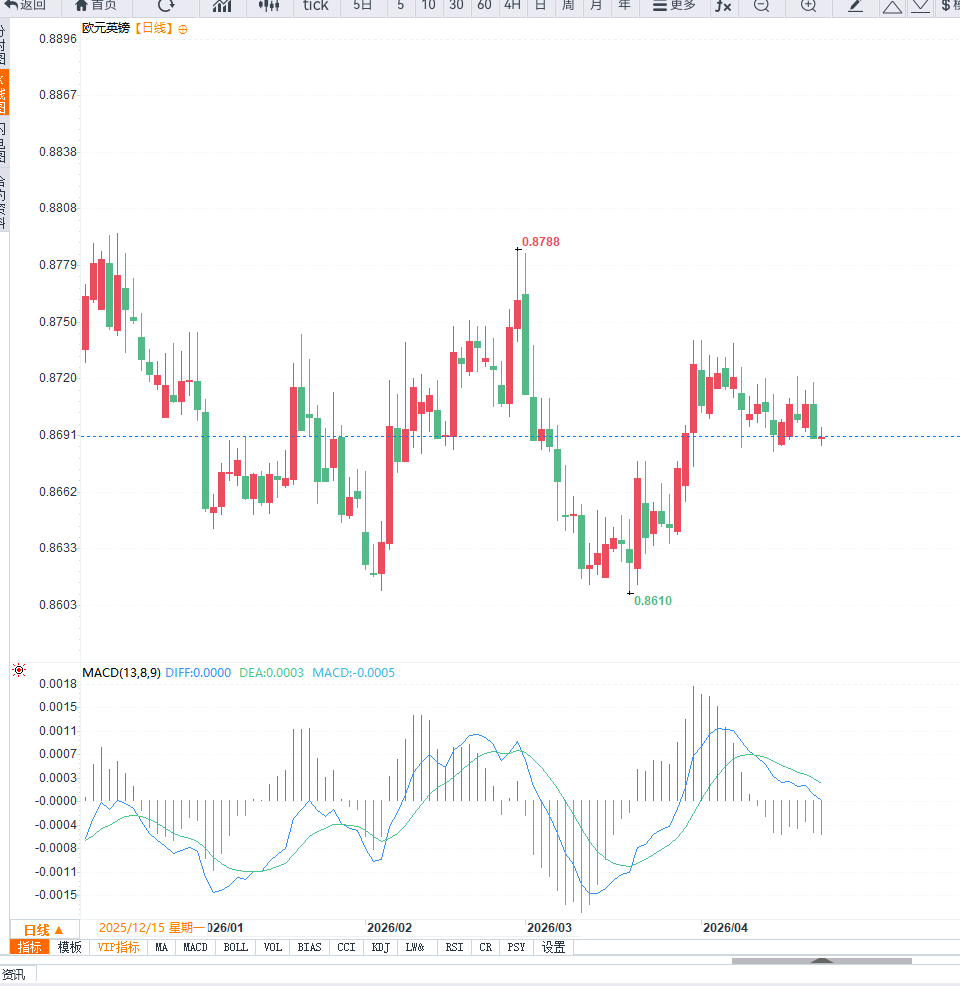
Overall, the euro is currently in a downward phase against the pound due to a combination of fundamental divergence and technical factors, with the pound showing a clear advantage.
Editor's Summary : The decline in the euro against the pound was mainly driven by strong UK inflation data, significantly strengthening market expectations for a tightening of Bank of England policy, while the Eurozone remained cautious, creating a stark contrast. In the short term, the exchange rate may continue its weakness, with the key factors being whether inflation expectations continue to rise and whether policy signals become clearer. If the pound's advantage persists, the euro/pound exchange rate may further test key support levels.
From a fundamental perspective, the latest UK inflation data became the core driver of the market. Data showed that the Consumer Price Index (CPI) rose to 3.3% year-on-year in March, higher than the 3.0% level maintained for the previous two months, indicating renewed inflationary pressures. On a monthly basis, the CPI increased by 0.7% , a near one-year high, exceeding market expectations of 0.6%. This result suggests that the momentum of price increases is accelerating again.
Broader price indicators also showed strength. The Producer Price Index (PPI) rose sharply month-on-month to an annualized rate of 5.4% , while the Retail Price Index (RSI) rose 4.1% year-on-year, both exceeding market expectations. These data collectively reflect that inflationary pressures are not only present on the consumption side but also accumulating upstream in the industrial chain. The broad-based rise in inflation has strengthened market expectations of policy tightening , becoming a key factor driving the pound's strength.
From a policy perspective, although the Bank of England is highly likely to keep interest rates unchanged at its upcoming meeting, upside risks to inflation provide more justification for a hawkish stance. The market is beginning to reassess the future policy path, believing that the central bank may take more tightening measures in the later stages. This shift in expectations directly increases the attractiveness of the pound.
In contrast, the Eurozone has maintained a relatively cautious policy stance. The European Central Bank prefers to wait for more economic data to determine future direction, lacking clear policy signals in the short term. This wait-and-see attitude puts the euro at a disadvantage compared to the pound sterling.
From a market sentiment perspective, funds are currently clearly flowing towards sectors with more positive policy expectations. The pound sterling was supported by inflation data, while the euro weakened due to a lack of catalysts, leading to a continued decline in the euro/pound exchange rate.
From a technical perspective, the daily chart shows that the exchange rate has broken below the lower edge of the previous trading range, with the 0.8700 level turning from support into resistance , indicating increased bearish momentum. The key support level is located in the 0.8650 area; a break below this level could lead to a further decline towards 0.8600. From a trend structure perspective, the overall pattern has shifted to bearish.
From a 4-hour chart perspective, the exchange rate shows a clear downward channel, with both highs and lows trending lower. Technically, the RSI is below 40, indicating a bearish market; the MACD continues below the zero line without a clear reversal signal, suggesting the short-term downtrend remains intact. If any subsequent rebound fails to regain the 0.8700 level, the bearish structure may continue to dominate the price action.
Overall, the euro is currently in a downward phase against the pound due to a combination of fundamental divergence and technical factors, with the pound showing a clear advantage.
Editor's Summary : The decline in the euro against the pound was mainly driven by strong UK inflation data, significantly strengthening market expectations for a tightening of Bank of England policy, while the Eurozone remained cautious, creating a stark contrast. In the short term, the exchange rate may continue its weakness, with the key factors being whether inflation expectations continue to rise and whether policy signals become clearer. If the pound's advantage persists, the euro/pound exchange rate may further test key support levels.
- Risk Warning and Disclaimer
- The market involves risk, and trading may not be suitable for all investors. This article is for reference only and does not constitute personal investment advice, nor does it take into account certain users’ specific investment objectives, financial situation, or other needs. Any investment decisions made based on this information are at your own risk.