Bank of England in a dilemma: With inflation accelerating, when will the interest rate hike finally happen?
2026-04-22 15:57:58
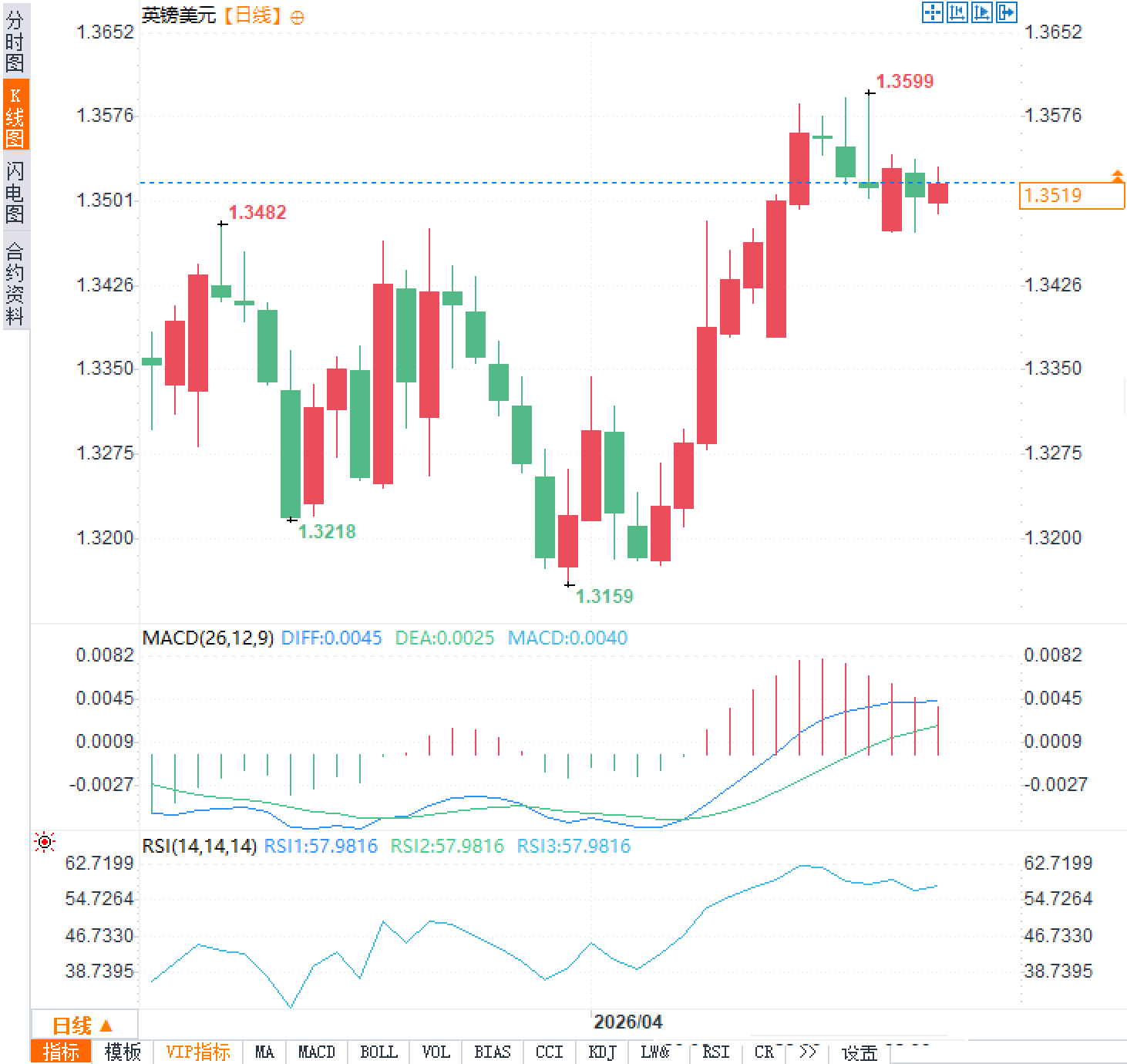
On Wednesday, April 22, the UK Office for National Statistics released its March Consumer Price Index (CPI) data, showing that the year-on-year increase accelerated to 3.3% from 3.0% in February. This indicates that the energy price shock triggered by Middle East geopolitical conflicts is beginning to significantly impact the UK economy. The pound sterling fluctuated slightly against the dollar after the data release, remaining around 1.35, while market expectations for the Bank of England's monetary policy meeting next week were adjusted accordingly. Faced with the rapid transmission of energy costs, traders are closely watching the potential impact of the inflation path on interest rate expectations, bond yields, and the pound's exchange rate.
Official data shows that motor vehicle fuel prices rose 8.7% month-on-month in March, the largest monthly increase since June 2022, directly driving up transportation costs significantly. High food prices also contributed to the upward pressure. Service price inflation unexpectedly rose from 4.3% to 4.5%, partly due to seasonal factors such as Easter holiday airfares. However, core inflation, excluding volatile items such as food and energy, fell slightly from 3.2% to 3.1%. Producer input prices rose 4.4% in a single month, the second largest monthly increase since records began in 1984, second only to the early stages of the energy crisis in March 2022. Producer service prices rose 3.0% quarter-on-quarter in the first quarter, higher than the 2.8% in the previous quarter. The following is a comparison of key inflation indicators:
These data indicate that the direct impact of energy prices has begun to emerge, but the core pressures have not yet fully spread. Traders need to closely observe whether the stickiness of service sector inflation will gradually permeate into core indicators.
The Middle East conflict has disrupted energy transport routes, causing a sharp rise in global crude oil and natural gas prices. As a net energy importer, the UK faces direct imported inflationary pressures. The dramatic increase in petrol and diesel prices in March not only raised transportation costs for consumers but also transmitted these costs to producers in the manufacturing and service sectors through the supply chain. This sharp jump in producer input prices indicates that cost pressures are spreading from upstream to downstream, although the current transmission speed is still constrained by weak demand. The Bank of England had previously projected that inflation would be close to its target level in April, but persistently high energy prices have forced an upward revision of the forecast, potentially reaching 3.5% by mid-year. The International Monetary Fund recently predicted that UK inflation could peak at 4%. Whether this shock will evolve into a broader wage-price spiral remains a market focus. The current weak labor market may limit wage bargaining power, thus suppressing a second-round effect, but the unexpected rebound in service sector prices indicates that localized pressures are beginning to emerge.
Capital Economics UK economists point out that inflation may fall to 2.9% in April as a sharp rise in regulatory prices will exit year-on-year comparisons, but the next eight months will be challenging for the Monetary Policy Committee.
The Bank of England's Monetary Policy Committee is expected to keep the benchmark interest rate unchanged at 3.75% at its meeting on April 30. Policymakers believe it is too early to assess the impact of rising energy prices on underlying inflationary pressures. Financial markets are currently pricing in one or two 25-basis-point rate hikes this year, but most economist surveys indicate that rates are expected to remain stable until 2026. A weak labor market is a key buffer, potentially making it harder for workers to demand higher wages and for businesses to pass on costs. The unexpected rise in services inflation serves as a reminder to policymakers not to underestimate the potential for a second-round effect, but overall, policymakers prefer to observe data developments rather than act immediately. TD Securities interest rate strategists stated that service sector price pressures suggest the Bank of England cannot easily ignore the indirect impact of energy prices.
The energy price shock has led the International Monetary Fund to significantly lower its UK economic growth forecast, the most substantial decline among the G7 countries. Higher living costs will dampen consumption and increase operational pressure on businesses, posing additional challenges to fiscal policy. The relative stability of the pound reflects the market's balance between policy uncertainty and global energy dynamics, but persistent long-term inflationary pressures could test the pound's attractiveness. Chancellor Rachel Reeves, responding to the data, stated that this is not their war, but it is pushing up bills for households and businesses, making cost control a top priority.
Key Interpretations of March Inflation Data
Official data shows that motor vehicle fuel prices rose 8.7% month-on-month in March, the largest monthly increase since June 2022, directly driving up transportation costs significantly. High food prices also contributed to the upward pressure. Service price inflation unexpectedly rose from 4.3% to 4.5%, partly due to seasonal factors such as Easter holiday airfares. However, core inflation, excluding volatile items such as food and energy, fell slightly from 3.2% to 3.1%. Producer input prices rose 4.4% in a single month, the second largest monthly increase since records began in 1984, second only to the early stages of the energy crisis in March 2022. Producer service prices rose 3.0% quarter-on-quarter in the first quarter, higher than the 2.8% in the previous quarter. The following is a comparison of key inflation indicators:
| index | March(%) | February(%) |
|---|---|---|
| Overall CPI | 3.3 | 3.0 |
| Service inflation | 4.5 | 4.3 |
| Core inflation | 3.1 | 3.2 |
| Producer input prices month-on-month | 4.4 | - |
Analysis of the transmission path of energy shocks
The Middle East conflict has disrupted energy transport routes, causing a sharp rise in global crude oil and natural gas prices. As a net energy importer, the UK faces direct imported inflationary pressures. The dramatic increase in petrol and diesel prices in March not only raised transportation costs for consumers but also transmitted these costs to producers in the manufacturing and service sectors through the supply chain. This sharp jump in producer input prices indicates that cost pressures are spreading from upstream to downstream, although the current transmission speed is still constrained by weak demand. The Bank of England had previously projected that inflation would be close to its target level in April, but persistently high energy prices have forced an upward revision of the forecast, potentially reaching 3.5% by mid-year. The International Monetary Fund recently predicted that UK inflation could peak at 4%. Whether this shock will evolve into a broader wage-price spiral remains a market focus. The current weak labor market may limit wage bargaining power, thus suppressing a second-round effect, but the unexpected rebound in service sector prices indicates that localized pressures are beginning to emerge.
Capital Economics UK economists point out that inflation may fall to 2.9% in April as a sharp rise in regulatory prices will exit year-on-year comparisons, but the next eight months will be challenging for the Monetary Policy Committee.
Bank of England Monetary Policy Outlook
The Bank of England's Monetary Policy Committee is expected to keep the benchmark interest rate unchanged at 3.75% at its meeting on April 30. Policymakers believe it is too early to assess the impact of rising energy prices on underlying inflationary pressures. Financial markets are currently pricing in one or two 25-basis-point rate hikes this year, but most economist surveys indicate that rates are expected to remain stable until 2026. A weak labor market is a key buffer, potentially making it harder for workers to demand higher wages and for businesses to pass on costs. The unexpected rise in services inflation serves as a reminder to policymakers not to underestimate the potential for a second-round effect, but overall, policymakers prefer to observe data developments rather than act immediately. TD Securities interest rate strategists stated that service sector price pressures suggest the Bank of England cannot easily ignore the indirect impact of energy prices.
Economic growth and broader economic impact
The energy price shock has led the International Monetary Fund to significantly lower its UK economic growth forecast, the most substantial decline among the G7 countries. Higher living costs will dampen consumption and increase operational pressure on businesses, posing additional challenges to fiscal policy. The relative stability of the pound reflects the market's balance between policy uncertainty and global energy dynamics, but persistent long-term inflationary pressures could test the pound's attractiveness. Chancellor Rachel Reeves, responding to the data, stated that this is not their war, but it is pushing up bills for households and businesses, making cost control a top priority.
Frequently Asked Questions
Question 1: Why did UK inflation unexpectedly accelerate to 3.3% in March?
A: This was mainly driven by a sharp 8.7% month-on-month increase in motor vehicle fuel prices, a direct reflection of the energy shock following the Middle East conflict. Services inflation also rose slightly to 4.5%, partly due to seasonal airfare factors, but core inflation fell slightly to 3.1%, indicating that pressure remains concentrated in the highly volatile energy sector. The 4.4% month-on-month increase in producer input prices further confirms the rapid accumulation of upstream costs.
Question 2: Will the Bank of England raise interest rates sooner than expected?
A: The interest rate is expected to remain unchanged at 3.75% at next week's meeting on April 30. Policymakers emphasized the need to observe whether the energy shock will trigger broader underlying inflation, as the current weak labor market is limiting the transmission of wage pressures. Although the market has priced in one or two rate hikes this year, most economists expect interest rates to remain generally stable until 2026.
Question 3: What does the energy shock mean for the UK economy in the long term?
A: This could lead to higher peak inflation and slower growth. The IMF has already lowered its growth forecast for the UK by the largest margin, as rising costs for households and businesses will impact consumption and investment. However, if energy prices stabilize and decline, inflation may gradually ease after April. Nevertheless, uncertainty will remain high in the coming months, and the policy path will depend on the strength of transmission and labor market dynamics.
- Risk Warning and Disclaimer
- The market involves risk, and trading may not be suitable for all investors. This article is for reference only and does not constitute personal investment advice, nor does it take into account certain users’ specific investment objectives, financial situation, or other needs. Any investment decisions made based on this information are at your own risk.