Black Swan Events Devour Aluminum Inventories: The Truth Behind Record Premiums in Europe and the US
2026-04-22 17:29:10
On Wednesday, April 22, LME aluminum prices were around $3,600 per ton, a slight pullback from the four-year high of $3,672 per ton reached on April 16, but still maintaining a high trading level overall. The escalating conflict in the Middle East has hampered regional aluminum smelting capacity, creating a severe bottleneck in the transport and logistics of alumina through the Strait of Hormuz, directly leading to a sharp contraction in global aluminum supply.
Nick Snowden, head of metals and mining research at Mercuria, recently pointed out that this supply shock could be the largest single event to hit the base metals market since 2000. "We are already in the midst of a black swan event; no one could have predicted such a large-scale shock before." The global aluminum market is shifting from a supply-demand balance to a deep shortage, with inventory buffers being rapidly depleted and physical premiums surging in tandem. Traders are closely watching the transmission effects of the duration of the conflict on the downstream supply chain.

The Middle East accounts for approximately 9% of global annual aluminum smelting capacity, corresponding to around 7 million tons of annual production. The conflict directly impacted several large smelters in the region, forcing some units to shut down or significantly reduce production. Disruptions to alumina raw material transportation routes further amplified the impact. Snowden emphasized that even if cross-strait logistics improve in the short term, it will be difficult to quickly restore smelting capacity because the disruption to the raw material supply chain has already caused irreversible damage. This event differs from previous cyclical supply fluctuations; it is a complex shock resulting from geopolitical factors combined with logistical bottlenecks, making it difficult to fill the gap with capacity from other regions in the short term. LME aluminum futures subsequently surged, reflecting market concerns about the sustainability of supply. Traders need to closely monitor navigation data in the Strait of Hormuz and the progress of smelter resumption in the region, as these variables will directly determine the duration and depth of the shortage.
Mercuria projects a supply gap of at least 2 million tons in the aluminum market from now until the end of the year. This figure may still be conservative; if the conflict prolongs and further restricts alumina inflows, the gap could widen to an even higher level. Current global visible inventories are approximately 1.5 million tons, and total inventories (including invisible portions) are just over 3 million tons, indicating extremely limited buffering capacity. The latest LME registered warehouse inventory data shows a decline to around 383,000 tons, with this low level exacerbating the tight spot market situation.
The supply-demand imbalance has directly pushed up the futures discount structure, while the physical market premium has simultaneously reached a new high. Traders are paying close attention to the timing of inventory report releases, as this data will be a key signal for judging the direction of the shortage's evolution.
The US and Europe are the primary targets of this supply shock due to extremely limited local spare capacity and historically low inventories. Last year, the US imported 3.4 million tons of primary aluminum and alloys, with nearly 22% originating from the Middle East; Europe imported 1.2 million tons, with the Middle East accounting for 18.5%. Regional smelters are finding it difficult to rapidly increase production, and alternative sources face lengthy approval and construction bottlenecks. Physical premiums have consequently surged, with the US spot premium over the LME benchmark reaching a record high of $2,521.50/ton, and European premiums recently rising to a near four-year high of $599/ton. These premium levels reflect that the additional costs paid by end-users to obtain physical metals are significantly higher than the futures price itself. The market logic is clear: supply contraction coupled with rigid demand has jointly driven up regional spot premiums. Traders need to continuously monitor US and European inventory changes and import data to assess the sustainability of these premiums.
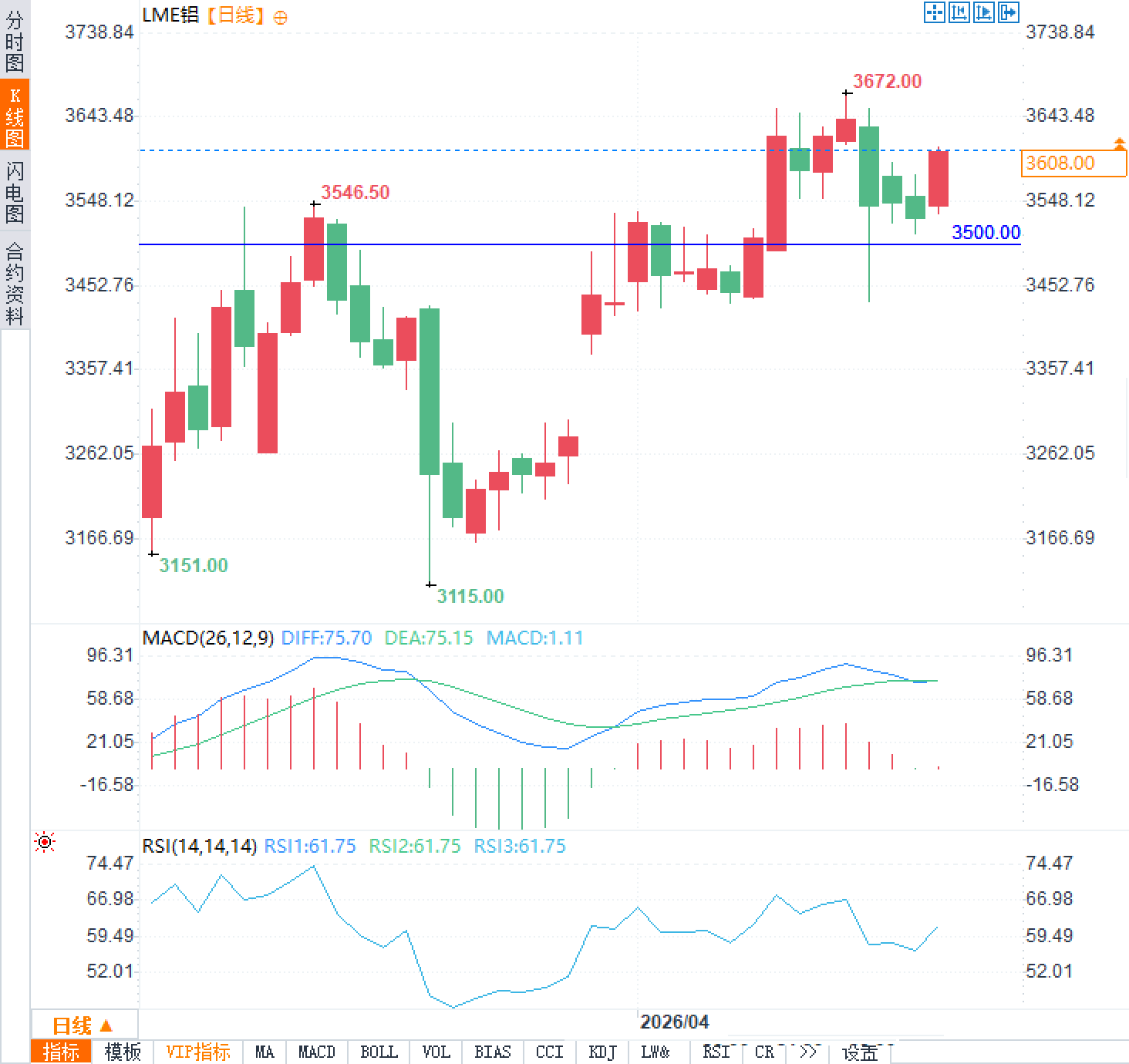
As a core raw material for the transportation, construction, and packaging industries, aluminum's supply shortage is gradually being transmitted to end-users. The automotive and aerospace manufacturing sectors face rising raw material procurement costs and delivery delays, construction projects are experiencing increased budget uncertainty due to metal price volatility, and the packaging industry needs to cope with supply chain restructuring pressures. High LME aluminum prices have further amplified the cost sensitivity of these industries. Looking ahead, if the conflict does not ease quickly, the supply gap will continue to suppress inventory rebuilding, and the price level may remain relatively strong. However, any signs of geopolitical easing could trigger a rapid correction, and market volatility will remain high.
Nick Snowden, head of metals and mining research at Mercuria, recently pointed out that this supply shock could be the largest single event to hit the base metals market since 2000. "We are already in the midst of a black swan event; no one could have predicted such a large-scale shock before." The global aluminum market is shifting from a supply-demand balance to a deep shortage, with inventory buffers being rapidly depleted and physical premiums surging in tandem. Traders are closely watching the transmission effects of the duration of the conflict on the downstream supply chain.
Black Swan Events in Aluminum Supply Triggered by Middle East Conflicts
The Middle East accounts for approximately 9% of global annual aluminum smelting capacity, corresponding to around 7 million tons of annual production. The conflict directly impacted several large smelters in the region, forcing some units to shut down or significantly reduce production. Disruptions to alumina raw material transportation routes further amplified the impact. Snowden emphasized that even if cross-strait logistics improve in the short term, it will be difficult to quickly restore smelting capacity because the disruption to the raw material supply chain has already caused irreversible damage. This event differs from previous cyclical supply fluctuations; it is a complex shock resulting from geopolitical factors combined with logistical bottlenecks, making it difficult to fill the gap with capacity from other regions in the short term. LME aluminum futures subsequently surged, reflecting market concerns about the sustainability of supply. Traders need to closely monitor navigation data in the Strait of Hormuz and the progress of smelter resumption in the region, as these variables will directly determine the duration and depth of the shortage.
Analysis of Global Supply and Demand Balance and Inventory Buffer
Mercuria projects a supply gap of at least 2 million tons in the aluminum market from now until the end of the year. This figure may still be conservative; if the conflict prolongs and further restricts alumina inflows, the gap could widen to an even higher level. Current global visible inventories are approximately 1.5 million tons, and total inventories (including invisible portions) are just over 3 million tons, indicating extremely limited buffering capacity. The latest LME registered warehouse inventory data shows a decline to around 383,000 tons, with this low level exacerbating the tight spot market situation.
| index | Current level | In comparison with history |
|---|---|---|
| Annual supply gap forecast | At least 2 million tons | Far exceeding the average profit in recent years |
| Visible inventory | 1.5 million tons | In the low range |
| Total inventory (including non-visible inventory) | Just over 3 million tons | Insufficient buffer space |
| LME warehouse inventory | Approximately 383,000 tons | Recent continuous decline |
Import dependence and premium transmission in Europe and the United States
The US and Europe are the primary targets of this supply shock due to extremely limited local spare capacity and historically low inventories. Last year, the US imported 3.4 million tons of primary aluminum and alloys, with nearly 22% originating from the Middle East; Europe imported 1.2 million tons, with the Middle East accounting for 18.5%. Regional smelters are finding it difficult to rapidly increase production, and alternative sources face lengthy approval and construction bottlenecks. Physical premiums have consequently surged, with the US spot premium over the LME benchmark reaching a record high of $2,521.50/ton, and European premiums recently rising to a near four-year high of $599/ton. These premium levels reflect that the additional costs paid by end-users to obtain physical metals are significantly higher than the futures price itself. The market logic is clear: supply contraction coupled with rigid demand has jointly driven up regional spot premiums. Traders need to continuously monitor US and European inventory changes and import data to assess the sustainability of these premiums.
Downstream Industry Transmission and Market Risk Outlook
As a core raw material for the transportation, construction, and packaging industries, aluminum's supply shortage is gradually being transmitted to end-users. The automotive and aerospace manufacturing sectors face rising raw material procurement costs and delivery delays, construction projects are experiencing increased budget uncertainty due to metal price volatility, and the packaging industry needs to cope with supply chain restructuring pressures. High LME aluminum prices have further amplified the cost sensitivity of these industries. Looking ahead, if the conflict does not ease quickly, the supply gap will continue to suppress inventory rebuilding, and the price level may remain relatively strong. However, any signs of geopolitical easing could trigger a rapid correction, and market volatility will remain high.
Frequently Asked Questions
Question 1: Why is the Middle East conflict defined as a "black swan" event in the aluminum market?
A: The Middle East accounts for about 9% of global aluminum supply. The conflict has disrupted 7 million tons of production capacity, and the disruption of alumina logistics has created a compound shock. Snowden called it the largest single supply shock to base metals since 2000. No one predicted it beforehand, and it was beyond the scope of normal cyclical fluctuations.
Question 2: Can the current inventory level effectively buffer against shortages?
A: As you can see, inventory is only 1.5 million tons, with total inventory just over 3 million tons. LME warehouse inventory is approximately 383,000 tons, far below historical buffer demand. Mercuria predicts a shortfall of at least 2 million tons by the end of the year, indicating that inventory depletion is exceeding rebuilding capacity, leaving extremely limited buffer space.
Question 3: Why did Europe and the United States become the main areas of exposure in this shock?
A: The US and Europe have scarce spare capacity and relied on imports from the Middle East for 22% and 18.5% respectively last year. Physical premiums have reached record highs. Supply contraction has directly pushed up spot costs, highlighting the high sensitivity of regional markets to external sources.
- Risk Warning and Disclaimer
- The market involves risk, and trading may not be suitable for all investors. This article is for reference only and does not constitute personal investment advice, nor does it take into account certain users’ specific investment objectives, financial situation, or other needs. Any investment decisions made based on this information are at your own risk.