Crude oil trading alert: A combination of fluctuating geopolitical tensions and declining inventories caused oil prices to rise and then fall, maintaining a high level of fluctuation.
2026-04-23 09:25:04
WTI crude oil prices retreated after hitting a recent high during Thursday's Asian trading session. It briefly rose to around $97.20 , a near one-and-a-half-week high, but subsequently gave back some gains and is currently holding above $93 , still showing a slight increase for the day. This movement reflects that while bullish sentiment remains dominant due to strong fundamentals, short-term funds are becoming more cautious.

The core factor driving this round of oil price increases remains the uncertainty surrounding the situation in the Middle East. Despite the extension of the ceasefire agreement, market confidence in a genuine easing of the conflict remains weak. The lack of substantial progress in negotiations has led investors to widely expect the situation to drag on, thus continuing to provide risk premium support for oil prices.
Meanwhile, tensions surrounding the Strait of Hormuz have escalated further. As one of the world's most critical energy transport routes, handling 20% of global crude oil shipments, any disruption to its passage would directly impact the stability of the global supply chain. Current shipping activities are significantly restricted, with multiple merchant ships being intercepted or facing security threats, further exacerbating market concerns about supply disruptions.
At the level of specific events, the US reiterated its commitment to maintaining the maritime blockade of relevant ports and strengthening restrictions on energy exports. The other side responded with countermeasures, including seizing ships and conducting armed intervention in the Strait. Market research indicates that multiple merchant ships have been intercepted or even attacked in the region, significantly increasing shipping risk premiums and driving oil prices up for the third consecutive trading day.
On the fundamental side, an unexpected decline in U.S. crude oil inventories provided another important supporting factor. Decreasing inventories typically indicate tighter supply and demand, and given the current geopolitical risks, this signal has been amplified and interpreted by the market, reinforcing expectations of short-term supply tightening. At the same time, rising U.S. energy export demand has further weakened its buffering capacity on the global market.
However, it's worth noting that this round of rapid oil price increases was partly driven by market sentiment. News of a sudden incident in a certain region initially triggered a short-term price surge, but the upward momentum quickly cooled due to a lack of subsequent confirmation. This indicates that the market is currently highly sensitive to news, and also suggests that price volatility may further intensify.
From a broader perspective, rising oil prices are reinvigorating global inflationary pressures. Rising energy costs not only impact transportation and manufacturing costs but may also force major central banks to maintain tight monetary policies, thus having a profound impact on the overall economic environment. This combination of "high oil prices + high interest rates" may limit demand growth, but it is unlikely to change the supply-driven upward trend in the short term.
From a technical perspective, WTI crude oil has broken through the upper edge of its previous trading range on the daily chart, shifting the overall structure to a bullish bias, although upward momentum is beginning to weaken. Currently, the price faces significant resistance in the $95-$96 area; a successful break above this level could lead to a test of the $100 mark. On the other hand, the $90-$92 range forms a key support zone; a break below this level could trigger a deeper correction. Momentum indicators suggest that bulls still dominate, but the market has entered a consolidation phase at higher levels. On the 4-hour chart, the price has pulled back after reaching a high, and short-term moving averages are flattening, indicating increased divergence between bulls and bears. If the price cannot regain a foothold above $94 , it may continue to consolidate in the short term; however, as long as it remains above $90 , the overall trend remains upward.
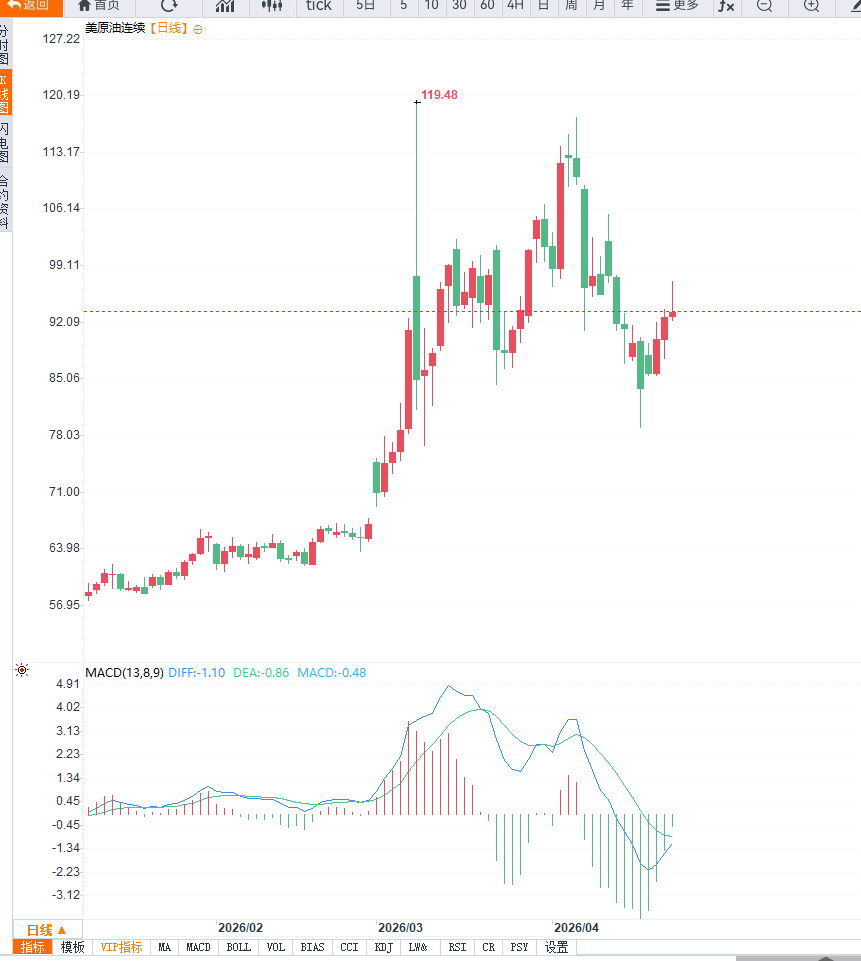
Editor's Summary : The WTI crude oil market is currently in a typical "event-driven upward phase," with geopolitical risks and supply uncertainties dominating. Although prices have corrected from their highs in the short term, the fundamentals have not changed substantially, and there is still room for the price center to move upward. In the medium term, as long as the Strait of Hormuz passage issue remains unresolved, the supply risk premium will persist. However, high oil prices may also suppress demand and exacerbate expectations of policy tightening, thus limiting the extent of the rise. Investors need to pay close attention to the evolution of the geopolitical situation and inventory changes, maintaining a flexible strategy in a highly volatile environment.
The core factor driving this round of oil price increases remains the uncertainty surrounding the situation in the Middle East. Despite the extension of the ceasefire agreement, market confidence in a genuine easing of the conflict remains weak. The lack of substantial progress in negotiations has led investors to widely expect the situation to drag on, thus continuing to provide risk premium support for oil prices.
Meanwhile, tensions surrounding the Strait of Hormuz have escalated further. As one of the world's most critical energy transport routes, handling 20% of global crude oil shipments, any disruption to its passage would directly impact the stability of the global supply chain. Current shipping activities are significantly restricted, with multiple merchant ships being intercepted or facing security threats, further exacerbating market concerns about supply disruptions.
At the level of specific events, the US reiterated its commitment to maintaining the maritime blockade of relevant ports and strengthening restrictions on energy exports. The other side responded with countermeasures, including seizing ships and conducting armed intervention in the Strait. Market research indicates that multiple merchant ships have been intercepted or even attacked in the region, significantly increasing shipping risk premiums and driving oil prices up for the third consecutive trading day.
On the fundamental side, an unexpected decline in U.S. crude oil inventories provided another important supporting factor. Decreasing inventories typically indicate tighter supply and demand, and given the current geopolitical risks, this signal has been amplified and interpreted by the market, reinforcing expectations of short-term supply tightening. At the same time, rising U.S. energy export demand has further weakened its buffering capacity on the global market.
However, it's worth noting that this round of rapid oil price increases was partly driven by market sentiment. News of a sudden incident in a certain region initially triggered a short-term price surge, but the upward momentum quickly cooled due to a lack of subsequent confirmation. This indicates that the market is currently highly sensitive to news, and also suggests that price volatility may further intensify.
From a broader perspective, rising oil prices are reinvigorating global inflationary pressures. Rising energy costs not only impact transportation and manufacturing costs but may also force major central banks to maintain tight monetary policies, thus having a profound impact on the overall economic environment. This combination of "high oil prices + high interest rates" may limit demand growth, but it is unlikely to change the supply-driven upward trend in the short term.
From a technical perspective, WTI crude oil has broken through the upper edge of its previous trading range on the daily chart, shifting the overall structure to a bullish bias, although upward momentum is beginning to weaken. Currently, the price faces significant resistance in the $95-$96 area; a successful break above this level could lead to a test of the $100 mark. On the other hand, the $90-$92 range forms a key support zone; a break below this level could trigger a deeper correction. Momentum indicators suggest that bulls still dominate, but the market has entered a consolidation phase at higher levels. On the 4-hour chart, the price has pulled back after reaching a high, and short-term moving averages are flattening, indicating increased divergence between bulls and bears. If the price cannot regain a foothold above $94 , it may continue to consolidate in the short term; however, as long as it remains above $90 , the overall trend remains upward.
Editor's Summary : The WTI crude oil market is currently in a typical "event-driven upward phase," with geopolitical risks and supply uncertainties dominating. Although prices have corrected from their highs in the short term, the fundamentals have not changed substantially, and there is still room for the price center to move upward. In the medium term, as long as the Strait of Hormuz passage issue remains unresolved, the supply risk premium will persist. However, high oil prices may also suppress demand and exacerbate expectations of policy tightening, thus limiting the extent of the rise. Investors need to pay close attention to the evolution of the geopolitical situation and inventory changes, maintaining a flexible strategy in a highly volatile environment.
- Risk Warning and Disclaimer
- The market involves risk, and trading may not be suitable for all investors. This article is for reference only and does not constitute personal investment advice, nor does it take into account certain users’ specific investment objectives, financial situation, or other needs. Any investment decisions made based on this information are at your own risk.