Gold prices hang by a thread at the $4,700 mark: Amid the Hormuz standoff and inflationary pressures, the dollar is making a strong comeback. Can gold bulls hold their last line of defense?
2026-04-23 13:43:16
The international gold market has been under pressure recently. Spot gold prices (XAU/USD) have been fluctuating around $4,700 per ounce, failing to sustain the slight gains of the previous trading day. During Thursday's (April 23) Asian trading session, renewed selling pressure repeatedly thwarted gold's upward attempts. Meanwhile, the US dollar index gained upward momentum for the third consecutive trading day, demonstrating significant strength. The core factors driving the dollar's strength are twofold: firstly, persistent geopolitical tensions between the US and Iran; and secondly, a readjustment of market expectations regarding the pace of future interest rate cuts by the Federal Reserve due to inflationary pressures. These two forces have jointly supported the dollar and exerted significant pressure on gold, which does not offer interest income.

The US Navy's maritime blockade of Iranian ports has made it difficult to ease tensions between the US and Iran. Although US President Trump announced on Tuesday a temporary extension of the expiring ceasefire agreement with Iran, market participants are generally skeptical about the possibility of a lasting de-escalation. The fundamental reason is the lack of substantial progress in peace negotiations, while the confrontation surrounding the Strait of Hormuz continues to escalate.
Trump made it clear that the U.S. Navy's blockade of Iranian ports would continue; in response, Iran listed the lifting of the U.S. maritime blockade as a strict prerequisite for resuming negotiations.
More seriously, the Islamic Revolutionary Guard Corps announced on Wednesday that it had seized two container ships, the first such action since clashes with the United States and Israel began in February. This incident significantly increases the risk of further escalation of tensions, leaving geopolitical uncertainty hanging over the markets.
Against this backdrop, the dollar's status as a reserve currency has been consolidated, and funds tend to flow into dollar assets in search of safe haven, thus creating a crowding-out effect on gold.
The Strait of Hormuz, a crucial global energy transport route, has seen persistent supply disruptions, providing strong support for crude oil prices. High crude oil prices have directly contributed to a significant rise in global inflation. This inflationary environment has prompted markets to reassess the monetary policy paths of major central banks, with the Federal Reserve's stance being particularly noteworthy.
Although Federal Reserve officials had previously anticipated a possible rate cut before the end of the year, recent stubborn inflation data and still resilient economic activity have significantly raised the bar for lowering borrowing costs.
Market expectations suggest the Federal Reserve may be forced to adopt a wait-and-see approach, maintaining its tightening stance for the time being. This speculation about a more hawkish shift in Fed policy has become another important factor supporting the US dollar. Since gold itself does not generate interest income, the opportunity cost of holding gold increases against the backdrop of high interest rates or weakening expectations of rate cuts, leading to a continuous outflow of funds from the gold market and further exacerbating downward pressure on gold prices.
From a technical perspective, gold prices are currently trading near the lower boundary of an upward-sloping parallel channel, indicating a neutral to slightly bearish short-term trend. The Relative Strength Index (RSI) is currently hovering around 39, which is at the lower end of its trading range. This suggests that the previous bullish momentum is gradually weakening, but it has not yet entered oversold territory.
Meanwhile, the moving average convergence divergence indicator remains in negative territory, reinforcing the assessment that any attempt to move upward is unlikely to be sustained unless there is a substantial improvement in market momentum.
Specifically, if gold prices clearly break below the lower channel support around $4,691 per ounce, they may further test the previously formed structural bottom area around $4,568. Once selling pressure accelerates, it will open up room for a deeper decline.
Conversely, from an upward perspective, the bulls need to successfully break through the upper channel resistance near $4,926 and hold above that level for a chance to revive the overall upward trend and create conditions for a new round of gains.
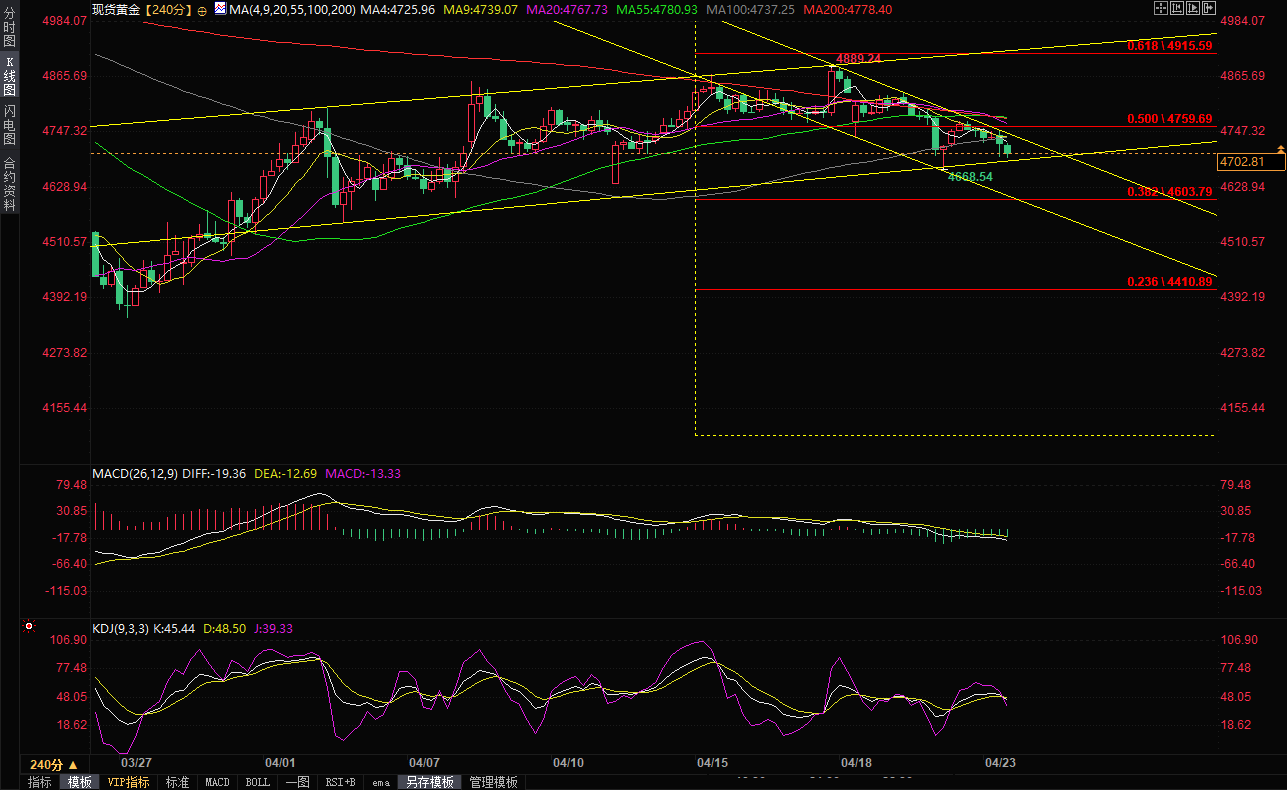
(Spot gold 4-hour chart, source: FX678)
In summary, the gold market is currently at a critical juncture of tug-of-war between bulls and bears. On the one hand, the geopolitical risks in the Strait of Hormuz and the escalating US-Iran standoff should theoretically stimulate safe-haven demand, potentially supporting gold prices. On the other hand, this geopolitical situation is indirectly reinforcing the Federal Reserve's rationale for maintaining a tight monetary policy by pushing up energy prices and exacerbating global inflation, thereby strengthening the US dollar and suppressing gold prices.
Currently, the US dollar is receiving a double boost from geopolitical safe-haven demand and monetary policy expectations, while gold continues to decline due to its disadvantage as a non-interest-bearing asset. Technically, the $4700 level and the channel support around $4691 have become the last line of defense for the bulls. If this area is effectively broken, gold prices may begin a new round of decline; conversely, if geopolitical tensions unexpectedly ease or the Federal Reserve releases clear dovish signals, gold has a chance to rebound based on the channel support. Investors are closely monitoring the evolution of these factors to seek a clear trading direction for the next move.
At 13:42 Beijing time, spot gold was trading at $4704.92 per ounce.
Escalating Geopolitical Risks – US-Iran Maritime Standoff and Strait of Hormuz Stalemate
The US Navy's maritime blockade of Iranian ports has made it difficult to ease tensions between the US and Iran. Although US President Trump announced on Tuesday a temporary extension of the expiring ceasefire agreement with Iran, market participants are generally skeptical about the possibility of a lasting de-escalation. The fundamental reason is the lack of substantial progress in peace negotiations, while the confrontation surrounding the Strait of Hormuz continues to escalate.
Trump made it clear that the U.S. Navy's blockade of Iranian ports would continue; in response, Iran listed the lifting of the U.S. maritime blockade as a strict prerequisite for resuming negotiations.
More seriously, the Islamic Revolutionary Guard Corps announced on Wednesday that it had seized two container ships, the first such action since clashes with the United States and Israel began in February. This incident significantly increases the risk of further escalation of tensions, leaving geopolitical uncertainty hanging over the markets.
Against this backdrop, the dollar's status as a reserve currency has been consolidated, and funds tend to flow into dollar assets in search of safe haven, thus creating a crowding-out effect on gold.
Inflationary pressures are being transmitted – energy supply disruptions are pushing up oil prices, and the Federal Reserve is raising the bar for interest rate cuts.
The Strait of Hormuz, a crucial global energy transport route, has seen persistent supply disruptions, providing strong support for crude oil prices. High crude oil prices have directly contributed to a significant rise in global inflation. This inflationary environment has prompted markets to reassess the monetary policy paths of major central banks, with the Federal Reserve's stance being particularly noteworthy.
Although Federal Reserve officials had previously anticipated a possible rate cut before the end of the year, recent stubborn inflation data and still resilient economic activity have significantly raised the bar for lowering borrowing costs.
Market expectations suggest the Federal Reserve may be forced to adopt a wait-and-see approach, maintaining its tightening stance for the time being. This speculation about a more hawkish shift in Fed policy has become another important factor supporting the US dollar. Since gold itself does not generate interest income, the opportunity cost of holding gold increases against the backdrop of high interest rates or weakening expectations of rate cuts, leading to a continuous outflow of funds from the gold market and further exacerbating downward pressure on gold prices.
Technical pressure – Gold prices hovered near the lower edge of an upward channel, with key support levels facing a test.
From a technical perspective, gold prices are currently trading near the lower boundary of an upward-sloping parallel channel, indicating a neutral to slightly bearish short-term trend. The Relative Strength Index (RSI) is currently hovering around 39, which is at the lower end of its trading range. This suggests that the previous bullish momentum is gradually weakening, but it has not yet entered oversold territory.
Meanwhile, the moving average convergence divergence indicator remains in negative territory, reinforcing the assessment that any attempt to move upward is unlikely to be sustained unless there is a substantial improvement in market momentum.
Specifically, if gold prices clearly break below the lower channel support around $4,691 per ounce, they may further test the previously formed structural bottom area around $4,568. Once selling pressure accelerates, it will open up room for a deeper decline.
Conversely, from an upward perspective, the bulls need to successfully break through the upper channel resistance near $4,926 and hold above that level for a chance to revive the overall upward trend and create conditions for a new round of gains.
(Spot gold 4-hour chart, source: FX678)
At a critical juncture in the battle between bulls and bears, the strength of the US dollar and geopolitical risks will determine the direction of gold.
In summary, the gold market is currently at a critical juncture of tug-of-war between bulls and bears. On the one hand, the geopolitical risks in the Strait of Hormuz and the escalating US-Iran standoff should theoretically stimulate safe-haven demand, potentially supporting gold prices. On the other hand, this geopolitical situation is indirectly reinforcing the Federal Reserve's rationale for maintaining a tight monetary policy by pushing up energy prices and exacerbating global inflation, thereby strengthening the US dollar and suppressing gold prices.
Currently, the US dollar is receiving a double boost from geopolitical safe-haven demand and monetary policy expectations, while gold continues to decline due to its disadvantage as a non-interest-bearing asset. Technically, the $4700 level and the channel support around $4691 have become the last line of defense for the bulls. If this area is effectively broken, gold prices may begin a new round of decline; conversely, if geopolitical tensions unexpectedly ease or the Federal Reserve releases clear dovish signals, gold has a chance to rebound based on the channel support. Investors are closely monitoring the evolution of these factors to seek a clear trading direction for the next move.
At 13:42 Beijing time, spot gold was trading at $4704.92 per ounce.
- Risk Warning and Disclaimer
- The market involves risk, and trading may not be suitable for all investors. This article is for reference only and does not constitute personal investment advice, nor does it take into account certain users’ specific investment objectives, financial situation, or other needs. Any investment decisions made based on this information are at your own risk.