A weakening yen coupled with a wait-and-see approach to policy, led to continued high-level fluctuations in the pound against the yen.
2026-04-23 15:36:02
During Thursday's European trading session, the British pound recovered its earlier losses against the Japanese yen (GBP/JPY), rising slightly to around 215.45 . This rebound was mainly driven by the overall weakening of the yen, rather than a significant strengthening of the pound, indicating that the current market movement is more driven by the counterparty's currency.

From a fundamental perspective, expectations regarding the Bank of Japan's policy are the core factor influencing the yen's exchange rate. The market widely expects the Bank of Japan to maintain its interest rate at 0.75% at its upcoming meeting. Against the backdrop of continuously rising energy prices, the Japanese economy faces increasing cost pressures, making the central bank more cautious about tightening policy. The delayed expectation of an interest rate hike has weakened the yen's attractiveness, thereby pushing GBP/JPY higher.
Meanwhile, tensions in the Strait of Hormuz have pushed up oil prices, putting additional pressure on Japan, an energy importer. Rising energy costs could drag down economic growth, further reducing the likelihood of the Bank of Japan raising interest rates in the near term. This environment of "rising inflation but pressured growth" complicates the policy path and continues to exert downward pressure on the yen.
From a market performance perspective, the Japanese yen has been relatively weak among major currencies, especially relative to commodity currencies, reflecting that funds are flowing to economies that benefit from rising energy prices.
In contrast, the pound's trajectory is more complex. The market is awaiting the latest UK PMI data, which is expected to show a potential drop in the composite PMI to 49.8 , below the 50- point threshold separating expansion from contraction, suggesting a contraction in economic activity. If this data is confirmed, it will put pressure on the pound and limit further upside potential for GBP/JPY.
Regarding monetary policy, the Bank of England is expected to keep interest rates unchanged at 3.75% at its next meeting. Despite persistent inflationary pressures, slowing economic growth has led policymakers to adopt a wait-and-see approach. Current market expectations that the Bank of England will neither cut rates quickly nor rush to raise them in the short term leave the pound lacking a clear direction.
Overall, the current GBP/JPY exchange rate movement is largely driven by the weakness of the Japanese yen, while the fundamentals of the British pound have not provided strong support. This structure suggests that the sustainability of the exchange rate's upward movement may be limited, and it is more likely to maintain a volatile but slightly bullish pattern in the short term.
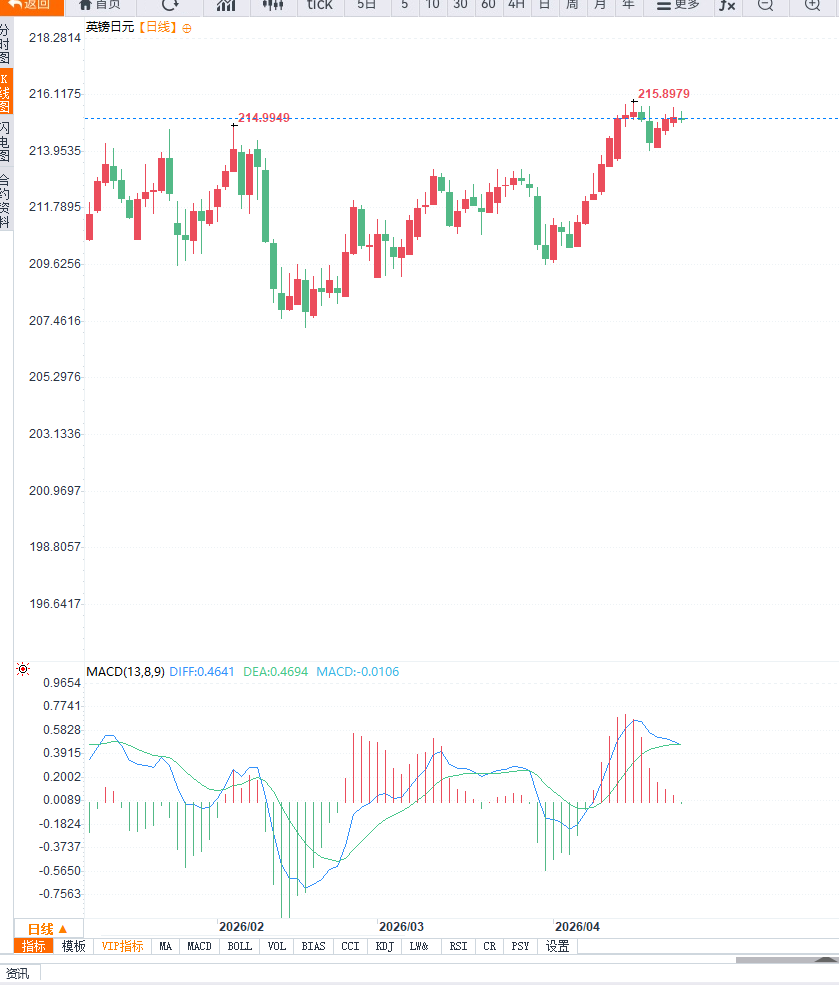
From a technical perspective, the daily chart for GBP/JPY maintains a high-level consolidation structure, with the overall trend still bullish, but momentum has weakened. Currently, the area around 216.50 forms short-term resistance; a break above this level would likely test the 218.00 area. On the downside, 213.80 is a key support level; a break below this level could lead to a pullback to the 212.50 area. Momentum indicators suggest that bullish momentum is slowing, and the market is entering a consolidation phase. On the 4-hour chart, the exchange rate shows a rebound and correction structure, but the moving averages are flattening, and the MACD momentum is moderate, indicating a lack of sustained upward momentum. If it cannot hold above 216.00 , it may return to range-bound trading in the short term.
Editor's Summary : The GBP/JPY exchange rate is currently in a phase of "yen weakness driving a rebound," but the weak fundamentals of the pound limit its upside potential. Uncertainty surrounding the Bank of Japan's policy and the impact of energy prices are key variables, while weak UK economic data is weakening the pound's momentum. In the short term, the exchange rate is more likely to remain in a high-level consolidation phase, awaiting further clarity on policy and data. Investors should pay attention to the Bank of Japan meeting and UK PMI data, as these will be crucial factors in determining the subsequent direction.
From a fundamental perspective, expectations regarding the Bank of Japan's policy are the core factor influencing the yen's exchange rate. The market widely expects the Bank of Japan to maintain its interest rate at 0.75% at its upcoming meeting. Against the backdrop of continuously rising energy prices, the Japanese economy faces increasing cost pressures, making the central bank more cautious about tightening policy. The delayed expectation of an interest rate hike has weakened the yen's attractiveness, thereby pushing GBP/JPY higher.
Meanwhile, tensions in the Strait of Hormuz have pushed up oil prices, putting additional pressure on Japan, an energy importer. Rising energy costs could drag down economic growth, further reducing the likelihood of the Bank of Japan raising interest rates in the near term. This environment of "rising inflation but pressured growth" complicates the policy path and continues to exert downward pressure on the yen.
From a market performance perspective, the Japanese yen has been relatively weak among major currencies, especially relative to commodity currencies, reflecting that funds are flowing to economies that benefit from rising energy prices.
In contrast, the pound's trajectory is more complex. The market is awaiting the latest UK PMI data, which is expected to show a potential drop in the composite PMI to 49.8 , below the 50- point threshold separating expansion from contraction, suggesting a contraction in economic activity. If this data is confirmed, it will put pressure on the pound and limit further upside potential for GBP/JPY.
Regarding monetary policy, the Bank of England is expected to keep interest rates unchanged at 3.75% at its next meeting. Despite persistent inflationary pressures, slowing economic growth has led policymakers to adopt a wait-and-see approach. Current market expectations that the Bank of England will neither cut rates quickly nor rush to raise them in the short term leave the pound lacking a clear direction.
Overall, the current GBP/JPY exchange rate movement is largely driven by the weakness of the Japanese yen, while the fundamentals of the British pound have not provided strong support. This structure suggests that the sustainability of the exchange rate's upward movement may be limited, and it is more likely to maintain a volatile but slightly bullish pattern in the short term.
From a technical perspective, the daily chart for GBP/JPY maintains a high-level consolidation structure, with the overall trend still bullish, but momentum has weakened. Currently, the area around 216.50 forms short-term resistance; a break above this level would likely test the 218.00 area. On the downside, 213.80 is a key support level; a break below this level could lead to a pullback to the 212.50 area. Momentum indicators suggest that bullish momentum is slowing, and the market is entering a consolidation phase. On the 4-hour chart, the exchange rate shows a rebound and correction structure, but the moving averages are flattening, and the MACD momentum is moderate, indicating a lack of sustained upward momentum. If it cannot hold above 216.00 , it may return to range-bound trading in the short term.
Editor's Summary : The GBP/JPY exchange rate is currently in a phase of "yen weakness driving a rebound," but the weak fundamentals of the pound limit its upside potential. Uncertainty surrounding the Bank of Japan's policy and the impact of energy prices are key variables, while weak UK economic data is weakening the pound's momentum. In the short term, the exchange rate is more likely to remain in a high-level consolidation phase, awaiting further clarity on policy and data. Investors should pay attention to the Bank of Japan meeting and UK PMI data, as these will be crucial factors in determining the subsequent direction.
- Risk Warning and Disclaimer
- The market involves risk, and trading may not be suitable for all investors. This article is for reference only and does not constitute personal investment advice, nor does it take into account certain users’ specific investment objectives, financial situation, or other needs. Any investment decisions made based on this information are at your own risk.