Japan's core inflation remained below target for the second consecutive month in March, posing a challenge to the Bank of Japan's policy balance.
2026-04-24 10:53:21
According to APP, Japan's core consumer price index (CPI) rose 1.8% year-on-year in March, falling below the Bank of Japan's 2% target for the second consecutive month. This was mainly due to government fuel subsidies effectively offsetting the energy price shocks caused by the Middle East conflict. The latest official data shows that the core CPI, excluding volatile fresh food, rose slightly to 1.8% from 1.6% in February, in line with market expectations. The core-core index, which excludes fresh food and fuel (a demand-driven inflation indicator closely monitored by the Bank of Japan), rose 2.4% year-on-year, slightly lower than February's 2.5%.
This data reflects the significant buffering effect of government intervention on energy costs in the short term, but underlying inflationary pressures have not disappeared. Analysts generally expect that as companies gradually pass on the increased fuel costs resulting from the Middle East conflict to end consumers, the inflation rate is likely to accelerate its rise above the Bank of Japan's target in the coming months. Related institutions point out that oil price volatility combined with the yen's exchange rate may drive overall price levels upward in the second quarter.
The Japanese economy is at a crucial stage of monetary policy normalization. Bank of Japan Governor Kazuo Ueda recently emphasized publicly that despite short-term inflation data fluctuations, achieving a sustainable and stable 2% inflation target remains the core of policy. He stated that the bank will closely monitor the transmission effects of energy prices, wage growth trends, and corporate pricing behavior, and will adjust policy interest rates appropriately based on actual circumstances if economic and price trends meet expectations. Multiple financial institutions predict that core CPI in fiscal year 2026 may fluctuate between 1.9% and 2.3%, with Middle East geopolitical risks becoming a significant upward variable.
Structurally, the current slowdown in inflation is primarily driven by temporary factors related to energy and food prices. Government subsidies for household energy bills played a significant role during the peak winter heating season, resulting in negative or low electricity and gas prices. Meanwhile, food inflation has also eased, with price increases for major agricultural products such as rice reaching their lowest levels in recent years. However, transportation and shipping costs have shown signs of accelerating, and fuel-related prices, such as gasoline, have rebounded due to the impact of the conflict.
The following table compares key inflation indicators in Japan for February-March 2026 (unit: year-on-year %):
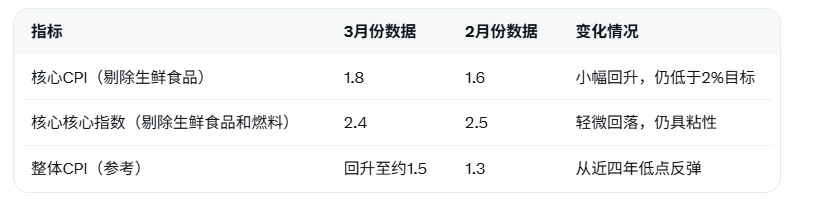
Compared to historical cycles, this round of inflation is more influenced by both external supply shocks and domestic policy interventions. Japan, having struggled to escape prolonged deflation in recent years, now faces the challenge of balancing imported inflation with a recovery in domestic demand. While demand-driven price change indicators have slightly declined, they remain above 2%, indicating that the underlying basis for corporate pricing power and the wage-price spiral still exists. Analysts believe that if the situation in the Middle East does not significantly ease, fuel cost pass-through will gradually become apparent between April and June, potentially pushing core CPI back above 2%.
Overall, Japan's inflation path exhibits a short-term characteristic of "first declining and then rising," with government subsidies providing a buffer. However, long-term sustainability depends on whether wage growth can effectively support domestic demand and the evolution of geopolitical risks. The Bank of Japan needs to strike a balance between controlling inflation expectations and supporting economic growth, and future policy adjustments will be highly dependent on data performance.
Editor's Summary:
Objectively speaking, Japan's March inflation data reflects the coexistence of the effectiveness of short-term policy intervention and medium- to long-term cost pressures. The stickiness of core indicators suggests that the demand-side foundation still exists. Future trends will depend on the degree of easing of geopolitical risks, the ability of enterprises to pass on costs, and the strength of wage growth. Policies need to maintain flexibility to achieve the goal of stable inflation.
This data reflects the significant buffering effect of government intervention on energy costs in the short term, but underlying inflationary pressures have not disappeared. Analysts generally expect that as companies gradually pass on the increased fuel costs resulting from the Middle East conflict to end consumers, the inflation rate is likely to accelerate its rise above the Bank of Japan's target in the coming months. Related institutions point out that oil price volatility combined with the yen's exchange rate may drive overall price levels upward in the second quarter.
The Japanese economy is at a crucial stage of monetary policy normalization. Bank of Japan Governor Kazuo Ueda recently emphasized publicly that despite short-term inflation data fluctuations, achieving a sustainable and stable 2% inflation target remains the core of policy. He stated that the bank will closely monitor the transmission effects of energy prices, wage growth trends, and corporate pricing behavior, and will adjust policy interest rates appropriately based on actual circumstances if economic and price trends meet expectations. Multiple financial institutions predict that core CPI in fiscal year 2026 may fluctuate between 1.9% and 2.3%, with Middle East geopolitical risks becoming a significant upward variable.
Structurally, the current slowdown in inflation is primarily driven by temporary factors related to energy and food prices. Government subsidies for household energy bills played a significant role during the peak winter heating season, resulting in negative or low electricity and gas prices. Meanwhile, food inflation has also eased, with price increases for major agricultural products such as rice reaching their lowest levels in recent years. However, transportation and shipping costs have shown signs of accelerating, and fuel-related prices, such as gasoline, have rebounded due to the impact of the conflict.
The following table compares key inflation indicators in Japan for February-March 2026 (unit: year-on-year %):
Compared to historical cycles, this round of inflation is more influenced by both external supply shocks and domestic policy interventions. Japan, having struggled to escape prolonged deflation in recent years, now faces the challenge of balancing imported inflation with a recovery in domestic demand. While demand-driven price change indicators have slightly declined, they remain above 2%, indicating that the underlying basis for corporate pricing power and the wage-price spiral still exists. Analysts believe that if the situation in the Middle East does not significantly ease, fuel cost pass-through will gradually become apparent between April and June, potentially pushing core CPI back above 2%.
Overall, Japan's inflation path exhibits a short-term characteristic of "first declining and then rising," with government subsidies providing a buffer. However, long-term sustainability depends on whether wage growth can effectively support domestic demand and the evolution of geopolitical risks. The Bank of Japan needs to strike a balance between controlling inflation expectations and supporting economic growth, and future policy adjustments will be highly dependent on data performance.
Editor's Summary:
Objectively speaking, Japan's March inflation data reflects the coexistence of the effectiveness of short-term policy intervention and medium- to long-term cost pressures. The stickiness of core indicators suggests that the demand-side foundation still exists. Future trends will depend on the degree of easing of geopolitical risks, the ability of enterprises to pass on costs, and the strength of wage growth. Policies need to maintain flexibility to achieve the goal of stable inflation.
- Risk Warning and Disclaimer
- The market involves risk, and trading may not be suitable for all investors. This article is for reference only and does not constitute personal investment advice, nor does it take into account certain users’ specific investment objectives, financial situation, or other needs. Any investment decisions made based on this information are at your own risk.