Gold fell below the $4,700 mark, continuing its weak correction.
2026-04-24 14:17:52
Gold prices remained weak during Friday's Asian trading session, trading below $4,700, near a two-week low reached in the previous session. Looking at the weekly chart, gold prices are poised to end their previous multi-week upward trend, indicating a shift in market structure.

The core driver of the current market remains the uncertainty surrounding the Middle East situation. Tensions continue to escalate around the Strait of Hormuz, with the US imposing a naval blockade on Iranian ports and Iran reacting strongly to these actions, exacerbating the already tense relationship between the two sides. Increased shipping security risks have significantly heightened market concerns about further escalation of the conflict, and this uncertainty has reinforced the safe-haven appeal of the US dollar.
Meanwhile, continued disruptions to energy supply have pushed up oil prices, leading to rising inflation expectations. The market generally believes that rising oil prices will drive up global inflation through cost transmission, thus limiting the scope for major central banks to shift towards looser monetary policies. Current market pricing suggests that the Federal Reserve may only implement one 25-basis-point rate cut in 2026, an expectation that significantly diminishes the appeal of gold.
In terms of interest rates and yields, US Treasury yields have risen against the backdrop of rising inflation expectations, further enhancing the attractiveness of dollar-denominated assets. Since gold does not generate interest income, its holding costs increase in a high-interest-rate environment, leading funds to flow more towards higher-yielding assets, which is a significant factor suppressing gold prices. Therefore, although geopolitical risks are generally favorable for gold, in the current environment, inflation and interest rate expectations are the dominant variables.
From a market sentiment perspective, investors are shifting from "risk-averse driving" to "interest rate driving," partially weakening gold's traditional safe-haven attributes. Meanwhile, the US dollar remains strong, supported by both its safe-haven and interest rate advantages, exerting sustained downward pressure on gold prices.
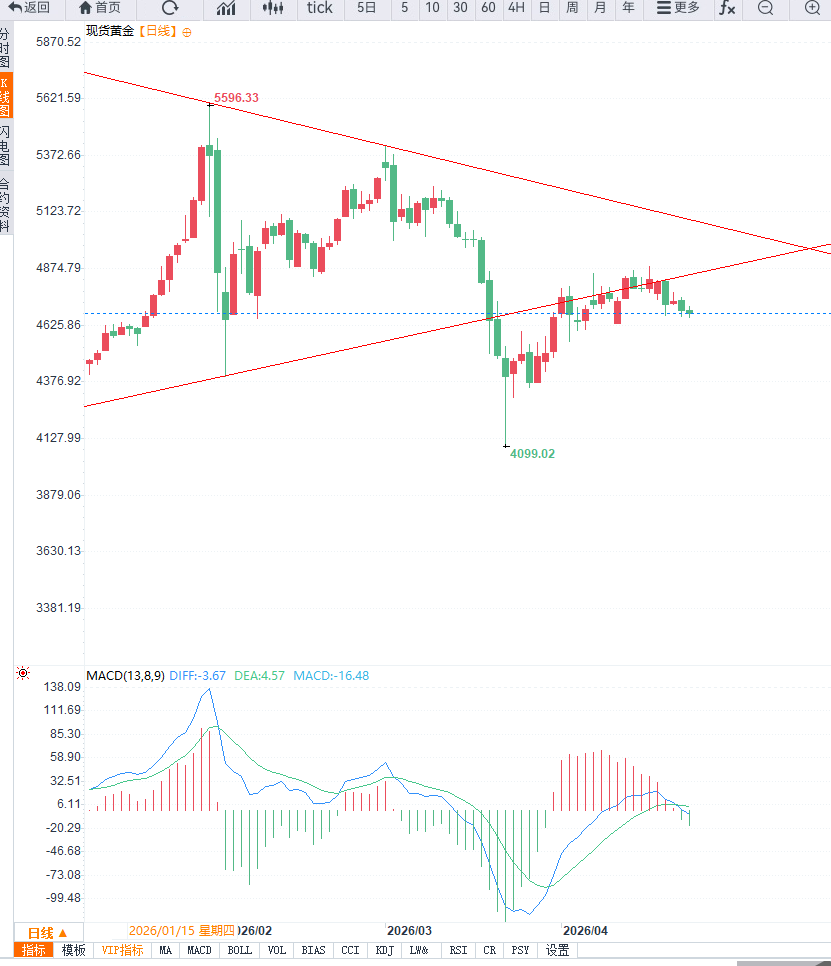
From a technical perspective, on the daily chart, gold broke below a key ascending channel support, indicating a breakdown of the bullish structure and a shift to a short-term bearish trend. The price is currently trading below major moving averages, further confirming the weak pattern. Key support lies at $4650; a break below this level could lead to a further test of the $4600 area. On the upside, the first resistance level to watch is $4680, followed by the $4775 area near the 200-period moving average. On the 4-hour chart, gold prices continue to trade within a descending channel. Momentum indicators are bearish, the RSI is near oversold territory but has not yet shown a clear reversal signal, and the MACD remains in negative territory, indicating that bearish forces still dominate.
Overall, gold will face further downward pressure in the short term until inflation expectations and policy tightening expectations show significant easing, and any rebounds may be seen as temporary corrections.
Editor's Summary : Gold's current price movement reflects a shift in macroeconomic logic, moving from geopolitical safe-haven demand to inflation and interest rate dominance. While tensions in the Middle East persist, their impact on oil prices and the resulting inflationary expectations indirectly suppress gold's performance. The strengthening of the US dollar and US Treasury yields have become the dominant forces, putting short-term pressure on gold prices. Future price movements will depend on inflation changes and policy paths; if interest rate expectations shift or risks escalate further, gold still has the potential for a rebound.
The core driver of the current market remains the uncertainty surrounding the Middle East situation. Tensions continue to escalate around the Strait of Hormuz, with the US imposing a naval blockade on Iranian ports and Iran reacting strongly to these actions, exacerbating the already tense relationship between the two sides. Increased shipping security risks have significantly heightened market concerns about further escalation of the conflict, and this uncertainty has reinforced the safe-haven appeal of the US dollar.
Meanwhile, continued disruptions to energy supply have pushed up oil prices, leading to rising inflation expectations. The market generally believes that rising oil prices will drive up global inflation through cost transmission, thus limiting the scope for major central banks to shift towards looser monetary policies. Current market pricing suggests that the Federal Reserve may only implement one 25-basis-point rate cut in 2026, an expectation that significantly diminishes the appeal of gold.
In terms of interest rates and yields, US Treasury yields have risen against the backdrop of rising inflation expectations, further enhancing the attractiveness of dollar-denominated assets. Since gold does not generate interest income, its holding costs increase in a high-interest-rate environment, leading funds to flow more towards higher-yielding assets, which is a significant factor suppressing gold prices. Therefore, although geopolitical risks are generally favorable for gold, in the current environment, inflation and interest rate expectations are the dominant variables.
From a market sentiment perspective, investors are shifting from "risk-averse driving" to "interest rate driving," partially weakening gold's traditional safe-haven attributes. Meanwhile, the US dollar remains strong, supported by both its safe-haven and interest rate advantages, exerting sustained downward pressure on gold prices.
From a technical perspective, on the daily chart, gold broke below a key ascending channel support, indicating a breakdown of the bullish structure and a shift to a short-term bearish trend. The price is currently trading below major moving averages, further confirming the weak pattern. Key support lies at $4650; a break below this level could lead to a further test of the $4600 area. On the upside, the first resistance level to watch is $4680, followed by the $4775 area near the 200-period moving average. On the 4-hour chart, gold prices continue to trade within a descending channel. Momentum indicators are bearish, the RSI is near oversold territory but has not yet shown a clear reversal signal, and the MACD remains in negative territory, indicating that bearish forces still dominate.
Overall, gold will face further downward pressure in the short term until inflation expectations and policy tightening expectations show significant easing, and any rebounds may be seen as temporary corrections.
Editor's Summary : Gold's current price movement reflects a shift in macroeconomic logic, moving from geopolitical safe-haven demand to inflation and interest rate dominance. While tensions in the Middle East persist, their impact on oil prices and the resulting inflationary expectations indirectly suppress gold's performance. The strengthening of the US dollar and US Treasury yields have become the dominant forces, putting short-term pressure on gold prices. Future price movements will depend on inflation changes and policy paths; if interest rate expectations shift or risks escalate further, gold still has the potential for a rebound.
- Risk Warning and Disclaimer
- The market involves risk, and trading may not be suitable for all investors. This article is for reference only and does not constitute personal investment advice, nor does it take into account certain users’ specific investment objectives, financial situation, or other needs. Any investment decisions made based on this information are at your own risk.