Iranian Foreign Minister arrives in Islamabad; cautious optimism prevails over Middle East situation.
2026-04-25 02:05:15
On Friday (April 24), during the US trading session, the current situation in the Middle East presented a cautiously optimistic outlook: Iranian Foreign Minister Abbas Araghchi arrived in Islamabad that day, a move that signaled the potential resumption of indirect peace talks between the US and Iran, but significant differences still exist between the two sides, and the continued blockade of the Strait of Hormuz caused sharp fluctuations in international oil prices.
Al-Aqi Islamabad Trip Coordination with Multiple Countries
According to Al Jazeera, Iranian Foreign Minister Araqchi arrived in Islamabad, the capital of Pakistan, on Friday evening, April 24, for a brief visit. The core topic of his visit is discussing Iran's proposals to restart peace talks with the United States. Pakistani government sources revealed that the primary purpose of the visit is for Pakistan to act as a mediator and convey Iran's negotiating proposals to Washington—following the breakdown of the first round of direct/indirect talks held earlier this week in Islamabad.
In a post on Twitter, Araqi emphasized that in addition to visiting Pakistan, his trip would also include Oman and Russia, focusing on coordinating bilateral affairs with these two countries and discussing the current regional situation. He stressed that Iran's neighboring countries remain a diplomatic priority. The Iranian Foreign Ministry stated that this series of visits represents the latest diplomatic effort to end regional conflict. Notably, Araqi did not mention a direct meeting with US representatives, but Pakistani officials have confirmed that US logistics and security teams have already been deployed to Islamabad to prepare for any potential contact.
In the United States, Trump plans to soon send special envoys Steve Witkoff and Jared Kushner to Islamabad for talks with Araqi. The two are expected to leave the US on Saturday morning, April 25. US Defense Secretary Pete Hegseth stated in a press briefing that Iran still has a "good opportunity to make an informed decision" and that a "fair and workable good agreement" can only be reached if it abandons its nuclear weapons program in a verifiable manner. Previously, the Trump administration unilaterally extended the ceasefire for two weeks to buy time and create conditions for both sides to resume negotiations.
Araki's visit to Pakistan is widely seen as a potential prelude to a second round of US-Iran talks, but Iran has not yet formally confirmed a direct meeting with the US, and the two sides remain in a state of mutual accusation: the US accuses Iran of "constantly adjusting its negotiating objectives and making exorbitant demands," while Iran counters that the US has made "excessive and unreasonable demands." Furthermore, Oman is considered likely to play a coordinating role in the management and navigation of the Strait of Hormuz, while Russia may hold consultations with Iran on issues such as negotiating guarantees, energy, and technological cooperation.
Lebanon's ceasefire extension and Hezbollah's stance
Parallel to the US-Iran negotiations was the development of the situation in Lebanon. On Thursday, April 23, under the mediation of the Trump administration, Israel and Lebanon, through a meeting at the White House, extended the ceasefire agreement that had taken effect on April 16 for three weeks. However, Hezbollah MP Ali Fayad stated explicitly that the ceasefire extension was "meaningless" and accused Israel of continuing assassinations, shelling southern Lebanon, and destroying villages. Lebanese authorities reported that Israeli airstrikes had killed two civilians, while Hezbollah responded by shooting down an Israeli drone; the Israeli military stated that it killed six Hezbollah members in southern Lebanon on Friday, April 24.
Iran has previously stated clearly that the stable implementation of the ceasefire in Lebanon is one of the preconditions for its negotiations with the United States. Currently, while large-scale conflict in southern Lebanon has significantly decreased, Israel still maintains a military presence in the so-called "buffer zone," and sporadic clashes between Hezbollah and the Israeli army have not completely ceased. Financial media analysis points out that this parallel conflict increases geopolitical uncertainty in the Middle East, but the extension of the ceasefire agreement also leaves some diplomatic space for the advancement of US-Iran negotiations.
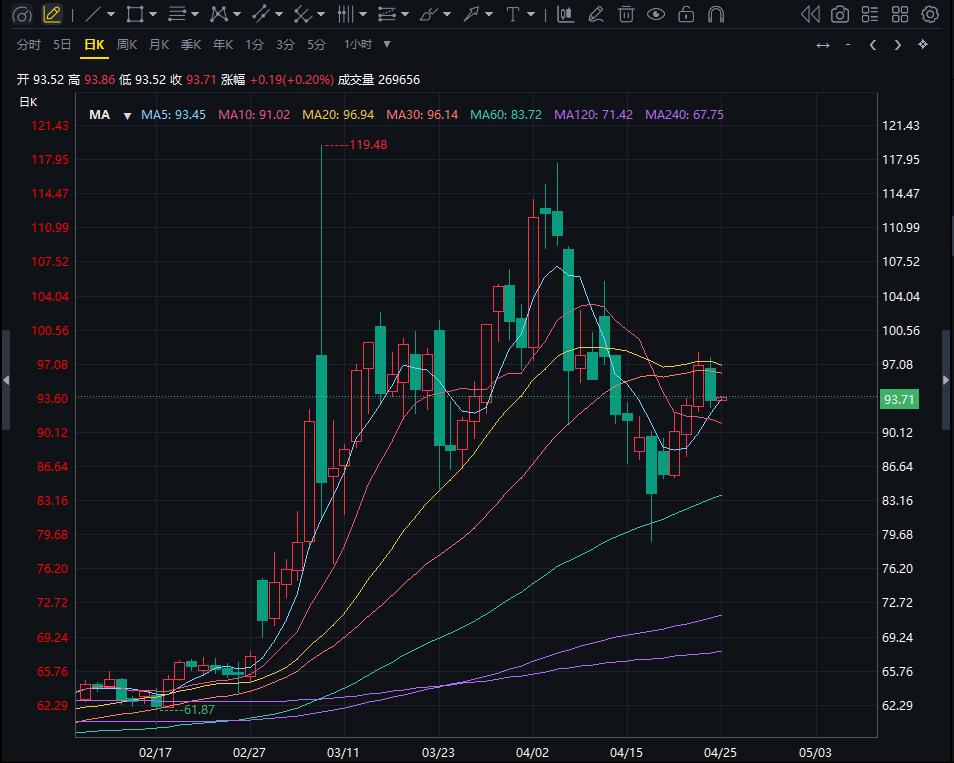
(WTI crude oil daily chart source: FX678)
Strait of Hormuz blockade and oil supply disruption
The Strait of Hormuz, a key waterway for approximately one-fifth of the world's oil shipments, remains the focal point of the current situation. According to Bloomberg, in the eight weeks since the conflict began, Iran has essentially imposed a blockade on ships from other countries, allowing only its own vessels to pass; the United States has imposed a blockade on shipping activities related to Iran and has boarded and inspected passing ships. To demonstrate its control over the strait, Iran has seized two giant cargo ships and made it clear that it will not reopen the Strait of Hormuz to free navigation unless the United States lifts its blockade.
Latest shipping data shows that only five vessels passed through the Strait of Hormuz in the past 24 hours (compared to an average of about 130 vessels per day before the conflict), including one Iranian oil tanker, but no large crude supertankers were seen. International container shipping giant Hapag-Lloyd has confirmed that one of its vessels passed through the strait, but has not disclosed specific details. It is understood that Iran is currently using small speedboats to counter US interception operations around the strait. President Trump has publicly stated that the US has the upper hand in the standoff with Iran and hopes to reach a "permanent" agreement through negotiations to completely resolve the navigation issue in the Strait of Hormuz.
Oil prices fluctuate wildly: Supply risks and negotiation prospects coexist.
International oil prices have recently fluctuated wildly due to supply risks from the Strait of Hormuz blockade and uncertainties surrounding US-Iran negotiations. Brent crude oil is currently trading at $104.28 per barrel, down 2.00% (US$2.13) in a single day; WTI crude oil is currently trading at $93.28 per barrel, down 2.68% (US$2.57) in a single day.
Over the past few days, international oil prices have continued to fluctuate above $100 per barrel, as traders weigh the potential risks of the "world's worst oil supply shock" against the easing expectations of a "breakthrough in US-Iran negotiations."
Expert Opinions
Bloomberg geopolitical analyst Marcus Gabriel points out that Araqi's trip to Islamabad and the upcoming visit of the US envoy have injected short-term optimism into the US-Iran negotiations, but "cautious optimism" remains the core theme. The two sides have long-standing differences on core issues such as nuclear verification, full lifting of sanctions, joint management of the Strait of Hormuz, and non-aggression guarantees, which are difficult to completely bridge in the short term. While Pakistan's mediating role is prominent, its own strength and US strategic considerations limit its ability to push for a substantial breakthrough. Hezbollah's position reflects the complexity of Iran's allied network and could also be a "variable" in the negotiations—a renewed escalation of the Lebanese conflict would directly affect Iran's negotiating attitude.
Goldman Sachs energy analyst Jeff Currie stated that the de facto blockade of the Strait of Hormuz has triggered "structural tensions" in global oil supply. Current daily oil production in the Persian Gulf is down by approximately 14.5 million barrels compared to pre-conflict levels, a drop of over 50%, and this shortfall cannot be compensated for by increased production from other oil-producing countries. Even if initial progress is made in US-Iran negotiations, the restoration of navigation through the strait will take time, and supply pressures in the global energy market will persist in the short term. JPMorgan Chase warned that if the Strait of Hormuz blockade continues until mid-May, Brent crude oil prices could exceed $150 per barrel, triggering a global energy crisis.
CNBC foreign affairs commentator Lena Morgan believes that the Trump administration's "not in a hurry to reach an agreement" stance, coupled with Iran's position of "prioritizing the protection of national interests and relations with regional neighbors," determines that US-Iran negotiations will be a long and iterative process. In the short term, the two sides are more likely to reach a temporary agreement of "phased ceasefire + partial sanctions relief" through indirect contact and exchange of proposals through third parties such as Pakistan and Oman, rather than a comprehensive peace agreement. The verifiability of the nuclear issue and the control of the Strait of Hormuz will be the core focus of the game between the two sides.
Overall Outlook: Cautiously Optimistic but with Remaining Disagreements
Araqi's trip to Islamabad and the upcoming dispatch of a US special envoy have injected optimism into the US-Iran peace negotiations, further highlighting Pakistan's mediating role. However, significant differences remain between the two sides, and the current ceasefire remains fragile. In the short term, the US and Iran may achieve indirect contact or exchange proposals, reaching a temporary consensus, but a comprehensive peace agreement will still require a considerable amount of time.
Al-Aqi Islamabad Trip Coordination with Multiple Countries
According to Al Jazeera, Iranian Foreign Minister Araqchi arrived in Islamabad, the capital of Pakistan, on Friday evening, April 24, for a brief visit. The core topic of his visit is discussing Iran's proposals to restart peace talks with the United States. Pakistani government sources revealed that the primary purpose of the visit is for Pakistan to act as a mediator and convey Iran's negotiating proposals to Washington—following the breakdown of the first round of direct/indirect talks held earlier this week in Islamabad.
In a post on Twitter, Araqi emphasized that in addition to visiting Pakistan, his trip would also include Oman and Russia, focusing on coordinating bilateral affairs with these two countries and discussing the current regional situation. He stressed that Iran's neighboring countries remain a diplomatic priority. The Iranian Foreign Ministry stated that this series of visits represents the latest diplomatic effort to end regional conflict. Notably, Araqi did not mention a direct meeting with US representatives, but Pakistani officials have confirmed that US logistics and security teams have already been deployed to Islamabad to prepare for any potential contact.
In the United States, Trump plans to soon send special envoys Steve Witkoff and Jared Kushner to Islamabad for talks with Araqi. The two are expected to leave the US on Saturday morning, April 25. US Defense Secretary Pete Hegseth stated in a press briefing that Iran still has a "good opportunity to make an informed decision" and that a "fair and workable good agreement" can only be reached if it abandons its nuclear weapons program in a verifiable manner. Previously, the Trump administration unilaterally extended the ceasefire for two weeks to buy time and create conditions for both sides to resume negotiations.
Araki's visit to Pakistan is widely seen as a potential prelude to a second round of US-Iran talks, but Iran has not yet formally confirmed a direct meeting with the US, and the two sides remain in a state of mutual accusation: the US accuses Iran of "constantly adjusting its negotiating objectives and making exorbitant demands," while Iran counters that the US has made "excessive and unreasonable demands." Furthermore, Oman is considered likely to play a coordinating role in the management and navigation of the Strait of Hormuz, while Russia may hold consultations with Iran on issues such as negotiating guarantees, energy, and technological cooperation.
Lebanon's ceasefire extension and Hezbollah's stance
Parallel to the US-Iran negotiations was the development of the situation in Lebanon. On Thursday, April 23, under the mediation of the Trump administration, Israel and Lebanon, through a meeting at the White House, extended the ceasefire agreement that had taken effect on April 16 for three weeks. However, Hezbollah MP Ali Fayad stated explicitly that the ceasefire extension was "meaningless" and accused Israel of continuing assassinations, shelling southern Lebanon, and destroying villages. Lebanese authorities reported that Israeli airstrikes had killed two civilians, while Hezbollah responded by shooting down an Israeli drone; the Israeli military stated that it killed six Hezbollah members in southern Lebanon on Friday, April 24.
Iran has previously stated clearly that the stable implementation of the ceasefire in Lebanon is one of the preconditions for its negotiations with the United States. Currently, while large-scale conflict in southern Lebanon has significantly decreased, Israel still maintains a military presence in the so-called "buffer zone," and sporadic clashes between Hezbollah and the Israeli army have not completely ceased. Financial media analysis points out that this parallel conflict increases geopolitical uncertainty in the Middle East, but the extension of the ceasefire agreement also leaves some diplomatic space for the advancement of US-Iran negotiations.
(WTI crude oil daily chart source: FX678)
Strait of Hormuz blockade and oil supply disruption
The Strait of Hormuz, a key waterway for approximately one-fifth of the world's oil shipments, remains the focal point of the current situation. According to Bloomberg, in the eight weeks since the conflict began, Iran has essentially imposed a blockade on ships from other countries, allowing only its own vessels to pass; the United States has imposed a blockade on shipping activities related to Iran and has boarded and inspected passing ships. To demonstrate its control over the strait, Iran has seized two giant cargo ships and made it clear that it will not reopen the Strait of Hormuz to free navigation unless the United States lifts its blockade.
Latest shipping data shows that only five vessels passed through the Strait of Hormuz in the past 24 hours (compared to an average of about 130 vessels per day before the conflict), including one Iranian oil tanker, but no large crude supertankers were seen. International container shipping giant Hapag-Lloyd has confirmed that one of its vessels passed through the strait, but has not disclosed specific details. It is understood that Iran is currently using small speedboats to counter US interception operations around the strait. President Trump has publicly stated that the US has the upper hand in the standoff with Iran and hopes to reach a "permanent" agreement through negotiations to completely resolve the navigation issue in the Strait of Hormuz.
Oil prices fluctuate wildly: Supply risks and negotiation prospects coexist.
International oil prices have recently fluctuated wildly due to supply risks from the Strait of Hormuz blockade and uncertainties surrounding US-Iran negotiations. Brent crude oil is currently trading at $104.28 per barrel, down 2.00% (US$2.13) in a single day; WTI crude oil is currently trading at $93.28 per barrel, down 2.68% (US$2.57) in a single day.
Over the past few days, international oil prices have continued to fluctuate above $100 per barrel, as traders weigh the potential risks of the "world's worst oil supply shock" against the easing expectations of a "breakthrough in US-Iran negotiations."
Expert Opinions
Bloomberg geopolitical analyst Marcus Gabriel points out that Araqi's trip to Islamabad and the upcoming visit of the US envoy have injected short-term optimism into the US-Iran negotiations, but "cautious optimism" remains the core theme. The two sides have long-standing differences on core issues such as nuclear verification, full lifting of sanctions, joint management of the Strait of Hormuz, and non-aggression guarantees, which are difficult to completely bridge in the short term. While Pakistan's mediating role is prominent, its own strength and US strategic considerations limit its ability to push for a substantial breakthrough. Hezbollah's position reflects the complexity of Iran's allied network and could also be a "variable" in the negotiations—a renewed escalation of the Lebanese conflict would directly affect Iran's negotiating attitude.
Goldman Sachs energy analyst Jeff Currie stated that the de facto blockade of the Strait of Hormuz has triggered "structural tensions" in global oil supply. Current daily oil production in the Persian Gulf is down by approximately 14.5 million barrels compared to pre-conflict levels, a drop of over 50%, and this shortfall cannot be compensated for by increased production from other oil-producing countries. Even if initial progress is made in US-Iran negotiations, the restoration of navigation through the strait will take time, and supply pressures in the global energy market will persist in the short term. JPMorgan Chase warned that if the Strait of Hormuz blockade continues until mid-May, Brent crude oil prices could exceed $150 per barrel, triggering a global energy crisis.
CNBC foreign affairs commentator Lena Morgan believes that the Trump administration's "not in a hurry to reach an agreement" stance, coupled with Iran's position of "prioritizing the protection of national interests and relations with regional neighbors," determines that US-Iran negotiations will be a long and iterative process. In the short term, the two sides are more likely to reach a temporary agreement of "phased ceasefire + partial sanctions relief" through indirect contact and exchange of proposals through third parties such as Pakistan and Oman, rather than a comprehensive peace agreement. The verifiability of the nuclear issue and the control of the Strait of Hormuz will be the core focus of the game between the two sides.
Overall Outlook: Cautiously Optimistic but with Remaining Disagreements
Araqi's trip to Islamabad and the upcoming dispatch of a US special envoy have injected optimism into the US-Iran peace negotiations, further highlighting Pakistan's mediating role. However, significant differences remain between the two sides, and the current ceasefire remains fragile. In the short term, the US and Iran may achieve indirect contact or exchange proposals, reaching a temporary consensus, but a comprehensive peace agreement will still require a considerable amount of time.
- Risk Warning and Disclaimer
- The market involves risk, and trading may not be suitable for all investors. This article is for reference only and does not constitute personal investment advice, nor does it take into account certain users’ specific investment objectives, financial situation, or other needs. Any investment decisions made based on this information are at your own risk.