Unusual activity in the Strait of Hormuz suggests a major shift in oil prices is brewing.
2026-04-27 10:13:42
The international crude oil market has always had hidden operating patterns. When the market appears stable, structural anomalies often occur suddenly. The energy market is currently at a critical juncture.
The escalating geopolitical conflicts around Iran and the disruption of shipping through the Strait of Hormuz, a vital global energy route, have combined to directly impact the overall oil market. The subsequent chain reaction may extend to all asset classes and affect the entire global economy.
Currently, the volume of vessels passing through the Strait of Hormuz has decreased sharply, with a large number of oil tankers voluntarily shutting down their Automatic Identification Systems (AIS) to conceal their navigation tracks, resulting in a continuous decline in the visibility of shipping through the strait. As a top global energy choke point, this strait carries a massive demand for cross-border crude oil transportation. The chaotic navigation order and information gaps have directly brought energy supply risks back into the market's focus, disrupting the previously stable rhythm of crude oil trading.
This round of oil price fluctuations is not caused by a single factor; three core hidden dangers are fermenting simultaneously, amplifying the volatility of Brent crude oil.
First, the visibility of crude oil supply across the region continues to deteriorate, the transportation rhythm of key shipping routes is disrupted, routine capacity scheduling is hindered, market risk aversion sentiment is rapidly rising, and blindly exacerbating market volatility.
Secondly, Iran's domestic crude oil onshore storage capacity is nearing its limit, with a total capacity of approximately 40 million barrels. If the export disruption continues, Iran may be forced to reduce production to protect its reserves in about ten days, and the temporary transportation difficulties will directly escalate into a substantial global supply gap.
Finally, the market's holdings show a highly concentrated, one-sided trend, with speculative funds deploying in a highly unified direction. Even minor geopolitical fluctuations can trigger concentrated portfolio adjustments, amplifying oil price fluctuations by deviating from fundamental supply and demand factors.
Oil price fluctuations are never confined to the energy sector alone; they profoundly impact the entire real economy and financial markets. Rising crude oil prices directly increase costs across the entire supply chain, from logistics and shipping to industrial manufacturing, while simultaneously pushing up residential energy expenditures, forcing a rebound in market inflation expectations. Central banks worldwide are already facing the challenge of balancing inflation resilience with economic slowdowns; higher oil prices further intensify the pressure on macroeconomic control.
At the same time, companies heavily reliant on fuel, such as airlines and long-haul freight companies, are facing increasing operational pressures, and the equity capital market will reassess the direction of monetary policy, leading to a continued weakening of the overall investment climate.
The divergence in the foreign exchange market is becoming increasingly apparent. The conventional logic that benefits commodity currencies has failed. As geopolitical risk aversion dominates the market, commodity currencies are under pressure, and the market's divergence is particularly pronounced.
At present, several core assets deserve close monitoring and analysis, with Brent crude oil remaining a key indicator for observing energy supply risks.
Energy giant ExxonMobil's stock price movements are linked to oil price trends, potentially leading to a simultaneous expansion of profit margins, while also requiring comprehensive assessment of production costs. NextEra Energy, a benchmark company in the new energy sector, is entering a favorable window of opportunity, with rising demand for energy security driving accelerated expansion in domestic power grid infrastructure and the new clean energy sector. The Australian dollar's exchange rate against the US dollar is linked to commodity cycles; conventionally positive factors have weakened due to geopolitical risk aversion, significantly increasing market volatility.
The oil price surge driven by geopolitical risks lacks long-term sustainability, and multiple variables could reverse the overall trend at any time. Easing geopolitical tensions leading to a ceasefire consensus, coordinated production increases by major oil-producing countries to ensure supply, and weaker-than-expected domestic demand for refined oil products could all quickly dissipate the geopolitical risk premium, pushing oil prices down rapidly. Current market pricing has long transcended a simple supply and demand dimension, taking into account shipping safety, inflation transmission, and global risk sentiment, resulting in a complex and volatile overall market.
Taking a long-term perspective, closely monitoring the dynamics of the Strait of Hormuz, and rationally assessing the pace of oil price fluctuations are essential to effectively mitigate sudden risks in the energy market and seize opportunities for compliant development.
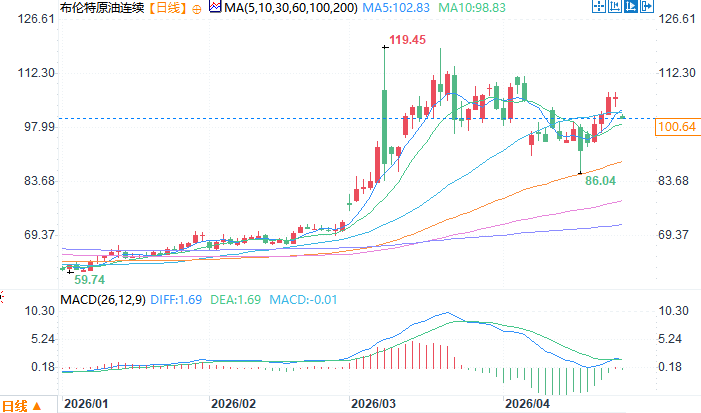
Brent crude oil daily chart source: EasyForex
At 10:11 AM Beijing time on April 27, Brent crude oil futures were trading at $100.72 per barrel.
The escalating geopolitical conflicts around Iran and the disruption of shipping through the Strait of Hormuz, a vital global energy route, have combined to directly impact the overall oil market. The subsequent chain reaction may extend to all asset classes and affect the entire global economy.
Key transportation routes are blocked, significantly increasing uncertainty in energy supply.
Currently, the volume of vessels passing through the Strait of Hormuz has decreased sharply, with a large number of oil tankers voluntarily shutting down their Automatic Identification Systems (AIS) to conceal their navigation tracks, resulting in a continuous decline in the visibility of shipping through the strait. As a top global energy choke point, this strait carries a massive demand for cross-border crude oil transportation. The chaotic navigation order and information gaps have directly brought energy supply risks back into the market's focus, disrupting the previously stable rhythm of crude oil trading.
Three key drivers are stirring up oil prices.
This round of oil price fluctuations is not caused by a single factor; three core hidden dangers are fermenting simultaneously, amplifying the volatility of Brent crude oil.
First, the visibility of crude oil supply across the region continues to deteriorate, the transportation rhythm of key shipping routes is disrupted, routine capacity scheduling is hindered, market risk aversion sentiment is rapidly rising, and blindly exacerbating market volatility.
Secondly, Iran's domestic crude oil onshore storage capacity is nearing its limit, with a total capacity of approximately 40 million barrels. If the export disruption continues, Iran may be forced to reduce production to protect its reserves in about ten days, and the temporary transportation difficulties will directly escalate into a substantial global supply gap.
Finally, the market's holdings show a highly concentrated, one-sided trend, with speculative funds deploying in a highly unified direction. Even minor geopolitical fluctuations can trigger concentrated portfolio adjustments, amplifying oil price fluctuations by deviating from fundamental supply and demand factors.
The ripple effect spreads, putting pressure on economic assets across the entire region.
Oil price fluctuations are never confined to the energy sector alone; they profoundly impact the entire real economy and financial markets. Rising crude oil prices directly increase costs across the entire supply chain, from logistics and shipping to industrial manufacturing, while simultaneously pushing up residential energy expenditures, forcing a rebound in market inflation expectations. Central banks worldwide are already facing the challenge of balancing inflation resilience with economic slowdowns; higher oil prices further intensify the pressure on macroeconomic control.
At the same time, companies heavily reliant on fuel, such as airlines and long-haul freight companies, are facing increasing operational pressures, and the equity capital market will reassess the direction of monetary policy, leading to a continued weakening of the overall investment climate.
The divergence in the foreign exchange market is becoming increasingly apparent. The conventional logic that benefits commodity currencies has failed. As geopolitical risk aversion dominates the market, commodity currencies are under pressure, and the market's divergence is particularly pronounced.
Closely monitor key assets; opportunities and risks coexist in the same sector.
At present, several core assets deserve close monitoring and analysis, with Brent crude oil remaining a key indicator for observing energy supply risks.
Energy giant ExxonMobil's stock price movements are linked to oil price trends, potentially leading to a simultaneous expansion of profit margins, while also requiring comprehensive assessment of production costs. NextEra Energy, a benchmark company in the new energy sector, is entering a favorable window of opportunity, with rising demand for energy security driving accelerated expansion in domestic power grid infrastructure and the new clean energy sector. The Australian dollar's exchange rate against the US dollar is linked to commodity cycles; conventionally positive factors have weakened due to geopolitical risk aversion, significantly increasing market volatility.
The oil price surge driven by geopolitical risks lacks long-term sustainability, and multiple variables could reverse the overall trend at any time. Easing geopolitical tensions leading to a ceasefire consensus, coordinated production increases by major oil-producing countries to ensure supply, and weaker-than-expected domestic demand for refined oil products could all quickly dissipate the geopolitical risk premium, pushing oil prices down rapidly. Current market pricing has long transcended a simple supply and demand dimension, taking into account shipping safety, inflation transmission, and global risk sentiment, resulting in a complex and volatile overall market.
Taking a long-term perspective, closely monitoring the dynamics of the Strait of Hormuz, and rationally assessing the pace of oil price fluctuations are essential to effectively mitigate sudden risks in the energy market and seize opportunities for compliant development.
Brent crude oil daily chart source: EasyForex
At 10:11 AM Beijing time on April 27, Brent crude oil futures were trading at $100.72 per barrel.
- Risk Warning and Disclaimer
- The market involves risk, and trading may not be suitable for all investors. This article is for reference only and does not constitute personal investment advice, nor does it take into account certain users’ specific investment objectives, financial situation, or other needs. Any investment decisions made based on this information are at your own risk.