Uncertainty surrounding the Bank of Japan's policy, coupled with the Bank of England's wait-and-see approach to interest rates, pushed the pound up to around 215.70 against the yen.
2026-04-27 14:51:48
On Monday morning in Europe, the pound rose slightly against the yen to around 215.70, continuing its short-term rebound. The rise was mainly driven by the weakening yen, which has significantly underperformed other major currencies in the current market environment.

From a fundamental perspective, the Bank of Japan is set to announce its interest rate decision on Tuesday, with the market widely expecting it to maintain the rate at 0.75% for the third consecutive time. While there is a possibility of a pause in a hawkish stance, the Japanese economy faces downside risks amid rising energy prices due to the Middle East situation, leading policymakers to adopt a more cautious approach. This uncertainty has diminished the yen's appeal, making it weaker among major currencies.
Meanwhile, intraday currency performance showed that the yen weakened against most major currencies , particularly against riskier currencies such as the Australian dollar, reflecting a slight recovery in market risk appetite. In this environment, funds tend to flow to currencies with higher yields, thus putting continued pressure on the yen.
From the perspective of the pound sterling, its trend has been relatively mild. Although the stalemate in the Middle East is limiting risk appetite, the Bank of England is about to announce its interest rate decision, and the market generally expects it to keep the rate unchanged at 3.75%. Given the continued upside risks to inflation, the Bank of England's cautious policy stance provides some support for the pound, but also limits its potential for significant volatility.
Overall, the current GBP/JPY exchange rate movement is primarily driven by the yen, exhibiting a structural characteristic of "a weaker yen pushing the exchange rate upward." With the decisions of the two major central banks approaching, market sentiment is cautious, and the exchange rate is showing more of a fluctuating upward trend than a one-sided one.
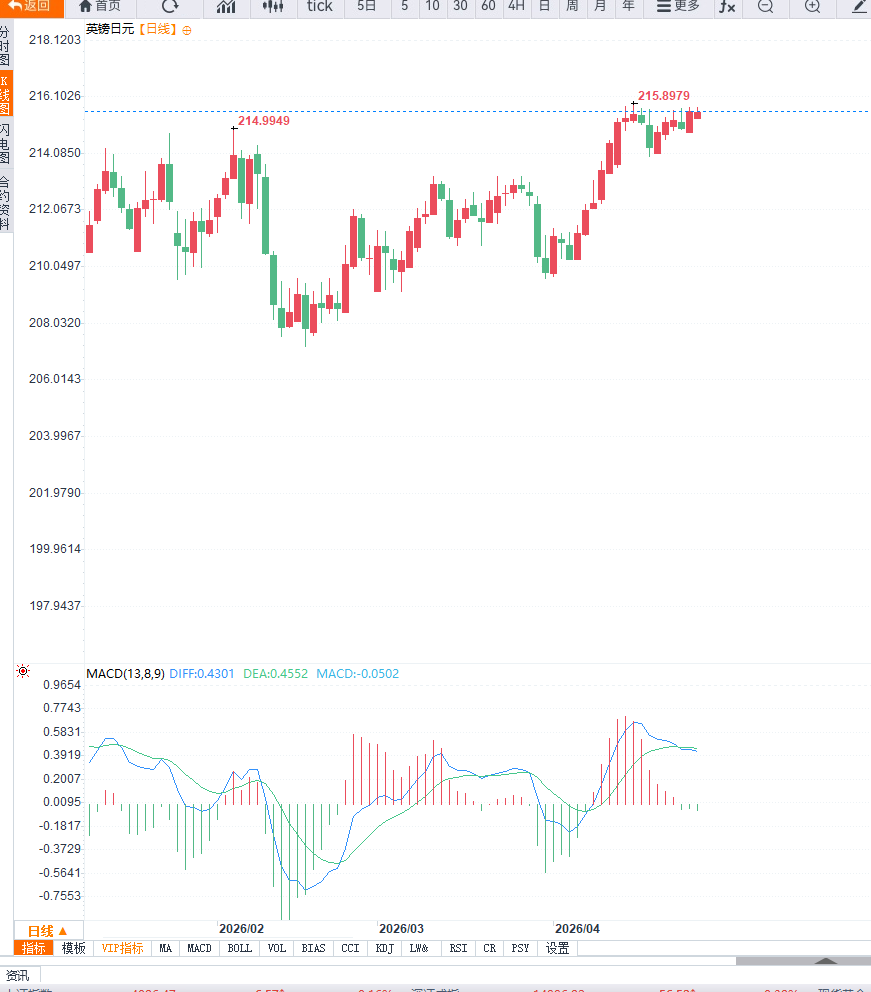
From a technical perspective, on the daily chart, GBP/JPY maintains a high-level trading pattern, with the overall trend still bullish. The price is moving along an upward channel, but short-term momentum has slowed. The current key support level is around 213.80 ; a break below this level could lead to a pullback to the 212.50 area . Resistance levels are concentrated in the 216.50 to 218.00 range , which is near the previous high. Momentum indicators show that bulls still dominate, but the upward slope is slowing. On the 4-hour chart, the exchange rate shows a fluctuating upward structure, with short-term moving averages maintaining a bullish alignment. However, multiple attempts to break above 216.00 have failed, indicating strong selling pressure. A break above 216.50 could open up further upside potential; conversely, a break below 213.80 could lead to a period of consolidation.
Editor's Summary:
The current GBP/JPY exchange rate movement is primarily driven by the weakening yen and uncertainty surrounding central bank policy expectations. With the Bank of Japan and Bank of England's interest rate decisions approaching, the market lacks a clear short-term direction, and the exchange rate remains volatile at high levels. If the Bank of Japan releases dovish signals, the yen may come under further pressure, pushing the exchange rate higher; however, a hawkish policy stance could trigger a pullback. Investors need to closely monitor changes in policy signals and breakouts of key technical levels.
From a fundamental perspective, the Bank of Japan is set to announce its interest rate decision on Tuesday, with the market widely expecting it to maintain the rate at 0.75% for the third consecutive time. While there is a possibility of a pause in a hawkish stance, the Japanese economy faces downside risks amid rising energy prices due to the Middle East situation, leading policymakers to adopt a more cautious approach. This uncertainty has diminished the yen's appeal, making it weaker among major currencies.
Meanwhile, intraday currency performance showed that the yen weakened against most major currencies , particularly against riskier currencies such as the Australian dollar, reflecting a slight recovery in market risk appetite. In this environment, funds tend to flow to currencies with higher yields, thus putting continued pressure on the yen.
From the perspective of the pound sterling, its trend has been relatively mild. Although the stalemate in the Middle East is limiting risk appetite, the Bank of England is about to announce its interest rate decision, and the market generally expects it to keep the rate unchanged at 3.75%. Given the continued upside risks to inflation, the Bank of England's cautious policy stance provides some support for the pound, but also limits its potential for significant volatility.
Overall, the current GBP/JPY exchange rate movement is primarily driven by the yen, exhibiting a structural characteristic of "a weaker yen pushing the exchange rate upward." With the decisions of the two major central banks approaching, market sentiment is cautious, and the exchange rate is showing more of a fluctuating upward trend than a one-sided one.
From a technical perspective, on the daily chart, GBP/JPY maintains a high-level trading pattern, with the overall trend still bullish. The price is moving along an upward channel, but short-term momentum has slowed. The current key support level is around 213.80 ; a break below this level could lead to a pullback to the 212.50 area . Resistance levels are concentrated in the 216.50 to 218.00 range , which is near the previous high. Momentum indicators show that bulls still dominate, but the upward slope is slowing. On the 4-hour chart, the exchange rate shows a fluctuating upward structure, with short-term moving averages maintaining a bullish alignment. However, multiple attempts to break above 216.00 have failed, indicating strong selling pressure. A break above 216.50 could open up further upside potential; conversely, a break below 213.80 could lead to a period of consolidation.
Editor's Summary:
The current GBP/JPY exchange rate movement is primarily driven by the weakening yen and uncertainty surrounding central bank policy expectations. With the Bank of Japan and Bank of England's interest rate decisions approaching, the market lacks a clear short-term direction, and the exchange rate remains volatile at high levels. If the Bank of Japan releases dovish signals, the yen may come under further pressure, pushing the exchange rate higher; however, a hawkish policy stance could trigger a pullback. Investors need to closely monitor changes in policy signals and breakouts of key technical levels.
- Risk Warning and Disclaimer
- The market involves risk, and trading may not be suitable for all investors. This article is for reference only and does not constitute personal investment advice, nor does it take into account certain users’ specific investment objectives, financial situation, or other needs. Any investment decisions made based on this information are at your own risk.