Many central banks are expected to maintain tight interest rates, and gold may see the negative factors fully priced in.
2026-04-27 15:55:27
Central banks around the world are mired in an inflationary predicament fueled by geopolitical conflicts, and the bond market has long been on standby, closely monitoring policy signals from major central banks.
This week will be a crucial juncture for global monetary policy. Against the backdrop of escalating geopolitical tensions and resurgent inflation concerns, the major G7 central banks, including the Federal Reserve, the European Central Bank, the Bank of Japan, the Bank of England, and the Bank of Canada, will hold simultaneous policy meetings. This "synchronized decision-making" scenario is extremely rare, and the combined output of these economies is close to half of the global total.
The prevailing view is that the central bank will focus on its concerns about inflation and maintaining a tight interest rate level. At this time, investors can pay attention to interest rate-sensitive assets, or there may be opportunities to allocate assets even if the negative news does not lead to a decline.

The market generally expects that major central banks will keep their benchmark interest rates unchanged this time, but the core focus of funds is on the policymakers' tone and interpretation of the inflation risks arising from the geopolitical friction between the United States and Iran and the rise in energy prices.
Industry insiders generally believe that once the central bank signals that it will "maintain a tight policy for a long time" or even "further tighten" the policy, global sovereign bonds will face significant downward pressure, meaning that government bond yields will rise and the global interest rate center will shift upward.
It is worth noting that sovereign bonds have consistently underperformed stocks and credit assets recently, suggesting that investors are downplaying the short-term disruptions caused by geopolitical conflicts and are continuing to increase their allocation to risky assets.
The recent wave of interest rate announcements by central banks may push up government bond yields in the short term, potentially impacting long-duration assets such as gold and technology stocks.
Pander Group analyst Amy Xie pointed out that the current trend of crude oil prices is full of uncertainty, and the pressure of rising prices across the board remains stubborn. Against this backdrop, the central bank's "hawkish" stance in combating inflation will not produce significant negative effects.
She revealed that she had completely cleared her bond duration exposure in her investment portfolio this month to avoid the risks that interest rate fluctuations might bring.
Despite escalating geopolitical risks, the global bond market has maintained an unusually stable trend: yields on short-term bonds in major financial markets have remained high, and intraday volatility in one- to three-year bonds has narrowed significantly compared to March.
However, many institutional traders warn that if central banks around the world collectively release hawkish statements this week, the current stable market situation may come to an end quickly.
Stephen Miller, a former core member of BlackRock Australia and current advisor to GSFM, analyzed that during the pandemic, many central banks made policy misjudgments, simply attributing inflationary pressures to "short-term temporary phenomena." After learning from this lesson, central banks around the world are now highly vigilant against "underestimating inflation."
Taking the UK as an example, the Bank of England had already issued a warning that the continued escalation of geopolitical conflicts would further worsen the domestic inflationary environment.
Data shows that, affected by a sharp rise in fuel costs, the UK's CPI rose to 3.3% year-on-year in March, up from 3.0% in February;
Driven by this inflation data, market interest rate expectations underwent a significant adjustment last week, shifting from the original pricing of "one rate hike this year" to a trading logic of "at least two rate hikes".
The situation in the US market is equally complex: Federal Reserve officials have clearly acknowledged that prolonged high oil price volatility will disrupt the pace of inflation recovery, thereby reshaping the path of subsequent interest rate adjustments.
At the same time, the resilience of the US job market and the better-than-expected recovery in retail sales data are sufficient to prove that the real economy has not yet entered a stage of substantial weakness.
TD Securities strategist Molly Brooks predicts that Federal Reserve Chairman Powell will continue his "policy neutral" stance while acknowledging imported inflation from rising energy prices, further amplifying uncertainty in the macro market.
She emphasized that, before the Federal Reserve provides clear forward guidance, institutions predict that the 10-year US Treasury yield will continue to fluctuate within the range of 4.1% to 4.4%.
However, the US Department of Justice's decision to drop the criminal investigation into Powell's alleged overspending on the Federal Reserve's renovations and transfer the case to the Inspector General has removed obstacles to Warsh's appointment, increasing the probability of a US interest rate cut by the end of the year. This could effectively offset the impact of the central bank's concentrated interest rate decision this week.
Central banks in other economies are also seeking a balance between inflation and growth: Bank of Japan Governor Kazuo Ueda emphasized the need to consider both the upside risks and downside pressures of inflation. The Evercore ISI analyst team expects the Bank of Japan to keep interest rates unchanged and maintain a hawkish stance in its overall monetary policy.
Regarding the European Central Bank, although the market generally bets that it will continue to tighten monetary policy, President Lagarde will reiterate that uncertainty in the current macroeconomic environment remains high.
It needs to be clarified that inflation is only a core variable affecting monetary policy, not the sole determining factor.
Analysts point out that once high energy prices and geopolitical risks continue to erode end-consumer demand, central banks will inevitably adjust their policy focus, gradually shifting from "fighting inflation" to "stabilizing growth."
Once the market's inflation trading logic gradually cools down and the policy focus shifts, global bond yields will eventually see a phase of decline.
From the perspective of the global interest rate landscape, short-term bond yields are generally remaining high, and core instruments such as 10-year US Treasury bonds are caught in a range-bound oscillation. The "holding back" policy of central banks in major economies has not alleviated the market's divergence on the long-term trend of interest rates.
As a dual asset with both "inflation hedging and safe-haven attributes", gold's price trend is closely linked to global interest rate levels: on the one hand, high interest rates will increase the cost of holding gold, putting downward pressure on gold prices.
On the other hand, safe-haven demand triggered by geopolitical conflicts and inflation concerns driven by rising energy prices have provided strong support for gold prices.
Central banks around the world are expected to announce tighter interest rates this week, and their statements on inflation may fuel market concerns about inflation. However, gold has been correcting recently, and this week may see a rebound as the negative news is fully priced in.
From a technical perspective, spot gold has held above the key price level of 4705, and is expected to rebound along the lower rail of the upward channel this week.
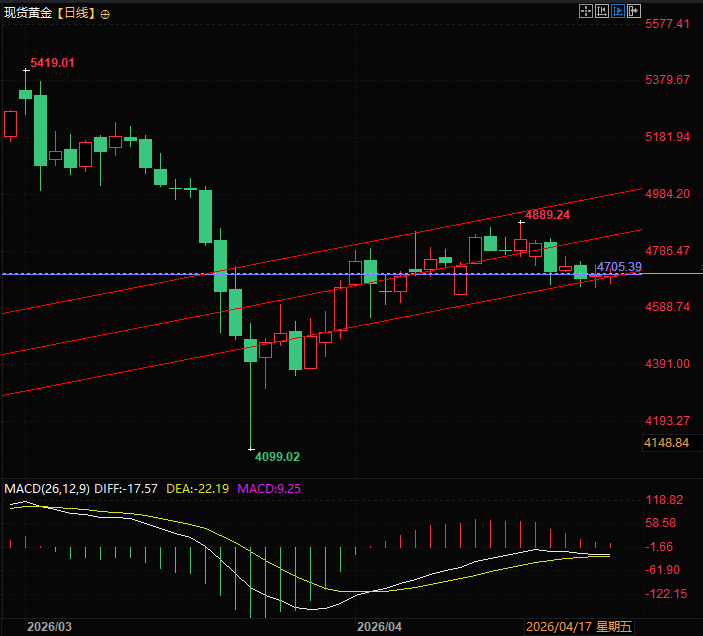
(Spot gold daily chart, source: EasyForex subsidiary)
At 15:54 Beijing time, spot gold is currently trading at $4,709 per ounce.
This week will be a crucial juncture for global monetary policy. Against the backdrop of escalating geopolitical tensions and resurgent inflation concerns, the major G7 central banks, including the Federal Reserve, the European Central Bank, the Bank of Japan, the Bank of England, and the Bank of Canada, will hold simultaneous policy meetings. This "synchronized decision-making" scenario is extremely rare, and the combined output of these economies is close to half of the global total.
The prevailing view is that the central bank will focus on its concerns about inflation and maintaining a tight interest rate level. At this time, investors can pay attention to interest rate-sensitive assets, or there may be opportunities to allocate assets even if the negative news does not lead to a decline.
Market forecast: Maintaining stable interest rates is a consensus; policy wording will be the core focus.
The market generally expects that major central banks will keep their benchmark interest rates unchanged this time, but the core focus of funds is on the policymakers' tone and interpretation of the inflation risks arising from the geopolitical friction between the United States and Iran and the rise in energy prices.
Industry insiders generally believe that once the central bank signals that it will "maintain a tight policy for a long time" or even "further tighten" the policy, global sovereign bonds will face significant downward pressure, meaning that government bond yields will rise and the global interest rate center will shift upward.
It is worth noting that sovereign bonds have consistently underperformed stocks and credit assets recently, suggesting that investors are downplaying the short-term disruptions caused by geopolitical conflicts and are continuing to increase their allocation to risky assets.
The recent wave of interest rate announcements by central banks may push up government bond yields in the short term, potentially impacting long-duration assets such as gold and technology stocks.
Bond Market Unusual: Beneath a Stable Appearance Lies Concerns About Duration Hedging and a Dovish Stance
Pander Group analyst Amy Xie pointed out that the current trend of crude oil prices is full of uncertainty, and the pressure of rising prices across the board remains stubborn. Against this backdrop, the central bank's "hawkish" stance in combating inflation will not produce significant negative effects.
She revealed that she had completely cleared her bond duration exposure in her investment portfolio this month to avoid the risks that interest rate fluctuations might bring.
Despite escalating geopolitical risks, the global bond market has maintained an unusually stable trend: yields on short-term bonds in major financial markets have remained high, and intraday volatility in one- to three-year bonds has narrowed significantly compared to March.
However, many institutional traders warn that if central banks around the world collectively release hawkish statements this week, the current stable market situation may come to an end quickly.
Inflation Warning: UK CPI Exceeds Expectations, Central Bank Learns from Pandemic Policy Lessons
Stephen Miller, a former core member of BlackRock Australia and current advisor to GSFM, analyzed that during the pandemic, many central banks made policy misjudgments, simply attributing inflationary pressures to "short-term temporary phenomena." After learning from this lesson, central banks around the world are now highly vigilant against "underestimating inflation."
Taking the UK as an example, the Bank of England had already issued a warning that the continued escalation of geopolitical conflicts would further worsen the domestic inflationary environment.
Data shows that, affected by a sharp rise in fuel costs, the UK's CPI rose to 3.3% year-on-year in March, up from 3.0% in February;
Driven by this inflation data, market interest rate expectations underwent a significant adjustment last week, shifting from the original pricing of "one rate hike this year" to a trading logic of "at least two rate hikes".
The US Game: Oil Prices Disrupt Inflation Path, 10-Year US Treasury Yields Trade in a Range
The situation in the US market is equally complex: Federal Reserve officials have clearly acknowledged that prolonged high oil price volatility will disrupt the pace of inflation recovery, thereby reshaping the path of subsequent interest rate adjustments.
At the same time, the resilience of the US job market and the better-than-expected recovery in retail sales data are sufficient to prove that the real economy has not yet entered a stage of substantial weakness.
TD Securities strategist Molly Brooks predicts that Federal Reserve Chairman Powell will continue his "policy neutral" stance while acknowledging imported inflation from rising energy prices, further amplifying uncertainty in the macro market.
She emphasized that, before the Federal Reserve provides clear forward guidance, institutions predict that the 10-year US Treasury yield will continue to fluctuate within the range of 4.1% to 4.4%.
However, the US Department of Justice's decision to drop the criminal investigation into Powell's alleged overspending on the Federal Reserve's renovations and transfer the case to the Inspector General has removed obstacles to Warsh's appointment, increasing the probability of a US interest rate cut by the end of the year. This could effectively offset the impact of the central bank's concentrated interest rate decision this week.
Global Collaboration: The Bank of Japan and the European Central Bank Maintain Their Stance, Balancing Inflation and Growth
Central banks in other economies are also seeking a balance between inflation and growth: Bank of Japan Governor Kazuo Ueda emphasized the need to consider both the upside risks and downside pressures of inflation. The Evercore ISI analyst team expects the Bank of Japan to keep interest rates unchanged and maintain a hawkish stance in its overall monetary policy.
Regarding the European Central Bank, although the market generally bets that it will continue to tighten monetary policy, President Lagarde will reiterate that uncertainty in the current macroeconomic environment remains high.
Policy turning point: With demand under pressure, the central bank may shift towards stabilizing growth.
It needs to be clarified that inflation is only a core variable affecting monetary policy, not the sole determining factor.
Analysts point out that once high energy prices and geopolitical risks continue to erode end-consumer demand, central banks will inevitably adjust their policy focus, gradually shifting from "fighting inflation" to "stabilizing growth."
Once the market's inflation trading logic gradually cools down and the policy focus shifts, global bond yields will eventually see a phase of decline.
Interest Rates and Gold: Safe-Haven Asset Allocation Under a Dual Framework
From the perspective of the global interest rate landscape, short-term bond yields are generally remaining high, and core instruments such as 10-year US Treasury bonds are caught in a range-bound oscillation. The "holding back" policy of central banks in major economies has not alleviated the market's divergence on the long-term trend of interest rates.
As a dual asset with both "inflation hedging and safe-haven attributes", gold's price trend is closely linked to global interest rate levels: on the one hand, high interest rates will increase the cost of holding gold, putting downward pressure on gold prices.
On the other hand, safe-haven demand triggered by geopolitical conflicts and inflation concerns driven by rising energy prices have provided strong support for gold prices.
Summary and Technical Analysis:
Central banks around the world are expected to announce tighter interest rates this week, and their statements on inflation may fuel market concerns about inflation. However, gold has been correcting recently, and this week may see a rebound as the negative news is fully priced in.
From a technical perspective, spot gold has held above the key price level of 4705, and is expected to rebound along the lower rail of the upward channel this week.
(Spot gold daily chart, source: EasyForex subsidiary)
At 15:54 Beijing time, spot gold is currently trading at $4,709 per ounce.
- Risk Warning and Disclaimer
- The market involves risk, and trading may not be suitable for all investors. This article is for reference only and does not constitute personal investment advice, nor does it take into account certain users’ specific investment objectives, financial situation, or other needs. Any investment decisions made based on this information are at your own risk.