US-Iran talks fall apart, oil prices break $100, and the US-Iran standoff may be prolonged.
2026-04-27 21:02:04
On Monday (April 27), during the Asian and European sessions, international oil prices continued to fluctuate at high levels, with Brent crude oil currently trading around 100.
In late April 2026, the geopolitical situation in the Middle East changed abruptly, the second round of negotiations between the US and Iran unexpectedly failed, shipping in the Strait of Hormuz continued to be disrupted, and the global crude oil market fluctuated sharply in response.
International oil prices rebounded strongly, with Brent crude rising nearly 17% in a week as market concerns about supply shortages intensified sharply.
The following analysis examines the latest developments in US-Iran negotiations, Iranian crude oil production capacity and inventory pressures, and changes in market supply and demand.
On April 25 local time, Iranian Foreign Minister Araqchi visited Islamabad, Pakistan, and met with Pakistani Prime Minister Sharif, Foreign Minister Dar, and other dignitaries to discuss the regional situation and peace efforts.
However, just hours before Araghshi's arrival, US President Trump suddenly announced the cancellation of the trip to Pakistan by US negotiators Steve Vitkov and Jared Kushner, causing the planned second round of US-Iran talks to be completely suspended.
Trump stated on social media that the reason for canceling the trip was "too much time wasted on travel, too much work," and added that "they can call us anytime," emphasizing that "we have all the leverage."
It is worth noting that Trump had previously revealed that Iran had submitted a new peace proposal, which he rejected because he felt it "could have been better." Ten minutes later, Iran submitted a new proposal that was "much better," but Trump did not disclose the specifics, only emphasizing that one of the core conditions for the U.S. was that Iran "would not possess nuclear weapons."
Pakistan's efforts to push for a second round of negotiations, as a key mediator, have suffered a serious setback. Pakistani officials said there has been no news of a resumption of talks since Araghshi left.
Previously, China had assisted in promoting Pakistan as the host of the US-Iran ceasefire negotiations, and Egypt had also coordinated with Pakistan to advance the negotiation process. Many countries believed that negotiations were the best way to end regional conflicts.
As negotiations broke down, the military standoff between the US and Iran escalated further.
Iran’s Joint Military Command issued a statement on April 25 warning that if the United States continues its “naval blockade, banditry and piracy” in the region, it will trigger a decisive military response from Iran. The statement added that if the United States and Israel resume their aggressive behavior, they will face further losses.
The situation in the Strait of Hormuz continues to deteriorate, with Trump stating that the U.S. Navy is clearing Iranian mines from the strait. Currently, the strait is closed to most ships, putting enormous pressure on the global economy.
Experts warn that despite the fragile ceasefire between the US and Iran, the search for underwater explosives could take months, and any future statements that the US has cleared the waterway may not convince merchant ships and their insurance companies that the waterway is ultimately safe.
The stalled US-Iran negotiations have also indirectly affected the Lebanon-Israel conflict.
Although Israel and Lebanon agreed to extend the ceasefire between themselves and Hezbollah for three weeks, the ceasefire agreement has been violated multiple times.
On April 25, the Israel Defense Forces killed six militants in multiple attacks in southern Lebanon, while several rockets and drones were launched from Lebanon into Israel, escalating tensions in the region.
Analysts at Societe Generale believe that, constrained by onshore storage capacity and offshore floating storage, there is a clear limit to the period during which Iran can maintain full crude oil production under the US blockade.
However, energy consultancy EnergyAspect estimates that Iran's incremental available onshore storage is only around 30 million barrels, with a buffer period of only two weeks to operate at full capacity.
Societe Generale further pointed out that if crude oil exports come to a complete standstill, Iran may begin to reduce production capacity around 16 days from now, with the reduction gradually increasing around the 30-day mark.
Once Iranian crude oil exports are completely halted, around 16 days will be a critical point for production cuts. By the 30th day, the scale of production cuts will gradually match the level of a full shutdown of exports, with the average daily production cut remaining in the range of 1.7 million to 2 million barrels.
Meanwhile, Iran can still maintain its cash flow with its crude oil assets already shipped outside the Gulf region. According to shipping data agency Kpler, Iran currently has approximately 176 million barrels of crude oil in floating storage at sea, of which 142 million barrels are located outside the core waters of the Arabian Gulf and the Gulf of Oman, thus avoiding direct control by the US military's maritime blockade focused on the Strait of Hormuz.
This large-scale offshore floating oil inventory provides Iran with ample flexibility in terms of revenue, and to some extent alleviates the pressure on onshore storage and the urgency of production capacity contraction.
In summary, there is still room for tug-of-war between the US and Iran in their negotiations. Even if the US blocks the Strait of Hormuz, Iran still has nearly a month's worth of resistance capabilities, a point that the market may not have yet priced in.
Iran can hold out for another month, but can the rise in global energy prices and the rebound in domestic sentiment in the United States sustain this momentum for another month?
In the short term, expectations of shrinking Iranian crude oil production capacity and widening global supply gap will dominate market sentiment; in the medium to long term, whether negotiations can be restarted, whether the Strait of Hormuz can be safely navigated, and the speed at which Iranian floating storage crude oil is absorbed will be key variables affecting oil price trends.
For market participants, geopolitical risk premiums will persist, and oil price volatility is likely to remain high. Energy policymakers worldwide must closely monitor developments and proactively address potential energy supply disruptions to ensure energy security and economic stability.
From a technical perspective, Brent crude oil has broken out of a descending wedge pattern and is trading in a very strong range, with support around 98.40, where the blue line and the 5-day moving average intersect.
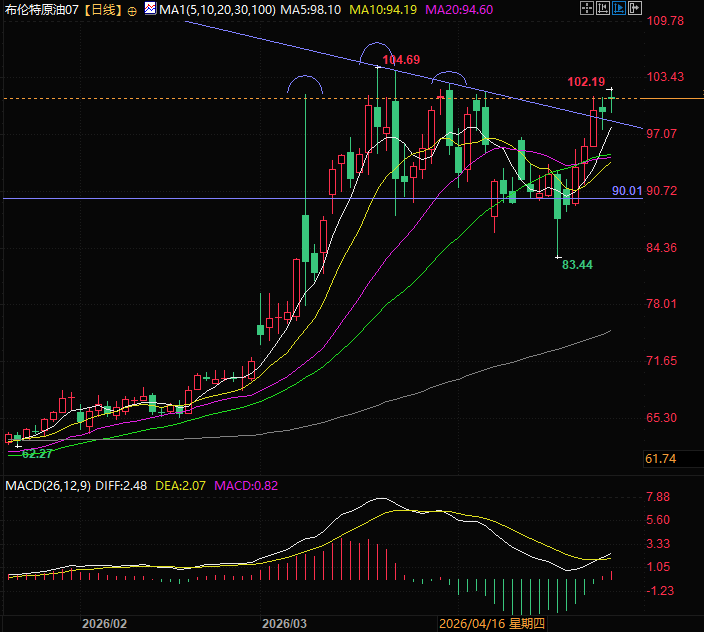
(Brent crude oil July contract daily chart, source: EasyForex)
At 21:00 Beijing time, the Brent crude oil July contract is currently trading at $101.18 per barrel.
In late April 2026, the geopolitical situation in the Middle East changed abruptly, the second round of negotiations between the US and Iran unexpectedly failed, shipping in the Strait of Hormuz continued to be disrupted, and the global crude oil market fluctuated sharply in response.
International oil prices rebounded strongly, with Brent crude rising nearly 17% in a week as market concerns about supply shortages intensified sharply.
The following analysis examines the latest developments in US-Iran negotiations, Iranian crude oil production capacity and inventory pressures, and changes in market supply and demand.
A dramatic turn of events after negotiations stalled: mediation efforts faltered, geopolitical risks escalated.
On April 25 local time, Iranian Foreign Minister Araqchi visited Islamabad, Pakistan, and met with Pakistani Prime Minister Sharif, Foreign Minister Dar, and other dignitaries to discuss the regional situation and peace efforts.
However, just hours before Araghshi's arrival, US President Trump suddenly announced the cancellation of the trip to Pakistan by US negotiators Steve Vitkov and Jared Kushner, causing the planned second round of US-Iran talks to be completely suspended.
Trump stated on social media that the reason for canceling the trip was "too much time wasted on travel, too much work," and added that "they can call us anytime," emphasizing that "we have all the leverage."
It is worth noting that Trump had previously revealed that Iran had submitted a new peace proposal, which he rejected because he felt it "could have been better." Ten minutes later, Iran submitted a new proposal that was "much better," but Trump did not disclose the specifics, only emphasizing that one of the core conditions for the U.S. was that Iran "would not possess nuclear weapons."
Pakistan's efforts to push for a second round of negotiations, as a key mediator, have suffered a serious setback. Pakistani officials said there has been no news of a resumption of talks since Araghshi left.
Previously, China had assisted in promoting Pakistan as the host of the US-Iran ceasefire negotiations, and Egypt had also coordinated with Pakistan to advance the negotiation process. Many countries believed that negotiations were the best way to end regional conflicts.
Military standoff and the Strait of Hormuz crisis
As negotiations broke down, the military standoff between the US and Iran escalated further.
Iran’s Joint Military Command issued a statement on April 25 warning that if the United States continues its “naval blockade, banditry and piracy” in the region, it will trigger a decisive military response from Iran. The statement added that if the United States and Israel resume their aggressive behavior, they will face further losses.
The situation in the Strait of Hormuz continues to deteriorate, with Trump stating that the U.S. Navy is clearing Iranian mines from the strait. Currently, the strait is closed to most ships, putting enormous pressure on the global economy.
Experts warn that despite the fragile ceasefire between the US and Iran, the search for underwater explosives could take months, and any future statements that the US has cleared the waterway may not convince merchant ships and their insurance companies that the waterway is ultimately safe.
The regional situation has triggered a chain reaction, and the conflict between Lebanon and Israel has reignited.
The stalled US-Iran negotiations have also indirectly affected the Lebanon-Israel conflict.
Although Israel and Lebanon agreed to extend the ceasefire between themselves and Hezbollah for three weeks, the ceasefire agreement has been violated multiple times.
On April 25, the Israel Defense Forces killed six militants in multiple attacks in southern Lebanon, while several rockets and drones were launched from Lebanon into Israel, escalating tensions in the region.
Societe Generale: Iranian oil production capacity faces clear contraction limits
Analysts at Societe Generale believe that, constrained by onshore storage capacity and offshore floating storage, there is a clear limit to the period during which Iran can maintain full crude oil production under the US blockade.
However, energy consultancy EnergyAspect estimates that Iran's incremental available onshore storage is only around 30 million barrels, with a buffer period of only two weeks to operate at full capacity.
Societe Generale further pointed out that if crude oil exports come to a complete standstill, Iran may begin to reduce production capacity around 16 days from now, with the reduction gradually increasing around the 30-day mark.
Once Iranian crude oil exports are completely halted, around 16 days will be a critical point for production cuts. By the 30th day, the scale of production cuts will gradually match the level of a full shutdown of exports, with the average daily production cut remaining in the range of 1.7 million to 2 million barrels.
Meanwhile, Iran can still maintain its cash flow with its crude oil assets already shipped outside the Gulf region. According to shipping data agency Kpler, Iran currently has approximately 176 million barrels of crude oil in floating storage at sea, of which 142 million barrels are located outside the core waters of the Arabian Gulf and the Gulf of Oman, thus avoiding direct control by the US military's maritime blockade focused on the Strait of Hormuz.
This large-scale offshore floating oil inventory provides Iran with ample flexibility in terms of revenue, and to some extent alleviates the pressure on onshore storage and the urgency of production capacity contraction.
Summary and technical analysis of annual interest rates:
In summary, there is still room for tug-of-war between the US and Iran in their negotiations. Even if the US blocks the Strait of Hormuz, Iran still has nearly a month's worth of resistance capabilities, a point that the market may not have yet priced in.
Iran can hold out for another month, but can the rise in global energy prices and the rebound in domestic sentiment in the United States sustain this momentum for another month?
In the short term, expectations of shrinking Iranian crude oil production capacity and widening global supply gap will dominate market sentiment; in the medium to long term, whether negotiations can be restarted, whether the Strait of Hormuz can be safely navigated, and the speed at which Iranian floating storage crude oil is absorbed will be key variables affecting oil price trends.
For market participants, geopolitical risk premiums will persist, and oil price volatility is likely to remain high. Energy policymakers worldwide must closely monitor developments and proactively address potential energy supply disruptions to ensure energy security and economic stability.
From a technical perspective, Brent crude oil has broken out of a descending wedge pattern and is trading in a very strong range, with support around 98.40, where the blue line and the 5-day moving average intersect.
(Brent crude oil July contract daily chart, source: EasyForex)
At 21:00 Beijing time, the Brent crude oil July contract is currently trading at $101.18 per barrel.
- Risk Warning and Disclaimer
- The market involves risk, and trading may not be suitable for all investors. This article is for reference only and does not constitute personal investment advice, nor does it take into account certain users’ specific investment objectives, financial situation, or other needs. Any investment decisions made based on this information are at your own risk.