Why did the dollar fall despite the lifting of the Taiwan Strait blockade and the mobilization of US troops?
2026-04-27 21:53:54
On Monday (April 27), during the Asian and European sessions, the US dollar index retreated throughout the day and is currently down 0.26%. Although the negotiations were cancelled, the probability of another round of fighting is still not high. The US dollar index is currently trading around 98.26.
Despite Iran's new ceasefire proposal, its negotiations with the United States remain fraught with uncertainty. This geopolitical stalemate continues to disrupt the global crude oil trading market, with shipping safety in the Strait of Hormuz becoming a key variable influencing oil price trends.
Iranian Foreign Minister Abbas Araghchi continued his shuttle diplomacy, visiting Pakistan and Oman over the weekend before flying to St. Petersburg on Monday to meet with Russian President Vladimir Putin. The new ceasefire proposal submitted by Tehran at the same time essentially brought a brief expectation of a resumption of supply to the crude oil market.
The core framework of the plan targets the lifeline of crude oil trade: Iran promises to lift the shipping blockade of the Strait of Hormuz in exchange for the United States lifting its maritime blockade of Iranian ports and a long-term ceasefire guarantee.
It is important to know that this waterway, which is only 33 kilometers wide at its narrowest point, carries an average of 15 million barrels of crude oil and 5 million barrels of refined oil products per day, accounting for 25%-30% of the world's total oil and gas exports. Its passage status directly determines the stability of the global crude oil supply chain.

However, the US delegation's sudden cancellation of its trip to Pakistan has once again stalled the much-anticipated agreement to restart the shipping route.
From the perspective of crude oil trading, this proposal is unlikely to be approved by the Trump administration. The core issue is that it does not address the US’s core concerns about Iran’s nuclear and missile programs. The continued blockade is precisely the key means by which the US exerts pressure by squeezing Iran’s crude oil exports (which have now fallen to 300,000 barrels per day, a decrease of more than 88% compared to 2025).
Trump's decision to postpone the dispatch of a special envoy and demand direct communication with Iran suggests that the United States is inclined to maintain the existing blockade, which means that the crude oil market will continue to be subject to rigid constraints on the supply side.
The continued blockade of the Strait of Hormuz has triggered a chain reaction in the crude oil market. For Iran, the US maritime blockade not only severely damages its core source of hard currency, oil exports, but may also force Iran to shut down production capacity due to the inability to ship crude oil, further shrinking the total global supply.
For the global market, shipping lane traffic has plummeted to 10% of normal levels, resulting in a cumulative decrease of over 474 million barrels in global crude oil inventories. Brent crude oil futures prices surged from $80 per barrel before the conflict to the $110-$120 per barrel range, and Singapore diesel spot prices once broke through the historical high of $272 per barrel.
This supply shortage has spread to end consumers, with aviation fuel and residential gas experiencing supply shortages in some areas. Operating costs for energy-dependent industries such as logistics and agriculture have risen sharply, further driving up the end-user demand premium for crude oil.
For Trump's Gulf allies, whose oil and gas exports are also highly dependent on the shipping route, the pressure of supply disruptions is forcing these countries to adjust their export strategies, further exacerbating the regional supply and demand imbalance.
Although the current indefinite ceasefire continues in form, the stagnation of substantive negotiations has left the crude oil market without a clear window for the release of negative news.
Since the ceasefire agreement took effect on April 8, the highest-level negotiations between the US and Iran have ended without results. Pakistan's move to dismantle security facilities related to the negotiations means that the resumption of shipping lanes is unlikely in the short term.
Goldman Sachs estimates that the current global crude oil market has a daily supply deficit of 14.3-15.4 million barrels, and that for every four weeks the lockdown is extended, the annualized supply loss will increase by 1.07 million barrels per day, corresponding to a 10%-20% upward shift in the oil price center. If the lockdown continues for 20 weeks, Brent crude oil prices may reach the $140 per barrel mark.
Behind the deadlock in negotiations, the US military's continued escalation of its military deployments in the Middle East has further amplified the geopolitical risk premium in the crude oil market.
As of Monday, the U.S. Navy had deployed three carrier strike groups and amphibious assault groups to the region, carrying a total of 15,000 personnel and more than 200 aircraft. This comprehensive military deterrence has not only exacerbated tensions but also continued to undermine market confidence in the recovery of the supply chain.
This risk expectation has been reflected in the futures market structure. The crude oil market has maintained a "spot premium" pattern for a long time, with the DFL index once soaring to $40 per barrel, highlighting the market's urgent need for immediate supply.
Iran is actively seeking external support to solidify its crude oil production and export base in an effort to break free from the blockade.
Foreign Minister Araghzi made a series of visits to Oman, Pakistan, and Russia. Pakistan is the core mediator, Oman has long served as a bridge between the US and Iran, and Russia's neutral stance hints at a turning point. Although there have been proposals to transfer Iran's highly enriched uranium to Russian storage, Iran's refusal to give up its uranium reserves means that the nuclear deadlock is unlikely to be resolved in the short term, which in turn continues to constrain the recovery of crude oil supply.
Currently, all of Iran's highly enriched uranium remains in the country. The enrichment facilities were damaged in the US military strike last year, which has indirectly constrained the recovery of its crude oil production capacity.
It is worth noting that the current geopolitical driving logic of the crude oil market is in a subtle game with the US dollar index, and the traditional negative correlation has shown a phased divergence, with the dollar and oil prices rising and falling together.
At the beginning of the conflict, the US dollar index surged to 100.51 due to safe-haven demand, but gradually fell back to around 98 as the situation became deadlocked, while crude oil prices remained high and volatile.
Behind this divergence is, on the one hand, the US, as a net exporter of crude oil, has seen its trade surplus, resulting from rising oil prices, support the dollar.
On the other hand, the demand for safe-haven assets brought about by previous wars has led to a continued strengthening of the US dollar.
Despite the current failure of negotiations, oil prices remain firm while the US dollar index is correcting. This is not due to a significant change in the aforementioned logic, but rather because the market is betting on a continued ceasefire between the US and Iran, while oil prices continue to rise due to the strait blockade. This has led to a situation where the demand for the US dollar as a safe haven has decreased, while oil prices have increased. At the same time, the US military buildup is still considered primarily for deterrence, as the assembly of aircraft carriers does not necessarily mean there are more targets to strike, and the troop buildup does not necessarily mean there are enough troops to land.
For crude oil traders, it is crucial to monitor marginal changes in this correlation: if the US dollar index strengthens again due to support from the US economic fundamentals, it may partially offset the rise in oil prices brought about by geopolitical risks; however, if the blockade of the Strait of Hormuz is extended beyond expectations, energy supply shocks will continue to dominate the pricing logic, causing oil prices and the US dollar index to fluctuate in the same direction for a period of time, becoming a key variable affecting trading strategies.
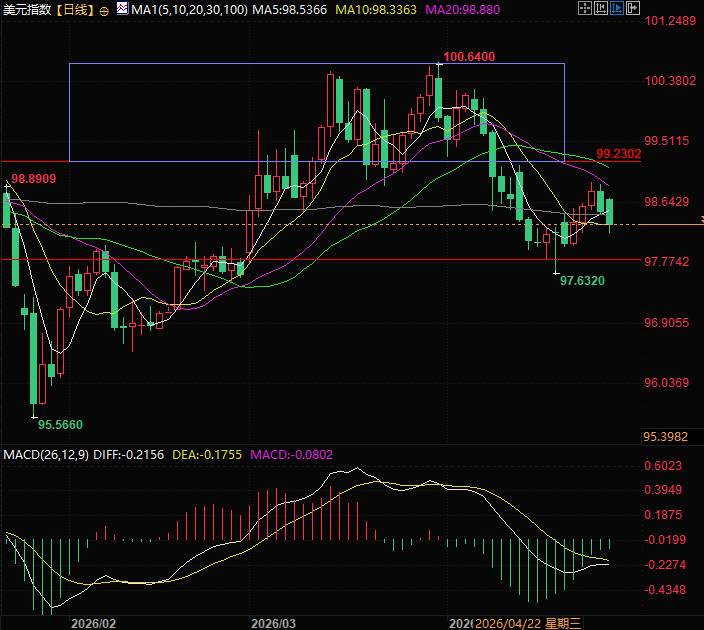
(US Dollar Index Daily Chart, Source: EasyForex)
At 21:49 Beijing time, the US dollar index is currently at 98.35.
Despite Iran's new ceasefire proposal, its negotiations with the United States remain fraught with uncertainty. This geopolitical stalemate continues to disrupt the global crude oil trading market, with shipping safety in the Strait of Hormuz becoming a key variable influencing oil price trends.
Iranian Foreign Minister Abbas Araghchi continued his shuttle diplomacy, visiting Pakistan and Oman over the weekend before flying to St. Petersburg on Monday to meet with Russian President Vladimir Putin. The new ceasefire proposal submitted by Tehran at the same time essentially brought a brief expectation of a resumption of supply to the crude oil market.
The core framework of the plan targets the lifeline of crude oil trade: Iran promises to lift the shipping blockade of the Strait of Hormuz in exchange for the United States lifting its maritime blockade of Iranian ports and a long-term ceasefire guarantee.
It is important to know that this waterway, which is only 33 kilometers wide at its narrowest point, carries an average of 15 million barrels of crude oil and 5 million barrels of refined oil products per day, accounting for 25%-30% of the world's total oil and gas exports. Its passage status directly determines the stability of the global crude oil supply chain.
The US takes a tough stance: the rejection of the proposal exacerbates supply-side constraints.
However, the US delegation's sudden cancellation of its trip to Pakistan has once again stalled the much-anticipated agreement to restart the shipping route.
From the perspective of crude oil trading, this proposal is unlikely to be approved by the Trump administration. The core issue is that it does not address the US’s core concerns about Iran’s nuclear and missile programs. The continued blockade is precisely the key means by which the US exerts pressure by squeezing Iran’s crude oil exports (which have now fallen to 300,000 barrels per day, a decrease of more than 88% compared to 2025).
Trump's decision to postpone the dispatch of a special envoy and demand direct communication with Iran suggests that the United States is inclined to maintain the existing blockade, which means that the crude oil market will continue to be subject to rigid constraints on the supply side.
Strait blockade escalates: global crude oil market experiences chain reactions.
The continued blockade of the Strait of Hormuz has triggered a chain reaction in the crude oil market. For Iran, the US maritime blockade not only severely damages its core source of hard currency, oil exports, but may also force Iran to shut down production capacity due to the inability to ship crude oil, further shrinking the total global supply.
For the global market, shipping lane traffic has plummeted to 10% of normal levels, resulting in a cumulative decrease of over 474 million barrels in global crude oil inventories. Brent crude oil futures prices surged from $80 per barrel before the conflict to the $110-$120 per barrel range, and Singapore diesel spot prices once broke through the historical high of $272 per barrel.
This supply shortage has spread to end consumers, with aviation fuel and residential gas experiencing supply shortages in some areas. Operating costs for energy-dependent industries such as logistics and agriculture have risen sharply, further driving up the end-user demand premium for crude oil.
For Trump's Gulf allies, whose oil and gas exports are also highly dependent on the shipping route, the pressure of supply disruptions is forcing these countries to adjust their export strategies, further exacerbating the regional supply and demand imbalance.
Ceasefire Fails to Break Stalemate: Short-Term Supply Recovery Hopeless
Although the current indefinite ceasefire continues in form, the stagnation of substantive negotiations has left the crude oil market without a clear window for the release of negative news.
Since the ceasefire agreement took effect on April 8, the highest-level negotiations between the US and Iran have ended without results. Pakistan's move to dismantle security facilities related to the negotiations means that the resumption of shipping lanes is unlikely in the short term.
Goldman Sachs estimates that the current global crude oil market has a daily supply deficit of 14.3-15.4 million barrels, and that for every four weeks the lockdown is extended, the annualized supply loss will increase by 1.07 million barrels per day, corresponding to a 10%-20% upward shift in the oil price center. If the lockdown continues for 20 weeks, Brent crude oil prices may reach the $140 per barrel mark.
Military deployment upgrade: Geopolitical risk premium continues to rise
Behind the deadlock in negotiations, the US military's continued escalation of its military deployments in the Middle East has further amplified the geopolitical risk premium in the crude oil market.
As of Monday, the U.S. Navy had deployed three carrier strike groups and amphibious assault groups to the region, carrying a total of 15,000 personnel and more than 200 aircraft. This comprehensive military deterrence has not only exacerbated tensions but also continued to undermine market confidence in the recovery of the supply chain.
This risk expectation has been reflected in the futures market structure. The crude oil market has maintained a "spot premium" pattern for a long time, with the DFL index once soaring to $40 per barrel, highlighting the market's urgent need for immediate supply.
Iran seeks a breakthrough: External support fails to overcome core constraints.
Iran is actively seeking external support to solidify its crude oil production and export base in an effort to break free from the blockade.
Foreign Minister Araghzi made a series of visits to Oman, Pakistan, and Russia. Pakistan is the core mediator, Oman has long served as a bridge between the US and Iran, and Russia's neutral stance hints at a turning point. Although there have been proposals to transfer Iran's highly enriched uranium to Russian storage, Iran's refusal to give up its uranium reserves means that the nuclear deadlock is unlikely to be resolved in the short term, which in turn continues to constrain the recovery of crude oil supply.
Currently, all of Iran's highly enriched uranium remains in the country. The enrichment facilities were damaged in the US military strike last year, which has indirectly constrained the recovery of its crude oil production capacity.
Key Interaction: A New Pattern of Game Between Crude Oil and the US Dollar Index
It is worth noting that the current geopolitical driving logic of the crude oil market is in a subtle game with the US dollar index, and the traditional negative correlation has shown a phased divergence, with the dollar and oil prices rising and falling together.
At the beginning of the conflict, the US dollar index surged to 100.51 due to safe-haven demand, but gradually fell back to around 98 as the situation became deadlocked, while crude oil prices remained high and volatile.
Behind this divergence is, on the one hand, the US, as a net exporter of crude oil, has seen its trade surplus, resulting from rising oil prices, support the dollar.
On the other hand, the demand for safe-haven assets brought about by previous wars has led to a continued strengthening of the US dollar.
Despite the current failure of negotiations, oil prices remain firm while the US dollar index is correcting. This is not due to a significant change in the aforementioned logic, but rather because the market is betting on a continued ceasefire between the US and Iran, while oil prices continue to rise due to the strait blockade. This has led to a situation where the demand for the US dollar as a safe haven has decreased, while oil prices have increased. At the same time, the US military buildup is still considered primarily for deterrence, as the assembly of aircraft carriers does not necessarily mean there are more targets to strike, and the troop buildup does not necessarily mean there are enough troops to land.
For crude oil traders, it is crucial to monitor marginal changes in this correlation: if the US dollar index strengthens again due to support from the US economic fundamentals, it may partially offset the rise in oil prices brought about by geopolitical risks; however, if the blockade of the Strait of Hormuz is extended beyond expectations, energy supply shocks will continue to dominate the pricing logic, causing oil prices and the US dollar index to fluctuate in the same direction for a period of time, becoming a key variable affecting trading strategies.
(US Dollar Index Daily Chart, Source: EasyForex)
At 21:49 Beijing time, the US dollar index is currently at 98.35.
- Risk Warning and Disclaimer
- The market involves risk, and trading may not be suitable for all investors. This article is for reference only and does not constitute personal investment advice, nor does it take into account certain users’ specific investment objectives, financial situation, or other needs. Any investment decisions made based on this information are at your own risk.