April 28th Financial Breakfast: Inflation concerns intensify, gold prices fall back below $4700; global supply shortages drive oil prices to a two-week high.
2026-04-28 07:27:43
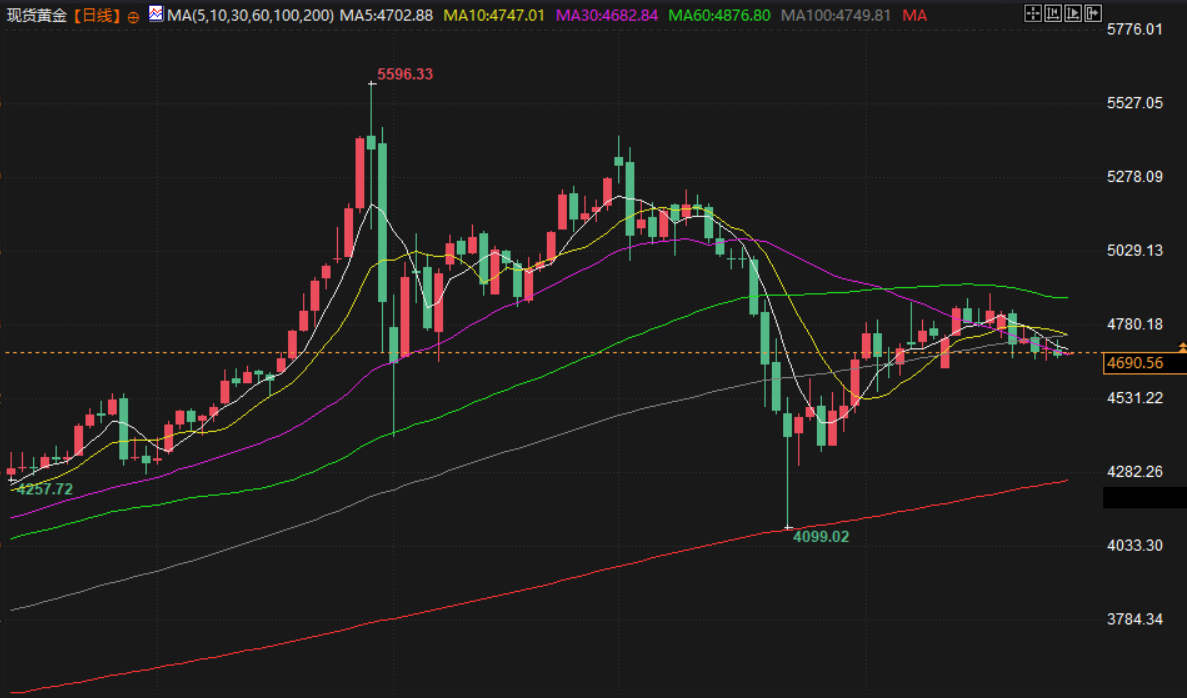
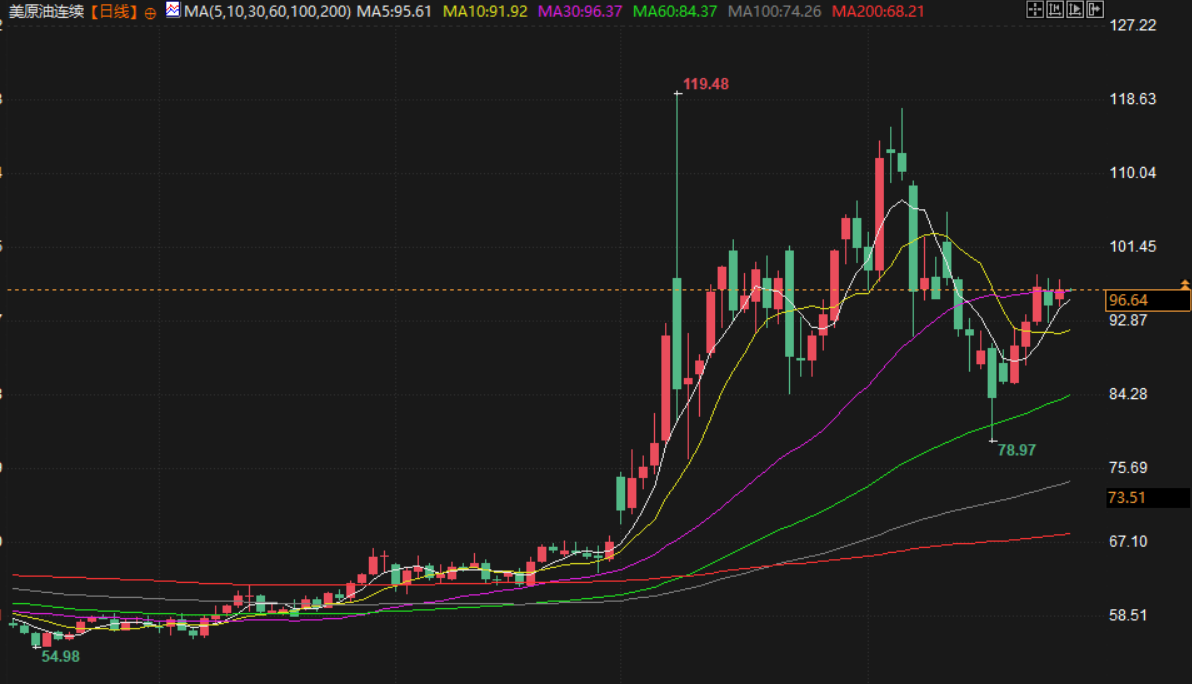
On Tuesday (April 28, Beijing time) in early Asian trading, spot gold was trading around $4,690 per ounce. Gold prices fell slightly on Monday, mainly due to stalled diplomatic progress toward ending the US-Israel war in Iraq, which exacerbated inflation concerns. Meanwhile, the market is focused on this week's meetings of the Federal Reserve and other major central banks to assess the war's economic impact. US crude oil was trading around $96.65 per barrel. Oil prices hit a two-week high on Monday, as the deadlock in US-Iran peace talks and continued restrictions on oil transport through the Strait of Hormuz led to tight global supply.

U.S. stocks, the S&P 500 and Nasdaq, closed slightly higher on Monday in light trading. The Dow Jones Industrial Average fell 0.13%, the S&P 500 rose 0.12%, and the Nasdaq gained 0.20%. Investors were cautious ahead of a busy week, including a plethora of earnings reports, economic data, the Federal Reserve's interest rate decision, and the situation in the Middle East. The market lacked clear direction after last week's surge, but the S&P 500 and Nasdaq still hit a series of record closing highs. The S&P 500 has more than doubled since the start of the current bull market in October 2022.
Earnings season is in full swing, with five of the "Big Seven" tech giants—Amazon, Alphabet, Meta, Apple, and Microsoft—releasing their earnings reports this week. The market is focused on the return on investment in AI. As of last Friday, 139 S&P 500 companies had reported earnings, with 81% exceeding expectations. Analysts predict overall earnings will grow by 16.1% year-over-year.
Trump canceled the US envoy's visit to Pakistan; the US and Iran are still working to restart peace talks; and Iran continues to restrict shipping through the Strait of Hormuz. The Federal Reserve begins a two-day policy meeting on Tuesday, and is expected to keep interest rates unchanged. Markets are focused on its assessment of the economic impact and the effects of soaring energy prices on inflation.
In terms of individual stocks, Verizon Communications rose 1.5% due to better-than-expected new user growth and an upward revision of its annual earnings forecast; Domino's fell 8.8% due to lower-than-expected first-quarter sales; and Nvidia surged 4.0%, with its market capitalization returning to over $5 trillion.
Gold prices fell 0.6% to $4,682.13 an ounce on Monday, with June gold futures settling down 1% at $4,693.70. This was mainly due to stalled diplomatic progress toward ending the US-Israel war in Iran, which kept oil prices high and exacerbated inflation concerns. Meanwhile, the market focused on this week's meetings of the Federal Reserve and other major central banks to assess the economic impact of the war. Although Trump canceled his special envoy's trip and stated that Iran could contact him if it wanted negotiations, Pakistani mediators said efforts to bridge the US-Iran differences had not stopped, and the Strait of Hormuz remained largely closed.
TD Securities analysts pointed out that inflation has reached twice the target, making it difficult for the Federal Reserve to cut interest rates in the coming months, which is bearish for gold. The market is also paying attention to the Fed's policy statement on Wednesday and Powell's stance at his last meeting (as chairman).
Spot silver fell 0.5% to $75.26, platinum fell 1.1% to $1989.13, and palladium fell 1.3% to $1476.58.
Oil prices rose about 3% on Monday, hitting a two-week high: Brent crude futures closed up 2.8% at $108.23 a barrel, marking the sixth consecutive trading day of gains (the first time since March 2025), while WTI crude futures closed up 2.1% at $96.37 a barrel, mainly due to the stalemate in US-Iran peace talks and continued restrictions on oil transport through the Strait of Hormuz, leading to tight global supply.
Analysts point out that the Brent crude premium over WTI crude has widened to double digits, potentially driving U.S. crude exports to a record high. Trump discussed new Iranian proposals with his national security advisor, but the diplomatic deadlock means that 10 to 13 million barrels of crude oil per day cannot enter the market. Only about seven ships passed through the Strait of Hormuz in the past 24 hours, far fewer than the pre-conflict average of 140 ships per day, while six tankers carrying Iranian crude were forced to turn back due to the U.S. blockade. Russian President Putin stated that he would do his utmost to assist Tehran.
The European Central Bank will meet on Thursday, and the ceasefire has eased pressure for an immediate rate hike, but traders expect high oil prices to push up inflation and force the central bank to raise rates later. Goldman Sachs raised its fourth-quarter forecast for Brent crude to $90 and WTI crude to $83. U.S. gasoline futures closed at their highest level since July 2022 for the fourth consecutive trading day, and gasoline crack spreads also rose to their highest level at that time.
The dollar weakened against the euro on Monday, with the dollar index falling 0.18% to 98.45, as investors assessed the impact of the diplomatic deadlock in U.S.-Iran negotiations and prepared for a busy week of central bank meetings—including what is widely expected to be Federal Reserve Chairman Jerome Powell's last interest rate decision meeting.
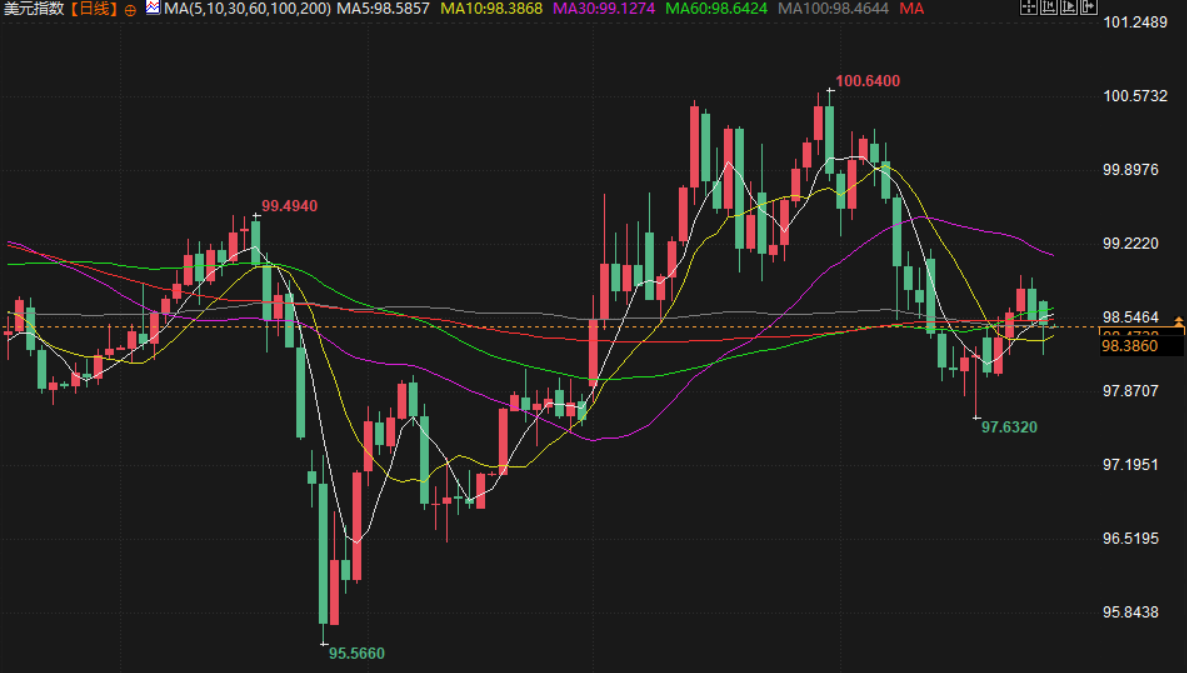
Despite Iran's new proposal to postpone discussions on its nuclear program until after the conflict and the Hormuz shipping dispute are resolved, this strategy is unlikely to satisfy Trump, as he prioritizes nuclear disarmament. Pakistan continues to mediate, but face-to-face talks broke down last week. Markets were optimistic over the weekend about the possibility of a US-Iran meeting, but the talks did not materialize. Iran's new proposal has given the market renewed hope, putting pressure on the dollar.
The Federal Reserve will announce its interest rate decision on Wednesday, with the market widely expecting it to remain unchanged. The nomination of Powell's successor, Warsh, has secured the support of key Republican senators, giving Republicans a majority on the Senate Banking Committee. Warsh has hinted at pushing for Fed reforms and potentially a more aggressive rate-cutting cycle, with market expectations for the magnitude of rate cuts this year doubling. The yield on the 2-year U.S. Treasury note rose 2.6 basis points to 3.802%.
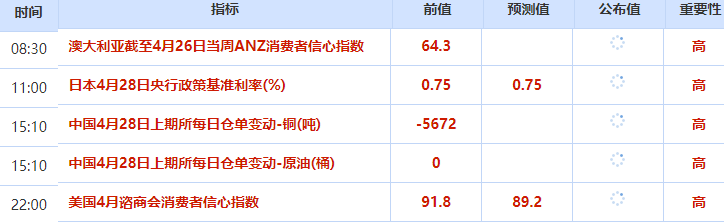
The euro was boosted by the European Central Bank's meeting (which is expected to keep interest rates unchanged), trading at 1.17225 against the dollar, essentially flat. The dollar traded at 159.39 against the yen, hovering below the 160 level, which traders said could trigger intervention from Tokyo if broken. The market expects the Bank of Japan to keep interest rates unchanged on Tuesday but may signal a rate hike in June.
The pound was essentially unchanged at 1.35340 against the dollar, while the Canadian dollar strengthened by 0.42% to 1.363. The Bank of England and the Bank of Canada are also expected to hold rates steady this week, but analysts are watching their comments on the impact on energy and trade. Goldman Sachs analysts noted that although these central banks are not expected to adjust their policies this week, market uncertainty regarding their current response mechanisms remains high.
Mertz: The US lacks a strategic exit plan from the war with Iran.
German Chancellor Merz stated on the 27th that the United States lacks a strategic exit plan regarding the war with Iran. Speaking at an event at a high school in North Rhine-Westphalia, Germany, Merz said he couldn't see what kind of strategic exit plan the US would choose. He noted that Iran had been very sophisticated in negotiations, or rather, very sophisticated in refusing to negotiate, "letting the Americans go to Islamabad and leave empty-handed." Merz pointed out that once a war is started, "a way to exit must be found," and the US clearly lacks a strategy in this regard. He cited the US's actions in the wars in Afghanistan and Iraq as examples. (Xinhua)
Iranian Foreign Ministry: The US seizure of an Iranian oil tanker is a legitimization of "piracy".
On the 27th local time, in response to the earlier admission by US judicial officials that they had ordered the seizure of ships carrying Iranian oil and the confiscation of their cargo, Iranian Foreign Ministry spokesman Baghae stated that the so-called "ordering the seizure and confiscation of ships carrying Iranian oil" is nothing more than formally legitimizing piracy and armed plunder in international waters. He pointed out that the United States must bear full responsibility for this "blatant illegal behavior," which is an unprecedented blow to international law and free trade and threatens the fundamental principles of maritime security. Previously, US Federal Prosecutor Piro stated on his personal social media that, based on a seizure warrant submitted by his office and signed by a US federal magistrate judge, the US military intercepted the oil tankers "Majestic" and "Tiffany" carrying Iranian oil in the Indian Ocean, and stated that it would hold sanctioned parties accountable and deprive them of the ability to profit from illegal maritime activities. (CCTV News)
Germany will run for a non-permanent seat on the UN Security Council.
German Foreign Minister Karl-Heinz Wadfol stated on the 27th, before attending a UN-related meeting in New York, that Germany will participate in the next round of elections for a non-permanent seat on the UN Security Council, aiming to assume the position from 2027. Wadfol stated that under the current circumstances, the Security Council should be urged to effectively fulfill its responsibilities and resolve the Strait of Hormuz issue through diplomatic channels. He pointed out that the security of the relevant waters is crucial to global energy supply and economic stability, and the international community needs to jointly maintain the unimpeded flow of maritime routes. Furthermore, regarding the nuclear issue, Wadfol stated that the Treaty on the Non-Proliferation of Nuclear Weapons should be universally implemented, but this is becoming increasingly difficult. He believes that given the continued existence of the nuclear threat, a credible deterrent capability must be maintained. (CCTV News)
Israeli Prime Minister: Disarming Hezbollah is key to negotiations with Lebanon
On April 27 local time, Israeli Prime Minister Benjamin Netanyahu stated during a meeting with senior Israeli military commanders that Israel has the right to strike Hezbollah targets in Lebanon, and that the Israeli military "has full freedom of action to eliminate current and emerging threats," which is "part of the agreement we have reached with the United States and the Lebanese government." He stated that the Israeli military is continuing military operations in the security zone established in southern Lebanon and north of the Litani River, but "the mission is not yet complete, and I am not naive enough to think it will be easy." He pointed out that "two major threats from Hezbollah remain, including the use of 122mm rockets and drones." He also emphasized that disarming Hezbollah is key to negotiations with Lebanon. (CCTV News)
Russian presidential aide: He does not rule out conveying the views from the Russia-Iran talks to the US.
On the 27th local time, Russian Presidential Aide Ushakov stated after the Russia-Iran talks that Russia would combine signals received from the US and Israel with a comprehensive analysis of the information conveyed by Iranian Foreign Minister Araqchi before deciding on its next course of action. He stated that it did not rule out conveying the opinions formed during the Russia-Iran talks to "across the ocean" (i.e., the United States) and Russia's closest partners. Ushakov revealed that Iran contacted Russia last Friday, with the initial itinerary planned for Araqchi to first fly to Islamabad, then to Doha, and subsequently visit Russia. After the talks, Araqchi would return to Tehran to report on the situation, including the content of his talks with the Russian President. (CCTV News)
White House: Trump's bottom line on Iran remains unchanged.
White House Press Secretary Janet Levitt told reporters that President Trump discussed a new proposal from Iran aimed at resolving the conflict with his senior national security advisors that day. According to the proposal, the Strait of Hormuz would remain open, while the issue of Iran's nuclear program would be discussed at a later date. When answering questions at the press conference, Levitt did not comment specifically on the proposal. However, she stated that Trump's bottom line remains unchanged: Trump demands that the Strait of Hormuz, a vital oil shipping route, remain open and that Iran hand over its enriched uranium. Levitt said, "I wouldn't say they are 'considering' this proposal. I can only say that there was indeed a discussion this morning, and I don't want to preemptively speak before the president makes a formal statement; I'm sure you will hear directly from the president on this topic later."
Report: Trump is skeptical of Iran's proposals regarding the Strait of Hormuz.
According to the Wall Street Journal, U.S. officials revealed that President Trump and his national security team are skeptical of a proposed agreement from Iran. The agreement proposes ensuring the passage of the Strait of Hormuz and suspending nuclear negotiations. Trump consulted with his aides on the Iranian proposal on Monday morning. Officials stated that Trump did not directly reject the proposal, but repeatedly pointed out Iran's lack of negotiating sincerity and unwillingness to meet core U.S. demands: ending uranium enrichment activities and promising never to develop nuclear weapons. Officials said the U.S. will continue negotiations with Iran, and the White House is expected to respond and propose countermeasures in the coming days. (Xinhua)
The gunman at the White House Correspondents' Club dinner is charged with attempted assassination of the president and could face life imprisonment.
Cole Allen, the suspect in the White House Correspondents' Club dinner shooting, made his first court appearance on March 27 in the U.S. District Court for the District of Columbia, where he was formally charged with attempted assassination of President Trump, interstate arms trafficking, and the use of a firearm in a violent crime. Judge Matthew Shabo ordered Allen to be remanded in custody, with a hearing scheduled for March 30 to determine whether to continue his detention. According to U.S. media reports, if convicted, Allen could face life imprisonment for the attempted assassination of the president alone.
The Law on State-Owned Assets of Enterprises, which has been in effect for nearly 17 years, is undergoing its first revision.
The draft revision of the Law on State-Owned Assets of Enterprises was submitted to the 22nd session of the Standing Committee of the 14th National People's Congress for its first review on April 27. The revision adheres to the leadership of the Party, a problem-oriented approach, the principle of coordinating development and security, and the principle of seeking progress while maintaining stability. The draft revises 71 articles and adds 32 new articles, comprising nine chapters and 109 articles, comprehensively revising the existing law. Major revisions include improving the modern enterprise system with Chinese characteristics, improving the management and supervision system for state-owned assets of enterprises, clarifying the principle of classified management, and improving the management system for state-owned capital gains. The Law on State-Owned Assets of Enterprises stipulates the basic system for the management and supervision of state-owned assets of enterprises in my country. Since its implementation on May 1, 2009, it has provided strong legal protection for the reform and development of state-owned assets and enterprises. During the 15th Five-Year Plan period, my country's development environment faces profound and complex changes. Revising and improving the Law on State-Owned Assets of Enterprises, using legislation to guide and guarantee the reform and development of state-owned assets and enterprises, and strengthening the rule of law in the management and supervision of state-owned assets, is of great significance for ensuring the sustained and healthy development of the state-owned economy. (Xinhua News Agency)
The "instant refund upon purchase" tax refund policy for departing tourists has seen rapid growth in both the number of people receiving refunds and the amount of refunds in the first year since its implementation.
To further enhance the convenience of tax refunds for overseas tourists and optimize their consumption experience, my country fully implemented the "instant refund upon purchase" tax refund service nationwide in April 2025. According to the latest news from the State Taxation Administration, this measure has been smoothly implemented for a full year, effectively stimulating inbound consumption. Data from the State Taxation Administration shows that in the year since the implementation of the "instant refund upon purchase" measure, the number of people applying nationwide has increased by 12.96 times year-on-year, and the sales volume and amount of tax refunds have increased by 9.35 times year-on-year, achieving rapid growth in business scale. It is understood that "instant refund upon purchase" means that in regions where the tax refund policy has been implemented, overseas tourists can apply for a refund in RMB equivalent to the tax amount on-site at "instant refund" stores after signing an agreement and pre-authorizing their credit cards when purchasing tax-refundable goods. The government actively encourages eligible tax-refund shops to offer "instant refund upon purchase" services. Currently, over 8,000 tax-refund shops nationwide offer this service, representing an increase of over 100% compared to when the service was first rolled out nationwide a year ago. As the coverage of the "instant refund upon purchase" service continues to expand, more overseas tourists can receive their tax refunds immediately upon shopping, which can then be used for secondary purchases, effectively stimulating consumer demand. (Xinhua News Agency)
Key Focus Today
stock market
U.S. stocks, the S&P 500 and Nasdaq, closed slightly higher on Monday in light trading. The Dow Jones Industrial Average fell 0.13%, the S&P 500 rose 0.12%, and the Nasdaq gained 0.20%. Investors were cautious ahead of a busy week, including a plethora of earnings reports, economic data, the Federal Reserve's interest rate decision, and the situation in the Middle East. The market lacked clear direction after last week's surge, but the S&P 500 and Nasdaq still hit a series of record closing highs. The S&P 500 has more than doubled since the start of the current bull market in October 2022.
Earnings season is in full swing, with five of the "Big Seven" tech giants—Amazon, Alphabet, Meta, Apple, and Microsoft—releasing their earnings reports this week. The market is focused on the return on investment in AI. As of last Friday, 139 S&P 500 companies had reported earnings, with 81% exceeding expectations. Analysts predict overall earnings will grow by 16.1% year-over-year.
Trump canceled the US envoy's visit to Pakistan; the US and Iran are still working to restart peace talks; and Iran continues to restrict shipping through the Strait of Hormuz. The Federal Reserve begins a two-day policy meeting on Tuesday, and is expected to keep interest rates unchanged. Markets are focused on its assessment of the economic impact and the effects of soaring energy prices on inflation.
In terms of individual stocks, Verizon Communications rose 1.5% due to better-than-expected new user growth and an upward revision of its annual earnings forecast; Domino's fell 8.8% due to lower-than-expected first-quarter sales; and Nvidia surged 4.0%, with its market capitalization returning to over $5 trillion.
Gold Market
Gold prices fell 0.6% to $4,682.13 an ounce on Monday, with June gold futures settling down 1% at $4,693.70. This was mainly due to stalled diplomatic progress toward ending the US-Israel war in Iran, which kept oil prices high and exacerbated inflation concerns. Meanwhile, the market focused on this week's meetings of the Federal Reserve and other major central banks to assess the economic impact of the war. Although Trump canceled his special envoy's trip and stated that Iran could contact him if it wanted negotiations, Pakistani mediators said efforts to bridge the US-Iran differences had not stopped, and the Strait of Hormuz remained largely closed.
TD Securities analysts pointed out that inflation has reached twice the target, making it difficult for the Federal Reserve to cut interest rates in the coming months, which is bearish for gold. The market is also paying attention to the Fed's policy statement on Wednesday and Powell's stance at his last meeting (as chairman).
Spot silver fell 0.5% to $75.26, platinum fell 1.1% to $1989.13, and palladium fell 1.3% to $1476.58.
oil market
Oil prices rose about 3% on Monday, hitting a two-week high: Brent crude futures closed up 2.8% at $108.23 a barrel, marking the sixth consecutive trading day of gains (the first time since March 2025), while WTI crude futures closed up 2.1% at $96.37 a barrel, mainly due to the stalemate in US-Iran peace talks and continued restrictions on oil transport through the Strait of Hormuz, leading to tight global supply.
Analysts point out that the Brent crude premium over WTI crude has widened to double digits, potentially driving U.S. crude exports to a record high. Trump discussed new Iranian proposals with his national security advisor, but the diplomatic deadlock means that 10 to 13 million barrels of crude oil per day cannot enter the market. Only about seven ships passed through the Strait of Hormuz in the past 24 hours, far fewer than the pre-conflict average of 140 ships per day, while six tankers carrying Iranian crude were forced to turn back due to the U.S. blockade. Russian President Putin stated that he would do his utmost to assist Tehran.
The European Central Bank will meet on Thursday, and the ceasefire has eased pressure for an immediate rate hike, but traders expect high oil prices to push up inflation and force the central bank to raise rates later. Goldman Sachs raised its fourth-quarter forecast for Brent crude to $90 and WTI crude to $83. U.S. gasoline futures closed at their highest level since July 2022 for the fourth consecutive trading day, and gasoline crack spreads also rose to their highest level at that time.
Foreign exchange market
The dollar weakened against the euro on Monday, with the dollar index falling 0.18% to 98.45, as investors assessed the impact of the diplomatic deadlock in U.S.-Iran negotiations and prepared for a busy week of central bank meetings—including what is widely expected to be Federal Reserve Chairman Jerome Powell's last interest rate decision meeting.
Despite Iran's new proposal to postpone discussions on its nuclear program until after the conflict and the Hormuz shipping dispute are resolved, this strategy is unlikely to satisfy Trump, as he prioritizes nuclear disarmament. Pakistan continues to mediate, but face-to-face talks broke down last week. Markets were optimistic over the weekend about the possibility of a US-Iran meeting, but the talks did not materialize. Iran's new proposal has given the market renewed hope, putting pressure on the dollar.
The Federal Reserve will announce its interest rate decision on Wednesday, with the market widely expecting it to remain unchanged. The nomination of Powell's successor, Warsh, has secured the support of key Republican senators, giving Republicans a majority on the Senate Banking Committee. Warsh has hinted at pushing for Fed reforms and potentially a more aggressive rate-cutting cycle, with market expectations for the magnitude of rate cuts this year doubling. The yield on the 2-year U.S. Treasury note rose 2.6 basis points to 3.802%.
The euro was boosted by the European Central Bank's meeting (which is expected to keep interest rates unchanged), trading at 1.17225 against the dollar, essentially flat. The dollar traded at 159.39 against the yen, hovering below the 160 level, which traders said could trigger intervention from Tokyo if broken. The market expects the Bank of Japan to keep interest rates unchanged on Tuesday but may signal a rate hike in June.
The pound was essentially unchanged at 1.35340 against the dollar, while the Canadian dollar strengthened by 0.42% to 1.363. The Bank of England and the Bank of Canada are also expected to hold rates steady this week, but analysts are watching their comments on the impact on energy and trade. Goldman Sachs analysts noted that although these central banks are not expected to adjust their policies this week, market uncertainty regarding their current response mechanisms remains high.
International News
Mertz: The US lacks a strategic exit plan from the war with Iran.
German Chancellor Merz stated on the 27th that the United States lacks a strategic exit plan regarding the war with Iran. Speaking at an event at a high school in North Rhine-Westphalia, Germany, Merz said he couldn't see what kind of strategic exit plan the US would choose. He noted that Iran had been very sophisticated in negotiations, or rather, very sophisticated in refusing to negotiate, "letting the Americans go to Islamabad and leave empty-handed." Merz pointed out that once a war is started, "a way to exit must be found," and the US clearly lacks a strategy in this regard. He cited the US's actions in the wars in Afghanistan and Iraq as examples. (Xinhua)
Iranian Foreign Ministry: The US seizure of an Iranian oil tanker is a legitimization of "piracy".
On the 27th local time, in response to the earlier admission by US judicial officials that they had ordered the seizure of ships carrying Iranian oil and the confiscation of their cargo, Iranian Foreign Ministry spokesman Baghae stated that the so-called "ordering the seizure and confiscation of ships carrying Iranian oil" is nothing more than formally legitimizing piracy and armed plunder in international waters. He pointed out that the United States must bear full responsibility for this "blatant illegal behavior," which is an unprecedented blow to international law and free trade and threatens the fundamental principles of maritime security. Previously, US Federal Prosecutor Piro stated on his personal social media that, based on a seizure warrant submitted by his office and signed by a US federal magistrate judge, the US military intercepted the oil tankers "Majestic" and "Tiffany" carrying Iranian oil in the Indian Ocean, and stated that it would hold sanctioned parties accountable and deprive them of the ability to profit from illegal maritime activities. (CCTV News)
Germany will run for a non-permanent seat on the UN Security Council.
German Foreign Minister Karl-Heinz Wadfol stated on the 27th, before attending a UN-related meeting in New York, that Germany will participate in the next round of elections for a non-permanent seat on the UN Security Council, aiming to assume the position from 2027. Wadfol stated that under the current circumstances, the Security Council should be urged to effectively fulfill its responsibilities and resolve the Strait of Hormuz issue through diplomatic channels. He pointed out that the security of the relevant waters is crucial to global energy supply and economic stability, and the international community needs to jointly maintain the unimpeded flow of maritime routes. Furthermore, regarding the nuclear issue, Wadfol stated that the Treaty on the Non-Proliferation of Nuclear Weapons should be universally implemented, but this is becoming increasingly difficult. He believes that given the continued existence of the nuclear threat, a credible deterrent capability must be maintained. (CCTV News)
Israeli Prime Minister: Disarming Hezbollah is key to negotiations with Lebanon
On April 27 local time, Israeli Prime Minister Benjamin Netanyahu stated during a meeting with senior Israeli military commanders that Israel has the right to strike Hezbollah targets in Lebanon, and that the Israeli military "has full freedom of action to eliminate current and emerging threats," which is "part of the agreement we have reached with the United States and the Lebanese government." He stated that the Israeli military is continuing military operations in the security zone established in southern Lebanon and north of the Litani River, but "the mission is not yet complete, and I am not naive enough to think it will be easy." He pointed out that "two major threats from Hezbollah remain, including the use of 122mm rockets and drones." He also emphasized that disarming Hezbollah is key to negotiations with Lebanon. (CCTV News)
Russian presidential aide: He does not rule out conveying the views from the Russia-Iran talks to the US.
On the 27th local time, Russian Presidential Aide Ushakov stated after the Russia-Iran talks that Russia would combine signals received from the US and Israel with a comprehensive analysis of the information conveyed by Iranian Foreign Minister Araqchi before deciding on its next course of action. He stated that it did not rule out conveying the opinions formed during the Russia-Iran talks to "across the ocean" (i.e., the United States) and Russia's closest partners. Ushakov revealed that Iran contacted Russia last Friday, with the initial itinerary planned for Araqchi to first fly to Islamabad, then to Doha, and subsequently visit Russia. After the talks, Araqchi would return to Tehran to report on the situation, including the content of his talks with the Russian President. (CCTV News)
White House: Trump's bottom line on Iran remains unchanged.
White House Press Secretary Janet Levitt told reporters that President Trump discussed a new proposal from Iran aimed at resolving the conflict with his senior national security advisors that day. According to the proposal, the Strait of Hormuz would remain open, while the issue of Iran's nuclear program would be discussed at a later date. When answering questions at the press conference, Levitt did not comment specifically on the proposal. However, she stated that Trump's bottom line remains unchanged: Trump demands that the Strait of Hormuz, a vital oil shipping route, remain open and that Iran hand over its enriched uranium. Levitt said, "I wouldn't say they are 'considering' this proposal. I can only say that there was indeed a discussion this morning, and I don't want to preemptively speak before the president makes a formal statement; I'm sure you will hear directly from the president on this topic later."
Report: Trump is skeptical of Iran's proposals regarding the Strait of Hormuz.
According to the Wall Street Journal, U.S. officials revealed that President Trump and his national security team are skeptical of a proposed agreement from Iran. The agreement proposes ensuring the passage of the Strait of Hormuz and suspending nuclear negotiations. Trump consulted with his aides on the Iranian proposal on Monday morning. Officials stated that Trump did not directly reject the proposal, but repeatedly pointed out Iran's lack of negotiating sincerity and unwillingness to meet core U.S. demands: ending uranium enrichment activities and promising never to develop nuclear weapons. Officials said the U.S. will continue negotiations with Iran, and the White House is expected to respond and propose countermeasures in the coming days. (Xinhua)
The gunman at the White House Correspondents' Club dinner is charged with attempted assassination of the president and could face life imprisonment.
Cole Allen, the suspect in the White House Correspondents' Club dinner shooting, made his first court appearance on March 27 in the U.S. District Court for the District of Columbia, where he was formally charged with attempted assassination of President Trump, interstate arms trafficking, and the use of a firearm in a violent crime. Judge Matthew Shabo ordered Allen to be remanded in custody, with a hearing scheduled for March 30 to determine whether to continue his detention. According to U.S. media reports, if convicted, Allen could face life imprisonment for the attempted assassination of the president alone.
Domestic News
The Law on State-Owned Assets of Enterprises, which has been in effect for nearly 17 years, is undergoing its first revision.
The draft revision of the Law on State-Owned Assets of Enterprises was submitted to the 22nd session of the Standing Committee of the 14th National People's Congress for its first review on April 27. The revision adheres to the leadership of the Party, a problem-oriented approach, the principle of coordinating development and security, and the principle of seeking progress while maintaining stability. The draft revises 71 articles and adds 32 new articles, comprising nine chapters and 109 articles, comprehensively revising the existing law. Major revisions include improving the modern enterprise system with Chinese characteristics, improving the management and supervision system for state-owned assets of enterprises, clarifying the principle of classified management, and improving the management system for state-owned capital gains. The Law on State-Owned Assets of Enterprises stipulates the basic system for the management and supervision of state-owned assets of enterprises in my country. Since its implementation on May 1, 2009, it has provided strong legal protection for the reform and development of state-owned assets and enterprises. During the 15th Five-Year Plan period, my country's development environment faces profound and complex changes. Revising and improving the Law on State-Owned Assets of Enterprises, using legislation to guide and guarantee the reform and development of state-owned assets and enterprises, and strengthening the rule of law in the management and supervision of state-owned assets, is of great significance for ensuring the sustained and healthy development of the state-owned economy. (Xinhua News Agency)
The "instant refund upon purchase" tax refund policy for departing tourists has seen rapid growth in both the number of people receiving refunds and the amount of refunds in the first year since its implementation.
To further enhance the convenience of tax refunds for overseas tourists and optimize their consumption experience, my country fully implemented the "instant refund upon purchase" tax refund service nationwide in April 2025. According to the latest news from the State Taxation Administration, this measure has been smoothly implemented for a full year, effectively stimulating inbound consumption. Data from the State Taxation Administration shows that in the year since the implementation of the "instant refund upon purchase" measure, the number of people applying nationwide has increased by 12.96 times year-on-year, and the sales volume and amount of tax refunds have increased by 9.35 times year-on-year, achieving rapid growth in business scale. It is understood that "instant refund upon purchase" means that in regions where the tax refund policy has been implemented, overseas tourists can apply for a refund in RMB equivalent to the tax amount on-site at "instant refund" stores after signing an agreement and pre-authorizing their credit cards when purchasing tax-refundable goods. The government actively encourages eligible tax-refund shops to offer "instant refund upon purchase" services. Currently, over 8,000 tax-refund shops nationwide offer this service, representing an increase of over 100% compared to when the service was first rolled out nationwide a year ago. As the coverage of the "instant refund upon purchase" service continues to expand, more overseas tourists can receive their tax refunds immediately upon shopping, which can then be used for secondary purchases, effectively stimulating consumer demand. (Xinhua News Agency)
- Risk Warning and Disclaimer
- The market involves risk, and trading may not be suitable for all investors. This article is for reference only and does not constitute personal investment advice, nor does it take into account certain users’ specific investment objectives, financial situation, or other needs. Any investment decisions made based on this information are at your own risk.