Gold prices remained range-bound ahead of the Fed's interest rate decision, coupled with uncertainty surrounding the Middle East situation.
2026-04-28 10:12:46
Gold prices came under pressure during Tuesday's Asian trading session, falling back to around $4,685 , as market sentiment became more cautious. The core factors currently influencing gold prices are concentrated on two main themes: firstly, the policy uncertainty arising from the upcoming Federal Reserve interest rate decision; and secondly, the marginal impact of changes in the Middle East situation on safe-haven demand. Ahead of key events, investors generally chose to wait and see, leading to increased short-term volatility in gold prices with an unclear direction.

From a macroeconomic perspective, the upcoming Federal Reserve interest rate decision is the focus of market attention. The market widely expects the Federal Open Market Committee (FOMC) to maintain interest rates within the 3.50%–3.75% range, a level that has remained stable since the end of last year. However, the key factor truly influencing market trends lies in the post-meeting statements, especially Fed Chairman Powell's press conference. A hawkish signal, such as emphasizing sticky inflation or not ruling out future rate hikes, would significantly boost the dollar, thus putting downward pressure on dollar-denominated gold.
Meanwhile, the market is also focused on the uncertainty surrounding potential personnel changes within the Federal Reserve. Market surveys indicate that if new policymakers take over subsequent meetings ahead of schedule, it could subtly influence the path of monetary policy, and this uncertainty has, to some extent, increased market caution.
In terms of geopolitics, tensions in the Middle East remain a significant variable. Friction between the US and Iran has not eased, and the closure of the Strait of Hormuz continues to disrupt global energy markets, keeping crude oil prices high. Inflationary pressures from rising energy prices have further delayed market expectations for a Federal Reserve interest rate cut, logically weakening the appeal of gold. Although gold is generally considered a safe-haven asset, in a high-interest-rate environment, its "non-yielding" characteristic is amplified, thus reducing the willingness to allocate funds to it.
However, some signs of easing have emerged in the situation. Market research indicates that the US is assessing Iran's proposal, which includes restoring passage through the Strait of Hormuz and postponing nuclear negotiations. Although the proposal has not yet received a clear response, it itself releases potential diplomatic space, reducing market concerns about further escalation of the conflict. This "decreasing risk margin" has led some safe-haven funds to temporarily leave the market, putting short-term pressure on gold.
From a market perspective, the current gold price movement exhibits a typical tug-of-war between bulls and bears. On one hand, geopolitical risks and inflation expectations provide support for gold prices; on the other hand, persistently high interest rates and a potential strengthening of the US dollar exert downward pressure. Globally, funds are repeatedly shifting between safe-haven assets and yield-generating assets, leading to increased volatility in gold prices but without a clear trend.
From a sentiment perspective, investors are currently in a clear "waiting for a driving factor" phase. Once the Federal Reserve's policy signals or the situation in the Middle East become clear, the market could quickly break out of its current consolidation pattern. In the short term, gold prices are more likely to remain range-bound rather than trend in one direction.
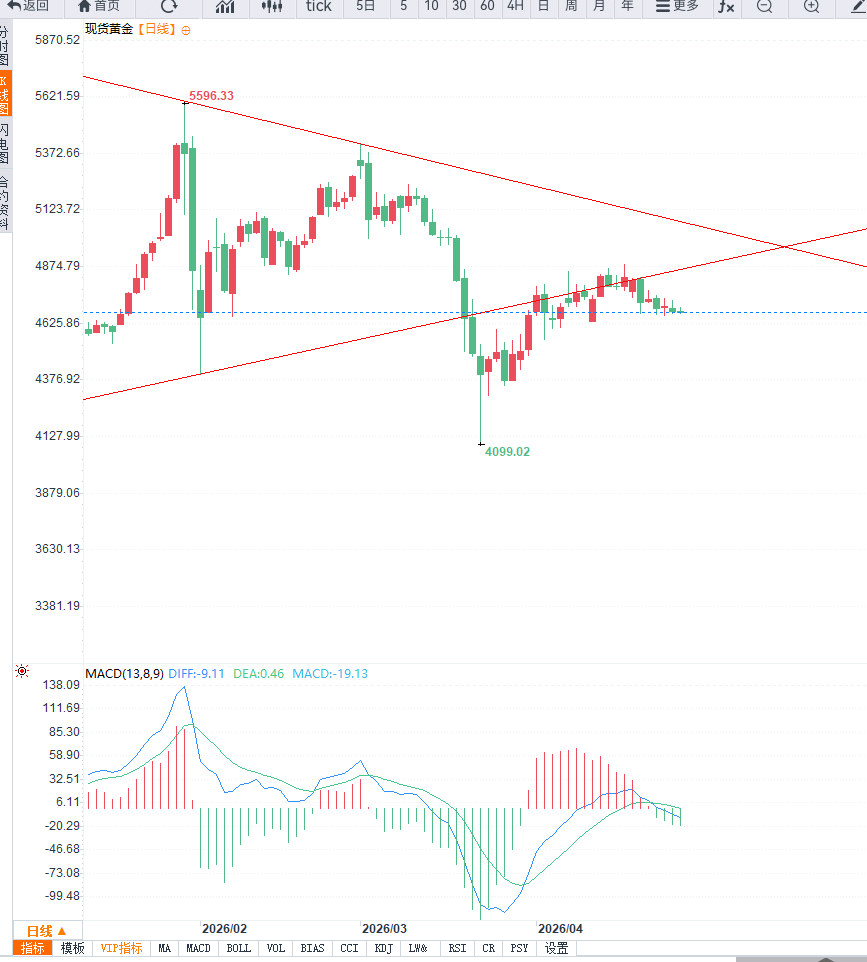
From a technical perspective, gold's daily chart structure remains in a high-level consolidation pattern. While the overall trend hasn't completely turned bearish, upward momentum has clearly weakened. Key resistance is concentrated around $4750 , an area that has repeatedly acted as resistance, indicating heavy selling pressure. Support lies at the $4600 level ; a break below this level could trigger further pullbacks. Momentum indicators show that bullish strength is gradually weakening, and prices have entered a consolidation phase. On the 4-hour chart, the short-term trend is biased towards a downward consolidation, with prices trading within a descending channel. The RSI indicator is gradually falling back to the neutral zone, indicating cautious market sentiment. A break below $4600 support could test lower levels; conversely, a retest of $4750 could potentially resume the upward trend.
Editor's Summary : Overall, the gold market is currently at a critical turning point. On the one hand, the uncertainty surrounding the Federal Reserve's policy path determines the medium-term interest rate environment, directly impacting gold valuations; on the other hand, the situation in the Middle East continues to provide potential safe-haven support. In the short term, interest rate expectations remain the dominant factor, and gold may continue to experience downward pressure and volatility. However, if geopolitical risks escalate again or inflation expectations rise further, gold prices still have the potential to strengthen again. Given the interplay of multiple variables, future volatility in the gold market may increase significantly, and investors need to pay close attention to policy signals and changes in risk events.
From a macroeconomic perspective, the upcoming Federal Reserve interest rate decision is the focus of market attention. The market widely expects the Federal Open Market Committee (FOMC) to maintain interest rates within the 3.50%–3.75% range, a level that has remained stable since the end of last year. However, the key factor truly influencing market trends lies in the post-meeting statements, especially Fed Chairman Powell's press conference. A hawkish signal, such as emphasizing sticky inflation or not ruling out future rate hikes, would significantly boost the dollar, thus putting downward pressure on dollar-denominated gold.
Meanwhile, the market is also focused on the uncertainty surrounding potential personnel changes within the Federal Reserve. Market surveys indicate that if new policymakers take over subsequent meetings ahead of schedule, it could subtly influence the path of monetary policy, and this uncertainty has, to some extent, increased market caution.
In terms of geopolitics, tensions in the Middle East remain a significant variable. Friction between the US and Iran has not eased, and the closure of the Strait of Hormuz continues to disrupt global energy markets, keeping crude oil prices high. Inflationary pressures from rising energy prices have further delayed market expectations for a Federal Reserve interest rate cut, logically weakening the appeal of gold. Although gold is generally considered a safe-haven asset, in a high-interest-rate environment, its "non-yielding" characteristic is amplified, thus reducing the willingness to allocate funds to it.
However, some signs of easing have emerged in the situation. Market research indicates that the US is assessing Iran's proposal, which includes restoring passage through the Strait of Hormuz and postponing nuclear negotiations. Although the proposal has not yet received a clear response, it itself releases potential diplomatic space, reducing market concerns about further escalation of the conflict. This "decreasing risk margin" has led some safe-haven funds to temporarily leave the market, putting short-term pressure on gold.
From a market perspective, the current gold price movement exhibits a typical tug-of-war between bulls and bears. On one hand, geopolitical risks and inflation expectations provide support for gold prices; on the other hand, persistently high interest rates and a potential strengthening of the US dollar exert downward pressure. Globally, funds are repeatedly shifting between safe-haven assets and yield-generating assets, leading to increased volatility in gold prices but without a clear trend.
From a sentiment perspective, investors are currently in a clear "waiting for a driving factor" phase. Once the Federal Reserve's policy signals or the situation in the Middle East become clear, the market could quickly break out of its current consolidation pattern. In the short term, gold prices are more likely to remain range-bound rather than trend in one direction.
From a technical perspective, gold's daily chart structure remains in a high-level consolidation pattern. While the overall trend hasn't completely turned bearish, upward momentum has clearly weakened. Key resistance is concentrated around $4750 , an area that has repeatedly acted as resistance, indicating heavy selling pressure. Support lies at the $4600 level ; a break below this level could trigger further pullbacks. Momentum indicators show that bullish strength is gradually weakening, and prices have entered a consolidation phase. On the 4-hour chart, the short-term trend is biased towards a downward consolidation, with prices trading within a descending channel. The RSI indicator is gradually falling back to the neutral zone, indicating cautious market sentiment. A break below $4600 support could test lower levels; conversely, a retest of $4750 could potentially resume the upward trend.
Editor's Summary : Overall, the gold market is currently at a critical turning point. On the one hand, the uncertainty surrounding the Federal Reserve's policy path determines the medium-term interest rate environment, directly impacting gold valuations; on the other hand, the situation in the Middle East continues to provide potential safe-haven support. In the short term, interest rate expectations remain the dominant factor, and gold may continue to experience downward pressure and volatility. However, if geopolitical risks escalate again or inflation expectations rise further, gold prices still have the potential to strengthen again. Given the interplay of multiple variables, future volatility in the gold market may increase significantly, and investors need to pay close attention to policy signals and changes in risk events.
- Risk Warning and Disclaimer
- The market involves risk, and trading may not be suitable for all investors. This article is for reference only and does not constitute personal investment advice, nor does it take into account certain users’ specific investment objectives, financial situation, or other needs. Any investment decisions made based on this information are at your own risk.