Uncertainty surrounding the Bank of England's policy, coupled with a stronger dollar, pushed the pound down to the 1.35 level, putting downward pressure on its price.
2026-04-28 16:56:00
The pound weakened against the dollar during Tuesday's European trading session, trading around 1.3500 , down about 0.2% on the day. Overall, the pound was relatively weaker than other major currencies, indicating a cautious market sentiment, mainly due to uncertainty surrounding the upcoming Bank of England interest rate decision.
The market widely expects the Bank of England to keep interest rates unchanged at its meeting this week, with the benchmark rate expected to remain at 3.75% , and a vote likely to be 8 to 1. This expectation is primarily based on recent changes in inflation data. Data shows that core inflation in the UK fell in March, indicating that previous price pressures have eased. However, despite the cooling inflation, the overall level remains above the central bank's target range, making policymakers cautious about adjusting interest rates.
It is worth noting that the global energy market still poses a potential threat to inflation. The ongoing situation in the Middle East continues to impact energy supply, and the supply risks posed by the prolonged closure of the Strait of Hormuz are keeping oil prices high, thus increasing imported inflationary pressures. This means that even if domestic inflation in the UK subsides somewhat, external factors may still limit the central bank's ability to quickly shift to an easing policy.
Bank of England Governor Andrew Bailey stated at an International Monetary Fund event that the current policy environment is highly uncertain, therefore there is no need to rush to adjust monetary policy. He pointed out that the economy faces "significant negative shocks," but the transmission path and duration remain unclear. This statement reinforced market expectations that the Bank of England will maintain a wait-and-see stance in the short term, and also weakened the attractiveness of the pound to some extent.
Meanwhile, the dollar's performance has exerted significant downward pressure on the pound. The dollar index is currently hovering around 98.65 , showing a slight increase. Although the market expects the Federal Reserve to keep interest rates unchanged for the third consecutive time at its meeting this week, with the rate range expected to remain between 3.50% and 3.75% , the dollar still possesses some safe-haven appeal in the context of global uncertainty. Furthermore, investors are closely watching Federal Reserve Chairman Jerome Powell's speech for clues about the future policy path.
From a market structure perspective, the current performance of the pound sterling is mainly influenced by a combination of factors: domestic policy uncertainty and a strong external dollar. On the one hand, the Bank of England lacks clear signals of a policy shift; on the other hand, the dollar remains relatively strong due to safe-haven demand, making it difficult for the pound to stage an effective rebound.
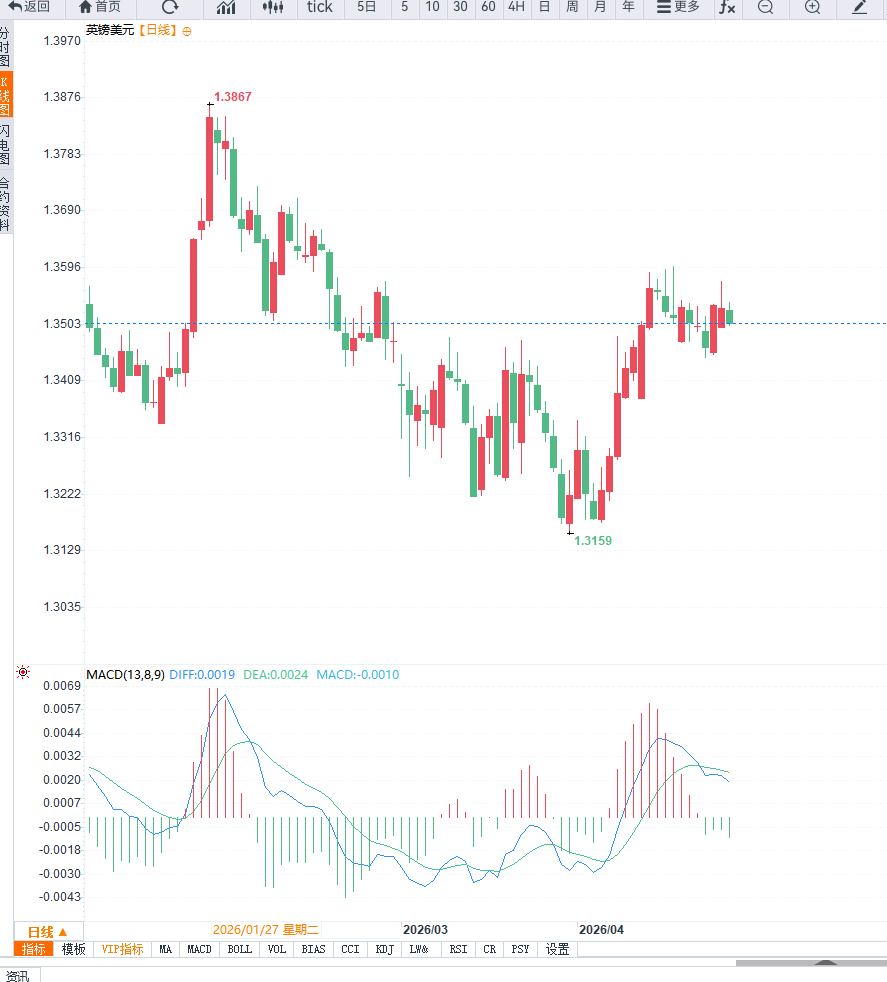
From a technical perspective, the daily chart shows that GBP/USD has recently retreated from its highs, with an overall trend towards a weak and volatile movement. The price is gradually approaching a key support area, indicating some downward pressure in the market. The current important support level is around 1.3450 ; a break below this level could trigger further pullback. Resistance is located at the 1.3600 level , which is a significant obstacle to any short-term rebound.
From the 4-hour chart, the short-term trend shows a downward consolidation pattern, with the moving average system slightly diverging downwards, indicating that the bears have a slight advantage. In terms of momentum indicators, the Relative Strength Index (RSI) is in the lower neutral zone, indicating insufficient market momentum; the MACD indicator is close to the zero line but slightly negative, indicating that the bearish force is still continuing. Without new positive drivers, the pound may continue its weak and volatile trend.
Editor's Summary:
The pound market is currently in a critical policy window, with the Bank of England's interest rate decision being the core driver of short-term movements. Although inflation has eased somewhat, high energy prices and external uncertainties limit policy flexibility, leading the central bank to maintain a cautious stance. Meanwhile, the US dollar remains strong due to safe-haven demand, putting downward pressure on the pound. Future movements will depend on the Bank of England's policy signals and changes in the Federal Reserve's stance; the pound is likely to maintain a weak and volatile pattern in the short term.
The market widely expects the Bank of England to keep interest rates unchanged at its meeting this week, with the benchmark rate expected to remain at 3.75% , and a vote likely to be 8 to 1. This expectation is primarily based on recent changes in inflation data. Data shows that core inflation in the UK fell in March, indicating that previous price pressures have eased. However, despite the cooling inflation, the overall level remains above the central bank's target range, making policymakers cautious about adjusting interest rates.
It is worth noting that the global energy market still poses a potential threat to inflation. The ongoing situation in the Middle East continues to impact energy supply, and the supply risks posed by the prolonged closure of the Strait of Hormuz are keeping oil prices high, thus increasing imported inflationary pressures. This means that even if domestic inflation in the UK subsides somewhat, external factors may still limit the central bank's ability to quickly shift to an easing policy.
Bank of England Governor Andrew Bailey stated at an International Monetary Fund event that the current policy environment is highly uncertain, therefore there is no need to rush to adjust monetary policy. He pointed out that the economy faces "significant negative shocks," but the transmission path and duration remain unclear. This statement reinforced market expectations that the Bank of England will maintain a wait-and-see stance in the short term, and also weakened the attractiveness of the pound to some extent.
Meanwhile, the dollar's performance has exerted significant downward pressure on the pound. The dollar index is currently hovering around 98.65 , showing a slight increase. Although the market expects the Federal Reserve to keep interest rates unchanged for the third consecutive time at its meeting this week, with the rate range expected to remain between 3.50% and 3.75% , the dollar still possesses some safe-haven appeal in the context of global uncertainty. Furthermore, investors are closely watching Federal Reserve Chairman Jerome Powell's speech for clues about the future policy path.
From a market structure perspective, the current performance of the pound sterling is mainly influenced by a combination of factors: domestic policy uncertainty and a strong external dollar. On the one hand, the Bank of England lacks clear signals of a policy shift; on the other hand, the dollar remains relatively strong due to safe-haven demand, making it difficult for the pound to stage an effective rebound.
From a technical perspective, the daily chart shows that GBP/USD has recently retreated from its highs, with an overall trend towards a weak and volatile movement. The price is gradually approaching a key support area, indicating some downward pressure in the market. The current important support level is around 1.3450 ; a break below this level could trigger further pullback. Resistance is located at the 1.3600 level , which is a significant obstacle to any short-term rebound.
From the 4-hour chart, the short-term trend shows a downward consolidation pattern, with the moving average system slightly diverging downwards, indicating that the bears have a slight advantage. In terms of momentum indicators, the Relative Strength Index (RSI) is in the lower neutral zone, indicating insufficient market momentum; the MACD indicator is close to the zero line but slightly negative, indicating that the bearish force is still continuing. Without new positive drivers, the pound may continue its weak and volatile trend.
Editor's Summary:
The pound market is currently in a critical policy window, with the Bank of England's interest rate decision being the core driver of short-term movements. Although inflation has eased somewhat, high energy prices and external uncertainties limit policy flexibility, leading the central bank to maintain a cautious stance. Meanwhile, the US dollar remains strong due to safe-haven demand, putting downward pressure on the pound. Future movements will depend on the Bank of England's policy signals and changes in the Federal Reserve's stance; the pound is likely to maintain a weak and volatile pattern in the short term.
- Risk Warning and Disclaimer
- The market involves risk, and trading may not be suitable for all investors. This article is for reference only and does not constitute personal investment advice, nor does it take into account certain users’ specific investment objectives, financial situation, or other needs. Any investment decisions made based on this information are at your own risk.