Why does Dalio still recommend investors allocate to gold after gold prices plummeted nearly 11% in a single month?
2026-04-28 18:13:02
Gold prices continued to decline during the Asian and European sessions on Tuesday (April 28), and are currently trading around 4600.
The geopolitical conflict between the US and Iran has entered its ninth week, with the situation exhibiting a complex characteristic of "a hard standoff coexisting with glimmers of peace."
Aladdin Borujdi, a member of the Iranian parliament's National Security and Foreign Policy Committee, confirmed that the Central Bank of Iran has opened a special account covering four currencies: rial, yuan, US dollar, and euro, specifically to receive transit fees for ships passing through the Strait of Hormuz, which will be collected by the Islamic Revolutionary Guard Corps Navy.
This move underscores Iran's demand for dominance over key energy routes and further exacerbates geopolitical risk premiums.
Meanwhile, Henry S. Ensher, a former senior U.S. State Department official, revealed that the ceasefire proposal put forward by Iran may be accepted by the Trump administration to mitigate the impact of the conflict on the global economy, creating a two-way tug-of-war between "tough action" and "expectations of peace".
The core contradiction: Inflation stickiness restricts the Fed's room for easing. The core contradiction in the current gold market lies in the suppression of gold prices by the "inflation-interest rate" transmission chain triggered by rising oil prices.
Suzhou Commercial Bank points out that gold prices are highly negatively correlated with expectations of a Fed rate cut, while soaring oil prices have deepened inflation stickiness, severely restricting the Fed's room for easing, causing market trading logic to quickly shift from "betting on rate cuts" to "pricing high interest rate risks".
Rising real interest rates have increased the cost of holding gold, and coupled with a surge in global dollar demand driven by dollar settlements in oil trade, the dollar's appeal as a safe-haven asset has strengthened, further suppressing gold prices denominated in dollars.
Brian Lundin, editor-in-chief of Gold Bulletin, pointed out that as expectations for Middle East peace cool, a surge in oil prices will force the Federal Reserve to maintain high interest rates, triggering a collective sell-off in risk assets—the S&P 500 index plunged 5.1% in March, the S&P 500 Metals & Mining sector index fell 13%, and gold followed the equity market downwards, with a monthly decline of nearly 11% in March, marking the largest monthly pullback in nearly 13 years, and a 17.5% drop from the historical intraday high of $5,593 on January 29.
This logic has been validated by market data: although gold still maintains a positive return of 8.1% this year, the pace of the rise has slowed significantly compared to last year's one-sided bull market of over 60%, and the rebound is noticeably weaker.
The latest survey shows that due to the energy shock caused by the war, the Federal Reserve may delay cutting interest rates for up to six months this year, and the tight interest rate signals continue to adjust market expectations for easing.
Michael Ambrook, co-founder of futures firm Altavist, also admitted that in the short term, gold is dominated by its financial attributes, and the dual pressures of inflation and interest rates will continue to constrain its performance.
Central banks are selling gold to secure liquidity, highlighting gold's status as a hard currency. The widening dollar liquidity gap in the Middle East has become the core background for recent central bank gold transactions.
Data from the World Gold Council shows that central banks in several countries, including Turkey and Russia, began reducing their gold holdings in February, selling gold to obtain dollar liquidity in order to stabilize their currencies.
This action not only did not weaken the asset value of gold, but also confirmed its monetary attribute as the "ultimate hard currency"—in times of crisis when the supply of US dollars is tight, gold can directly serve as a means of cross-border payments and reserve adjustment, perfectly matching the judgment of Bridgewater Associates founder Ray Dalio: "The world is changing rapidly, and more and more transactions are moving away from the dollar system, and gold has become an important safe-haven currency."
Dalio strongly supports gold allocation, stating that the logic of central banks increasing their holdings in the long term remains unchanged. Dalio further suggests that as the US-Iran war continues, investors should allocate 5%-15% of their portfolios to gold, emphasizing that "gold is also a form of currency" and is a core asset for diversified portfolios.
In the long term, the core logic behind central bank gold purchases remains unchanged: although global central bank gold purchases will fall below the level of thousands of tons in the previous three years in 2025, the World Gold Council still defines its demand as "resilient".
According to Lun Ding, editor-in-chief of Gold Communications, official gold purchases have shifted from being a "proactive driver" of market trends to a "bottom protection cushion" for prices. The long-term direction of increasing holdings remains unchanged, but the pace of purchases has naturally slowed down when gold prices are at historical highs.
Against the backdrop of a loosening petrodollar system (as Dongwu Securities points out, the Middle Eastern version of the petrodollar system has essentially disintegrated), the value of gold as a non-credit currency will continue to stand out, becoming a key asset for central banks to hedge against the weakening of the dollar's hegemony.
Despite short-term pressure, the long-term investment value of gold is becoming increasingly apparent as positive factors accumulate.
Many experts predict that if the US and Iran reach a ceasefire agreement, the core factors currently suppressing gold prices will gradually reverse: First, geopolitical easing will effectively suppress oil price increases, alleviate global inflationary pressures, weaken the Federal Reserve's need to maintain high interest rates, and the renewed expectation of interest rate cuts will directly benefit gold.
Secondly, with the decline in oil prices and the easing of dollar liquidity tensions, global central banks' demand for gold allocation is expected to return, providing underlying support for gold prices.
Finally, the cracks in the petrodollar system (declining US dependence on Middle Eastern oil and the trend of diversified settlements) will continue to weaken the dollar's hegemony and push the global monetary system toward multipolarity. Gold, as a non-fiat currency, will become the core beneficiary asset in this process.
Stefan Gleeson, CEO of the Currency Metals Exchange, emphasized that the current gold price correction has not changed the core logic: the economic growth pressure brought about by high oil prices and the expectation of monetary easing under the US fiscal deficit of trillions of dollars will continue to provide long-term support for gold bulls.
Lundin likened the current state of gold to a "racehorse poised to start," believing that the US-Iran peace agreement would be a key signal for the restart of the bull market. At that time, the three major factors of interest rate cut expectations, central bank allocation, and a weakening dollar would resonate, and gold is expected to break free from short-term pressure and restart a new round of upward trend.
As mentioned in previous articles, the technical level of 4705 has been broken, and a trend of "all the bad news has been priced in" is expected in the near future. The current support level has moved down to the lower rail of the channel, followed by the area around 4500.
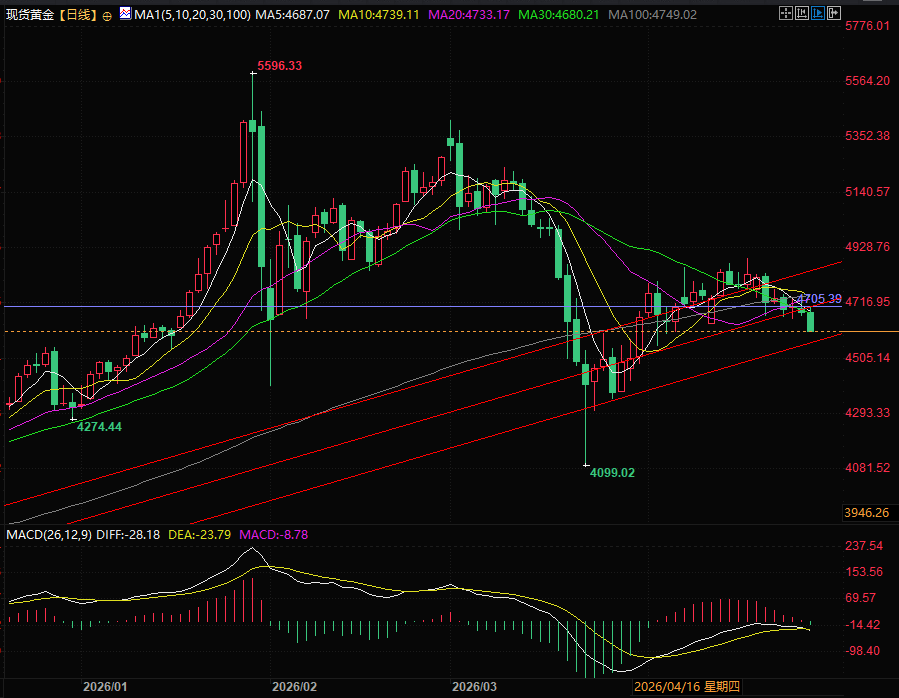
(Spot gold daily chart, source: EasyForex subsidiary)
At 18:10 Beijing time, spot gold was trading at $4,609 per ounce.
The geopolitical conflict between the US and Iran has entered its ninth week, with the situation exhibiting a complex characteristic of "a hard standoff coexisting with glimmers of peace."
Aladdin Borujdi, a member of the Iranian parliament's National Security and Foreign Policy Committee, confirmed that the Central Bank of Iran has opened a special account covering four currencies: rial, yuan, US dollar, and euro, specifically to receive transit fees for ships passing through the Strait of Hormuz, which will be collected by the Islamic Revolutionary Guard Corps Navy.
This move underscores Iran's demand for dominance over key energy routes and further exacerbates geopolitical risk premiums.
Meanwhile, Henry S. Ensher, a former senior U.S. State Department official, revealed that the ceasefire proposal put forward by Iran may be accepted by the Trump administration to mitigate the impact of the conflict on the global economy, creating a two-way tug-of-war between "tough action" and "expectations of peace".
Inflation and interest rate convergence: the core contradiction suppressing gold prices in the short term.
The core contradiction: Inflation stickiness restricts the Fed's room for easing. The core contradiction in the current gold market lies in the suppression of gold prices by the "inflation-interest rate" transmission chain triggered by rising oil prices.
Suzhou Commercial Bank points out that gold prices are highly negatively correlated with expectations of a Fed rate cut, while soaring oil prices have deepened inflation stickiness, severely restricting the Fed's room for easing, causing market trading logic to quickly shift from "betting on rate cuts" to "pricing high interest rate risks".
Rising real interest rates have increased the cost of holding gold, and coupled with a surge in global dollar demand driven by dollar settlements in oil trade, the dollar's appeal as a safe-haven asset has strengthened, further suppressing gold prices denominated in dollars.
Brian Lundin, editor-in-chief of Gold Bulletin, pointed out that as expectations for Middle East peace cool, a surge in oil prices will force the Federal Reserve to maintain high interest rates, triggering a collective sell-off in risk assets—the S&P 500 index plunged 5.1% in March, the S&P 500 Metals & Mining sector index fell 13%, and gold followed the equity market downwards, with a monthly decline of nearly 11% in March, marking the largest monthly pullback in nearly 13 years, and a 17.5% drop from the historical intraday high of $5,593 on January 29.
This logic has been validated by market data: although gold still maintains a positive return of 8.1% this year, the pace of the rise has slowed significantly compared to last year's one-sided bull market of over 60%, and the rebound is noticeably weaker.
The latest survey shows that due to the energy shock caused by the war, the Federal Reserve may delay cutting interest rates for up to six months this year, and the tight interest rate signals continue to adjust market expectations for easing.
Michael Ambrook, co-founder of futures firm Altavist, also admitted that in the short term, gold is dominated by its financial attributes, and the dual pressures of inflation and interest rates will continue to constrain its performance.
Central bank actions amid the dollar gap: Gold's monetary attributes are reaffirmed.
Central banks are selling gold to secure liquidity, highlighting gold's status as a hard currency. The widening dollar liquidity gap in the Middle East has become the core background for recent central bank gold transactions.
Data from the World Gold Council shows that central banks in several countries, including Turkey and Russia, began reducing their gold holdings in February, selling gold to obtain dollar liquidity in order to stabilize their currencies.
This action not only did not weaken the asset value of gold, but also confirmed its monetary attribute as the "ultimate hard currency"—in times of crisis when the supply of US dollars is tight, gold can directly serve as a means of cross-border payments and reserve adjustment, perfectly matching the judgment of Bridgewater Associates founder Ray Dalio: "The world is changing rapidly, and more and more transactions are moving away from the dollar system, and gold has become an important safe-haven currency."
Dalio strongly supports gold allocation, stating that the logic of central banks increasing their holdings in the long term remains unchanged. Dalio further suggests that as the US-Iran war continues, investors should allocate 5%-15% of their portfolios to gold, emphasizing that "gold is also a form of currency" and is a core asset for diversified portfolios.
In the long term, the core logic behind central bank gold purchases remains unchanged: although global central bank gold purchases will fall below the level of thousands of tons in the previous three years in 2025, the World Gold Council still defines its demand as "resilient".
According to Lun Ding, editor-in-chief of Gold Communications, official gold purchases have shifted from being a "proactive driver" of market trends to a "bottom protection cushion" for prices. The long-term direction of increasing holdings remains unchanged, but the pace of purchases has naturally slowed down when gold prices are at historical highs.
Against the backdrop of a loosening petrodollar system (as Dongwu Securities points out, the Middle Eastern version of the petrodollar system has essentially disintegrated), the value of gold as a non-credit currency will continue to stand out, becoming a key asset for central banks to hedge against the weakening of the dollar's hegemony.
Expectations of easing tensions: Gold returns to multiple bullish factors
Despite short-term pressure, the long-term investment value of gold is becoming increasingly apparent as positive factors accumulate.
Many experts predict that if the US and Iran reach a ceasefire agreement, the core factors currently suppressing gold prices will gradually reverse: First, geopolitical easing will effectively suppress oil price increases, alleviate global inflationary pressures, weaken the Federal Reserve's need to maintain high interest rates, and the renewed expectation of interest rate cuts will directly benefit gold.
Secondly, with the decline in oil prices and the easing of dollar liquidity tensions, global central banks' demand for gold allocation is expected to return, providing underlying support for gold prices.
Finally, the cracks in the petrodollar system (declining US dependence on Middle Eastern oil and the trend of diversified settlements) will continue to weaken the dollar's hegemony and push the global monetary system toward multipolarity. Gold, as a non-fiat currency, will become the core beneficiary asset in this process.
Stefan Gleeson, CEO of the Currency Metals Exchange, emphasized that the current gold price correction has not changed the core logic: the economic growth pressure brought about by high oil prices and the expectation of monetary easing under the US fiscal deficit of trillions of dollars will continue to provide long-term support for gold bulls.
Lundin likened the current state of gold to a "racehorse poised to start," believing that the US-Iran peace agreement would be a key signal for the restart of the bull market. At that time, the three major factors of interest rate cut expectations, central bank allocation, and a weakening dollar would resonate, and gold is expected to break free from short-term pressure and restart a new round of upward trend.
As mentioned in previous articles, the technical level of 4705 has been broken, and a trend of "all the bad news has been priced in" is expected in the near future. The current support level has moved down to the lower rail of the channel, followed by the area around 4500.
(Spot gold daily chart, source: EasyForex subsidiary)
At 18:10 Beijing time, spot gold was trading at $4,609 per ounce.
- Risk Warning and Disclaimer
- The market involves risk, and trading may not be suitable for all investors. This article is for reference only and does not constitute personal investment advice, nor does it take into account certain users’ specific investment objectives, financial situation, or other needs. Any investment decisions made based on this information are at your own risk.