Why hasn't the yen collapsed yet despite the internal strife within the Bank of Japan? With the Fed's comments on Wednesday, the 160 level might be in danger!
2026-04-28 20:14:12
On Tuesday (April 28), the foreign exchange market witnessed significant two-way fluctuations in the Japanese yen. Influenced by the Bank of Japan's (BoJ) interest rate decision and subsequent policy statement, the USD/JPY exchange rate showed remarkable resilience after hitting highs, currently hovering in the 159.60-159.80 range. At the policy meeting that concluded today, the Bank of Japan, as expected, kept its short-term policy rate unchanged at 0.75% , but the voting showed significant divergence.
Of the nine members on the committee, three (Hajime Takada, Naoki Tamura, and Junko Nakagawa) voted against maintaining the status quo and instead supported raising interest rates to 1% . This "hawkish pause" stance initially triggered a rapid short-term strengthening of the yen. However, as Bank of Japan Governor Kazuo Ueda adopted a relatively cautious tone at the press conference, emphasizing that the status quo was being maintained due to a decline in confidence in the outlook, the yen subsequently gave back most of its gains. Currently, the market remains cautious ahead of the Federal Reserve meeting, with the dollar slightly higher and the dollar index rising to around 98.64 .
From a macro-narrative perspective, the yen's current exchange rate is caught between "policy divergence" and "intervention threat" .
First, the movements in the Japanese government bond (JGB) market are key to understanding today's exchange rate logic. The three dissenting votes at this policy meeting were interpreted by the market as a further increase in the probability of future interest rate hikes, leading to a flattening trend in the JGB yield curve . Yields on 2-year and 5-year JGBs rose slightly, driven by expectations of rate hikes, while yields on ultra-long-term bonds declined slightly. While this repricing in the bond market provided short-term support for the yen, Kazuo Ueda's subsequent restrained remarks erased any hints of a clear timetable for rate hikes, preventing a trend reversal in the yen's direction.
Secondly, geopolitical uncertainty surrounding tariff rhetoric continues to support safe-haven demand. A well-known institution pointed out that although energy prices face volatility risks due to the Middle East situation, the resilience of US stocks and the continued momentum in the AI sector have offset some of the risks, limiting excessive declines in the US dollar. Meanwhile, Japanese Finance Minister Satsuki Katayama reiterated today that the government is prepared to take action to address foreign exchange volatility and clearly expressed its determination to curb excessive yen depreciation through intervention. This means that when the exchange rate approaches the 160.00 mark, the market will be highly vigilant about the risk of potential administrative intervention.
Finally, regarding the external environment, market focus has shifted to Wednesday's Federal Open Market Committee (FOMC) meeting. With expectations that Kevin Warsh might succeed him, the market's assessment of the Fed's future inflation path has become more stringent, making it difficult for the US-Japan interest rate differential to narrow significantly in the short term.
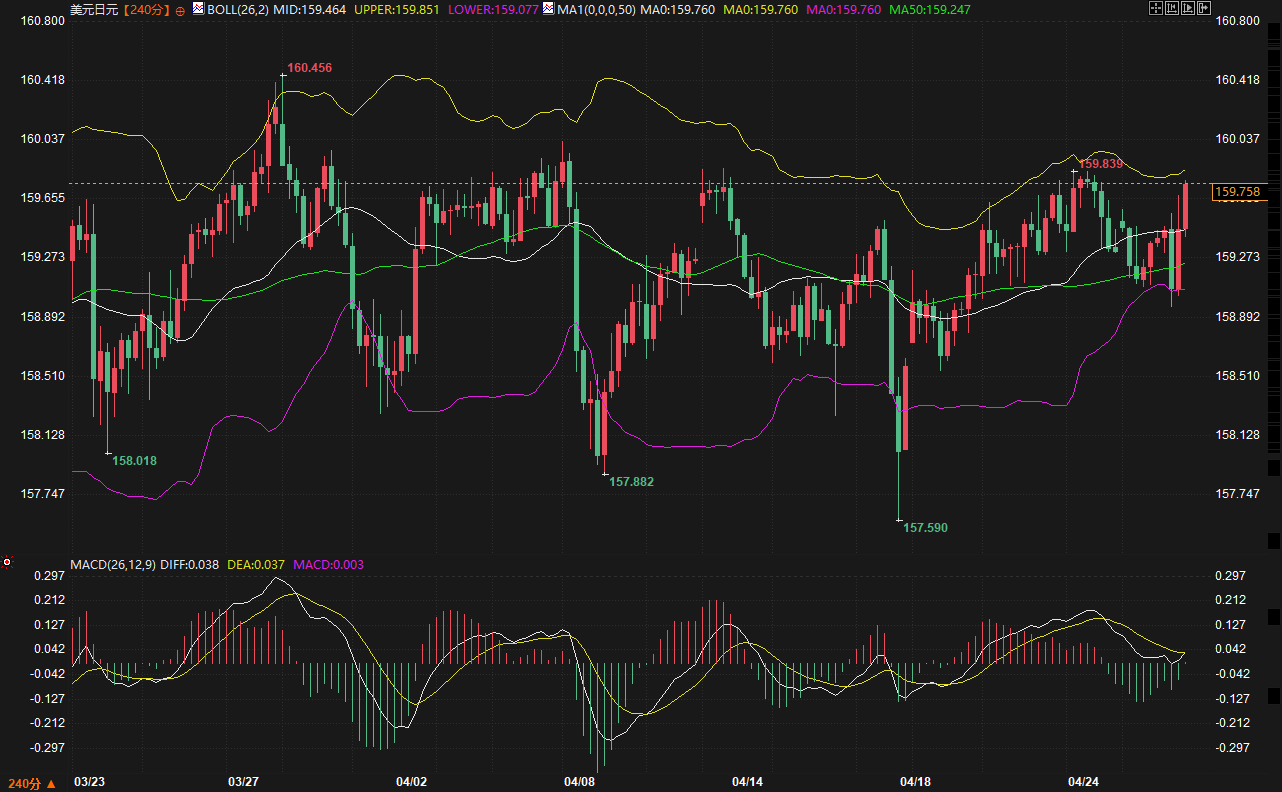
Based on the 240-minute candlestick chart, the USD/JPY pair is currently in a rebound and recovery phase after a period of wide-range fluctuations, with the price center gradually moving towards the psychological level of 160.00 .
Looking at the Bollinger Bands (BOLL) indicator, the latest price of 159.758 is close to the upper band (159.851), indicating strong short-term upward momentum. However, the MACD signal shows that the DIF and DEA indicators are highly overlapping, and the red bars are close to the zero axis. This means that although the price is rising, the upward momentum is flattening, and there is a potential risk of a top divergence.
Support and resistance range prediction:
Reference Contract: USD/JPY Spot
Resistance range: 159.85 - 160.45 . Rationale: This range encompasses the upper Bollinger Band resistance and the interim high formed at the end of March. Approaching 160.50 will enter a highly sensitive zone for official intervention.
Support range: 159.08 - 159.25 . Rationale: This area is where the lower Bollinger Band and the 50-day moving average (MA50) intersect, providing strong technical buying support.
Key points to watch during trading: Closely monitor the battle around the 160.00 psychological level. If a surge in volume followed by stagnation occurs at this level, it could indicate a surge in intervention or profit-taking by long positions.
In the short term, the yen's exchange rate will be highly dependent on dynamic expectations regarding the US-Japan interest rate differential . Although hawkish forces are rising within the Bank of Japan, as long as Kazuo Ueda maintains the tone of "gradual interest rate hikes" and the Federal Reserve remains hawkish on inflation, the fundamental pressure for yen depreciation will be difficult to eliminate.
Looking ahead, the USD/JPY pair is likely to remain range-bound at high levels in the coming trading days. If the FOMC meeting reveals stronger-than-expected inflation concerns, the yen could face the risk of falling below 160.00 and triggering direct intervention from Tokyo. Conversely, if the Fed's stance is muted and Japanese government bond yields continue to rise driven by interest rate hike expectations, the yen may find some breathing room above 158.50 . Overall, the market is in a "calm before the storm," with trading focus shifting from policy decisions to the specific red lines of intervention.
Why did the yen strengthen after the Bank of Japan kept interest rates unchanged?
This is because, although the interest rate itself remained unchanged, three of the nine committee members voted against it and called for a rate hike, a level of disagreement that exceeded market expectations. In particular, Junko Nakagawa's unexpected joining the hawkish camp was interpreted by the market as a sign that concerns about inflation were intensifying within the Bank of Japan, thus triggering the logic of a "pause in hawkishness," causing the yen to rise in a short period of time due to rising expectations of a rate hike.
What is the actual impact of the "foreign exchange intervention" frequently mentioned by Japanese officials on the market?
Foreign exchange intervention primarily works by altering market liquidity and psychological expectations. When the exchange rate approaches sensitive levels such as 160.00 , intervention warnings significantly increase the cost for short sellers and force some long positions to take profits. While intervention is unlikely to change trends determined by interest rate differentials in the long term, it often triggers sharp pullbacks of several hundred points in the short term, making it the primary source of uncertainty and risk in the market.
What does the current flattening of the Japanese government bond yield curve mean?
A flattening yield curve typically means that short-term interest rates rise due to expectations of policy rate hikes, while long-term interest rates weaken due to expectations of slower economic growth. In the current context, this reflects the market pricing in earlier and more frequent rate hikes by the Bank of Japan, which usually provides a marginal boost to the domestic currency, but its positive effect is limited in a strong dollar cycle.
What is the potential impact of personnel changes at the Federal Reserve on the USD/JPY exchange rate?
If figures like Kevin Warsh, who hold a more hawkish stance on inflation, enter the core decision-making body, the market will anticipate that the Federal Reserve will adopt a more aggressive tightening policy to address the slowly improving inflation. This will lead to a strong dollar index, further widening the US-Japan interest rate differential and putting sustained downward pressure on the yen exchange rate.
From a technical perspective, is the current rebound of the yen sustainable?
Current technical indicators suggest that the rebound momentum is weakening. Although the price is trading above the 50-day moving average and near the upper Bollinger Band, the shortening of the MACD histogram indicates that the battle between bulls and bears is approaching equilibrium. Without further positive fundamental catalysts, the price may face strong selling pressure before reaching the recent high near 160.45. Whether the rebound can be sustained depends on whether it can effectively break through and hold above the key resistance level.
Of the nine members on the committee, three (Hajime Takada, Naoki Tamura, and Junko Nakagawa) voted against maintaining the status quo and instead supported raising interest rates to 1% . This "hawkish pause" stance initially triggered a rapid short-term strengthening of the yen. However, as Bank of Japan Governor Kazuo Ueda adopted a relatively cautious tone at the press conference, emphasizing that the status quo was being maintained due to a decline in confidence in the outlook, the yen subsequently gave back most of its gains. Currently, the market remains cautious ahead of the Federal Reserve meeting, with the dollar slightly higher and the dollar index rising to around 98.64 .
Fundamental Analysis: Japanese Bond Yield Curve and Intervention Expectations
From a macro-narrative perspective, the yen's current exchange rate is caught between "policy divergence" and "intervention threat" .
First, the movements in the Japanese government bond (JGB) market are key to understanding today's exchange rate logic. The three dissenting votes at this policy meeting were interpreted by the market as a further increase in the probability of future interest rate hikes, leading to a flattening trend in the JGB yield curve . Yields on 2-year and 5-year JGBs rose slightly, driven by expectations of rate hikes, while yields on ultra-long-term bonds declined slightly. While this repricing in the bond market provided short-term support for the yen, Kazuo Ueda's subsequent restrained remarks erased any hints of a clear timetable for rate hikes, preventing a trend reversal in the yen's direction.
Secondly, geopolitical uncertainty surrounding tariff rhetoric continues to support safe-haven demand. A well-known institution pointed out that although energy prices face volatility risks due to the Middle East situation, the resilience of US stocks and the continued momentum in the AI sector have offset some of the risks, limiting excessive declines in the US dollar. Meanwhile, Japanese Finance Minister Satsuki Katayama reiterated today that the government is prepared to take action to address foreign exchange volatility and clearly expressed its determination to curb excessive yen depreciation through intervention. This means that when the exchange rate approaches the 160.00 mark, the market will be highly vigilant about the risk of potential administrative intervention.
Finally, regarding the external environment, market focus has shifted to Wednesday's Federal Open Market Committee (FOMC) meeting. With expectations that Kevin Warsh might succeed him, the market's assessment of the Fed's future inflation path has become more stringent, making it difficult for the US-Japan interest rate differential to narrow significantly in the short term.
Technical Analysis and Range Forecast
Based on the 240-minute candlestick chart, the USD/JPY pair is currently in a rebound and recovery phase after a period of wide-range fluctuations, with the price center gradually moving towards the psychological level of 160.00 .
Looking at the Bollinger Bands (BOLL) indicator, the latest price of 159.758 is close to the upper band (159.851), indicating strong short-term upward momentum. However, the MACD signal shows that the DIF and DEA indicators are highly overlapping, and the red bars are close to the zero axis. This means that although the price is rising, the upward momentum is flattening, and there is a potential risk of a top divergence.
Support and resistance range prediction:
Reference Contract: USD/JPY Spot
Resistance range: 159.85 - 160.45 . Rationale: This range encompasses the upper Bollinger Band resistance and the interim high formed at the end of March. Approaching 160.50 will enter a highly sensitive zone for official intervention.
Support range: 159.08 - 159.25 . Rationale: This area is where the lower Bollinger Band and the 50-day moving average (MA50) intersect, providing strong technical buying support.
Key points to watch during trading: Closely monitor the battle around the 160.00 psychological level. If a surge in volume followed by stagnation occurs at this level, it could indicate a surge in intervention or profit-taking by long positions.
Future Trend Outlook
In the short term, the yen's exchange rate will be highly dependent on dynamic expectations regarding the US-Japan interest rate differential . Although hawkish forces are rising within the Bank of Japan, as long as Kazuo Ueda maintains the tone of "gradual interest rate hikes" and the Federal Reserve remains hawkish on inflation, the fundamental pressure for yen depreciation will be difficult to eliminate.
Looking ahead, the USD/JPY pair is likely to remain range-bound at high levels in the coming trading days. If the FOMC meeting reveals stronger-than-expected inflation concerns, the yen could face the risk of falling below 160.00 and triggering direct intervention from Tokyo. Conversely, if the Fed's stance is muted and Japanese government bond yields continue to rise driven by interest rate hike expectations, the yen may find some breathing room above 158.50 . Overall, the market is in a "calm before the storm," with trading focus shifting from policy decisions to the specific red lines of intervention.
Frequently Asked Questions
Why did the yen strengthen after the Bank of Japan kept interest rates unchanged?
This is because, although the interest rate itself remained unchanged, three of the nine committee members voted against it and called for a rate hike, a level of disagreement that exceeded market expectations. In particular, Junko Nakagawa's unexpected joining the hawkish camp was interpreted by the market as a sign that concerns about inflation were intensifying within the Bank of Japan, thus triggering the logic of a "pause in hawkishness," causing the yen to rise in a short period of time due to rising expectations of a rate hike.
What is the actual impact of the "foreign exchange intervention" frequently mentioned by Japanese officials on the market?
Foreign exchange intervention primarily works by altering market liquidity and psychological expectations. When the exchange rate approaches sensitive levels such as 160.00 , intervention warnings significantly increase the cost for short sellers and force some long positions to take profits. While intervention is unlikely to change trends determined by interest rate differentials in the long term, it often triggers sharp pullbacks of several hundred points in the short term, making it the primary source of uncertainty and risk in the market.
What does the current flattening of the Japanese government bond yield curve mean?
A flattening yield curve typically means that short-term interest rates rise due to expectations of policy rate hikes, while long-term interest rates weaken due to expectations of slower economic growth. In the current context, this reflects the market pricing in earlier and more frequent rate hikes by the Bank of Japan, which usually provides a marginal boost to the domestic currency, but its positive effect is limited in a strong dollar cycle.
What is the potential impact of personnel changes at the Federal Reserve on the USD/JPY exchange rate?
If figures like Kevin Warsh, who hold a more hawkish stance on inflation, enter the core decision-making body, the market will anticipate that the Federal Reserve will adopt a more aggressive tightening policy to address the slowly improving inflation. This will lead to a strong dollar index, further widening the US-Japan interest rate differential and putting sustained downward pressure on the yen exchange rate.
From a technical perspective, is the current rebound of the yen sustainable?
Current technical indicators suggest that the rebound momentum is weakening. Although the price is trading above the 50-day moving average and near the upper Bollinger Band, the shortening of the MACD histogram indicates that the battle between bulls and bears is approaching equilibrium. Without further positive fundamental catalysts, the price may face strong selling pressure before reaching the recent high near 160.45. Whether the rebound can be sustained depends on whether it can effectively break through and hold above the key resistance level.
- Risk Warning and Disclaimer
- The market involves risk, and trading may not be suitable for all investors. This article is for reference only and does not constitute personal investment advice, nor does it take into account certain users’ specific investment objectives, financial situation, or other needs. Any investment decisions made based on this information are at your own risk.