Breaking News! Oil price increases hit a headwind as OPEC fractures! UAE abruptly withdraws from the agreement.
2026-04-28 21:06:41
On Tuesday (April 28), during the Asian and European sessions, international oil prices hit new highs but encountered negative news, resulting in a tug-of-war between bulls and bears. Brent crude is currently trading around 104.17, up 2.49%. On April 28 local time, the UAE Energy Minister officially announced that the country will formally withdraw from OPEC and the OPEC+ mechanism from May 1. This key decision was made without consultation with Saudi Arabia or any other country before implementation, and is entirely based on the country's long-term development and sovereign strategic considerations.
The UAE stated that with global energy demand steadily rising and global strategic crude oil reserves being depleted at an alarming rate, coupled with the special circumstances of restricted shipping in the Strait of Hormuz, this presents a crucial window for adjusting energy policies. The UAE will gradually lift restrictions on crude oil production, leveraging its own production capacity advantages to match the long-term global demand for crude oil, petrochemical products, and natural gas.
This departure from the oil alliance is a well-considered national strategic choice by the UAE.
For a long time, the UAE’s massive crude oil production capacity has been strictly constrained by OPEC+ production quotas. The country has already implemented large-scale energy expansion investments and has a strong advantage in low-cost extraction. A large amount of idle capacity cannot be released, which has suppressed oil export revenue for a long time.
At present, the UAE is making every effort to promote economic diversification and transformation, and urgently needs stable and sufficient oil revenue to support the development of non-oil industries such as new energy development, high-end industry, finance and tourism, and accelerate the reduction of the national economy's dependence on fossil fuels.
Meanwhile, the UAE and Saudi Arabia have deep-rooted differences in energy strategy. Saudi Arabia insists on production cuts to support oil prices, while the UAE focuses on increasing production to seize market share. By leaving OPEC+, the UAE can completely get rid of external policy constraints and gain full autonomy in production control.
Amid the complex geopolitical situation in the Middle East, the UAE also hopes to balance relations with major powers through energy independence, avoid the risks of regional bloc competition, secure a share of core consumer markets in Asia in advance, improve the layout of the entire petrochemical and natural gas industry chain, and consolidate its long-term economic competitiveness.
The UAE's sudden withdrawal as a core oil-producing country in the Gulf has directly damaged the overall cohesion and market regulation capabilities of the OPEC+ alliance. The traditional cooperation mechanism of production cuts to maintain prices has shown obvious cracks, and the organization's control over global crude oil prices and its pricing power have continued to weaken.
The crude oil market will become more complex in the future, with supply and demand fundamentals, regional geopolitical conflicts, and independent production capacity policies of various countries jointly influencing market trends. Crude oil price volatility will increase significantly, and overall trading uncertainty will rise accordingly.
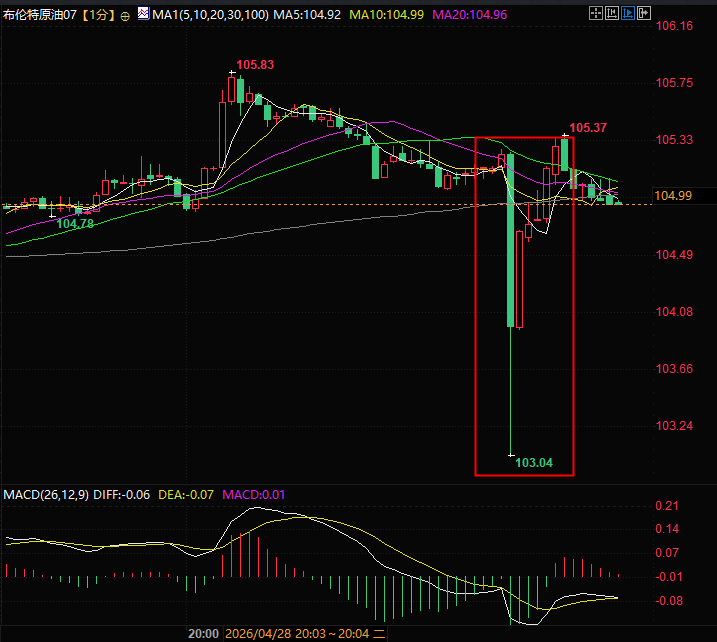
(1-minute chart of Brent crude oil futures contract, source: EasyForex)
The core underlying issue of this round of dramatic changes in the oil market is the escalating and difficult-to-resolve comprehensive confrontation between the US and Iran.
The United States has recently intensified its blockade and sanctions against Iranian ports in an effort to pressure Iran into making concessions. Iran has responded with strong countermeasures, reinstating restrictions on passage through the Strait of Hormuz and launching multiple attacks on passing commercial vessels, escalating the conflict across the Middle East's energy heartland.
Currently, there is extreme dissatisfaction within the US regarding the latest peace proposal from Iran. The Trump administration has clearly stated that the proposal does not touch the core red line of Iran's nuclear program. Even without a direct veto of the negotiations, the core differences between the two sides remain unbridgeable, and the expectation of a short-term thaw and reconciliation between the US and Iran has completely failed.
Coupled with external factors such as adjustments in US domestic policy and changes in NATO summit plans, the US Middle East strategy continues to waver, further amplifying regional instability. The long-term confrontation between the US and Iran has become a foregone conclusion, creating persistent hidden dangers for the Middle East energy supply chain.
According to data from Lloyd's Register, the Strait of Hormuz, a vital global oil shipping route, has seen its capacity nearly halved due to the direct impact of the US-Iran conflict. Currently, only 35 large cargo ships pass through the strait per week, a significant decrease compared to the pre-war daily average of over 100 ships. The strait's traffic level is less than 3% of its pre-war level, effectively putting the waterway in a semi-closed state.
Normal commercial shipping in the Strait of Hormuz has essentially come to a standstill, with only a small amount of trade transport maintained by Iranian shadow fleets. Export channels for crude oil and liquefied natural gas from the Middle East are severely blocked, which is the core reason for the rapid depletion of global crude oil inventories, and the pressure of a global crude oil supply shortage continues to intensify.
While supply continues to tighten, regional demand is seeing a marginal recovery.
As regional tensions ease, Emirates announced that it will resume operations on several Middle East routes on May 1, covering key regions such as Oman and Kuwait. Regional trade and travel activities are steadily recovering, directly driving up demand for fuels such as aviation kerosene, and the overall resilience of global crude oil consumption continues to strengthen.
However, there is a serious mismatch between supply and demand. Even if the UAE plans to increase production, it will be constrained by the Strait of Hormuz blockade, detours on ocean shipping routes, a sharp increase in shipping insurance and freight costs, and insufficient regional freight capacity. The new production capacity will be difficult to be quickly transported outwards. Alternative routes such as detouring around the Cape of Good Hope will significantly lengthen the transportation cycle and increase trade costs, further pushing up the global crude oil landed premium.
In summary, the UAE's energy strategy shift, the decline of OPEC+'s influence, the ongoing geopolitical stalemate between the US and Iran, and the transportation bottleneck in the Strait of Hormuz are all factors that combine to constrain the operating logic of the crude oil market.
In the short term, geopolitical risk premiums and supply gaps will provide strong support for oil prices, making it easier for prices to rise than fall. In the medium to long term, the continued production increases in the UAE and the policy divergence within OPEC+ will intensify the battle between bulls and bears in the market.
Currently, international oil prices are still fluctuating around the passage through the Strait of Hormuz. Meanwhile, the rift within OPEC will have a significant negative impact on oil prices. The market has not yet fully priced in the potential for the rift to spread further.
Technical Analysis: As mentioned in previous articles, oil prices have broken out of the downward pressure line and formed a strong consolidation pattern, subsequently reaching new highs. Currently, oil prices are dominated by bulls and are expected to continue to reach new highs, supported by the 5-day moving average.
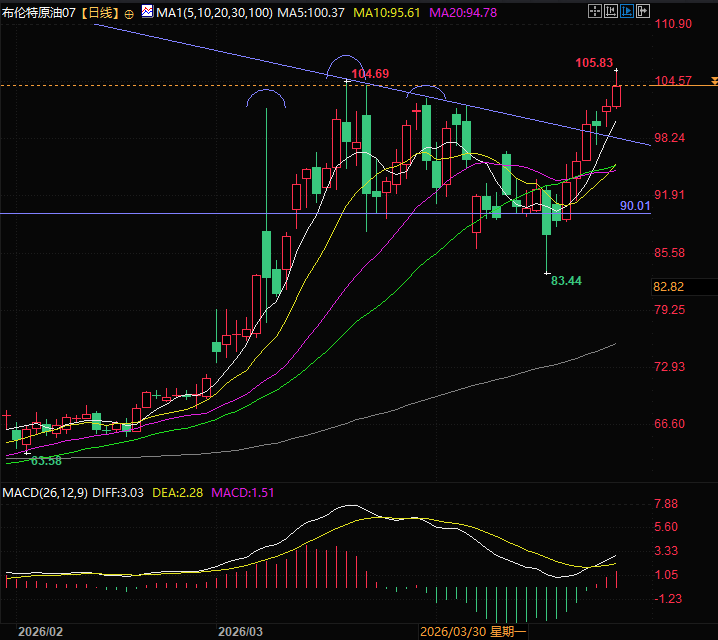
(Brent July futures contract daily chart, source: FX678's subsidiary EasyForex)
At 21:05 Beijing time, the Brent crude oil July contract was trading at $104.26 per barrel.
The UAE stated that with global energy demand steadily rising and global strategic crude oil reserves being depleted at an alarming rate, coupled with the special circumstances of restricted shipping in the Strait of Hormuz, this presents a crucial window for adjusting energy policies. The UAE will gradually lift restrictions on crude oil production, leveraging its own production capacity advantages to match the long-term global demand for crude oil, petrochemical products, and natural gas.
Strategic Core: The Deep Sovereign Considerations Behind the UAE's Withdrawal
This departure from the oil alliance is a well-considered national strategic choice by the UAE.
For a long time, the UAE’s massive crude oil production capacity has been strictly constrained by OPEC+ production quotas. The country has already implemented large-scale energy expansion investments and has a strong advantage in low-cost extraction. A large amount of idle capacity cannot be released, which has suppressed oil export revenue for a long time.
At present, the UAE is making every effort to promote economic diversification and transformation, and urgently needs stable and sufficient oil revenue to support the development of non-oil industries such as new energy development, high-end industry, finance and tourism, and accelerate the reduction of the national economy's dependence on fossil fuels.
Meanwhile, the UAE and Saudi Arabia have deep-rooted differences in energy strategy. Saudi Arabia insists on production cuts to support oil prices, while the UAE focuses on increasing production to seize market share. By leaving OPEC+, the UAE can completely get rid of external policy constraints and gain full autonomy in production control.
Amid the complex geopolitical situation in the Middle East, the UAE also hopes to balance relations with major powers through energy independence, avoid the risks of regional bloc competition, secure a share of core consumer markets in Asia in advance, improve the layout of the entire petrochemical and natural gas industry chain, and consolidate its long-term economic competitiveness.
Shaking the alliance: OPEC+ oil price control system under pressure
The UAE's sudden withdrawal as a core oil-producing country in the Gulf has directly damaged the overall cohesion and market regulation capabilities of the OPEC+ alliance. The traditional cooperation mechanism of production cuts to maintain prices has shown obvious cracks, and the organization's control over global crude oil prices and its pricing power have continued to weaken.
The crude oil market will become more complex in the future, with supply and demand fundamentals, regional geopolitical conflicts, and independent production capacity policies of various countries jointly influencing market trends. Crude oil price volatility will increase significantly, and overall trading uncertainty will rise accordingly.
(1-minute chart of Brent crude oil futures contract, source: EasyForex)
Geopolitical Focus: Escalating US-Iran Standoff Continues to Cause Tensions in the Middle East
The core underlying issue of this round of dramatic changes in the oil market is the escalating and difficult-to-resolve comprehensive confrontation between the US and Iran.
The United States has recently intensified its blockade and sanctions against Iranian ports in an effort to pressure Iran into making concessions. Iran has responded with strong countermeasures, reinstating restrictions on passage through the Strait of Hormuz and launching multiple attacks on passing commercial vessels, escalating the conflict across the Middle East's energy heartland.
Currently, there is extreme dissatisfaction within the US regarding the latest peace proposal from Iran. The Trump administration has clearly stated that the proposal does not touch the core red line of Iran's nuclear program. Even without a direct veto of the negotiations, the core differences between the two sides remain unbridgeable, and the expectation of a short-term thaw and reconciliation between the US and Iran has completely failed.
Coupled with external factors such as adjustments in US domestic policy and changes in NATO summit plans, the US Middle East strategy continues to waver, further amplifying regional instability. The long-term confrontation between the US and Iran has become a foregone conclusion, creating persistent hidden dangers for the Middle East energy supply chain.
Transportation bottleneck: Navigation in the Strait of Hormuz is almost at a standstill.
According to data from Lloyd's Register, the Strait of Hormuz, a vital global oil shipping route, has seen its capacity nearly halved due to the direct impact of the US-Iran conflict. Currently, only 35 large cargo ships pass through the strait per week, a significant decrease compared to the pre-war daily average of over 100 ships. The strait's traffic level is less than 3% of its pre-war level, effectively putting the waterway in a semi-closed state.
Normal commercial shipping in the Strait of Hormuz has essentially come to a standstill, with only a small amount of trade transport maintained by Iranian shadow fleets. Export channels for crude oil and liquefied natural gas from the Middle East are severely blocked, which is the core reason for the rapid depletion of global crude oil inventories, and the pressure of a global crude oil supply shortage continues to intensify.
Supply-demand mismatch: the contradiction between recovering demand and transportation capacity constraints
While supply continues to tighten, regional demand is seeing a marginal recovery.
As regional tensions ease, Emirates announced that it will resume operations on several Middle East routes on May 1, covering key regions such as Oman and Kuwait. Regional trade and travel activities are steadily recovering, directly driving up demand for fuels such as aviation kerosene, and the overall resilience of global crude oil consumption continues to strengthen.
However, there is a serious mismatch between supply and demand. Even if the UAE plans to increase production, it will be constrained by the Strait of Hormuz blockade, detours on ocean shipping routes, a sharp increase in shipping insurance and freight costs, and insufficient regional freight capacity. The new production capacity will be difficult to be quickly transported outwards. Alternative routes such as detouring around the Cape of Good Hope will significantly lengthen the transportation cycle and increase trade costs, further pushing up the global crude oil landed premium.
Trading Outlook: Oil Price Logic and Opportunities Amidst a Complex Interplay of Factors
In summary, the UAE's energy strategy shift, the decline of OPEC+'s influence, the ongoing geopolitical stalemate between the US and Iran, and the transportation bottleneck in the Strait of Hormuz are all factors that combine to constrain the operating logic of the crude oil market.
In the short term, geopolitical risk premiums and supply gaps will provide strong support for oil prices, making it easier for prices to rise than fall. In the medium to long term, the continued production increases in the UAE and the policy divergence within OPEC+ will intensify the battle between bulls and bears in the market.
Currently, international oil prices are still fluctuating around the passage through the Strait of Hormuz. Meanwhile, the rift within OPEC will have a significant negative impact on oil prices. The market has not yet fully priced in the potential for the rift to spread further.
Technical Analysis: As mentioned in previous articles, oil prices have broken out of the downward pressure line and formed a strong consolidation pattern, subsequently reaching new highs. Currently, oil prices are dominated by bulls and are expected to continue to reach new highs, supported by the 5-day moving average.
(Brent July futures contract daily chart, source: FX678's subsidiary EasyForex)
At 21:05 Beijing time, the Brent crude oil July contract was trading at $104.26 per barrel.
- Risk Warning and Disclaimer
- The market involves risk, and trading may not be suitable for all investors. This article is for reference only and does not constitute personal investment advice, nor does it take into account certain users’ specific investment objectives, financial situation, or other needs. Any investment decisions made based on this information are at your own risk.