













Middle East energy risks weighed on the yen, putting pressure on the pound; the pound/yen pair traded in a weak, range-bound manner at high levels.
2026-04-29 15:53:52
On Wednesday during the European session, the British pound/Japanese yen (GBP/JPY) attracted renewed selling pressure, ending its earlier rebound from weekly lows. The exchange rate briefly fell below the 215.00 level before settling into a range-bound trading pattern around 215. Despite the apparent short-term pressure, the downward movement lacked sustainability, indicating that bearish forces in the market remain cautious.
From a fundamental perspective, current exchange rate fluctuations are mainly influenced by a combination of factors. On the one hand, the US dollar maintains its safe-haven appeal amid rising global uncertainty, putting some pressure on the pound and indirectly dragging down the pound/yen exchange rate. On the other hand, Japan's economic outlook is under pressure due to energy supply risks, making it difficult for the yen to find effective buying support, thus limiting the downside potential of the exchange rate.
The situation in the Middle East remains a key variable for the market. The ongoing restrictions on shipping through the Strait of Hormuz, which carries approximately 20% of global energy transport , put significant pressure on Japan's energy-dependent economy. Rising energy costs not only push up inflation but may also weaken economic growth expectations, leading to market caution regarding the yen. This factor has, to some extent, offset the support for the yen from the Bank of Japan's hawkish policy.
Regarding monetary policy, the Bank of Japan maintained its interest rate at 0.75% , but internal voting was divided, with some members supporting a rate hike, while inflation expectations were revised upwards. This indicates that the policy normalization process is still underway, and market expectations for a rate hike in June or July remain. Furthermore, with the yen continuing to depreciate, market concerns about potential intervention have intensified, which also limits the upside potential of the exchange rate.
Meanwhile, the Bank of England is about to announce its interest rate decision, and the market expects further rate hikes this year, with a high probability of a June rate hike. This provides some support for the pound, but given the backdrop of global risk sentiment and a strengthening dollar, the support is limited. The market generally prefers to remain cautious until clear policy signals emerge.
From a market structure perspective, the current GBP/JPY exchange rate exhibits a typical "high-level consolidation" characteristic. On the one hand, the pound is supported by policy expectations; on the other hand, although the yen's fundamentals are weak, policy expectations and the risk of intervention limit its further depreciation. This interplay of bullish and bearish forces makes it difficult for the exchange rate to form a unilateral trend.
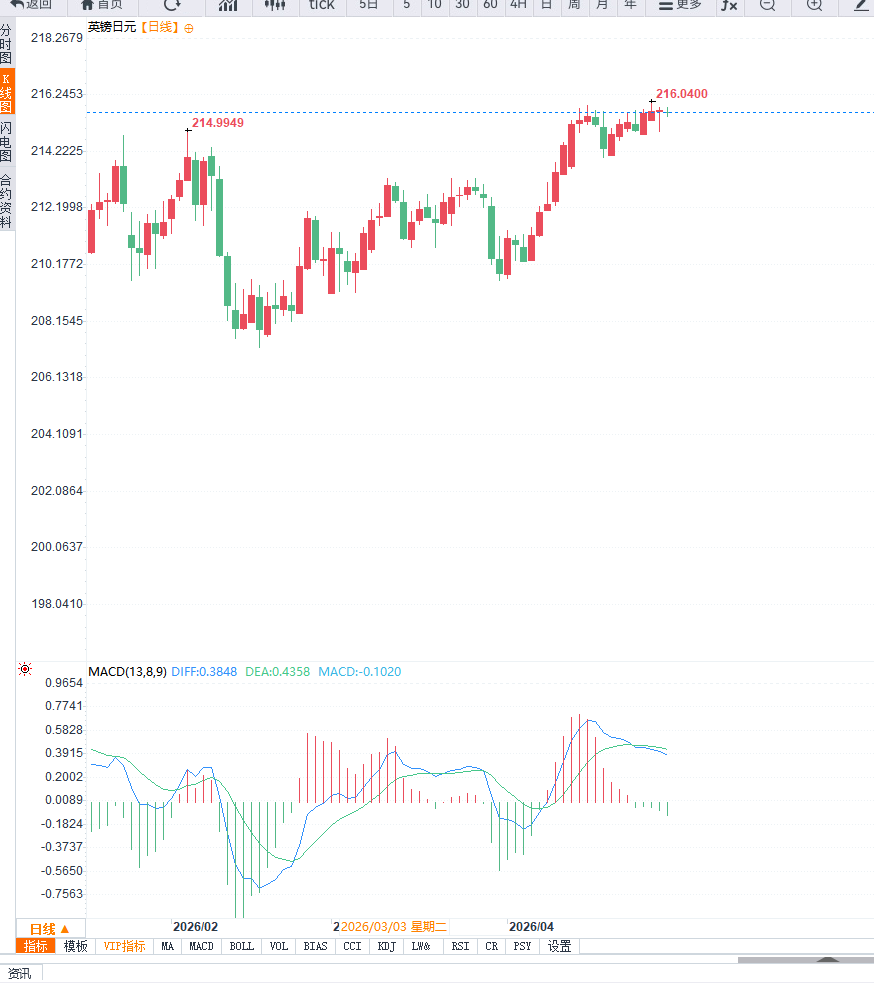
From a technical perspective, the daily chart remains in a high-level consolidation pattern, with the exchange rate repeatedly encountering resistance around 216.00 , indicating strong selling pressure in this area. Support lies at 214.50 and 213.80 ; a break below these levels could lead to a further test of the 212.50 level. Momentum indicators show the RSI is pulling back from neutral-to-high territory, suggesting weakening upward momentum but the trend has not yet fully turned bearish.
From a 4-hour chart perspective, the short-term trend shows a slightly weak and volatile structure, with prices fluctuating within the 214.50-216.00 range, currently trading in the lower half of the range. Resistance is concentrated in the 215.80 and 216.00 area, while support is seen at the 214.50 and 213.80 levels. Momentum indicators suggest a slight short-term bearish advantage, but the lack of significant downward volume indicates that the market is still in a consolidation phase.
Editor's Summary : Overall, the GBP/JPY pair is currently in a high-level consolidation phase with a slight downward bias. Safe-haven demand for the US dollar is suppressing the pound, while the yen's weakness is attributed to energy risks, limiting the downside potential of the exchange rate. Meanwhile, expectations of a Bank of Japan interest rate hike and potential intervention are exerting upward pressure. In the short term, the exchange rate may continue to fluctuate within a range, with its future direction depending on policy signals from the Bank of England and developments in the Middle East.
From a fundamental perspective, current exchange rate fluctuations are mainly influenced by a combination of factors. On the one hand, the US dollar maintains its safe-haven appeal amid rising global uncertainty, putting some pressure on the pound and indirectly dragging down the pound/yen exchange rate. On the other hand, Japan's economic outlook is under pressure due to energy supply risks, making it difficult for the yen to find effective buying support, thus limiting the downside potential of the exchange rate.
The situation in the Middle East remains a key variable for the market. The ongoing restrictions on shipping through the Strait of Hormuz, which carries approximately 20% of global energy transport , put significant pressure on Japan's energy-dependent economy. Rising energy costs not only push up inflation but may also weaken economic growth expectations, leading to market caution regarding the yen. This factor has, to some extent, offset the support for the yen from the Bank of Japan's hawkish policy.
Regarding monetary policy, the Bank of Japan maintained its interest rate at 0.75% , but internal voting was divided, with some members supporting a rate hike, while inflation expectations were revised upwards. This indicates that the policy normalization process is still underway, and market expectations for a rate hike in June or July remain. Furthermore, with the yen continuing to depreciate, market concerns about potential intervention have intensified, which also limits the upside potential of the exchange rate.
Meanwhile, the Bank of England is about to announce its interest rate decision, and the market expects further rate hikes this year, with a high probability of a June rate hike. This provides some support for the pound, but given the backdrop of global risk sentiment and a strengthening dollar, the support is limited. The market generally prefers to remain cautious until clear policy signals emerge.
From a market structure perspective, the current GBP/JPY exchange rate exhibits a typical "high-level consolidation" characteristic. On the one hand, the pound is supported by policy expectations; on the other hand, although the yen's fundamentals are weak, policy expectations and the risk of intervention limit its further depreciation. This interplay of bullish and bearish forces makes it difficult for the exchange rate to form a unilateral trend.
From a technical perspective, the daily chart remains in a high-level consolidation pattern, with the exchange rate repeatedly encountering resistance around 216.00 , indicating strong selling pressure in this area. Support lies at 214.50 and 213.80 ; a break below these levels could lead to a further test of the 212.50 level. Momentum indicators show the RSI is pulling back from neutral-to-high territory, suggesting weakening upward momentum but the trend has not yet fully turned bearish.
From a 4-hour chart perspective, the short-term trend shows a slightly weak and volatile structure, with prices fluctuating within the 214.50-216.00 range, currently trading in the lower half of the range. Resistance is concentrated in the 215.80 and 216.00 area, while support is seen at the 214.50 and 213.80 levels. Momentum indicators suggest a slight short-term bearish advantage, but the lack of significant downward volume indicates that the market is still in a consolidation phase.
Editor's Summary : Overall, the GBP/JPY pair is currently in a high-level consolidation phase with a slight downward bias. Safe-haven demand for the US dollar is suppressing the pound, while the yen's weakness is attributed to energy risks, limiting the downside potential of the exchange rate. Meanwhile, expectations of a Bank of Japan interest rate hike and potential intervention are exerting upward pressure. In the short term, the exchange rate may continue to fluctuate within a range, with its future direction depending on policy signals from the Bank of England and developments in the Middle East.
- Risk Warning and Disclaimer
- The market involves risk, and trading may not be suitable for all investors. This article is for reference only and does not constitute personal investment advice, nor does it take into account certain users’ specific investment objectives, financial situation, or other needs. Any investment decisions made based on this information are at your own risk.

