













Amid the interplay of energy inflation and economic weakness, Rabobank expects the Bank of Canada to keep interest rates unchanged this year.
2026-04-29 15:40:14
Amid a divergence between global inflation and economic growth, the outlook for Canadian monetary policy is becoming increasingly cautious. A senior macro strategist at Rabobank noted that the Bank of Canada expects to maintain its overnight rate at 2.25% throughout 2026, a assessment reflecting a more prudent balance among policymakers regarding inflation and economic growth.

From an inflation perspective, Canada's inflation level had previously gradually declined and approached the policy target, but recently, due to rising energy prices, inflation is facing upward pressure again. Particularly against the backdrop of heightened uncertainty in the Middle East, tight energy supplies are driving up price volatility, thus disrupting overall prices through imported inflation. However, this upward inflation is generally viewed as an external shock rather than a result of overheated domestic demand.
From a fundamental economic perspective, the Canadian economy is relatively weak. Growth momentum is unstable, with significant cyclical fluctuations, and persistently low productivity limits potential growth. Against this backdrop, prematurely tightening monetary policy could further suppress investment and consumption, negatively impacting economic recovery. Therefore, the Bank of Canada is inclined to remain cautious in its policy choices to avoid exacerbating downside risks to the economy.
In terms of policy logic, the Bank of Canada is currently more focused on changes in the "nature of inflation." If inflation is primarily driven by external energy prices rather than domestic demand expansion, the central bank is more likely to choose to "manage" short-term fluctuations to avoid overreacting. This means that even if short-term inflation data rebounds, policy rates may remain stable to observe whether inflation is sustainable.
Meanwhile, the Federal Reserve's policy path also indirectly influences the Bank of Canada. The market widely expects the Fed to maintain its current interest rates, which to some extent alleviates external pressure on the Bank of Canada to adjust its policy. If the interest rate policies of both countries remain synchronized and stable, it will help maintain a relative balance between exchange rates and capital flows.
From a market perspective, keeping interest rates unchanged means that the Canadian dollar lacks a clear interest rate driver in the short term, and its trend will depend more on oil price fluctuations and changes in global risk sentiment. Given the current high energy prices, the Canadian dollar may still receive some support, but weak economic fundamentals will limit its appreciation potential.
From a technical perspective, Canadian dollar-related currency pairs are generally maintaining a range-bound trading pattern, with no clear short-term direction. Continued high oil prices may provide support for the Canadian dollar; however, weaker global economic data could trigger increased exchange rate volatility. Overall, the market remains in a phase awaiting new catalysts.
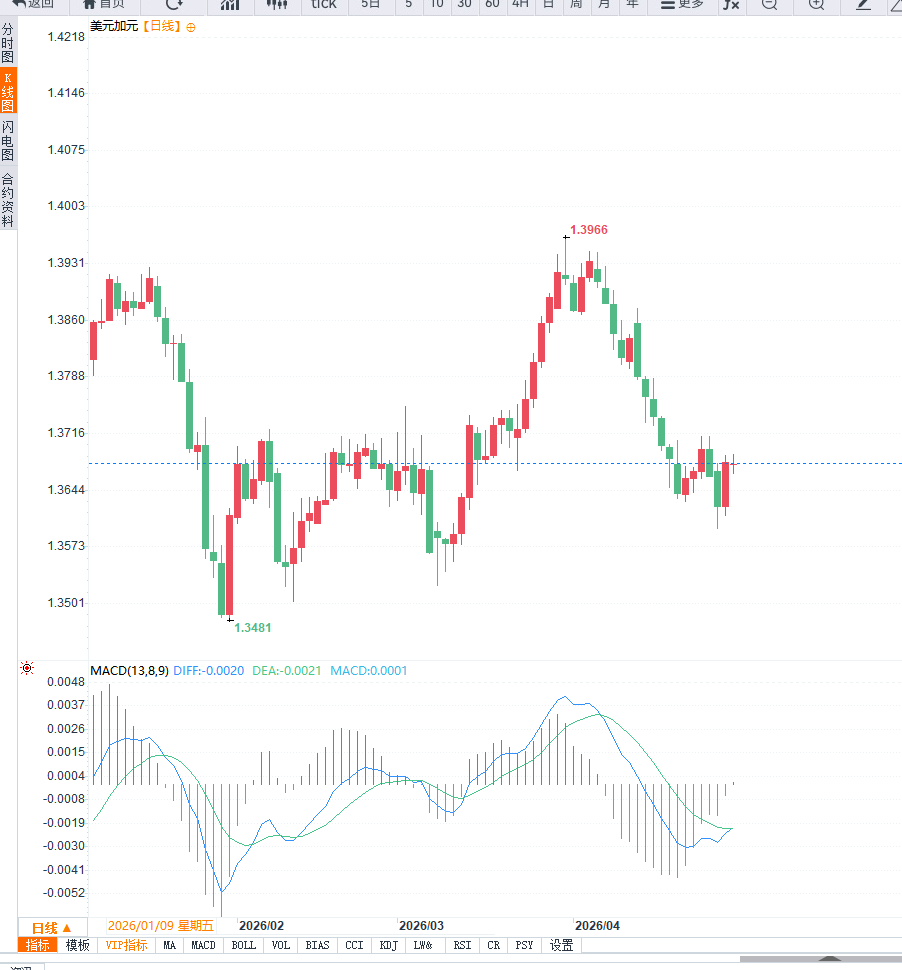
Editor's Summary <br/>Overall, the Bank of Canada's current policy path exhibits a clear "wait-and-see" characteristic. While energy prices are pushing up inflation expectations, weak economic growth and productivity issues limit the scope for policy tightening. In the short term, the central bank is more likely to ignore external inflationary shocks and maintain interest rates unchanged to observe further developments in the economy and inflation. The pace of future policy adjustments will depend on whether inflation persists and whether economic fundamentals can improve.
From an inflation perspective, Canada's inflation level had previously gradually declined and approached the policy target, but recently, due to rising energy prices, inflation is facing upward pressure again. Particularly against the backdrop of heightened uncertainty in the Middle East, tight energy supplies are driving up price volatility, thus disrupting overall prices through imported inflation. However, this upward inflation is generally viewed as an external shock rather than a result of overheated domestic demand.
From a fundamental economic perspective, the Canadian economy is relatively weak. Growth momentum is unstable, with significant cyclical fluctuations, and persistently low productivity limits potential growth. Against this backdrop, prematurely tightening monetary policy could further suppress investment and consumption, negatively impacting economic recovery. Therefore, the Bank of Canada is inclined to remain cautious in its policy choices to avoid exacerbating downside risks to the economy.
In terms of policy logic, the Bank of Canada is currently more focused on changes in the "nature of inflation." If inflation is primarily driven by external energy prices rather than domestic demand expansion, the central bank is more likely to choose to "manage" short-term fluctuations to avoid overreacting. This means that even if short-term inflation data rebounds, policy rates may remain stable to observe whether inflation is sustainable.
Meanwhile, the Federal Reserve's policy path also indirectly influences the Bank of Canada. The market widely expects the Fed to maintain its current interest rates, which to some extent alleviates external pressure on the Bank of Canada to adjust its policy. If the interest rate policies of both countries remain synchronized and stable, it will help maintain a relative balance between exchange rates and capital flows.
From a market perspective, keeping interest rates unchanged means that the Canadian dollar lacks a clear interest rate driver in the short term, and its trend will depend more on oil price fluctuations and changes in global risk sentiment. Given the current high energy prices, the Canadian dollar may still receive some support, but weak economic fundamentals will limit its appreciation potential.
From a technical perspective, Canadian dollar-related currency pairs are generally maintaining a range-bound trading pattern, with no clear short-term direction. Continued high oil prices may provide support for the Canadian dollar; however, weaker global economic data could trigger increased exchange rate volatility. Overall, the market remains in a phase awaiting new catalysts.
Editor's Summary <br/>Overall, the Bank of Canada's current policy path exhibits a clear "wait-and-see" characteristic. While energy prices are pushing up inflation expectations, weak economic growth and productivity issues limit the scope for policy tightening. In the short term, the central bank is more likely to ignore external inflationary shocks and maintain interest rates unchanged to observe further developments in the economy and inflation. The pace of future policy adjustments will depend on whether inflation persists and whether economic fundamentals can improve.
- Risk Warning and Disclaimer
- The market involves risk, and trading may not be suitable for all investors. This article is for reference only and does not constitute personal investment advice, nor does it take into account certain users’ specific investment objectives, financial situation, or other needs. Any investment decisions made based on this information are at your own risk.

