The US dollar index held steady at 98.7; will Powell's final remarks determine the future market trend?
2026-04-29 20:05:59
The US dollar index (DXY) rose slightly in pre-market trading in New York on Wednesday (April 29). The dollar index fluctuated between 98.50 and 99.00 today, currently trading around 98.70, up approximately 0.08%-0.12% from the previous trading day. The dollar has risen for two consecutive days this week, rebounding moderately from recent lows, but has still accumulated a decline of approximately 1.78% over the past month. Today's gains were relatively limited, with the market remaining cautious overall, mainly due to investors awaiting the Federal Reserve's interest rate decision, while the stalemate in US-Iran peace talks in the Middle East provided some safe-haven support.
The US dollar rebounded slightly, mainly due to the lack of significant progress in the US-Iran peace talks, continued concerns about supply disruptions in the Strait of Hormuz pushing up oil prices and exacerbating global inflation risks, coupled with uncertainty ahead of the Federal Reserve's policy statement today, all of which supported demand for the dollar as a safe-haven asset.
Fundamental analysis
The Fed's interest rate decision and Powell's speech (today's most important event) : The market almost 100% expects the Fed to keep the target range for the federal funds rate unchanged at 3.50%-3.75% at today's meeting. This may be Powell's last meeting as Fed Chairman. Market focus is entirely on the policy statement's assessment of the economic impact of the Middle East war, the signals from the dot plot, and the tone of Powell's press conference. If Powell adopts a hawkish stance—clearly emphasizing that inflation stickiness caused by rising energy prices remains above the 2% target and hinting that policy needs to be maintained "higher and longer"—the dollar is expected to receive a strong boost; conversely, if he downplays inflation risks or hints that there is still room for further rate cuts, the dollar may see profit-taking. Currently, high oil prices have already been transmitted to inflation through production and consumption channels, further limiting the Fed's room for a rapid shift to easing.
Middle East Geopolitical Risks (US-Iran Stalemate) : Peace negotiations between the US and Iran are currently at an impasse. US President Trump is dissatisfied with Iran's latest proposal and insists on resolving the nuclear issue from the outset. Continued concerns about supply disruptions in the Strait of Hormuz have kept Brent crude oil prices near $110 per barrel. This not only increases global inflationary pressures but also significantly enhances the traditional safe-haven appeal of the US dollar. As a net energy exporter, the US has a relative advantage over other economies in a high oil price environment, further supporting the dollar. However, if future negotiations suddenly break through or tensions significantly ease, a rebound in risk appetite will quickly weaken the dollar's safe-haven premium.
Impact of US Inflation and Economic Data : Recent data shows that inflation is somewhat sticky, the job market is relatively robust, and coupled with rising energy prices, the Federal Reserve's interest rate cut path faces significant constraints. Tomorrow (April 30th), the preliminary US Q1 GDP figure and core PCE price index will be released, and these data will further calibrate market expectations for the Fed's long-term policy. The inflation transmission effect brought about by high oil prices may force the Fed to maintain a restrictive policy for a longer period, providing medium- to long-term support for the US dollar.
Other factors: Several central banks (including the Bank of Canada) will also announce policy decisions this week, and the divergence in global monetary policies will continue to influence the dollar's trajectory. Overall, the dollar's short-term performance is clearly driven by events, while its medium- to long-term direction depends on the evolution of the Middle East situation and the relative resilience of the US economy.
mainstream view
Reuters noted that the dollar edged higher as investors prepared for the Federal Reserve's decision. With the Middle East war ongoing and hopes for a US-Iran peace agreement fading, the Fed is expected to hold rates steady, but the market is focused on its assessment of the war's economic impact and what may be Powell's final statement as chairman.
FXStreet analysis shows the US dollar index holding steady around 98.50-99.00. The analysis emphasizes that cautious market sentiment and the stalled US-Iran peace process are providing support for the dollar; rising oil prices and war uncertainty are clouding expectations for further easing by the Federal Reserve. Institutions such as ING also mentioned that potentially hawkish signals from Powell could be a positive for the dollar.
FXEmpire believes the US dollar index is currently at an inflection point, with a very high probability that the Federal Reserve will remain on hold. However, the speed of policy shifts after Warsh takes over and whether inflation will follow suit will determine the medium-term direction of the dollar. Currently, high oil prices and sticky inflation make it difficult for the Fed to ease monetary policy quickly, providing short-term support for the dollar.
DBS emphasized that the dollar remained robust despite the impact of oil prices; OCBC pointed out that rising oil prices are weakening the Fed's easing hopes; TD Securities and others also focused on the impact of oil-driven inflation on central bank decisions, indirectly benefiting the dollar's safe-haven status.
Technical Analysis
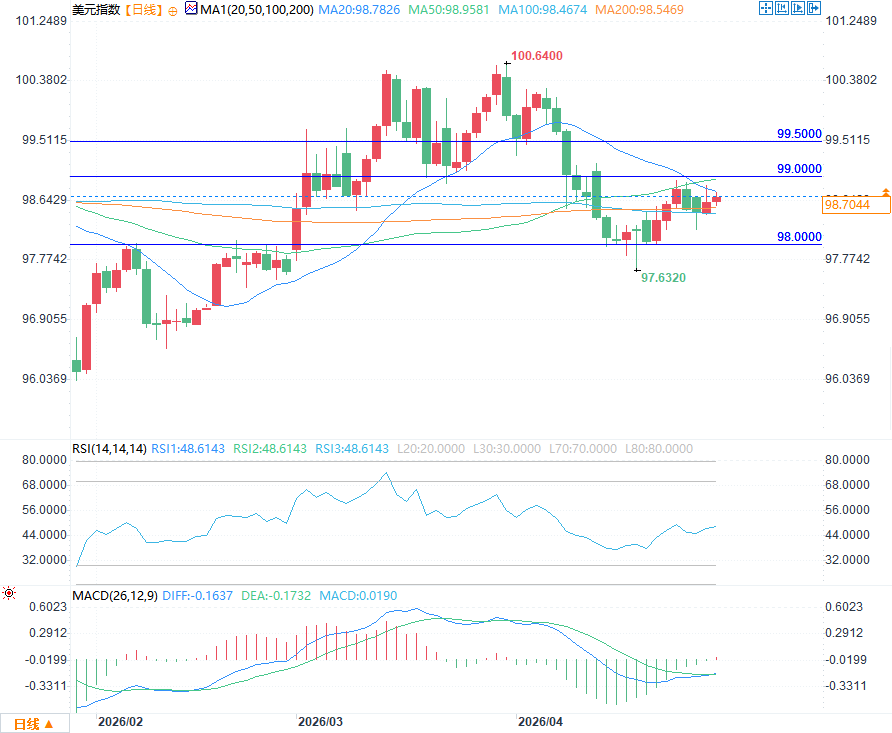
(US Dollar Index Daily Chart Source: FX678)
On the daily chart, the DXY index is currently holding above 98.50, near a two-week high. If it can effectively hold above 98.80-99.00, it may further test the 99.20-99.50 area; key support lies at 98.00-98.40, a break below which could accelerate the decline to around 97.60.
Key technical levels and indicators: Resistance levels: 98.80/99.00/99.50; Support levels: 98.40/98.00. The RSI is in the neutral-to-slightly-bullish zone, and the short-term direction will heavily depend on changes in risk sentiment after the outcome of the Fed event becomes clear.
Mainstream institutional technical views: Some analysts believe that the DXY is at a significant turning point, and after the Fed's decision, it will likely choose to break out or fall back, and may continue to maintain a range-bound trading pattern in the short term.
Financial Calendar (Beijing Time)
Today’s (April 29) highlights:
20:30: US March Durable Goods Orders (MoM)
20:30: US March Housing Starts/Building Permits
Tomorrow (April 30)
02:00: Federal Reserve Interest Rate Decision + FOMC Policy Statement (Most Important)
02:30: Federal Reserve Chairman Powell's press conference
20:30: US Q1 GDP (preliminary) + Core PCE Price Index (the Fed's most closely watched inflation indicator)
Frequently Asked Questions
Q1: Why did the US dollar only rise slightly today instead of experiencing a strong surge?
A: The market is currently in typical pre-event "wait-and-see mode." The Fed's interest rate decision and Powell's speech are the core catalysts today. Before the official results are released, investors are unwilling to make major directional bets, resulting in relatively cautious trading. While the situation in the Middle East provides safe-haven support, the uncertainty surrounding peace negotiations also limits the emergence of one-sided market movements.
Q2: What signal is the Federal Reserve most likely to release today?
A: The probability of interest rates remaining unchanged is close to 100%. The key lies in whether the statement will explicitly mention the role of war in pushing up inflation, and whether Powell will adopt a hawkish communication style (such as emphasizing that inflation risks still need to be monitored). If the signal is hawkish, the dollar is likely to be boosted; if it is relatively dovish, it may trigger profit-taking.
Q3: What is the actual mechanism by which the US-Iran conflict affects the US dollar?
A: Conflict leads to higher oil prices → increased global inflationary pressures → narrower room for the Federal Reserve to cut interest rates, while demand for the US dollar as a safe-haven currency rises. As a net energy exporter, the US benefits relatively in this environment, further strengthening the dollar's performance. However, once the conflict eases or supply resumes, this support will weaken rapidly.
Q4: Why is core PCE data receiving so much market attention?
A: PCE is the Federal Reserve's preferred measure of inflation. Current energy price increases are pushing up inflation readings through production and consumption channels. If core PCE continues to rise above the target, it will significantly constrain the pace of the Fed's shift to an easing policy, thus providing more sustained support for the dollar.
Q5: What factors should be considered for the short-term and medium-term trends of the US dollar?
A: In the short term, the main factors depend on the tone of the Fed's communication today and the GDP/PCE data results tomorrow; in the medium term, it depends on the evolution of the situation in the Middle East (progress in negotiations or escalation of conflict), the resilience of the US economy, and the degree of policy divergence among other central banks globally. If inflationary pressures remain high and risk aversion persists, the US dollar is expected to fluctuate with a slightly upward bias in the 98-100 range.
The US dollar rebounded slightly, mainly due to the lack of significant progress in the US-Iran peace talks, continued concerns about supply disruptions in the Strait of Hormuz pushing up oil prices and exacerbating global inflation risks, coupled with uncertainty ahead of the Federal Reserve's policy statement today, all of which supported demand for the dollar as a safe-haven asset.
Fundamental analysis
The Fed's interest rate decision and Powell's speech (today's most important event) : The market almost 100% expects the Fed to keep the target range for the federal funds rate unchanged at 3.50%-3.75% at today's meeting. This may be Powell's last meeting as Fed Chairman. Market focus is entirely on the policy statement's assessment of the economic impact of the Middle East war, the signals from the dot plot, and the tone of Powell's press conference. If Powell adopts a hawkish stance—clearly emphasizing that inflation stickiness caused by rising energy prices remains above the 2% target and hinting that policy needs to be maintained "higher and longer"—the dollar is expected to receive a strong boost; conversely, if he downplays inflation risks or hints that there is still room for further rate cuts, the dollar may see profit-taking. Currently, high oil prices have already been transmitted to inflation through production and consumption channels, further limiting the Fed's room for a rapid shift to easing.
Middle East Geopolitical Risks (US-Iran Stalemate) : Peace negotiations between the US and Iran are currently at an impasse. US President Trump is dissatisfied with Iran's latest proposal and insists on resolving the nuclear issue from the outset. Continued concerns about supply disruptions in the Strait of Hormuz have kept Brent crude oil prices near $110 per barrel. This not only increases global inflationary pressures but also significantly enhances the traditional safe-haven appeal of the US dollar. As a net energy exporter, the US has a relative advantage over other economies in a high oil price environment, further supporting the dollar. However, if future negotiations suddenly break through or tensions significantly ease, a rebound in risk appetite will quickly weaken the dollar's safe-haven premium.
Impact of US Inflation and Economic Data : Recent data shows that inflation is somewhat sticky, the job market is relatively robust, and coupled with rising energy prices, the Federal Reserve's interest rate cut path faces significant constraints. Tomorrow (April 30th), the preliminary US Q1 GDP figure and core PCE price index will be released, and these data will further calibrate market expectations for the Fed's long-term policy. The inflation transmission effect brought about by high oil prices may force the Fed to maintain a restrictive policy for a longer period, providing medium- to long-term support for the US dollar.
Other factors: Several central banks (including the Bank of Canada) will also announce policy decisions this week, and the divergence in global monetary policies will continue to influence the dollar's trajectory. Overall, the dollar's short-term performance is clearly driven by events, while its medium- to long-term direction depends on the evolution of the Middle East situation and the relative resilience of the US economy.
mainstream view
Reuters noted that the dollar edged higher as investors prepared for the Federal Reserve's decision. With the Middle East war ongoing and hopes for a US-Iran peace agreement fading, the Fed is expected to hold rates steady, but the market is focused on its assessment of the war's economic impact and what may be Powell's final statement as chairman.
FXStreet analysis shows the US dollar index holding steady around 98.50-99.00. The analysis emphasizes that cautious market sentiment and the stalled US-Iran peace process are providing support for the dollar; rising oil prices and war uncertainty are clouding expectations for further easing by the Federal Reserve. Institutions such as ING also mentioned that potentially hawkish signals from Powell could be a positive for the dollar.
FXEmpire believes the US dollar index is currently at an inflection point, with a very high probability that the Federal Reserve will remain on hold. However, the speed of policy shifts after Warsh takes over and whether inflation will follow suit will determine the medium-term direction of the dollar. Currently, high oil prices and sticky inflation make it difficult for the Fed to ease monetary policy quickly, providing short-term support for the dollar.
DBS emphasized that the dollar remained robust despite the impact of oil prices; OCBC pointed out that rising oil prices are weakening the Fed's easing hopes; TD Securities and others also focused on the impact of oil-driven inflation on central bank decisions, indirectly benefiting the dollar's safe-haven status.
Technical Analysis
(US Dollar Index Daily Chart Source: FX678)
On the daily chart, the DXY index is currently holding above 98.50, near a two-week high. If it can effectively hold above 98.80-99.00, it may further test the 99.20-99.50 area; key support lies at 98.00-98.40, a break below which could accelerate the decline to around 97.60.
Key technical levels and indicators: Resistance levels: 98.80/99.00/99.50; Support levels: 98.40/98.00. The RSI is in the neutral-to-slightly-bullish zone, and the short-term direction will heavily depend on changes in risk sentiment after the outcome of the Fed event becomes clear.
Mainstream institutional technical views: Some analysts believe that the DXY is at a significant turning point, and after the Fed's decision, it will likely choose to break out or fall back, and may continue to maintain a range-bound trading pattern in the short term.
Financial Calendar (Beijing Time)
Today’s (April 29) highlights:
20:30: US March Durable Goods Orders (MoM)
20:30: US March Housing Starts/Building Permits
Tomorrow (April 30)
02:00: Federal Reserve Interest Rate Decision + FOMC Policy Statement (Most Important)
02:30: Federal Reserve Chairman Powell's press conference
20:30: US Q1 GDP (preliminary) + Core PCE Price Index (the Fed's most closely watched inflation indicator)
Frequently Asked Questions
Q1: Why did the US dollar only rise slightly today instead of experiencing a strong surge?
A: The market is currently in typical pre-event "wait-and-see mode." The Fed's interest rate decision and Powell's speech are the core catalysts today. Before the official results are released, investors are unwilling to make major directional bets, resulting in relatively cautious trading. While the situation in the Middle East provides safe-haven support, the uncertainty surrounding peace negotiations also limits the emergence of one-sided market movements.
Q2: What signal is the Federal Reserve most likely to release today?
A: The probability of interest rates remaining unchanged is close to 100%. The key lies in whether the statement will explicitly mention the role of war in pushing up inflation, and whether Powell will adopt a hawkish communication style (such as emphasizing that inflation risks still need to be monitored). If the signal is hawkish, the dollar is likely to be boosted; if it is relatively dovish, it may trigger profit-taking.
Q3: What is the actual mechanism by which the US-Iran conflict affects the US dollar?
A: Conflict leads to higher oil prices → increased global inflationary pressures → narrower room for the Federal Reserve to cut interest rates, while demand for the US dollar as a safe-haven currency rises. As a net energy exporter, the US benefits relatively in this environment, further strengthening the dollar's performance. However, once the conflict eases or supply resumes, this support will weaken rapidly.
Q4: Why is core PCE data receiving so much market attention?
A: PCE is the Federal Reserve's preferred measure of inflation. Current energy price increases are pushing up inflation readings through production and consumption channels. If core PCE continues to rise above the target, it will significantly constrain the pace of the Fed's shift to an easing policy, thus providing more sustained support for the dollar.
Q5: What factors should be considered for the short-term and medium-term trends of the US dollar?
A: In the short term, the main factors depend on the tone of the Fed's communication today and the GDP/PCE data results tomorrow; in the medium term, it depends on the evolution of the situation in the Middle East (progress in negotiations or escalation of conflict), the resilience of the US economy, and the degree of policy divergence among other central banks globally. If inflationary pressures remain high and risk aversion persists, the US dollar is expected to fluctuate with a slightly upward bias in the 98-100 range.
- Risk Warning and Disclaimer
- The market involves risk, and trading may not be suitable for all investors. This article is for reference only and does not constitute personal investment advice, nor does it take into account certain users’ specific investment objectives, financial situation, or other needs. Any investment decisions made based on this information are at your own risk.