The Fed's hawkish shift doesn't necessarily mean gold will fall, but it could present an opportunity.
2026-04-30 15:47:36
The Federal Reserve maintained its policy rate range of 3.5% to 3.75% at its April meeting as expected. While this result was in line with market expectations, the hawkish marginal changes and rare internal disagreements released at the meeting became the key points of interest.
This meeting saw the most dissenting votes since October 1992, with four. Among these dissenting votes were three that advocated for a rate hike and one that advocated for a rate cut – a rare occurrence . Milan, who consistently advocates for rate cuts , is not discussed here. The main issue was the strong hawkish dissent from three voting members: Cleveland Fed President Hammark, Minneapolis Fed President Kashkari, and Dallas Fed President Logan. They disagreed with the policy statement's implicit easing stance, directly lowering market expectations for a Fed rate cut this year and causing overall US Treasury yields to surge.
The core demands of these three hawkish committee members are very clear: they want the statement to remove the phrase "in consideration of the magnitude and timing of further adjustments to the target range for the federal funds rate," with the word "further" being interpreted by the market as an implicit indication of a rate cut.
They prefer policy guidance that explicitly states "the next interest rate adjustment may be a rate hike or a rate cut," thus completely weakening expectations of unilateral easing and demonstrating a high degree of vigilance against inflation risks.
Federal Reserve Chairman Jerome Powell further confirmed the marginal hawkish shift in the policy stance at the post-meeting press conference.
He admitted that the wording changes in this statement were highly controversial, with more committee members supporting the more hawkish revisions compared to the March meeting. He also emphasized the “broad potential consequences” and “generally high degree of uncertainty” brought about by the Middle East geopolitical conflict, making it clear that the Federal Reserve needs to wait for the marginal trade-off between inflation and employment to become fully clear before adjusting its policy path.
Powell also pointed out that energy supply shocks pose a two-way risk to the Fed’s dual mandate of full employment and price stability. The current policy stance is sufficient to deal with the shock, which means that the Fed will not blindly ease monetary policy due to economic growth pressures, reinforcing a cautious hawkish stance of “wait and see + data dependence”.
It is worth noting that this meeting is likely to be the final meeting attended by Powell as Chairman of the Federal Reserve. He pledged to remain on the board until the relevant legal investigation is fully concluded and emphasized that the Federal Reserve's policy-making must remain independent and free from political interference, setting the tone for an "independent continuation" of policy transition for Chairman-designate Warsh.
The interest rate futures data from CME's FedWatch tool directly reflects the dramatic adjustment in market expectations for the Fed's policy path, showing a significant trend of continuously cooling expectations for rate cuts and the beginning of pricing in the risk of rate hikes:
In the short term (June-September): the probability of keeping interest rates unchanged in June is as high as 98.6%, and the probability of a cumulative rate cut of 25 basis points is only 1.4%; the probability of keeping rates unchanged in July is 96.5%, and the probability of a rate cut is 3.4%; the probability of keeping rates unchanged in September is 96.1%, and the probability of a rate cut is 3.8%. The market has basically ruled out the possibility of a short-term rate cut this year.
Year-end (December): A disruptive shift is expected, with the probability of keeping interest rates unchanged at 85.5%, the probability of a cumulative 25 basis point rate cut plummeting from about 20% to 1%, while the probability of a cumulative 25 basis point rate hike soaring from 0 to 13.5%. This shift highlights the market's reassessment of inflation resilience and the risks of policy shift.
This pricing adjustment is essentially a direct reaction to the internal divisions and hawkish signals within the Federal Reserve. The market has shifted from the baseline expectation of "gradual rate cuts" to risk pricing of "high interest rates being maintained for a long time" or even "not ruling out rate hikes," completely changing the previous expectation of unilateral easing.
Wall Street institutions have also drastically adjusted their predictions on the Federal Reserve's policy path, with Morgan Stanley's shift in forecasts being particularly representative.
The bank had previously expected the Federal Reserve to implement two 25-basis-point rate cuts in September and December 2026. However, after the April meeting, based on its assessment of persistent inflation and economic resilience, it significantly revised its forecast: interest rates will remain unchanged throughout 2026, with the first rate cuts postponed to January and March 2027 , each a 25-basis-point cut, in order to gradually move towards a neutral policy rate of about 3%.
This adjustment is not an isolated phenomenon; multiple institutions have reinforced the stance of "maintaining high interest rates for a longer period." Morgan Stanley's core logic lies in the fact that the current macroeconomic environment is fundamentally different from the period of soaring inflation in 2021-2022—there are no large-scale fiscal transfer payments and the labor market is not extremely tight. While this can curb the spread of core inflation, it also means that the pace of inflation decline is slowing down. The Federal Reserve lacks the fundamental support for rapid interest rate cuts and needs to wait for inflation to more clearly decline toward the 2% target before initiating an easing cycle.
The Federal Reserve's hawkish signals and adjustments in market expectations triggered a sharp reaction in the US Treasury market, with yields across all maturities rising sharply by more than 1%, forming a typical "hawkish sell-off." Among them, the 2-year Treasury yield, which is sensitive to policy rates, led the rise, once approaching 3%, while the 10-year Treasury yield rose by 1.84%.
The core drivers of rising yields include three aspects: First, the internal divisions and hawkish statements within the Federal Reserve have strengthened expectations of "high interest rates for a long time," which has depressed bond prices.
Second, the escalating geopolitical conflict in the Middle East has driven up oil prices, exacerbated inflation expectations, and weakened the attractiveness of bonds.
Third, the market's increased pricing of the risk of an interest rate hike in 2027 has further pushed up long-term yields, resulting in an overall upward shift in the yield curve.
This significant increase in yields directly raises the holding costs of non-interest-bearing assets such as gold, theoretically creating a significant negative impact on gold prices.
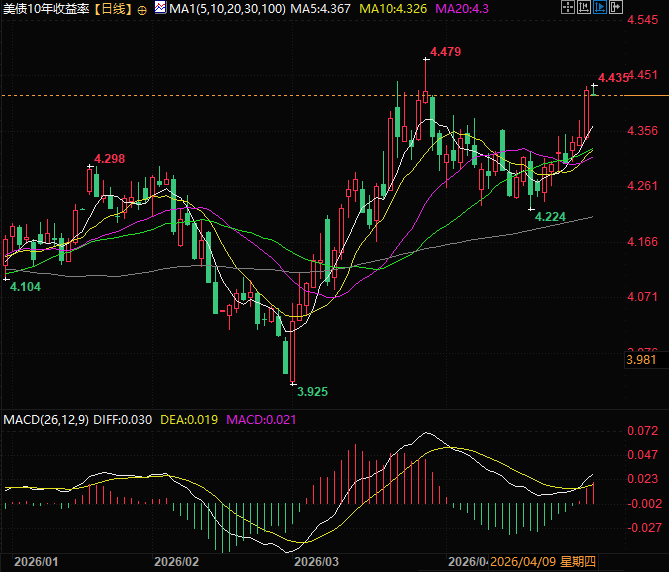
(Daily chart of the US 10-year Treasury yield, source: EasyTrade)
Despite facing multiple negative factors such as the Federal Reserve's hawkish shift, soaring US Treasury yields, and a stronger dollar, gold prices have shown resilience, exhibiting a "no decline despite negative news" trend. This perfectly aligns with the previously mentioned scenario of "all negative factors being priced in," and the core logic is as follows:
The negative news has been fully priced in: The market had already digested the impact of the cooling interest rate cut expectations. Although the Fed's hawkish signal was strong, it did not exceed the expected boundaries. Instead, it created a market mentality of "all the bad news has been priced in". The short-selling power was released in advance, and there was a lack of motivation to further suppress gold prices.
Hedging demand: The potential risks of geopolitical conflict in the Middle East have not been eliminated, and uncertainties in energy supply remain. The safe-haven demand brought about by geopolitical risks provides underlying support for gold prices, partially offsetting the pressure of rising interest rates.
Central bank gold purchases provide a floor: Global central banks continue to diversify their reserves, and the trend of increasing gold holdings remains unchanged. Major economies such as China have increased their gold holdings for several consecutive months, providing long-term support for gold prices and limiting the downside potential.
Reversal of Expectations: The market has begun to speculate on the long-term logic that "high interest rates will eventually suppress the economy." Although short-term interest rate cuts have been delayed, the baseline expectation of long-term easing remains unchanged. Once economic data weakens or inflation falls, gold prices are expected to rebound quickly. Therefore, some funds have positioned themselves in advance to support the current price.
The hawkish shift at the Fed's April meeting is the core logic behind the rise in US Treasury bonds. Gold, which is most sensitive to this, did not fall despite the negative news, presenting a buying opportunity around 4500. This opportunity has been mentioned in previous articles.
From a technical perspective, we need to observe whether gold prices can return to the upward channel and the support level around 4500, which remains the most critical support level in the near term.
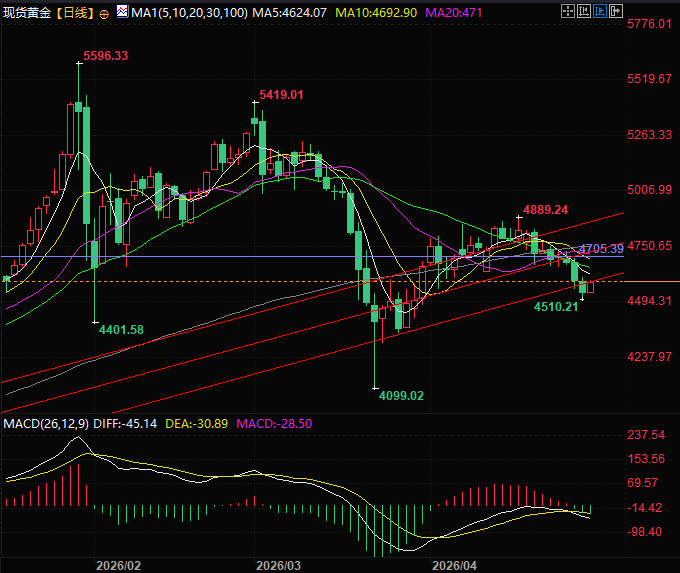
(Spot gold daily chart, source: EasyForex subsidiary)
At 15:42 Beijing time, spot gold is currently trading at $4,595 per ounce.
This meeting saw the most dissenting votes since October 1992, with four. Among these dissenting votes were three that advocated for a rate hike and one that advocated for a rate cut – a rare occurrence . Milan, who consistently advocates for rate cuts , is not discussed here. The main issue was the strong hawkish dissent from three voting members: Cleveland Fed President Hammark, Minneapolis Fed President Kashkari, and Dallas Fed President Logan. They disagreed with the policy statement's implicit easing stance, directly lowering market expectations for a Fed rate cut this year and causing overall US Treasury yields to surge.
The core demands of these three hawkish committee members are very clear: they want the statement to remove the phrase "in consideration of the magnitude and timing of further adjustments to the target range for the federal funds rate," with the word "further" being interpreted by the market as an implicit indication of a rate cut.
They prefer policy guidance that explicitly states "the next interest rate adjustment may be a rate hike or a rate cut," thus completely weakening expectations of unilateral easing and demonstrating a high degree of vigilance against inflation risks.
Federal Reserve Chairman Jerome Powell further confirmed the marginal hawkish shift in the policy stance at the post-meeting press conference.
He admitted that the wording changes in this statement were highly controversial, with more committee members supporting the more hawkish revisions compared to the March meeting. He also emphasized the “broad potential consequences” and “generally high degree of uncertainty” brought about by the Middle East geopolitical conflict, making it clear that the Federal Reserve needs to wait for the marginal trade-off between inflation and employment to become fully clear before adjusting its policy path.
Powell also pointed out that energy supply shocks pose a two-way risk to the Fed’s dual mandate of full employment and price stability. The current policy stance is sufficient to deal with the shock, which means that the Fed will not blindly ease monetary policy due to economic growth pressures, reinforcing a cautious hawkish stance of “wait and see + data dependence”.
It is worth noting that this meeting is likely to be the final meeting attended by Powell as Chairman of the Federal Reserve. He pledged to remain on the board until the relevant legal investigation is fully concluded and emphasized that the Federal Reserve's policy-making must remain independent and free from political interference, setting the tone for an "independent continuation" of policy transition for Chairman-designate Warsh.
Dramatic shift in CME interest rate futures pricing: Expectations for rate cuts plummet, while the risk of rate hikes increases.
The interest rate futures data from CME's FedWatch tool directly reflects the dramatic adjustment in market expectations for the Fed's policy path, showing a significant trend of continuously cooling expectations for rate cuts and the beginning of pricing in the risk of rate hikes:
In the short term (June-September): the probability of keeping interest rates unchanged in June is as high as 98.6%, and the probability of a cumulative rate cut of 25 basis points is only 1.4%; the probability of keeping rates unchanged in July is 96.5%, and the probability of a rate cut is 3.4%; the probability of keeping rates unchanged in September is 96.1%, and the probability of a rate cut is 3.8%. The market has basically ruled out the possibility of a short-term rate cut this year.
Year-end (December): A disruptive shift is expected, with the probability of keeping interest rates unchanged at 85.5%, the probability of a cumulative 25 basis point rate cut plummeting from about 20% to 1%, while the probability of a cumulative 25 basis point rate hike soaring from 0 to 13.5%. This shift highlights the market's reassessment of inflation resilience and the risks of policy shift.
This pricing adjustment is essentially a direct reaction to the internal divisions and hawkish signals within the Federal Reserve. The market has shifted from the baseline expectation of "gradual rate cuts" to risk pricing of "high interest rates being maintained for a long time" or even "not ruling out rate hikes," completely changing the previous expectation of unilateral easing.
Morgan Stanley predicts a major shift: interest rates will remain unchanged in 2026, with rate cuts postponed until 2027.
Wall Street institutions have also drastically adjusted their predictions on the Federal Reserve's policy path, with Morgan Stanley's shift in forecasts being particularly representative.
The bank had previously expected the Federal Reserve to implement two 25-basis-point rate cuts in September and December 2026. However, after the April meeting, based on its assessment of persistent inflation and economic resilience, it significantly revised its forecast: interest rates will remain unchanged throughout 2026, with the first rate cuts postponed to January and March 2027 , each a 25-basis-point cut, in order to gradually move towards a neutral policy rate of about 3%.
This adjustment is not an isolated phenomenon; multiple institutions have reinforced the stance of "maintaining high interest rates for a longer period." Morgan Stanley's core logic lies in the fact that the current macroeconomic environment is fundamentally different from the period of soaring inflation in 2021-2022—there are no large-scale fiscal transfer payments and the labor market is not extremely tight. While this can curb the spread of core inflation, it also means that the pace of inflation decline is slowing down. The Federal Reserve lacks the fundamental support for rapid interest rate cuts and needs to wait for inflation to more clearly decline toward the 2% target before initiating an easing cycle.
US Treasury yields surged across the board by more than 1%: Hawkish expectations and geopolitical risks combined.
The Federal Reserve's hawkish signals and adjustments in market expectations triggered a sharp reaction in the US Treasury market, with yields across all maturities rising sharply by more than 1%, forming a typical "hawkish sell-off." Among them, the 2-year Treasury yield, which is sensitive to policy rates, led the rise, once approaching 3%, while the 10-year Treasury yield rose by 1.84%.
The core drivers of rising yields include three aspects: First, the internal divisions and hawkish statements within the Federal Reserve have strengthened expectations of "high interest rates for a long time," which has depressed bond prices.
Second, the escalating geopolitical conflict in the Middle East has driven up oil prices, exacerbated inflation expectations, and weakened the attractiveness of bonds.
Third, the market's increased pricing of the risk of an interest rate hike in 2027 has further pushed up long-term yields, resulting in an overall upward shift in the yield curve.
This significant increase in yields directly raises the holding costs of non-interest-bearing assets such as gold, theoretically creating a significant negative impact on gold prices.
(Daily chart of the US 10-year Treasury yield, source: EasyTrade)
Gold prices did not fall despite negative news: the logic of "bad news exhausted" becomes apparent.
Despite facing multiple negative factors such as the Federal Reserve's hawkish shift, soaring US Treasury yields, and a stronger dollar, gold prices have shown resilience, exhibiting a "no decline despite negative news" trend. This perfectly aligns with the previously mentioned scenario of "all negative factors being priced in," and the core logic is as follows:
The negative news has been fully priced in: The market had already digested the impact of the cooling interest rate cut expectations. Although the Fed's hawkish signal was strong, it did not exceed the expected boundaries. Instead, it created a market mentality of "all the bad news has been priced in". The short-selling power was released in advance, and there was a lack of motivation to further suppress gold prices.
Hedging demand: The potential risks of geopolitical conflict in the Middle East have not been eliminated, and uncertainties in energy supply remain. The safe-haven demand brought about by geopolitical risks provides underlying support for gold prices, partially offsetting the pressure of rising interest rates.
Central bank gold purchases provide a floor: Global central banks continue to diversify their reserves, and the trend of increasing gold holdings remains unchanged. Major economies such as China have increased their gold holdings for several consecutive months, providing long-term support for gold prices and limiting the downside potential.
Reversal of Expectations: The market has begun to speculate on the long-term logic that "high interest rates will eventually suppress the economy." Although short-term interest rate cuts have been delayed, the baseline expectation of long-term easing remains unchanged. Once economic data weakens or inflation falls, gold prices are expected to rebound quickly. Therefore, some funds have positioned themselves in advance to support the current price.
Summary and Technical Analysis:
The hawkish shift at the Fed's April meeting is the core logic behind the rise in US Treasury bonds. Gold, which is most sensitive to this, did not fall despite the negative news, presenting a buying opportunity around 4500. This opportunity has been mentioned in previous articles.
From a technical perspective, we need to observe whether gold prices can return to the upward channel and the support level around 4500, which remains the most critical support level in the near term.
(Spot gold daily chart, source: EasyForex subsidiary)
At 15:42 Beijing time, spot gold is currently trading at $4,595 per ounce.
- Risk Warning and Disclaimer
- The market involves risk, and trading may not be suitable for all investors. This article is for reference only and does not constitute personal investment advice, nor does it take into account certain users’ specific investment objectives, financial situation, or other needs. Any investment decisions made based on this information are at your own risk.