The Bank of England held rates steady, but internal divisions and scenario forecasts are more alarming than anticipated; the pound appears calm but is actually hiding a deadly threat.
2026-04-30 19:10:55
On Thursday (April 30), at 19:00 Beijing time, the Bank of England announced its interest rate decision. The Monetary Policy Committee decided by a vote of 8-1 to maintain the benchmark interest rate at 3.75%, with only Chief Economist Peale voting in favor of an immediate rate hike of 25 basis points to 4.00%. This result was in line with expectations.
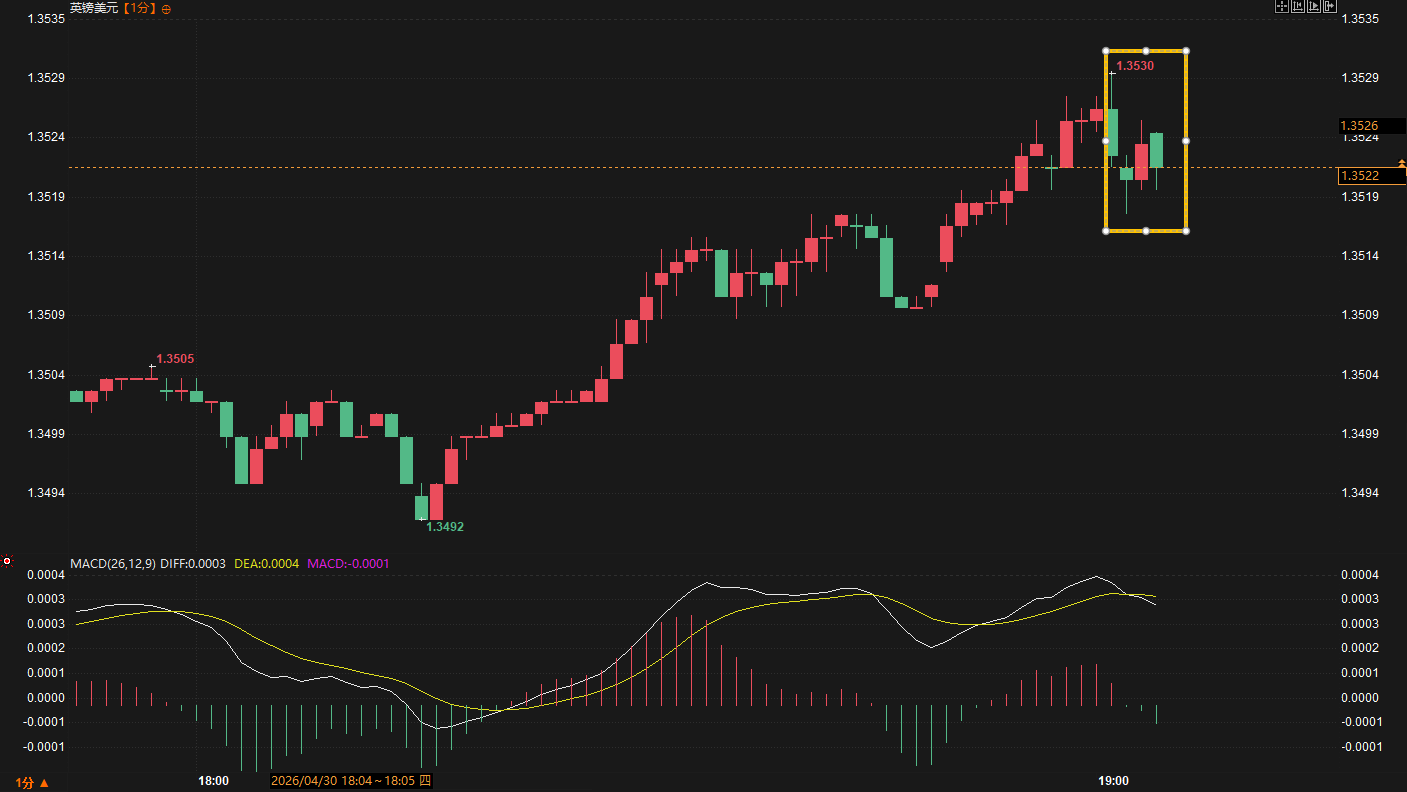
Prior to the decision, the market widely expected the Bank of England to hold rates steady, but uncertainty surrounding the Middle East situation had already led investors to price in cautiously. The pound traded around 1.35 against the dollar before the decision, experiencing brief fluctuations. Following the decision, the pound fell about 12 points against the dollar before entering a period of slight consolidation, currently trading at 1.3523. Overall, the immediate reaction was relatively mild, reflecting the market's digestion of an "expected" outcome.
The meeting took place against the backdrop of significantly increased uncertainty in energy prices due to the geopolitical situation in the Middle East. As a major natural gas consumer, the UK is particularly sensitive to energy shocks. Prior to the decision, the market had already anticipated that the UK economy would face the dual pressures of high energy costs and slowing growth, with UK government bond yields among the highest in the G7, reflecting the reality of rising financing costs.
The Bank of England's decision combined a cautious approach based on fundamentals with a pragmatic approach based on scenario analysis. Governor Bailey stated that maintaining the interest rate at 3.75% was "reasonable" given the current state of the UK economy and the uncertainties in the Middle East. The committee emphasized that it would closely monitor the situation in the Middle East and reiterated its "preparedness to take the necessary actions to ensure that CPI inflation returns to the 2% target over the medium term."
On the fundamental front, the Bank of England abandoned its usual single-center forecasting approach, instead releasing three scenarios based on energy prices and the extent of second-round effects. This reflects the high degree of uncertainty surrounding the spillover effects of the Russia-Ukraine situation and the Middle East conflict. In Scenario C (the worst-case scenario), energy prices remain high for an extended period, and inflation could peak at 6.2% in the first quarter of 2027, remaining above the 2% target for three consecutive years. In this scenario, adjusting interest rates solely based on current market expectations would likely require a "forceful tightening" of monetary policy. In the other two scenarios, the policy stance is relatively less stringent, with rising market interest rates already helping to offset some inflationary pressures.
The latest forecasts show that the average CPI will be 3.3%-4.5% in 2026 (compared to 2.2% in the February center forecast), 2.6%-4.8% in 2027 (previously 1.9%), and 1.5%-2.9% in 2028 (previously 2.0%). GDP growth forecasts have also been revised downwards: 0.7%-0.8% in 2026 (previously 0.9%) and 0.8%-1.0% in 2027 (previously 1.5%). These adjustments highlight the potential drag on prices and activity from energy cost transmission, while acknowledging that a weakening labor market and tighter financial conditions will help to subside inflation in the long term.
Historically, during similar geopolitical and energy shocks, the pound typically faces initial pressure, but if central bank signals lean towards combating inflation, the exchange rate may find support in the medium term. Following this decision, the pound fell slightly against the dollar in the short term, consistent with a typical reaction of "meeting expectations but accompanied by inflation risk warnings." Compared to the more optimistic path projected by the central bank in February, the current scenario analysis shifts the inflation center upward and the growth center downward, indicating that the policy balance remains between "data dependence" and risk prevention.
From a technical perspective, the pound/dollar exchange rate did not experience a sharp breakout before and after the decision, remaining within a narrow range. This indicates a relatively balanced short-term balance between bullish and bearish forces, while the long-term outlook depends on the actual impact of energy price movements on the UK's current account and financing costs. Overall, the decision was a mildly bearish factor for the pound, with limited direct upward pressure on UK government bond yields, but it reinforced market concerns about a potential second-round effect (wage-price spiral).
The contrast between the views of prominent institutions and market participants before and after the decision was stark. Prior to the decision, some institutions, such as HSBC, warned of a possible split vote with hawkish voters, with the market pricing in approximately 60-70 basis points of interest rate hikes this year. Some traders adopted a cautious wait-and-see attitude, fearing that unexpected hawkish signals would push up the pound. At the retail level, some voices anticipated a "clean 9-0" vote or focused on the constraints of slowing growth on policy, with overall sentiment leaning towards neutral to slightly cautious.
Following the resolution's release, institutional interpretations quickly shifted to the complexities of scenario analysis. Most institutions believed the moderate 8-1 split and Bailey's emphasis on Scenario B indicated short-term policy flexibility, with no immediate shift to a hardline approach. Traders maintained their 2026 rate hike pricing at approximately 73 basis points, reflecting an acceptance of long-term inflation risks without overreacting. Retail investors and real-time information accounts focused on facts such as "in line with expectations," "Bailey stated it was reasonable to maintain," and "Pierre alone supported a rate hike." Some discussions shifted to the amplified vulnerability of the UK to energy prices. Overall sentiment moved from a wait-and-see approach to a mild discussion of the risks of Scenario C, but no panic selling occurred. Institutional perspectives focused more on medium- to long-term policy space, while retail investors focused more on immediate price fluctuations and key statements. The bias in expectations mainly manifested in underestimating the magnitude of the split vote and initially ignoring the depth of the scenario analysis.
In the short term, the pound sterling exchange rate is likely to continue its volatile pattern, with the focus on actual energy price developments and signals from Bailey's subsequent press conference. If the situation in the Middle East does not deteriorate further, the market may gradually digest the range-bound characteristics of the scenario analysis, and the pound/dollar exchange rate may seek equilibrium around its current level. In the long term, if the risk of a second wave of economic impacts gradually emerges, policy adjustments may be necessary based on data support; conversely, if signs of economic slowdown strengthen, policy flexibility will provide a buffer for the subsequent path. Overall market movements will continue to be influenced by the interplay of global energy dynamics, labor market data, and changes in financial conditions, exhibiting a data-dependent characteristic.
Q: What are the main reasons the Bank of England is keeping interest rates unchanged this time?
The Bank of England believes that maintaining the interest rate at 3.75% is appropriate given the current economic conditions and the uncertainty in the Middle East. The Committee observed that a weakening labor market and tighter financial conditions are helping to gradually reduce inflation, while emphasizing the need to be wary of a second-round effect triggered by energy price shocks, such as changes in wage and price-setting behavior. The 8-1 vote indicates that a majority of members support the current policy stance, with only the Chief Economist favoring an immediate, slight tightening.
Q: What are the differences in the three scenario analyses regarding future inflation and growth forecasts?
The three scenarios are based on differences in energy price paths and the strength of the second-round effects. In Scenario C (the worst-case scenario), inflation is likely to be significantly higher than the target, peaking at 6.2% in the first quarter of 2027 and remaining high for the next three years, putting corresponding pressure on GDP growth. In the other scenarios, the inflation path is closer to the target, allowing for a less stringent policy stance. Overall, the forecasts have been revised upward for inflation and downward for growth compared to the February central path, highlighting the impact of uncertainty on the economic outlook.
Q: Why did the pound fall against the dollar in the short term after the resolution?
The pound fell by about 12 points in the short term, mainly due to concerns about the fragility of the UK economy stemming from scenario analysis's indication of upside risks to inflation and downside risks to growth, despite the resolution being in line with expectations. The UK's high dependence on natural gas amplified the potential impact of energy price shocks, leading to a mild adjustment in the exchange rate before entering a narrow trading range, reflecting a temporary balance between bullish and bearish forces.
Q: What are the main differences between institutional and retail investors' views before and after the resolution?
Prior to the decision, institutions focused more on the potential for a split vote by hawks and the pricing space for interest rate hikes, with some warning the market against excessive optimism; retail investors, on the other hand, tended to focus on the probability of maintaining the current stance and immediate economic data. After the decision, institutions quickly focused on the complex implications of the three scenarios and their impact on policy flexibility, while retail investors' views remained largely focused on key facts such as "in line with expectations." Overall sentiment was stable without significant divergence, but discussions about long-term risks increased.
Q: What factors will dominate the future policy direction of the Bank of England?
Future policies will remain data-dependent, with key indicators including the actual transmission path of energy prices, labor market dynamics, evidence of the second round of wage-price effects, and developments in the Middle East. The Committee has made it clear that if the risks of Scenario C materialize, more forceful action may be needed; conversely, if economic slowdown pressures emerge, policy space will be adjusted accordingly. In the near term, the market will continue to weigh the return to the inflation target against the sustainability of economic activity.
Prior to the decision, the market widely expected the Bank of England to hold rates steady, but uncertainty surrounding the Middle East situation had already led investors to price in cautiously. The pound traded around 1.35 against the dollar before the decision, experiencing brief fluctuations. Following the decision, the pound fell about 12 points against the dollar before entering a period of slight consolidation, currently trading at 1.3523. Overall, the immediate reaction was relatively mild, reflecting the market's digestion of an "expected" outcome.
The meeting took place against the backdrop of significantly increased uncertainty in energy prices due to the geopolitical situation in the Middle East. As a major natural gas consumer, the UK is particularly sensitive to energy shocks. Prior to the decision, the market had already anticipated that the UK economy would face the dual pressures of high energy costs and slowing growth, with UK government bond yields among the highest in the G7, reflecting the reality of rising financing costs.
Deep interconnect analysis
The Bank of England's decision combined a cautious approach based on fundamentals with a pragmatic approach based on scenario analysis. Governor Bailey stated that maintaining the interest rate at 3.75% was "reasonable" given the current state of the UK economy and the uncertainties in the Middle East. The committee emphasized that it would closely monitor the situation in the Middle East and reiterated its "preparedness to take the necessary actions to ensure that CPI inflation returns to the 2% target over the medium term."
On the fundamental front, the Bank of England abandoned its usual single-center forecasting approach, instead releasing three scenarios based on energy prices and the extent of second-round effects. This reflects the high degree of uncertainty surrounding the spillover effects of the Russia-Ukraine situation and the Middle East conflict. In Scenario C (the worst-case scenario), energy prices remain high for an extended period, and inflation could peak at 6.2% in the first quarter of 2027, remaining above the 2% target for three consecutive years. In this scenario, adjusting interest rates solely based on current market expectations would likely require a "forceful tightening" of monetary policy. In the other two scenarios, the policy stance is relatively less stringent, with rising market interest rates already helping to offset some inflationary pressures.
The latest forecasts show that the average CPI will be 3.3%-4.5% in 2026 (compared to 2.2% in the February center forecast), 2.6%-4.8% in 2027 (previously 1.9%), and 1.5%-2.9% in 2028 (previously 2.0%). GDP growth forecasts have also been revised downwards: 0.7%-0.8% in 2026 (previously 0.9%) and 0.8%-1.0% in 2027 (previously 1.5%). These adjustments highlight the potential drag on prices and activity from energy cost transmission, while acknowledging that a weakening labor market and tighter financial conditions will help to subside inflation in the long term.
Historically, during similar geopolitical and energy shocks, the pound typically faces initial pressure, but if central bank signals lean towards combating inflation, the exchange rate may find support in the medium term. Following this decision, the pound fell slightly against the dollar in the short term, consistent with a typical reaction of "meeting expectations but accompanied by inflation risk warnings." Compared to the more optimistic path projected by the central bank in February, the current scenario analysis shifts the inflation center upward and the growth center downward, indicating that the policy balance remains between "data dependence" and risk prevention.
From a technical perspective, the pound/dollar exchange rate did not experience a sharp breakout before and after the decision, remaining within a narrow range. This indicates a relatively balanced short-term balance between bullish and bearish forces, while the long-term outlook depends on the actual impact of energy price movements on the UK's current account and financing costs. Overall, the decision was a mildly bearish factor for the pound, with limited direct upward pressure on UK government bond yields, but it reinforced market concerns about a potential second-round effect (wage-price spiral).
The contrast between the views of prominent institutions and market participants before and after the decision was stark. Prior to the decision, some institutions, such as HSBC, warned of a possible split vote with hawkish voters, with the market pricing in approximately 60-70 basis points of interest rate hikes this year. Some traders adopted a cautious wait-and-see attitude, fearing that unexpected hawkish signals would push up the pound. At the retail level, some voices anticipated a "clean 9-0" vote or focused on the constraints of slowing growth on policy, with overall sentiment leaning towards neutral to slightly cautious.
Following the resolution's release, institutional interpretations quickly shifted to the complexities of scenario analysis. Most institutions believed the moderate 8-1 split and Bailey's emphasis on Scenario B indicated short-term policy flexibility, with no immediate shift to a hardline approach. Traders maintained their 2026 rate hike pricing at approximately 73 basis points, reflecting an acceptance of long-term inflation risks without overreacting. Retail investors and real-time information accounts focused on facts such as "in line with expectations," "Bailey stated it was reasonable to maintain," and "Pierre alone supported a rate hike." Some discussions shifted to the amplified vulnerability of the UK to energy prices. Overall sentiment moved from a wait-and-see approach to a mild discussion of the risks of Scenario C, but no panic selling occurred. Institutional perspectives focused more on medium- to long-term policy space, while retail investors focused more on immediate price fluctuations and key statements. The bias in expectations mainly manifested in underestimating the magnitude of the split vote and initially ignoring the depth of the scenario analysis.
Trend Outlook
In the short term, the pound sterling exchange rate is likely to continue its volatile pattern, with the focus on actual energy price developments and signals from Bailey's subsequent press conference. If the situation in the Middle East does not deteriorate further, the market may gradually digest the range-bound characteristics of the scenario analysis, and the pound/dollar exchange rate may seek equilibrium around its current level. In the long term, if the risk of a second wave of economic impacts gradually emerges, policy adjustments may be necessary based on data support; conversely, if signs of economic slowdown strengthen, policy flexibility will provide a buffer for the subsequent path. Overall market movements will continue to be influenced by the interplay of global energy dynamics, labor market data, and changes in financial conditions, exhibiting a data-dependent characteristic.
Frequently Asked Questions
Q: What are the main reasons the Bank of England is keeping interest rates unchanged this time?
The Bank of England believes that maintaining the interest rate at 3.75% is appropriate given the current economic conditions and the uncertainty in the Middle East. The Committee observed that a weakening labor market and tighter financial conditions are helping to gradually reduce inflation, while emphasizing the need to be wary of a second-round effect triggered by energy price shocks, such as changes in wage and price-setting behavior. The 8-1 vote indicates that a majority of members support the current policy stance, with only the Chief Economist favoring an immediate, slight tightening.
Q: What are the differences in the three scenario analyses regarding future inflation and growth forecasts?
The three scenarios are based on differences in energy price paths and the strength of the second-round effects. In Scenario C (the worst-case scenario), inflation is likely to be significantly higher than the target, peaking at 6.2% in the first quarter of 2027 and remaining high for the next three years, putting corresponding pressure on GDP growth. In the other scenarios, the inflation path is closer to the target, allowing for a less stringent policy stance. Overall, the forecasts have been revised upward for inflation and downward for growth compared to the February central path, highlighting the impact of uncertainty on the economic outlook.
Q: Why did the pound fall against the dollar in the short term after the resolution?
The pound fell by about 12 points in the short term, mainly due to concerns about the fragility of the UK economy stemming from scenario analysis's indication of upside risks to inflation and downside risks to growth, despite the resolution being in line with expectations. The UK's high dependence on natural gas amplified the potential impact of energy price shocks, leading to a mild adjustment in the exchange rate before entering a narrow trading range, reflecting a temporary balance between bullish and bearish forces.
Q: What are the main differences between institutional and retail investors' views before and after the resolution?
Prior to the decision, institutions focused more on the potential for a split vote by hawks and the pricing space for interest rate hikes, with some warning the market against excessive optimism; retail investors, on the other hand, tended to focus on the probability of maintaining the current stance and immediate economic data. After the decision, institutions quickly focused on the complex implications of the three scenarios and their impact on policy flexibility, while retail investors' views remained largely focused on key facts such as "in line with expectations." Overall sentiment was stable without significant divergence, but discussions about long-term risks increased.
Q: What factors will dominate the future policy direction of the Bank of England?
Future policies will remain data-dependent, with key indicators including the actual transmission path of energy prices, labor market dynamics, evidence of the second round of wage-price effects, and developments in the Middle East. The Committee has made it clear that if the risks of Scenario C materialize, more forceful action may be needed; conversely, if economic slowdown pressures emerge, policy space will be adjusted accordingly. In the near term, the market will continue to weigh the return to the inflation target against the sustainability of economic activity.
- Risk Warning and Disclaimer
- The market involves risk, and trading may not be suitable for all investors. This article is for reference only and does not constitute personal investment advice, nor does it take into account certain users’ specific investment objectives, financial situation, or other needs. Any investment decisions made based on this information are at your own risk.