













Spot gold rebounded due to a weaker dollar, but continued high interest rate expectations limited its upside potential.
2026-05-01 01:41:17
On Thursday (April 30), spot gold prices rebounded during the US trading session, gradually recovering from a one-month low of $4,510 reached the previous day. XAU/USD hovered around $4,620 during the session, up approximately 1.67% from the opening price.
A weaker dollar provided momentum for the rebound.
The main factor driving the rebound in gold prices that day was the weakening of the US dollar index. The dollar index is currently down about 0.68%, around 98.28 points. Earlier warnings from Tokyo about increased foreign exchange intervention further exacerbated the dollar's weakness, providing some support for gold prices.
High interest rate expectations limit upside potential for gold prices.
Despite an intraday rebound, gold, as a non-yielding metal, is still significantly limited from further gains by expectations of higher long-term interest rates. Market concerns are widespread that the Federal Reserve will maintain a policy of "higher interest rates for a longer period," primarily stemming from continued tensions in the Middle East.
US President Trump stated that the US will continue its naval blockade of Iran until a nuclear agreement is reached with Tehran. Meanwhile, uncertainty surrounding the reopening of the Strait of Hormuz has pushed up oil prices, exacerbated inflation concerns, and led to market expectations that major central banks will maintain high interest rates for an extended period, and may even further tighten monetary policy.
Federal Reserve Policy and Market Expectations
The Federal Reserve kept interest rates unchanged on Wednesday and expressed concerns about the inflation outlook. According to the CMEFedWatch tool, the market now expects the Fed to keep rates unchanged throughout 2026, while the probability of a rate hike in April 2027 has risen sharply from 0.8% a week ago to 23.8%.
The Bank of England also kept interest rates unchanged and put forward several scenarios regarding the economic impact of the war with Iran, one of which might require a “forceful” increase in borrowing costs.
The latest economic data is mixed.
The annualized growth rate of US real GDP in the first quarter of 2026 is 2.0%, higher than 0.5% in the previous quarter, but lower than the market expectation of 2.3%. The PCE price index rose 0.7% month-on-month in March, the largest increase since June 2022; the core PCE rose 0.3% month-on-month, in line with market expectations.
Furthermore, for the week ending April 25, initial jobless claims in the United States fell to 189,000, far below the expected 215,000, marking the lowest level since 1969. These data had a relatively neutral impact on gold prices.
Technical Analysis
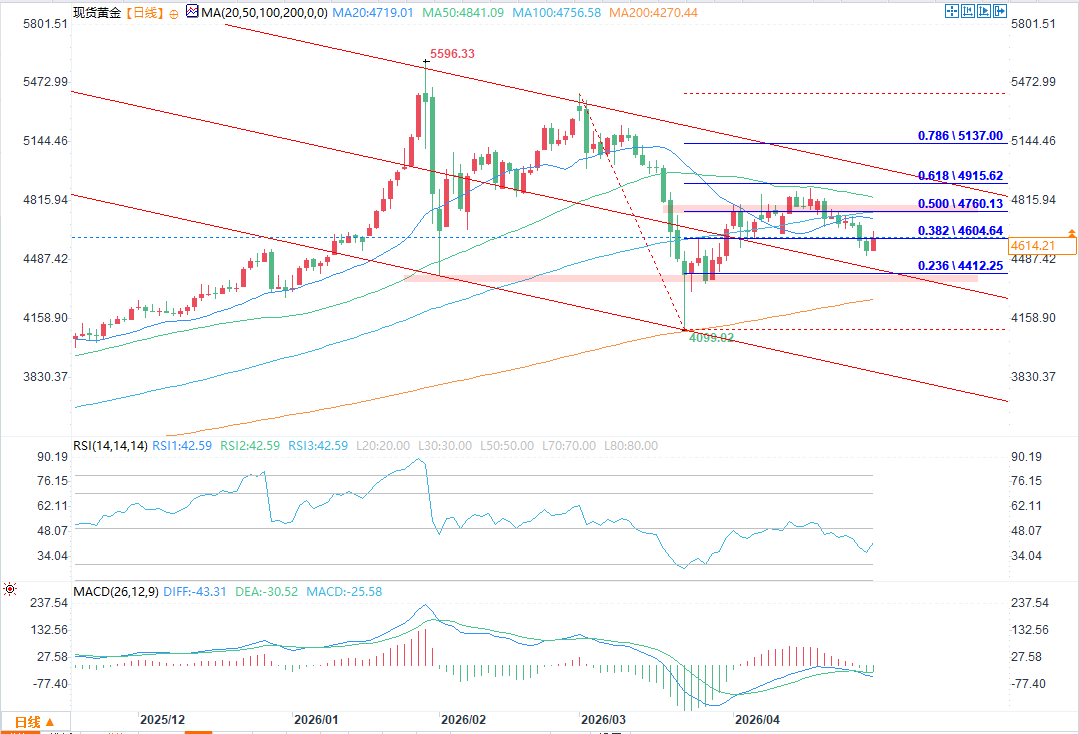
(Spot gold daily chart source: FX678)
From the daily chart of gold, the current price is in a downward channel since the January high. There is double support below, formed by the lower rail of the channel and the 23.6% Fibonacci level, while it is suppressed by the 50% Fibonacci resistance of the March decline.
In terms of technical indicators, short-term moving averages are in a bearish alignment, the MACD is still below the zero line but the downward momentum has weakened, and the RSI is in a neutral to weak range with no clear reversal signal yet.
As long as the price does not effectively fall below the 200-day moving average of 4270, the long-term upward trend remains intact; the current movement is merely a pullback and consolidation within the upward trend.
In the short term, attention should be paid to the directional breakout of the 4604-4760 range. An upward breakout above the 50% Fibonacci resistance would open up room for a rebound, while a downward breakout below the support zone could lead to a further test of the lower channel line.
Institutional Views
David Meger, head of metals trading at High Ridge Futures, said that the acceleration in energy prices slowed slightly on Thursday, and the decline in the dollar provided support for the gold market, which is currently focused on the Federal Reserve's interest rate expectations.
Citibank analysts believe that gold will face strong selling pressure in the short term due to the uncertainty surrounding the Middle East situation, but its appeal as a safe-haven asset is expected to re-emerge over time. The bank maintains its three-month gold price target of $4,300 per ounce and its six- to twelve-month target of $5,000 per ounce.
Overall, gold prices rebounded on Thursday, driven by a weaker dollar, but upside potential remains limited due to inflation concerns stemming from geopolitical conflicts and a high-interest-rate environment. Spot gold has fallen more than 1% so far this month, and the possibility of a second consecutive month of decline remains.
A weaker dollar provided momentum for the rebound.
The main factor driving the rebound in gold prices that day was the weakening of the US dollar index. The dollar index is currently down about 0.68%, around 98.28 points. Earlier warnings from Tokyo about increased foreign exchange intervention further exacerbated the dollar's weakness, providing some support for gold prices.
High interest rate expectations limit upside potential for gold prices.
Despite an intraday rebound, gold, as a non-yielding metal, is still significantly limited from further gains by expectations of higher long-term interest rates. Market concerns are widespread that the Federal Reserve will maintain a policy of "higher interest rates for a longer period," primarily stemming from continued tensions in the Middle East.
US President Trump stated that the US will continue its naval blockade of Iran until a nuclear agreement is reached with Tehran. Meanwhile, uncertainty surrounding the reopening of the Strait of Hormuz has pushed up oil prices, exacerbated inflation concerns, and led to market expectations that major central banks will maintain high interest rates for an extended period, and may even further tighten monetary policy.
Federal Reserve Policy and Market Expectations
The Federal Reserve kept interest rates unchanged on Wednesday and expressed concerns about the inflation outlook. According to the CMEFedWatch tool, the market now expects the Fed to keep rates unchanged throughout 2026, while the probability of a rate hike in April 2027 has risen sharply from 0.8% a week ago to 23.8%.
The Bank of England also kept interest rates unchanged and put forward several scenarios regarding the economic impact of the war with Iran, one of which might require a “forceful” increase in borrowing costs.
The latest economic data is mixed.
The annualized growth rate of US real GDP in the first quarter of 2026 is 2.0%, higher than 0.5% in the previous quarter, but lower than the market expectation of 2.3%. The PCE price index rose 0.7% month-on-month in March, the largest increase since June 2022; the core PCE rose 0.3% month-on-month, in line with market expectations.
Furthermore, for the week ending April 25, initial jobless claims in the United States fell to 189,000, far below the expected 215,000, marking the lowest level since 1969. These data had a relatively neutral impact on gold prices.
Technical Analysis
(Spot gold daily chart source: FX678)
From the daily chart of gold, the current price is in a downward channel since the January high. There is double support below, formed by the lower rail of the channel and the 23.6% Fibonacci level, while it is suppressed by the 50% Fibonacci resistance of the March decline.
In terms of technical indicators, short-term moving averages are in a bearish alignment, the MACD is still below the zero line but the downward momentum has weakened, and the RSI is in a neutral to weak range with no clear reversal signal yet.
As long as the price does not effectively fall below the 200-day moving average of 4270, the long-term upward trend remains intact; the current movement is merely a pullback and consolidation within the upward trend.
In the short term, attention should be paid to the directional breakout of the 4604-4760 range. An upward breakout above the 50% Fibonacci resistance would open up room for a rebound, while a downward breakout below the support zone could lead to a further test of the lower channel line.
Institutional Views
David Meger, head of metals trading at High Ridge Futures, said that the acceleration in energy prices slowed slightly on Thursday, and the decline in the dollar provided support for the gold market, which is currently focused on the Federal Reserve's interest rate expectations.
Citibank analysts believe that gold will face strong selling pressure in the short term due to the uncertainty surrounding the Middle East situation, but its appeal as a safe-haven asset is expected to re-emerge over time. The bank maintains its three-month gold price target of $4,300 per ounce and its six- to twelve-month target of $5,000 per ounce.
Overall, gold prices rebounded on Thursday, driven by a weaker dollar, but upside potential remains limited due to inflation concerns stemming from geopolitical conflicts and a high-interest-rate environment. Spot gold has fallen more than 1% so far this month, and the possibility of a second consecutive month of decline remains.
- Risk Warning and Disclaimer
- The market involves risk, and trading may not be suitable for all investors. This article is for reference only and does not constitute personal investment advice, nor does it take into account certain users’ specific investment objectives, financial situation, or other needs. Any investment decisions made based on this information are at your own risk.

