













Rising risk aversion supported a slight rebound in gold prices, but the high level of the US dollar index limited the upside potential for gold.
2026-05-01 08:44:45
Gold prices rebounded again during Friday's Asian trading session, driven by geopolitical tensions, and traded around $4,620. As tensions between the US and Iran continue to rise, market concerns about a further escalation of the situation in the Middle East have intensified, particularly regarding uncertainties surrounding key energy transport routes. This has led to a renewed inflow of safe-haven funds into the gold market, pushing prices back to near recent highs. Logically, geopolitical risks typically strengthen gold's safe-haven appeal, attracting investment and thus supporting price increases.

However, unlike previous unilateral safe-haven buying sprees, this round of gold price increases faces more macroeconomic constraints. The market is currently reassessing the inflation path; if tensions in the Middle East persist and drive up energy prices, it will indirectly raise global inflation levels. In this scenario, the Federal Reserve may be forced to maintain high interest rates for a longer period, thus diminishing gold's appeal. Since gold itself does not generate interest income, its opportunity cost increases in a high-interest-rate environment, naturally suppressing its price.
From a policy perspective, the Federal Reserve recently maintained interest rates unchanged while emphasizing that the economic outlook remains highly uncertain, particularly due to external shocks from geopolitical risks. This implies that monetary policy is unlikely to shift significantly towards easing in the short term, further limiting the upside potential for gold. Therefore, the current gold market exhibits a typical dual-game pattern of "safe-haven support + interest rate suppression."
Market sentiment is turning cautious. On one hand, risk aversion is driving capital inflows; on the other hand, high prices are prompting some profit-taking, slowing the upward momentum. This divergence in sentiment has led to increased volatility in gold prices, but a clear trend has not yet been fully established.
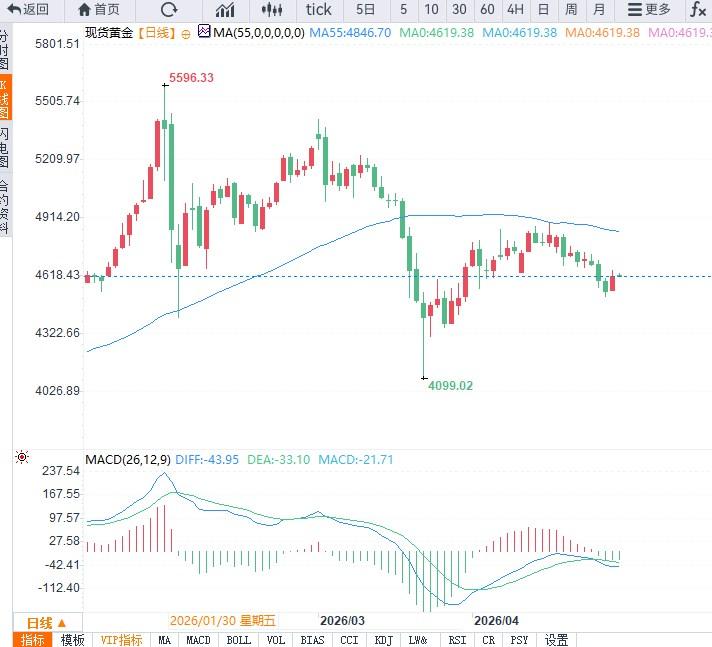
From a technical perspective, gold's daily chart structure remains in a range-bound, slightly bullish pattern. The price rebounded after testing key support, indicating that the bulls still have some control. In the short term, the $4600 level has become a crucial support area , having repeatedly seen buying pressure and possessing strong defensive significance; a breach of this level could trigger further pullbacks.
On the upside, the $4650-$4680 range forms a short-term resistance zone . This area is a dense cluster of previous highs and a key level that bulls need to break through. If the price can effectively hold above this area, it may open up further upside potential; conversely, if it repeatedly fails to break through, gold may enter a high-level consolidation phase.
Momentum indicators show that the RSI remains in the neutral-to-strong range, indicating that upward momentum has not yet fully weakened; the MACD is in a recovery phase, showing that the market is gradually recovering from the previous pullback, but a strong trend signal has not yet formed. Overall, the technical and fundamental indicators are consistent, both pointing to a structure of slightly bullish but limited volatility.
Editor's Viewpoint : The core contradiction in the current gold market lies in the hedging between safe-haven demand and interest rate expectations. In the short term, the situation in the Middle East will remain the dominant factor, providing a floor for gold prices. However, if inflation expectations continue to rise and reinforce the high-interest-rate environment, the upside potential for gold will be significantly suppressed. The subsequent trend is expected to be mainly range-bound, and investors should pay close attention to changes in geopolitical risks and marginal adjustments in expectations regarding Federal Reserve policy.
However, unlike previous unilateral safe-haven buying sprees, this round of gold price increases faces more macroeconomic constraints. The market is currently reassessing the inflation path; if tensions in the Middle East persist and drive up energy prices, it will indirectly raise global inflation levels. In this scenario, the Federal Reserve may be forced to maintain high interest rates for a longer period, thus diminishing gold's appeal. Since gold itself does not generate interest income, its opportunity cost increases in a high-interest-rate environment, naturally suppressing its price.
From a policy perspective, the Federal Reserve recently maintained interest rates unchanged while emphasizing that the economic outlook remains highly uncertain, particularly due to external shocks from geopolitical risks. This implies that monetary policy is unlikely to shift significantly towards easing in the short term, further limiting the upside potential for gold. Therefore, the current gold market exhibits a typical dual-game pattern of "safe-haven support + interest rate suppression."
Market sentiment is turning cautious. On one hand, risk aversion is driving capital inflows; on the other hand, high prices are prompting some profit-taking, slowing the upward momentum. This divergence in sentiment has led to increased volatility in gold prices, but a clear trend has not yet been fully established.
From a technical perspective, gold's daily chart structure remains in a range-bound, slightly bullish pattern. The price rebounded after testing key support, indicating that the bulls still have some control. In the short term, the $4600 level has become a crucial support area , having repeatedly seen buying pressure and possessing strong defensive significance; a breach of this level could trigger further pullbacks.
On the upside, the $4650-$4680 range forms a short-term resistance zone . This area is a dense cluster of previous highs and a key level that bulls need to break through. If the price can effectively hold above this area, it may open up further upside potential; conversely, if it repeatedly fails to break through, gold may enter a high-level consolidation phase.
Momentum indicators show that the RSI remains in the neutral-to-strong range, indicating that upward momentum has not yet fully weakened; the MACD is in a recovery phase, showing that the market is gradually recovering from the previous pullback, but a strong trend signal has not yet formed. Overall, the technical and fundamental indicators are consistent, both pointing to a structure of slightly bullish but limited volatility.
Editor's Viewpoint : The core contradiction in the current gold market lies in the hedging between safe-haven demand and interest rate expectations. In the short term, the situation in the Middle East will remain the dominant factor, providing a floor for gold prices. However, if inflation expectations continue to rise and reinforce the high-interest-rate environment, the upside potential for gold will be significantly suppressed. The subsequent trend is expected to be mainly range-bound, and investors should pay close attention to changes in geopolitical risks and marginal adjustments in expectations regarding Federal Reserve policy.
- Risk Warning and Disclaimer
- The market involves risk, and trading may not be suitable for all investors. This article is for reference only and does not constitute personal investment advice, nor does it take into account certain users’ specific investment objectives, financial situation, or other needs. Any investment decisions made based on this information are at your own risk.

