Tensions in the Middle East boosted safe-haven demand, coupled with a stronger US dollar, causing AUD/USD to fluctuate around the 0.7200 level.
2026-05-01 14:54:45
The Australian dollar continued its decline against the US dollar in Asian trading on Friday, falling to around 0.7200, showing overall weakness. The market's main focus remains on geopolitical risks and monetary policy expectations, with a clear struggle between the US dollar and the Australian dollar.

From an external perspective, the ongoing tensions in the Middle East have fueled risk aversion in the market, driving funds towards safe-haven assets such as the US dollar. The US's continued hardline stance on key energy routes has raised concerns about global supply chains and energy prices, increasing the attractiveness of the US dollar in the short term and thus putting downward pressure on the Australian dollar.
Meanwhile, the upcoming ISM manufacturing data from the United States is also a focus of market attention. Strong data will further strengthen the support for the US dollar; conversely, weak data may alleviate downward pressure on the Australian dollar.
From Australia's own fundamentals perspective, inflation data remains a key supporting factor. Latest data shows that Australia's CPI rose 4.6% year-on-year in March, slightly lower than expected, but still significantly higher than the central bank's target range. This means that inflationary pressures have not yet eased, and market expectations for further interest rate hikes by the Reserve Bank of Australia persist, thus providing medium-term support for the Australian dollar.
Therefore, the current AUD/USD exchange rate exhibits a pattern of "weak external and stable internal": the strong US dollar externally suppresses the exchange rate, while internal inflation supports and limits the downside potential.
From a technical perspective, the AUD/USD daily chart has entered a consolidation phase. The price retreated after encountering resistance near 0.7250, with the 0.7200 level becoming a short-term support/resistance level . A decisive break below this level could open up further downside potential, targeting the 0.7150 area.
In terms of momentum indicators, the RSI has gradually fallen back to the neutral range, indicating weakening bullish momentum; the MACD shows signs of overbought conditions, suggesting a slowdown in the upward trend. Overall, the short-term trend is weak, but no clear breakdown structure has formed.
The resistance levels are concentrated in the 0.7250 and 0.7300 area . If the price can regain its footing, it is expected to resume its rebound.
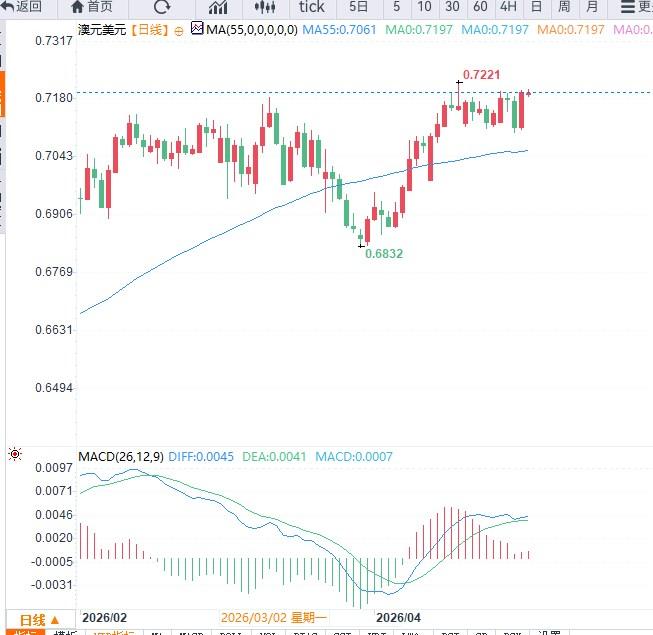
Editor's Viewpoint : The Australian dollar is currently caught in a tug-of-war between "inflation support" and "safe-haven selling pressure," with its short-term direction largely dependent on the performance of the US dollar and geopolitical developments. As long as key support levels hold, the exchange rate is expected to remain range-bound; however, if the US dollar continues to strengthen, the Australian dollar may face further downward pressure. A cautious approach is advised, focusing on key data and risk events for directional guidance.
From an external perspective, the ongoing tensions in the Middle East have fueled risk aversion in the market, driving funds towards safe-haven assets such as the US dollar. The US's continued hardline stance on key energy routes has raised concerns about global supply chains and energy prices, increasing the attractiveness of the US dollar in the short term and thus putting downward pressure on the Australian dollar.
Meanwhile, the upcoming ISM manufacturing data from the United States is also a focus of market attention. Strong data will further strengthen the support for the US dollar; conversely, weak data may alleviate downward pressure on the Australian dollar.
From Australia's own fundamentals perspective, inflation data remains a key supporting factor. Latest data shows that Australia's CPI rose 4.6% year-on-year in March, slightly lower than expected, but still significantly higher than the central bank's target range. This means that inflationary pressures have not yet eased, and market expectations for further interest rate hikes by the Reserve Bank of Australia persist, thus providing medium-term support for the Australian dollar.
Therefore, the current AUD/USD exchange rate exhibits a pattern of "weak external and stable internal": the strong US dollar externally suppresses the exchange rate, while internal inflation supports and limits the downside potential.
From a technical perspective, the AUD/USD daily chart has entered a consolidation phase. The price retreated after encountering resistance near 0.7250, with the 0.7200 level becoming a short-term support/resistance level . A decisive break below this level could open up further downside potential, targeting the 0.7150 area.
In terms of momentum indicators, the RSI has gradually fallen back to the neutral range, indicating weakening bullish momentum; the MACD shows signs of overbought conditions, suggesting a slowdown in the upward trend. Overall, the short-term trend is weak, but no clear breakdown structure has formed.
The resistance levels are concentrated in the 0.7250 and 0.7300 area . If the price can regain its footing, it is expected to resume its rebound.
Editor's Viewpoint : The Australian dollar is currently caught in a tug-of-war between "inflation support" and "safe-haven selling pressure," with its short-term direction largely dependent on the performance of the US dollar and geopolitical developments. As long as key support levels hold, the exchange rate is expected to remain range-bound; however, if the US dollar continues to strengthen, the Australian dollar may face further downward pressure. A cautious approach is advised, focusing on key data and risk events for directional guidance.
- Risk Warning and Disclaimer
- The market involves risk, and trading may not be suitable for all investors. This article is for reference only and does not constitute personal investment advice, nor does it take into account certain users’ specific investment objectives, financial situation, or other needs. Any investment decisions made based on this information are at your own risk.