Warning! A crisis of "desensitization" of the Japanese yen is brewing.
2026-05-01 17:45:22
On Friday, May 1st, the USD/JPY exchange rate fluctuated narrowly around 156.60 during the European session. Over the past 48 hours, it plunged from around 160.00 to 155.50, before quickly recovering some of its losses to its current level. This movement closely mirrors potential small-scale foreign exchange intervention by Japanese authorities, but the market did not experience the sustained strong rebound seen after previous interventions, indicating that Tokyo is taking a more cautious approach. On the fundamental front, ongoing geopolitical conflicts in the Middle East continue to push up Japan's energy import costs, and the Bank of Japan faces additional obstacles in its path to interest rate normalization. Negative factors are still accumulating, thus diminishing the effectiveness of intervention.

Over the past two days, the USD/JPY 10-minute chart has shown a typical V-shaped reversal pattern: after a rapid drop to a low of 155.50, the bearish momentum quickly weakened, and the bulls recovered in the 156.50-156.60 range. The daily Bollinger Bands show the middle band at 159.10, the upper band at 160.85, and the lower band at 157.35. The current price is still in the lower band's deviated area, indicating a technical correction needed after short-term overselling.
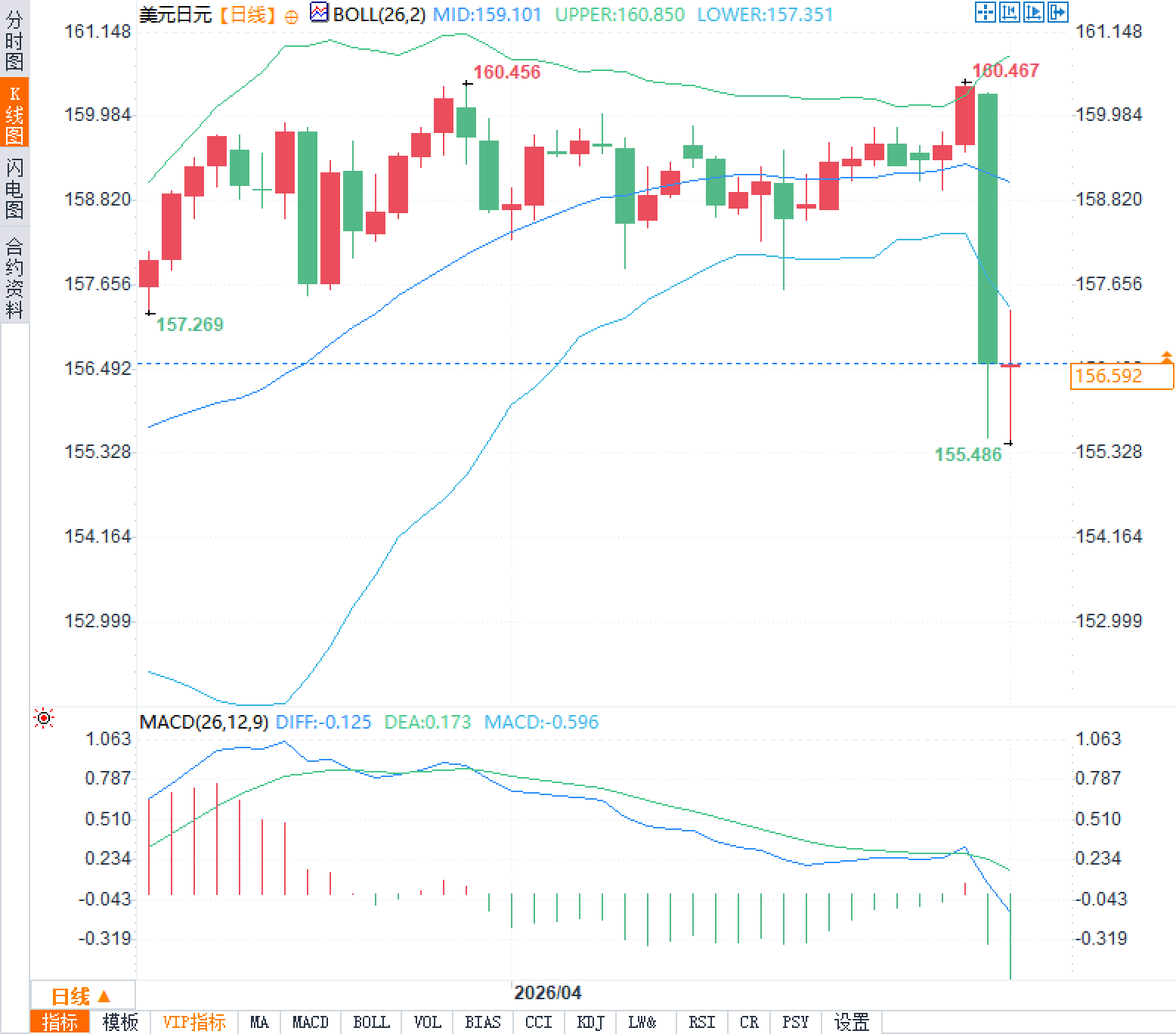
The market generally attributes the recent yen rebound to proxy intervention by the Japanese Ministry of Finance through the Bank of Japan. However, unlike the sharp, one-sided rallies that occurred during interventions in 2022 and 2024, this rebound has been mild and lacks sustainability. Tokyo has clearly adopted a "small steps, quick progress" strategy to avoid expending too much ammunition at once. This contrasts sharply with the current massive daily trading volume of over $1 trillion in the global foreign exchange market; interventions of $2 to $3 billion per day can only have a short-term disruptive effect and are unlikely to change the medium- to long-term supply and demand dynamics. The accuracy of signal transmission is crucial: overly weak actions may be interpreted by the market as "willing but unable," thus weakening subsequent deterrent power.
The expenditure scale and current reserve structure of Japan's three past large-scale intervention operations can be clearly compared in the table below:
Japan's total foreign exchange reserves are approximately $1.2 trillion, but over 80% are allocated to various securities assets, with US Treasury bonds accounting for the largest share. This means that the actual readily available cash reserves are far lower than the stated figures. If forced to sell large amounts of government bonds to stabilize the yen, it could very likely push up US Treasury yields, thereby supporting the dollar index through the interest rate channel, creating a "self-fulfilling" effect that contradicts policy objectives. This structural constraint forces Tokyo to precisely calculate the balance between marginal costs and market reactions before each intervention.
All current macroeconomic variables point to downward pressure on the yen. Despite the Bank of Japan maintaining its gradual interest rate hike path, high energy prices due to the Middle East conflict are directly eroding Japan's trade surplus, creating a double squeeze from rising import costs and diminished export competitiveness. Coupled with the continued market speculation on Japan's policy direction, funds are continuously flowing out of yen assets. While the US dollar index has not experienced a unilateral surge, its resilience relative to other G10 currencies remains, and the attractiveness of high-yield currencies in a global risk appetite recovery is further squeezing the space for low-yield yen.
These fundamental factors are not short-term disturbances, but rather medium- to long-term structural problems. Even if the Bank of Japan raises interest rates by another 25 basis points in the coming months, the narrowing of the interest rate differential will not be enough to reverse the trend of capital outflows. Analysts believe that in this context, any foreign exchange intervention can only be a supplementary tool, not a fundamental solution. If Tokyo relies too heavily on intervention while neglecting to build domestic economic resilience, it will face the risk of both reserve depletion and damage to policy credibility in the long run.
Foreign exchange intervention is essentially an information game, not a simple contest of funds. Japan possesses the world's largest reserve "ammunition depot," but market respect depends on the strength of the signal rather than the absolute amount. In the past, the key to effective intervention was releasing a sufficiently strong "warning signal" in one go, convincing traders that larger-scale action might follow, thus prompting a proactive withdrawal. Currently, if Tokyo continues to employ small-scale, decentralized operations, it is highly likely to create a "desensitization" effect in the market: traders will perceive intervention as normal noise rather than a real threat, thereby increasing leverage in shorting the yen.
The sheer volume of daily liquidity in the foreign exchange market means that a single intervention of $2 billion to $3 billion represents a negligible portion of overall trading volume. Its true value lies in altering market expectations. If Tokyo repeatedly sends signals of much talk but little action, market participants will reassess Japan's resolve and ability to maintain exchange rate stability, potentially leading to a self-reinforcing depreciation spiral. Finding the optimal balance between "showing presence" and "avoiding waste" is the most challenging issue currently facing the Japanese monetary authorities.
Interpretation of Recent Price Fluctuations and Intervention Signals
Over the past two days, the USD/JPY 10-minute chart has shown a typical V-shaped reversal pattern: after a rapid drop to a low of 155.50, the bearish momentum quickly weakened, and the bulls recovered in the 156.50-156.60 range. The daily Bollinger Bands show the middle band at 159.10, the upper band at 160.85, and the lower band at 157.35. The current price is still in the lower band's deviated area, indicating a technical correction needed after short-term overselling.
The market generally attributes the recent yen rebound to proxy intervention by the Japanese Ministry of Finance through the Bank of Japan. However, unlike the sharp, one-sided rallies that occurred during interventions in 2022 and 2024, this rebound has been mild and lacks sustainability. Tokyo has clearly adopted a "small steps, quick progress" strategy to avoid expending too much ammunition at once. This contrasts sharply with the current massive daily trading volume of over $1 trillion in the global foreign exchange market; interventions of $2 to $3 billion per day can only have a short-term disruptive effect and are unlikely to change the medium- to long-term supply and demand dynamics. The accuracy of signal transmission is crucial: overly weak actions may be interpreted by the market as "willing but unable," thus weakening subsequent deterrent power.
Historical intervention data comparison and reserve structure analysis
The expenditure scale and current reserve structure of Japan's three past large-scale intervention operations can be clearly compared in the table below:
| Intervention period | Expenditure Amount (USD Billion) | Main features |
|---|---|---|
| September-October 2022 | Approximately 600 | Large-scale purchases of Japanese yen for several consecutive days |
| April-May 2024 | More than 600 | Phased operation, with higher daily peaks. |
| July 2024 | Approximately 360 | The intensity gradually decreased in the final stage. |
Analysis of fundamental pressures and the root causes of the yen's weakness
All current macroeconomic variables point to downward pressure on the yen. Despite the Bank of Japan maintaining its gradual interest rate hike path, high energy prices due to the Middle East conflict are directly eroding Japan's trade surplus, creating a double squeeze from rising import costs and diminished export competitiveness. Coupled with the continued market speculation on Japan's policy direction, funds are continuously flowing out of yen assets. While the US dollar index has not experienced a unilateral surge, its resilience relative to other G10 currencies remains, and the attractiveness of high-yield currencies in a global risk appetite recovery is further squeezing the space for low-yield yen.
These fundamental factors are not short-term disturbances, but rather medium- to long-term structural problems. Even if the Bank of Japan raises interest rates by another 25 basis points in the coming months, the narrowing of the interest rate differential will not be enough to reverse the trend of capital outflows. Analysts believe that in this context, any foreign exchange intervention can only be a supplementary tool, not a fundamental solution. If Tokyo relies too heavily on intervention while neglecting to build domestic economic resilience, it will face the risk of both reserve depletion and damage to policy credibility in the long run.
The delicate balance between signal transmission mechanisms and market game theory
Foreign exchange intervention is essentially an information game, not a simple contest of funds. Japan possesses the world's largest reserve "ammunition depot," but market respect depends on the strength of the signal rather than the absolute amount. In the past, the key to effective intervention was releasing a sufficiently strong "warning signal" in one go, convincing traders that larger-scale action might follow, thus prompting a proactive withdrawal. Currently, if Tokyo continues to employ small-scale, decentralized operations, it is highly likely to create a "desensitization" effect in the market: traders will perceive intervention as normal noise rather than a real threat, thereby increasing leverage in shorting the yen.
The sheer volume of daily liquidity in the foreign exchange market means that a single intervention of $2 billion to $3 billion represents a negligible portion of overall trading volume. Its true value lies in altering market expectations. If Tokyo repeatedly sends signals of much talk but little action, market participants will reassess Japan's resolve and ability to maintain exchange rate stability, potentially leading to a self-reinforcing depreciation spiral. Finding the optimal balance between "showing presence" and "avoiding waste" is the most challenging issue currently facing the Japanese monetary authorities.
Frequently Asked Questions
Question 1: Is it possible that Japan will seek US assistance for a joint intervention?
A: Joint intervention can theoretically significantly enhance deterrence, but its practical implementation faces extremely high political and policy hurdles. The US would need to publicly acknowledge the dollar's "excessive strength" and express concern about the yen's "damage," which conflicts with the current independent stance of US monetary policy. Historically, similar coordination has only occurred during extreme crises, and the current environment lacks sufficient conditions to trigger joint action. Therefore, Japan will likely continue to operate independently in the short term.
Question 2: What kind of chain reaction will occur in global markets if Japan sells off a large amount of its U.S. Treasury bond reserves?
A: A large-scale sell-off of US Treasury bonds would directly push up US Treasury yields, which in turn would support the US dollar index through the interest rate channel, creating a negative feedback loop that contradicts the goal of stabilizing the yen. It could also trigger volatility in global bond markets, increase financing costs in emerging markets, and weaken the value of Japan's own reserve assets. This move carries extremely high risks, so Tokyo will try to avoid using it as much as possible, instead relying on its existing cash reserves to send precise and limited signals.
- Risk Warning and Disclaimer
- The market involves risk, and trading may not be suitable for all investors. This article is for reference only and does not constitute personal investment advice, nor does it take into account certain users’ specific investment objectives, financial situation, or other needs. Any investment decisions made based on this information are at your own risk.