US Dollar Analysis: Japan is highly likely to intervene again, putting short-term pressure on the dollar, but downside potential is limited.
2026-05-01 20:21:09
On Friday (May 1st), the US Dollar Index (DXY) exhibited a clear "rise and fall" pattern throughout the day. During the Asian and European trading sessions, the index fluctuated higher from around 98.09, climbing above 98.24 in the afternoon, showing strong bullish momentum. However, the situation changed dramatically after the start of the US session. As news of suspected market intervention by the Japanese Ministry of Finance spread rapidly, the US Dollar Index plummeted, with the decline accelerating significantly after 18:30, reaching a low of 97.90, a drop of more than 30 points from the intraday high. The DXY traded around 97.98 during the session, with the moving average system shifting from a bullish alignment to bearish pressure, indicating a clearly weak short-term sentiment.

The USD/JPY exchange rate has been fluctuating around the 160 mark recently. The thin liquidity window before and after the May Day international labor holiday has once again made the market sense the possibility of intervention by the Japanese authorities.
Looking back at history, this scene seems eerily familiar. In late April and early May of 2024, Japanese authorities spent approximately 9.8 trillion yen (equivalent to about US$62.5 billion) of their foreign exchange reserves over three trading days, significantly reducing the USD/JPY exchange rate from its high. They then intervened again in July, using approximately 5.5 trillion yen in additional funds. With history repeating itself, this current Golden Week holiday, coupled with market closures in many parts of the world, and the resulting liquidity crunch, has provided the authorities with a window of opportunity to leverage significant market movements at a relatively low cost.
Market estimates suggest that Japan's Ministry of Finance may have already used $30 billion in dollar sales yesterday. Coupled with the positive sentiment of a global stock market recovery, the dollar weakened across major currency pairs, with the dollar index (DXY) falling to around 98.
Intervention only addresses the symptoms, not the root cause; 155 may become a zone for bulls to accumulate strength.
However, the historical limitations of exchange rate intervention cannot be ignored. Past experience shows that while intervention may be effective against short-term speculation, it is often costly and short-lived when it comes to combating long-term trends driven by economic fundamentals such as interest rate differentials.
From a fundamental perspective, the structural factors supporting the USD/JPY pair's continued high levels remain solid: the USD/JPY pair is currently holding above the 50-day and 200-day moving averages on the daily chart. In terms of the macroeconomic background, the Federal Reserve's interest rate is expected to remain unchanged in the 3.50% to 3.75% range, while the inflationary transmission pressure caused by the oil price shock in the Strait of Hormuz makes it difficult for the Federal Reserve to easily release dovish signals.
In Japan, the Bank of Japan is cautiously and gradually exiting its ultra-loose monetary policy, and the interest rate differential continues to support the US dollar. High energy prices, however, have exacerbated import cost pressures on Japan, continuously eroding its trade account and contributing significantly to the structural depreciation of the yen.
In summary, the current intervention's suppression of the downside potential of USD/JPY is likely only a temporary effect. Technically, there is strong buying support around 155, and without a clear statement of support from Washington for the yen, the downside target for bears is unlikely to extend below 152.
Federal Reserve officials' statements and ISM data are the focus today.
As for the market today, the US April ISM manufacturing data will be released later. The interplay between inflation expectations and weakening demand will provide new directional guidance for the US dollar. Meanwhile, the current Federal Reserve meeting has shown a divided vote, with dovish officials expected to emphasize economic uncertainty in their public statements. However, given the continued rise in inflation expectations and persistently high energy prices, the market needs clearer signals to re-price an accelerated easing path.
It is noteworthy that the US Treasury holds approximately $200 billion in its foreign exchange stabilization fund. If Washington decides to coordinate intervention, it theoretically possesses the ability to suppress the dollar indefinitely, a stark contrast to Japan's limited ammunition of selling its foreign exchange reserves. Currently, market pricing in a joint US-Japan operation is heating up, but there are no clear signals yet indicating that the US will actually participate in this round of intervention.
Operational Outlook
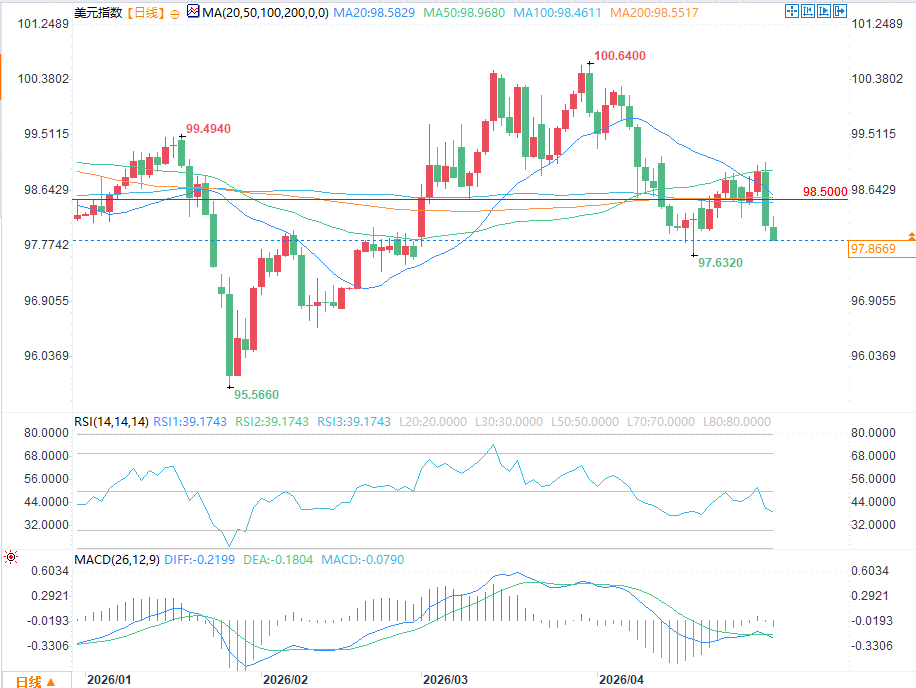
(US Dollar Index Daily Chart Source: FX678)
Based on the above analysis, the DXY is expected to continue finding support around 98 in the short term. Barring a major policy shift, the rebound target is around 98.50. Regarding USD/JPY, the downside potential created by government intervention is limited. Investors should pay attention to the actual strength of potential buying demand around 155 and whether there are signs of further intervention on the first trading day after the Japanese holiday next week, assessing the direction accordingly.
The USD/JPY exchange rate has been fluctuating around the 160 mark recently. The thin liquidity window before and after the May Day international labor holiday has once again made the market sense the possibility of intervention by the Japanese authorities.
Looking back at history, this scene seems eerily familiar. In late April and early May of 2024, Japanese authorities spent approximately 9.8 trillion yen (equivalent to about US$62.5 billion) of their foreign exchange reserves over three trading days, significantly reducing the USD/JPY exchange rate from its high. They then intervened again in July, using approximately 5.5 trillion yen in additional funds. With history repeating itself, this current Golden Week holiday, coupled with market closures in many parts of the world, and the resulting liquidity crunch, has provided the authorities with a window of opportunity to leverage significant market movements at a relatively low cost.
Market estimates suggest that Japan's Ministry of Finance may have already used $30 billion in dollar sales yesterday. Coupled with the positive sentiment of a global stock market recovery, the dollar weakened across major currency pairs, with the dollar index (DXY) falling to around 98.
Intervention only addresses the symptoms, not the root cause; 155 may become a zone for bulls to accumulate strength.
However, the historical limitations of exchange rate intervention cannot be ignored. Past experience shows that while intervention may be effective against short-term speculation, it is often costly and short-lived when it comes to combating long-term trends driven by economic fundamentals such as interest rate differentials.
From a fundamental perspective, the structural factors supporting the USD/JPY pair's continued high levels remain solid: the USD/JPY pair is currently holding above the 50-day and 200-day moving averages on the daily chart. In terms of the macroeconomic background, the Federal Reserve's interest rate is expected to remain unchanged in the 3.50% to 3.75% range, while the inflationary transmission pressure caused by the oil price shock in the Strait of Hormuz makes it difficult for the Federal Reserve to easily release dovish signals.
In Japan, the Bank of Japan is cautiously and gradually exiting its ultra-loose monetary policy, and the interest rate differential continues to support the US dollar. High energy prices, however, have exacerbated import cost pressures on Japan, continuously eroding its trade account and contributing significantly to the structural depreciation of the yen.
In summary, the current intervention's suppression of the downside potential of USD/JPY is likely only a temporary effect. Technically, there is strong buying support around 155, and without a clear statement of support from Washington for the yen, the downside target for bears is unlikely to extend below 152.
Federal Reserve officials' statements and ISM data are the focus today.
As for the market today, the US April ISM manufacturing data will be released later. The interplay between inflation expectations and weakening demand will provide new directional guidance for the US dollar. Meanwhile, the current Federal Reserve meeting has shown a divided vote, with dovish officials expected to emphasize economic uncertainty in their public statements. However, given the continued rise in inflation expectations and persistently high energy prices, the market needs clearer signals to re-price an accelerated easing path.
It is noteworthy that the US Treasury holds approximately $200 billion in its foreign exchange stabilization fund. If Washington decides to coordinate intervention, it theoretically possesses the ability to suppress the dollar indefinitely, a stark contrast to Japan's limited ammunition of selling its foreign exchange reserves. Currently, market pricing in a joint US-Japan operation is heating up, but there are no clear signals yet indicating that the US will actually participate in this round of intervention.
Operational Outlook
(US Dollar Index Daily Chart Source: FX678)
Based on the above analysis, the DXY is expected to continue finding support around 98 in the short term. Barring a major policy shift, the rebound target is around 98.50. Regarding USD/JPY, the downside potential created by government intervention is limited. Investors should pay attention to the actual strength of potential buying demand around 155 and whether there are signs of further intervention on the first trading day after the Japanese holiday next week, assessing the direction accordingly.
- Risk Warning and Disclaimer
- The market involves risk, and trading may not be suitable for all investors. This article is for reference only and does not constitute personal investment advice, nor does it take into account certain users’ specific investment objectives, financial situation, or other needs. Any investment decisions made based on this information are at your own risk.