Gold was just pushed down to 160, is it about to make a move again on Sunday? The dollar continues to fall, while the pound has already surged.
2026-05-02 11:54:42
This week, global currency markets experienced a period of dramatic volatility driven by administrative intervention. Amidst concerns about tariffs and divergent interest rate paths among major economies, the US dollar index fluctuated lower, ultimately closing at 98.0989, a weekly decline of 0.33%. However, market focus wasn't entirely on expectations of a Federal Reserve policy shift, but rather on the swift and decisive actions of the Japanese authorities. Constrained by the high US-Japan interest rate differential and energy inflationary pressures stemming from external geopolitical tensions, the yen briefly touched a multi-decade low, triggering what major international institutions termed an "epic intervention."

Following a public warning from Japanese Finance Ministry official Jun Mimura regarding speculative positions, market participants began to reassess the risk-reward ratio of carry trades. Although the US dollar rebounded somewhat towards the end of the week, non-US currencies generally performed steadily, particularly the British pound and the euro, which demonstrated strong defensiveness supported by tightening expectations. The current foreign exchange market logic has shifted from being solely driven by economic data to a hybrid model of policy intervention and macroeconomic expectation speculation. Especially with Japan entering a long holiday, the combination of liquidity and administrative risks has put the market on high alert.
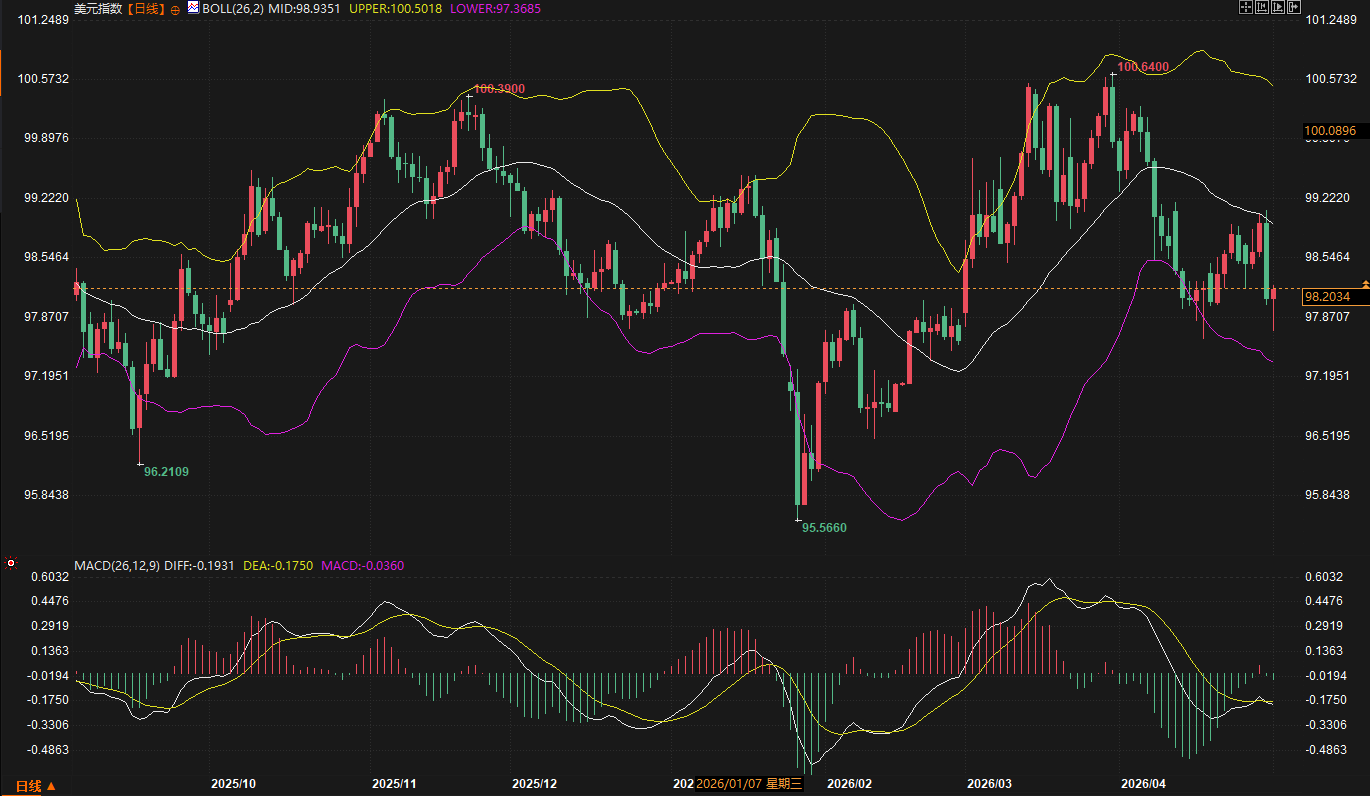
Weekly Market Review <br/>The US dollar index recorded a 0.33% decline this week, closing at 98.0989. From a daily chart perspective, the price trended downwards throughout the week, initially falling below 98.00 and touching support near 97.8 in the first three trading days due to pressure from stronger non-US currencies. Although there was a slight rebound at the end of the week, recovering some losses to 98.2034, it remained under pressure from the Bollinger Band middle line at 98.93.
Economic Data and Events Summary <br/>The Federal Reserve kept interest rates unchanged this week, in line with market expectations. However, due to the slow cooling of recent inflation data, market expectations for a Fed rate cut this year have cooled significantly. Meanwhile, global risk appetite fluctuated due to the volatile situation in Russia and Ukraine , with safe-haven funds rapidly switching between the US dollar and safe-haven assets.
Summary of Institutional Views : Major overseas institutions believe the US dollar index is in a short-term downward channel. Technically, while the MACD histogram shows signs of narrowing, the DIFF and DEA lines remain below the zero line, indicating the bearish trend remains unchanged. Analysts generally believe that if the dollar fails to hold above 99.00 next week, it may further retrace to the lower Bollinger Band area of 97.36.
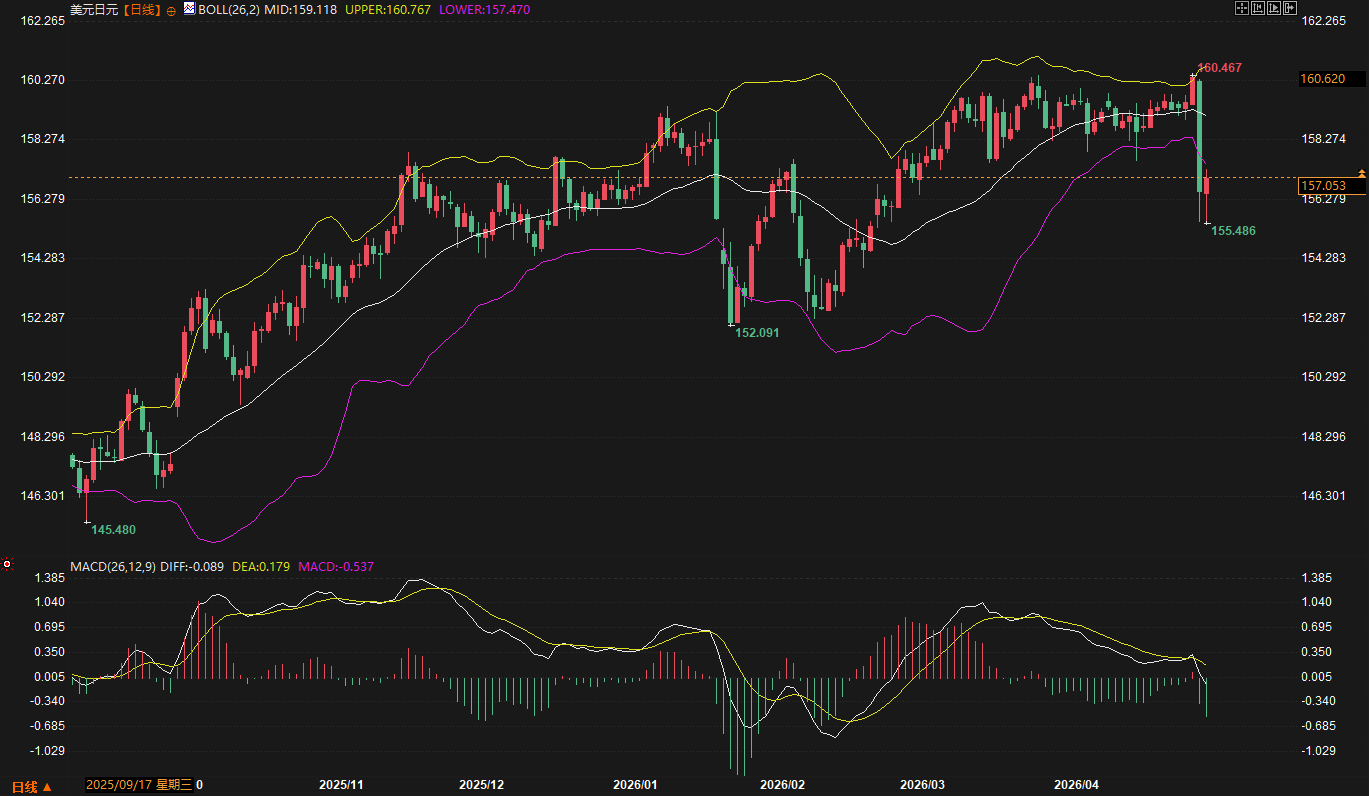
Weekly Market Recap: The USD/JPY pair recorded a 1.42% drop this week, on track for its biggest weekly performance since early February. After hitting a multi-year high of 160.7, the pair encountered what appeared to be strong intervention from Japanese authorities, plummeting from 157.1 to 155.49. Although it recovered to around 157.04 by the end of the week, the large bearish candlestick on the weekly chart has broken the previous one-sided upward trend.
Economic Data and Event Summary <br/>Data from the Bank of Japan indicates that the authorities may have used approximately 5.48 trillion yen (about US$35 billion) for foreign exchange operations. Finance Minister Jun Mimura explicitly stated that speculative fluctuations were excessive, which is seen as official disapproval of the current exchange rate level. Furthermore, with Japan's "Golden Week" approaching, the market is concerned that the authorities might launch a second surprise attack during a period of liquidity scarcity.
Summary of Analyst Views <br/>A prominent foreign media outlet quoted a senior strategist as saying that the sustainability of intervention depends on policy coordination. If the Bank of Japan cannot clarify its interest rate hike path in June, the effect of simple monetary intervention may diminish over time. The Barclays analyst team pointed out that, considering the historical experience of 2022 and 2024, continuous intervention is highly probable, and the 160 level has become Japan's "red line."
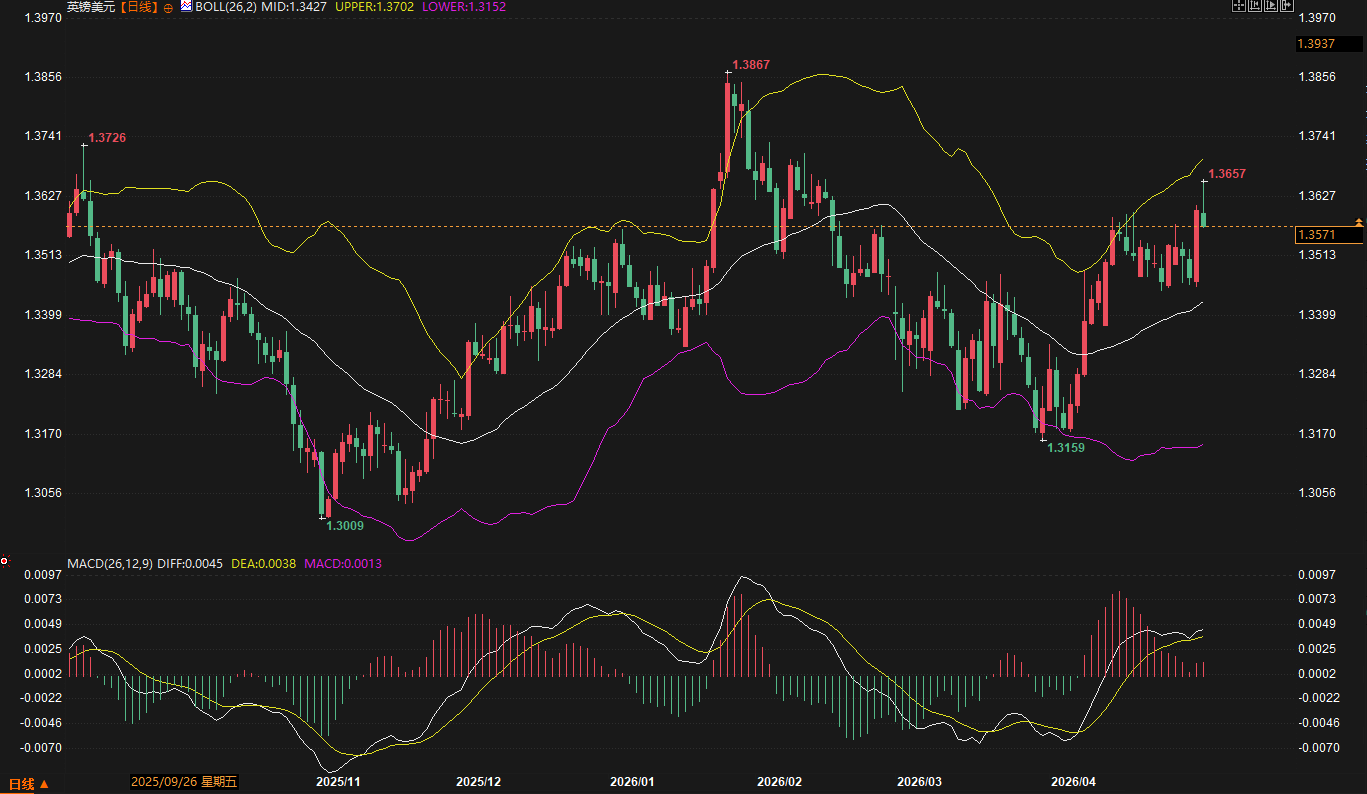
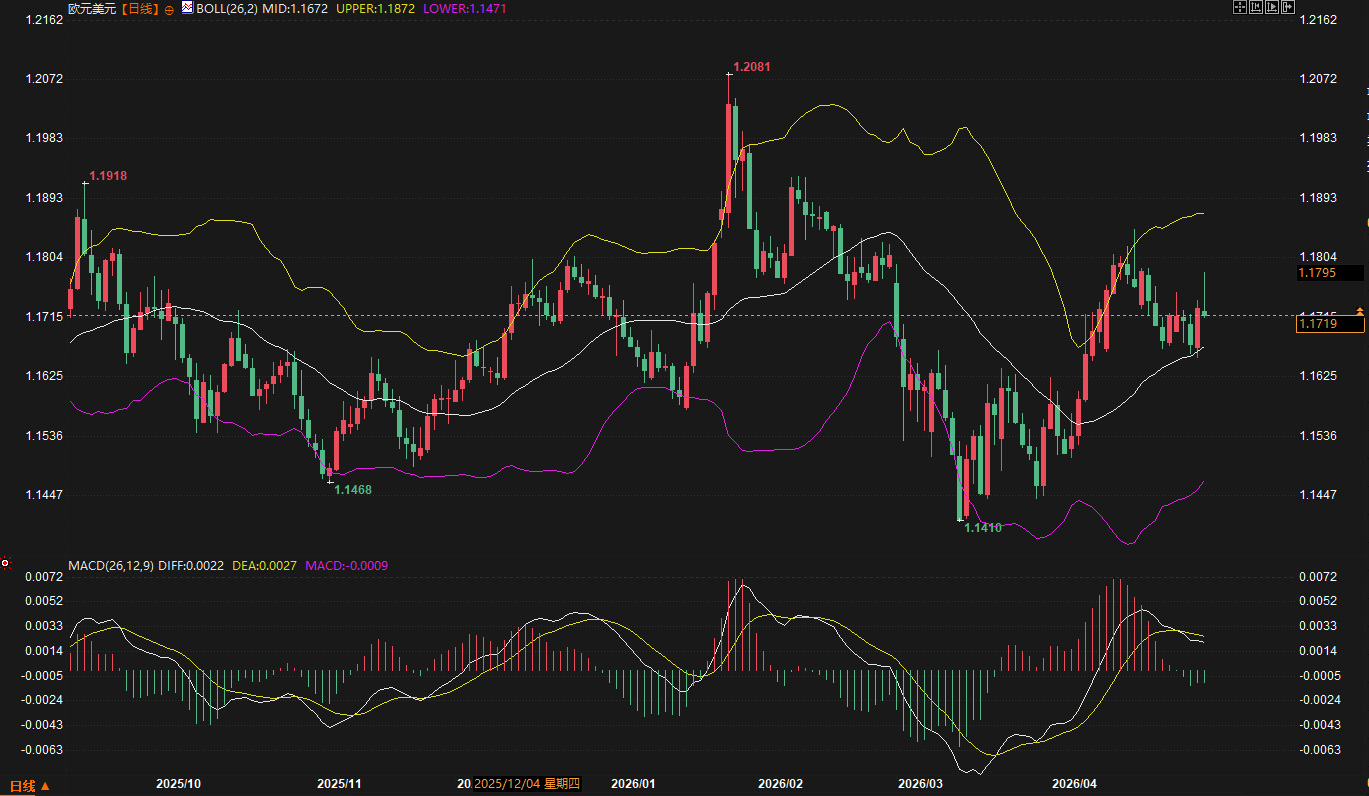
This Week's Market Recap : The British pound performed remarkably well against the US dollar this week, recording a 2.15% gain to close at 1.3571. On the daily chart, the pound recorded four consecutive bullish candles, breaking through the upper Bollinger Band and reaching a high of 1.3657. The euro also trended upwards against the US dollar, closing at 1.1719, showing strong resilience after testing the middle Bollinger Band support.
Economic Data and Events Summary <br/>While the European Central Bank and the Bank of England kept interest rates unchanged this week, the hawkish tone revealed in their policy statements boosted the market. Both central banks hinted at possible action in June due to rising energy import costs and renewed inflationary pressures. This earlier-than-expected rate hike contrasts sharply with the delayed rate cut expectations of the Federal Reserve, directly driving the strength of European currencies.
Analyst Views Summary : Institutional analysts believe that the pound is currently approaching the resistance zone near its previous high of 1.3867, with a clear bullish trend. In contrast, the euro is performing slightly worse than the pound, currently in a consolidation phase. Analysts from major overseas institutions point out that if the European Central Bank confirms a June rate hike at its upcoming meeting, the euro/dollar exchange rate could potentially challenge the 1.1850 level.
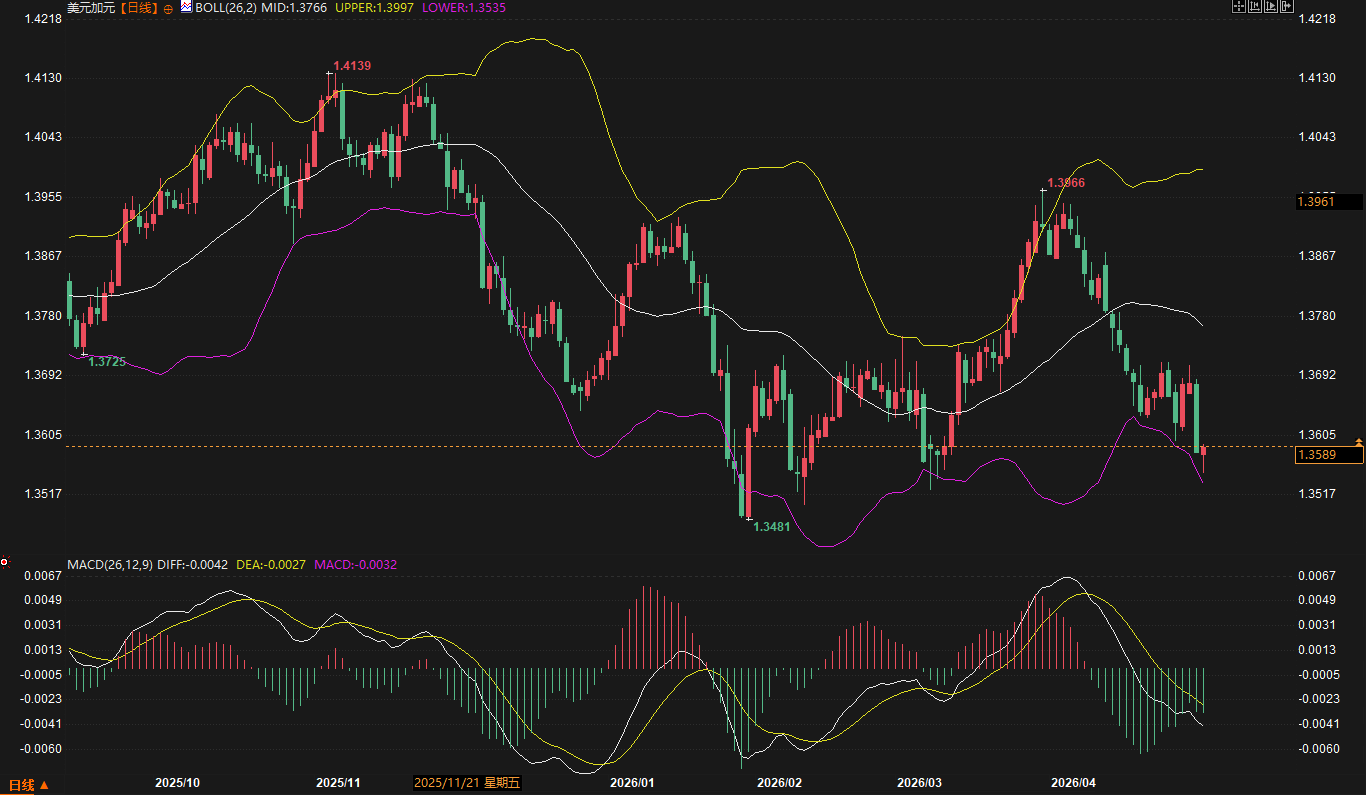
The USD/CAD pair fell 0.54% this week, marking its fourth consecutive week of declines. On the daily chart, the price is trading along the lower Bollinger Band and has broken below the key support level of 1.3600. The continued release of bearish momentum reflects a reassessment of North American currency interest rate differentials and the indirect boost to the Canadian dollar from energy prices.
In summary, the core trading logic in the global foreign exchange market this week shifted from "policy differences" to "intervention risks." The sharp depreciation and surge of the yen kicked off a rebound in non-US dollar currencies, while hawkish statements from the European Central Bank and the Bank of England provided fundamental support for this trend.
Next week, the market will enter a more complex period of competition. On the one hand, the potential liquidity black hole and threat of secondary intervention caused by Japan's long holiday will keep the USD/JPY exchange rate highly volatile. On the other hand, the support performance of the US dollar index after touching the lower Bollinger Band will determine whether this round of gains in non-US dollar currencies is sustainable. Investors need to closely monitor the transmission of the Russia-Ukraine situation and the latest trade tariff statements to commodity prices, as this directly affects the inflation considerations of major central banks.
1. Question: What are the significant differences between the momentum of the Japanese authorities' intervention this time and in the past?
A: This intervention demonstrates stronger administrative deterrence and targeted approach. While the ¥5.48 trillion injection is slightly lower than the record set in July 2024, the immediate intervention after the yen touched the historically crucial psychological level of 160.7 shows the Ministry of Finance's "zero tolerance" attitude towards speculative forces. Unlike past slow releases of liquidity, this action was accompanied by Finance Minister Jun Mimura's explicit warnings about "speculative positions," not only physically withdrawing yen liquidity but also psychologically reshaping the market's risk margin. Especially at this particular juncture, with Japan approaching the Golden Week holiday, the authorities chose this time to intervene, leveraging the thin trading volume during the holiday to achieve a greater deterrent effect with lower capital costs. This reflects the trend towards more precise foreign exchange management strategies in Japan.
2. Question: Why did the dollar index fall this week when the Federal Reserve kept interest rates unchanged?
A: This reflects the "over-consumption of expectations" and "strengthened counterparties" in market pricing logic. The US dollar index fell 0.33%, mainly not because the Fed turned dovish, but because tightening expectations for non-US currencies moved faster at the margin. Although the fading expectations of a Fed rate cut supported dollar yields, hints from the ECB and the Bank of England about a June rate hike provided clearer bullish options for the euro and pound. In addition, the yen's violent rebound after intervention dealt a heavy blow to the dollar index in terms of weighting. When the market realized that even if the Fed maintained high interest rates, it could not further raise the ceiling for the dollar, profit-taking on long positions and the resistance of the Bollinger Band middle line on the technical side jointly drove the weak consolidation this week.
3. Question: What is the logical basis for the analyst's mention of "intervention again during the Golden Week"?
A: The underlying logic lies in the "fragility" of the market due to a lack of liquidity. During the Golden Week holiday next week, major Japanese trading banks and institutions will be absent from the market, thinning the foreign exchange market. At this time, even a small trading volume can trigger sharp fluctuations in exchange rates. According to historical statistics from mainstream overseas institutions, the Japanese authorities tend to launch a "second strike" when market participation is low and speculators attempt to launch a surprise attack. If the USD/JPY pair attempts to touch the 158-160 range again during a rebound, the authorities only need to inject a portion of their usual funds to achieve a strong correction in the exchange rate. This strategy aims to establish a long-term psychological defense, meaning that even without official intervention, speculators will face the risk of non-market forces at any time.
4. Question: Does the current strength of European currencies (pound sterling, euro) have a medium- to long-term basis?
A: The strength of the pound and the euro is currently more driven by "inflation defense" and "interest rate differentials narrowing." Technically, the pound's 2.15% gain against the dollar this week has confirmed a bullish trend and broken through the upper Bollinger Band, indicating momentum. However, the resilience of this strength depends on whether its fundamentals can withstand the side effects of high inflation. Currently, the European Central Bank and the Bank of England are forced to adopt a hawkish stance to curb imported inflation from energy costs. If this "forced rate hike" leads to a substantial halt in economic growth, the rebound of European currencies will likely be limited to the 1.18-1.20 range. Therefore, it is currently viewed more as a valuation correction than a long-term, one-sided bull market.
5. Question: How can we use technical indicators to determine whether the US dollar index may reverse next week?
A: The key lies in the resilience of the lower Bollinger Band and the confirmation of a MACD golden cross. Currently, the US dollar index is trading at 98.2034. Although it's below the middle Bollinger Band, the weekly downward momentum has weakened. If the price can stabilize around 97.80 next week, accompanied by the complete disappearance of the MACD green bars and the DIFF line turning upwards, it signifies the completion of a temporary bottoming process. To confirm a trend reversal, the US dollar index must quickly recover the 99.00 level and regain its position above the middle Bollinger Band. Until then, any rebound should be considered a pullback within a downtrend. If the price fails to recover the moving average resistance early next week, be wary of the risk of a price drop towards the lower Bollinger Band at 97.36 or even lower.
Following a public warning from Japanese Finance Ministry official Jun Mimura regarding speculative positions, market participants began to reassess the risk-reward ratio of carry trades. Although the US dollar rebounded somewhat towards the end of the week, non-US currencies generally performed steadily, particularly the British pound and the euro, which demonstrated strong defensiveness supported by tightening expectations. The current foreign exchange market logic has shifted from being solely driven by economic data to a hybrid model of policy intervention and macroeconomic expectation speculation. Especially with Japan entering a long holiday, the combination of liquidity and administrative risks has put the market on high alert.
US Dollar Index: Weak Consolidation Under Bearish Dominance
Weekly Market Review <br/>The US dollar index recorded a 0.33% decline this week, closing at 98.0989. From a daily chart perspective, the price trended downwards throughout the week, initially falling below 98.00 and touching support near 97.8 in the first three trading days due to pressure from stronger non-US currencies. Although there was a slight rebound at the end of the week, recovering some losses to 98.2034, it remained under pressure from the Bollinger Band middle line at 98.93.
Economic Data and Events Summary <br/>The Federal Reserve kept interest rates unchanged this week, in line with market expectations. However, due to the slow cooling of recent inflation data, market expectations for a Fed rate cut this year have cooled significantly. Meanwhile, global risk appetite fluctuated due to the volatile situation in Russia and Ukraine , with safe-haven funds rapidly switching between the US dollar and safe-haven assets.
Summary of Institutional Views : Major overseas institutions believe the US dollar index is in a short-term downward channel. Technically, while the MACD histogram shows signs of narrowing, the DIFF and DEA lines remain below the zero line, indicating the bearish trend remains unchanged. Analysts generally believe that if the dollar fails to hold above 99.00 next week, it may further retrace to the lower Bollinger Band area of 97.36.
USD/JPY: A Violent Retreat Amidst the Fog of Intervention
Weekly Market Recap: The USD/JPY pair recorded a 1.42% drop this week, on track for its biggest weekly performance since early February. After hitting a multi-year high of 160.7, the pair encountered what appeared to be strong intervention from Japanese authorities, plummeting from 157.1 to 155.49. Although it recovered to around 157.04 by the end of the week, the large bearish candlestick on the weekly chart has broken the previous one-sided upward trend.
Economic Data and Event Summary <br/>Data from the Bank of Japan indicates that the authorities may have used approximately 5.48 trillion yen (about US$35 billion) for foreign exchange operations. Finance Minister Jun Mimura explicitly stated that speculative fluctuations were excessive, which is seen as official disapproval of the current exchange rate level. Furthermore, with Japan's "Golden Week" approaching, the market is concerned that the authorities might launch a second surprise attack during a period of liquidity scarcity.
Summary of Analyst Views <br/>A prominent foreign media outlet quoted a senior strategist as saying that the sustainability of intervention depends on policy coordination. If the Bank of Japan cannot clarify its interest rate hike path in June, the effect of simple monetary intervention may diminish over time. The Barclays analyst team pointed out that, considering the historical experience of 2022 and 2024, continuous intervention is highly probable, and the 160 level has become Japan's "red line."
British Pound and Euro: Strong Rebound Supported by Tightening Expectations
This Week's Market Recap : The British pound performed remarkably well against the US dollar this week, recording a 2.15% gain to close at 1.3571. On the daily chart, the pound recorded four consecutive bullish candles, breaking through the upper Bollinger Band and reaching a high of 1.3657. The euro also trended upwards against the US dollar, closing at 1.1719, showing strong resilience after testing the middle Bollinger Band support.
Economic Data and Events Summary <br/>While the European Central Bank and the Bank of England kept interest rates unchanged this week, the hawkish tone revealed in their policy statements boosted the market. Both central banks hinted at possible action in June due to rising energy import costs and renewed inflationary pressures. This earlier-than-expected rate hike contrasts sharply with the delayed rate cut expectations of the Federal Reserve, directly driving the strength of European currencies.
Analyst Views Summary : Institutional analysts believe that the pound is currently approaching the resistance zone near its previous high of 1.3867, with a clear bullish trend. In contrast, the euro is performing slightly worse than the pound, currently in a consolidation phase. Analysts from major overseas institutions point out that if the European Central Bank confirms a June rate hike at its upcoming meeting, the euro/dollar exchange rate could potentially challenge the 1.1850 level.
The USD/CAD pair has recorded its fourth consecutive weekly decline.
The USD/CAD pair fell 0.54% this week, marking its fourth consecutive week of declines. On the daily chart, the price is trading along the lower Bollinger Band and has broken below the key support level of 1.3600. The continued release of bearish momentum reflects a reassessment of North American currency interest rate differentials and the indirect boost to the Canadian dollar from energy prices.
In summary, the core trading logic in the global foreign exchange market this week shifted from "policy differences" to "intervention risks." The sharp depreciation and surge of the yen kicked off a rebound in non-US dollar currencies, while hawkish statements from the European Central Bank and the Bank of England provided fundamental support for this trend.
Next week, the market will enter a more complex period of competition. On the one hand, the potential liquidity black hole and threat of secondary intervention caused by Japan's long holiday will keep the USD/JPY exchange rate highly volatile. On the other hand, the support performance of the US dollar index after touching the lower Bollinger Band will determine whether this round of gains in non-US dollar currencies is sustainable. Investors need to closely monitor the transmission of the Russia-Ukraine situation and the latest trade tariff statements to commodity prices, as this directly affects the inflation considerations of major central banks.
QA module
1. Question: What are the significant differences between the momentum of the Japanese authorities' intervention this time and in the past?
A: This intervention demonstrates stronger administrative deterrence and targeted approach. While the ¥5.48 trillion injection is slightly lower than the record set in July 2024, the immediate intervention after the yen touched the historically crucial psychological level of 160.7 shows the Ministry of Finance's "zero tolerance" attitude towards speculative forces. Unlike past slow releases of liquidity, this action was accompanied by Finance Minister Jun Mimura's explicit warnings about "speculative positions," not only physically withdrawing yen liquidity but also psychologically reshaping the market's risk margin. Especially at this particular juncture, with Japan approaching the Golden Week holiday, the authorities chose this time to intervene, leveraging the thin trading volume during the holiday to achieve a greater deterrent effect with lower capital costs. This reflects the trend towards more precise foreign exchange management strategies in Japan.
2. Question: Why did the dollar index fall this week when the Federal Reserve kept interest rates unchanged?
A: This reflects the "over-consumption of expectations" and "strengthened counterparties" in market pricing logic. The US dollar index fell 0.33%, mainly not because the Fed turned dovish, but because tightening expectations for non-US currencies moved faster at the margin. Although the fading expectations of a Fed rate cut supported dollar yields, hints from the ECB and the Bank of England about a June rate hike provided clearer bullish options for the euro and pound. In addition, the yen's violent rebound after intervention dealt a heavy blow to the dollar index in terms of weighting. When the market realized that even if the Fed maintained high interest rates, it could not further raise the ceiling for the dollar, profit-taking on long positions and the resistance of the Bollinger Band middle line on the technical side jointly drove the weak consolidation this week.
3. Question: What is the logical basis for the analyst's mention of "intervention again during the Golden Week"?
A: The underlying logic lies in the "fragility" of the market due to a lack of liquidity. During the Golden Week holiday next week, major Japanese trading banks and institutions will be absent from the market, thinning the foreign exchange market. At this time, even a small trading volume can trigger sharp fluctuations in exchange rates. According to historical statistics from mainstream overseas institutions, the Japanese authorities tend to launch a "second strike" when market participation is low and speculators attempt to launch a surprise attack. If the USD/JPY pair attempts to touch the 158-160 range again during a rebound, the authorities only need to inject a portion of their usual funds to achieve a strong correction in the exchange rate. This strategy aims to establish a long-term psychological defense, meaning that even without official intervention, speculators will face the risk of non-market forces at any time.
4. Question: Does the current strength of European currencies (pound sterling, euro) have a medium- to long-term basis?
A: The strength of the pound and the euro is currently more driven by "inflation defense" and "interest rate differentials narrowing." Technically, the pound's 2.15% gain against the dollar this week has confirmed a bullish trend and broken through the upper Bollinger Band, indicating momentum. However, the resilience of this strength depends on whether its fundamentals can withstand the side effects of high inflation. Currently, the European Central Bank and the Bank of England are forced to adopt a hawkish stance to curb imported inflation from energy costs. If this "forced rate hike" leads to a substantial halt in economic growth, the rebound of European currencies will likely be limited to the 1.18-1.20 range. Therefore, it is currently viewed more as a valuation correction than a long-term, one-sided bull market.
5. Question: How can we use technical indicators to determine whether the US dollar index may reverse next week?
A: The key lies in the resilience of the lower Bollinger Band and the confirmation of a MACD golden cross. Currently, the US dollar index is trading at 98.2034. Although it's below the middle Bollinger Band, the weekly downward momentum has weakened. If the price can stabilize around 97.80 next week, accompanied by the complete disappearance of the MACD green bars and the DIFF line turning upwards, it signifies the completion of a temporary bottoming process. To confirm a trend reversal, the US dollar index must quickly recover the 99.00 level and regain its position above the middle Bollinger Band. Until then, any rebound should be considered a pullback within a downtrend. If the price fails to recover the moving average resistance early next week, be wary of the risk of a price drop towards the lower Bollinger Band at 97.36 or even lower.
- Risk Warning and Disclaimer
- The market involves risk, and trading may not be suitable for all investors. This article is for reference only and does not constitute personal investment advice, nor does it take into account certain users’ specific investment objectives, financial situation, or other needs. Any investment decisions made based on this information are at your own risk.