Gold Trading Alert: Middle East conflict reignites in the Strait of Hormuz, inflation alarms sound as the dollar surges, bulls crumble and gold prices plummet 2%!
2026-05-05 07:44:58
On Monday (May 4), spot gold prices fell sharply by 2%, closing at $4,523.67 per ounce, having briefly approached the $4,500 mark during the session. US gold futures also plunged 2.4%, closing at $4,533.30. The escalating direct confrontation between Iran and the US and its allies in the Strait of Hormuz, coupled with US President Trump's launch of the "Freedom Initiative," attempting to use naval power to secure this crucial global energy route, triggered a strong response from Iran. Reports of attacks on ships and the burning of UAE oil ports led to a surge in oil prices and a stronger dollar, significantly pressuring gold prices. On Tuesday (May 5) in early Asian trading, spot gold hovered at lower levels, currently trading around $4,520 per ounce.
The Strait of Hormuz has long been known as the "world's oil valve," handling approximately one-fifth of global crude oil and liquefied natural gas transport before the war. The flashpoint for this conflict was Trump's "Freedom Project," an attempt to break the Iranian blockade. Reports indicate that the US attempted to use its navy to escort merchant ships through the strait, an action Iran viewed as a direct provocation. Iran retaliated, attacking several merchant ships, including a South Korean merchant vessel that exploded and caught fire in the strait, and a major oil port in the UAE engulfed in flames after a drone strike.
Both sides offered conflicting accounts. The US Central Command claimed to have destroyed six small Iranian vessels and that two US merchant ships had successfully passed through the strait; Iran, however, vehemently denied the claims, stating that no merchant ships had passed and releasing maps showing the expansion of its controlled waters, extending even to the UAE coastline. Reports from British maritime security agencies and the UAE National Oil Company further corroborated the severity of the attacks. This information asymmetry and military standoff plunged the market into a state of high uncertainty.
Compared to the relative calm following the ceasefire announced four weeks ago, this escalation is considered the most serious backlash. Trump previously struggled to resolve the issue of Iran's blockade of shipping lanes, and the "Freedom Project," while initially intended to restore smooth energy transport, appears to have had the opposite effect in its early stages. Shipping companies are generally taking a wait-and-see approach, with large corporations stating they will only resume large-scale operations once the conflict has officially subsided. This directly leads to a renewed risk of disruption to the global energy supply chain, and market concerns about oil supply shortages have been rapidly amplified.
Given this geopolitical context, gold should have risen due to safe-haven demand, but the opposite has occurred. The conflict not only failed to generate a "pure safe-haven" premium, but also created stronger selling pressure by pushing up energy prices and reinforcing the dollar's position. This is precisely the core counterintuitive aspect of this gold price decline: when conflict is transmitted through "pushing up inflation and interest rate expectations," gold's safe-haven properties are suppressed by its sensitivity to real interest rates.
The strengthening of the US dollar was the most direct driver of the recent decline in gold prices. The US dollar index rose 0.27% to 98.47. Although the index has retreated from its high in early March, it remains strongly supported by the ongoing conflict in the Middle East. Gold priced in US dollars has become more expensive for investors holding other currencies, which has directly suppressed buying.
Market analysts point out that as long as the Strait of Hormuz remains blocked, the US dollar will remain relatively stable. This is because energy crises often strengthen the dollar's safe-haven status as the global reserve currency. If any signs of peace emerge and risk appetite recovers, the dollar could face a rapid correction. However, currently, conflicting reports and the ongoing military standoff make the prospects for peace uncertain.
Other major currencies, including the euro, were also dragged down. The euro fell 0.2% against the dollar, partly due to disagreements between the US and the EU over tariffs. The German Chancellor attempted to downplay her differences with Trump, but his threat to raise tariffs on EU cars continued to weigh on market sentiment. In an environment of suppressed global risk appetite, the relative strength of the dollar became a difficult obstacle for gold to overcome.
This monetary transmission mechanism has occurred repeatedly throughout history. When the US dollar strengthens due to geopolitical events or inflationary pressures, gold often comes under pressure. Even if the conflict itself brings uncertainty, if it ultimately reinforces the relative advantage of the US economy or the Federal Reserve's tightening stance, gold's reaction will be negative. This event once again confirms this pattern: geopolitical conflicts are not always "friends" of gold; the key lies in how the conflict affects macroeconomic variables.
Brent crude oil prices surged more than 5%, and U.S. crude oil also jumped 4.5%, with this energy price shock acting as a catalyst for inflation expectations. Rising energy costs will be transmitted to overall price levels through multiple stages of production, transportation, and consumption, exacerbating market expectations that central banks will maintain high interest rates for an extended period.
Bart Melek, global head of commodities strategy at TD Securities, bluntly stated that the latest news failed to convince the market that the situation would improve; instead, it reignited concerns about inflation and sent a rather hawkish signal regarding interest rates. The FedWatch Tool shows a 95.2% probability of keeping interest rates unchanged in June, while the probability of a rate hike this year has surged from 13.9% the previous day to 33.9%. The probability of keeping rates unchanged by December remains at 57.4%, but the cumulative expectation of rate hikes has significantly strengthened.
This shift in policy expectations is a double blow to gold. As a non-interest-bearing asset, the cost of holding gold increases in a high-interest-rate environment. At the same time, if real interest rates (nominal interest rate minus inflation) strengthen due to persistently high nominal interest rates, it will also diminish the attractiveness of gold. New York Fed President Williams stated that the Fed's monetary policy is well-positioned to address the uncertainty brought about by the Middle East wars, further solidifying market expectations that the Fed will adopt a "cautious wait-and-see" approach and may even tighten if necessary.
The bond market reacted in tandem. The yield on the 10-year U.S. Treasury note rose 7 basis points to 4.448%, on track for its biggest one-day gain in nearly six weeks; the two-year yield surged 8.1 basis points. Break-even yields on Treasury Inflation-Protected Securities (TIPS) rose to high levels, with the market expecting an average inflation rate of around 2.5% over the next decade. Institutions such as Barclays have revised their forecasts, believing the Federal Reserve is unlikely to cut interest rates this year, primarily due to persistently high energy prices stemming from the conflict with Iran.
Amid the dual pressures of conflict and inflation, the US will release job openings data, the ADP employment report, and the April non-farm payrolls report this week. These data will serve as crucial windows into the resilience of the labor market and the transmission of inflation. Economists expect non-farm payrolls to increase by 62,000, and factory new orders data has already shown a robust 1.5% increase, exceeding expectations.
Strong employment data would further support the Federal Reserve's stance of maintaining high interest rates; conversely, weak data showing signs of economic slowdown could alleviate some pressure to raise rates. However, against the backdrop of Middle East conflict, even weak data could limit the Fed's room for easing due to sticky energy inflation. This interaction between data and geopolitical events will continue to dominate short-term fluctuations in the gold market.
In the stock market, the S&P 500 retreated from its record high, falling 0.41%, with the energy sector bucking the trend and rising while most other sectors were under pressure. This reflects the market's cautious attitude towards downside risks at high valuation levels. Berkshire Hathaway's continued net selling of stocks also added a conservative tone to the overall market sentiment.
Despite short-term pressure, gold's long-term investment value has not disappeared. As a traditional tool for hedging against inflation, geopolitical risks, and currency devaluation, gold still holds a unique position in an era of high uncertainty. However, this event serves as a reminder to investors that safe-haven demand does not rise unconditionally, but rather depends on the nature of the conflict and its macroeconomic transmission path.
Gold may face a period of adjustment when conflict drives up oil prices and strengthens expectations of tightening; however, if the conflict prolongs and leads to a slowdown in global economic growth or ultimately triggers broader financial risks, safe-haven buying of gold may return strongly. Currently, the market is in a period of observation regarding this dynamic equilibrium. Investors need to closely monitor the situation on the Strait of Hormuz, oil price trends, and the latest statements from Federal Reserve officials.
Historically, energy crises like those in the Middle East have often led to periods of increased volatility in gold prices. Conflicts in the 1980s, 1990s, and more recently have all caused gold prices to experience periods of initial decline followed by a rise, or periods of sharp fluctuations. While gold prices have currently retreated from their highs, the area above $4,500 still shows strong support. Future price movements will depend on whether the conflict can be controlled and the evolution of inflation expectations.
Given the current situation, investors should remain cautious. In the short term, gold may continue to be pressured by a rising dollar and yields, but any signs of easing tensions or weaker-than-expected employment data could trigger a rebound. Diversification, monitoring physical gold or related ETFs, and setting reasonable stop-loss orders are key to managing risk.
At the same time, we must be wary of the amplifying effect of information warfare on market sentiment. Reports of conflicting statements from both sides can easily lead to price overshooting; a rational analysis of macroeconomic transmission mechanisms is more important than chasing breaking news. The potential drag on the real economy from global supply chain disruptions and high energy prices will also affect asset pricing, including gold, in the medium to long term.
In conclusion, the gold market turmoil in May 2026 was the result of a complex interplay of geopolitical, economic, and market psychological factors. It once again demonstrates that gold is not simply a "safe haven," but rather a complex asset requiring a comprehensive assessment that considers the dollar's performance, real interest rates, and global risk appetite.
Looking ahead, if the Strait of Hormuz issue is eased to some extent, the decline in oil prices will alleviate inflationary pressures, potentially providing an opportunity for gold to recover. Conversely, if the conflict escalates further, gold may continue to face short-term pressure, but its safe-haven value will gradually emerge in the medium to long term. Investors should maintain a flexible strategy, seeking opportunities with certainty amidst volatility.
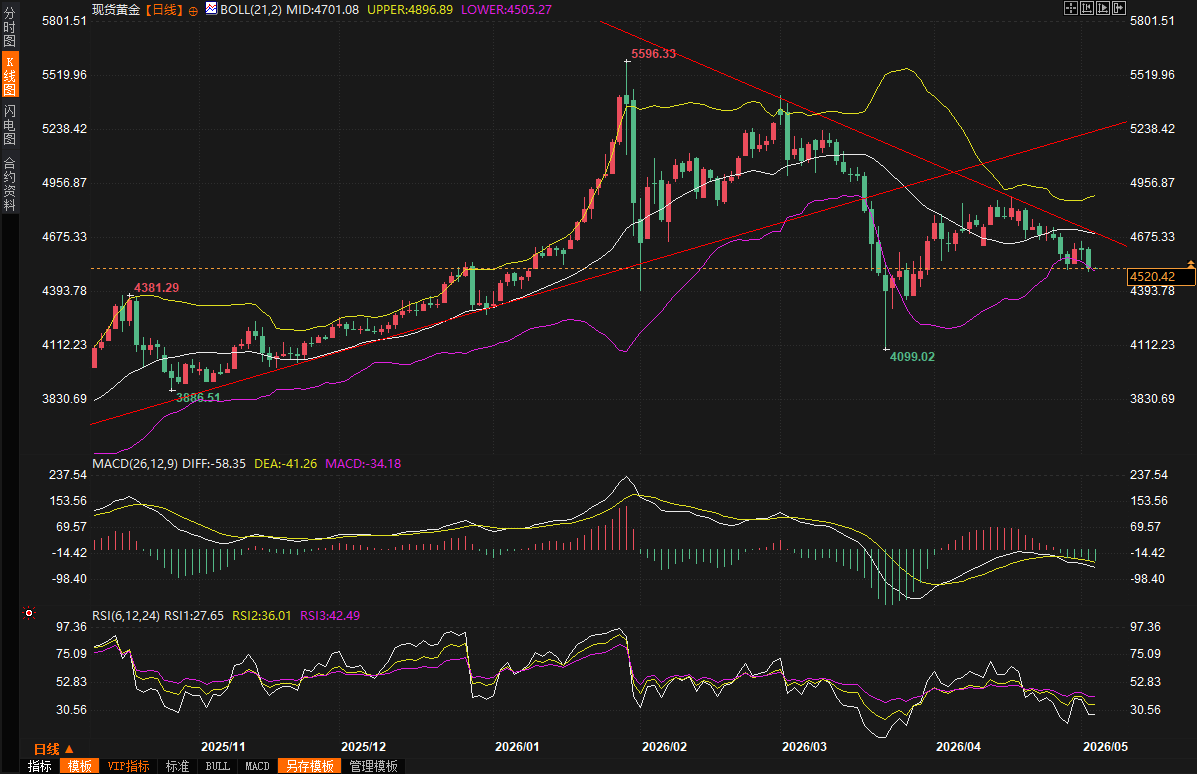
(Spot gold daily chart, source: FX678)
At 07:40 Beijing time, spot gold was trading at $4,520.38 per ounce.
Middle East conflict escalates again: Strait of Hormuz becomes a powder keg for global energy lifeline.
The Strait of Hormuz has long been known as the "world's oil valve," handling approximately one-fifth of global crude oil and liquefied natural gas transport before the war. The flashpoint for this conflict was Trump's "Freedom Project," an attempt to break the Iranian blockade. Reports indicate that the US attempted to use its navy to escort merchant ships through the strait, an action Iran viewed as a direct provocation. Iran retaliated, attacking several merchant ships, including a South Korean merchant vessel that exploded and caught fire in the strait, and a major oil port in the UAE engulfed in flames after a drone strike.
Both sides offered conflicting accounts. The US Central Command claimed to have destroyed six small Iranian vessels and that two US merchant ships had successfully passed through the strait; Iran, however, vehemently denied the claims, stating that no merchant ships had passed and releasing maps showing the expansion of its controlled waters, extending even to the UAE coastline. Reports from British maritime security agencies and the UAE National Oil Company further corroborated the severity of the attacks. This information asymmetry and military standoff plunged the market into a state of high uncertainty.
Compared to the relative calm following the ceasefire announced four weeks ago, this escalation is considered the most serious backlash. Trump previously struggled to resolve the issue of Iran's blockade of shipping lanes, and the "Freedom Project," while initially intended to restore smooth energy transport, appears to have had the opposite effect in its early stages. Shipping companies are generally taking a wait-and-see approach, with large corporations stating they will only resume large-scale operations once the conflict has officially subsided. This directly leads to a renewed risk of disruption to the global energy supply chain, and market concerns about oil supply shortages have been rapidly amplified.
Given this geopolitical context, gold should have risen due to safe-haven demand, but the opposite has occurred. The conflict not only failed to generate a "pure safe-haven" premium, but also created stronger selling pressure by pushing up energy prices and reinforcing the dollar's position. This is precisely the core counterintuitive aspect of this gold price decline: when conflict is transmitted through "pushing up inflation and interest rate expectations," gold's safe-haven properties are suppressed by its sensitivity to real interest rates.
The US dollar index rebounded strongly: the "killer" effect of gold on currencies.
The strengthening of the US dollar was the most direct driver of the recent decline in gold prices. The US dollar index rose 0.27% to 98.47. Although the index has retreated from its high in early March, it remains strongly supported by the ongoing conflict in the Middle East. Gold priced in US dollars has become more expensive for investors holding other currencies, which has directly suppressed buying.
Market analysts point out that as long as the Strait of Hormuz remains blocked, the US dollar will remain relatively stable. This is because energy crises often strengthen the dollar's safe-haven status as the global reserve currency. If any signs of peace emerge and risk appetite recovers, the dollar could face a rapid correction. However, currently, conflicting reports and the ongoing military standoff make the prospects for peace uncertain.
Other major currencies, including the euro, were also dragged down. The euro fell 0.2% against the dollar, partly due to disagreements between the US and the EU over tariffs. The German Chancellor attempted to downplay her differences with Trump, but his threat to raise tariffs on EU cars continued to weigh on market sentiment. In an environment of suppressed global risk appetite, the relative strength of the dollar became a difficult obstacle for gold to overcome.
This monetary transmission mechanism has occurred repeatedly throughout history. When the US dollar strengthens due to geopolitical events or inflationary pressures, gold often comes under pressure. Even if the conflict itself brings uncertainty, if it ultimately reinforces the relative advantage of the US economy or the Federal Reserve's tightening stance, gold's reaction will be negative. This event once again confirms this pattern: geopolitical conflicts are not always "friends" of gold; the key lies in how the conflict affects macroeconomic variables.
Inflation concerns resurface: Soaring oil prices reshape the Fed's policy path
Brent crude oil prices surged more than 5%, and U.S. crude oil also jumped 4.5%, with this energy price shock acting as a catalyst for inflation expectations. Rising energy costs will be transmitted to overall price levels through multiple stages of production, transportation, and consumption, exacerbating market expectations that central banks will maintain high interest rates for an extended period.
Bart Melek, global head of commodities strategy at TD Securities, bluntly stated that the latest news failed to convince the market that the situation would improve; instead, it reignited concerns about inflation and sent a rather hawkish signal regarding interest rates. The FedWatch Tool shows a 95.2% probability of keeping interest rates unchanged in June, while the probability of a rate hike this year has surged from 13.9% the previous day to 33.9%. The probability of keeping rates unchanged by December remains at 57.4%, but the cumulative expectation of rate hikes has significantly strengthened.
This shift in policy expectations is a double blow to gold. As a non-interest-bearing asset, the cost of holding gold increases in a high-interest-rate environment. At the same time, if real interest rates (nominal interest rate minus inflation) strengthen due to persistently high nominal interest rates, it will also diminish the attractiveness of gold. New York Fed President Williams stated that the Fed's monetary policy is well-positioned to address the uncertainty brought about by the Middle East wars, further solidifying market expectations that the Fed will adopt a "cautious wait-and-see" approach and may even tighten if necessary.
The bond market reacted in tandem. The yield on the 10-year U.S. Treasury note rose 7 basis points to 4.448%, on track for its biggest one-day gain in nearly six weeks; the two-year yield surged 8.1 basis points. Break-even yields on Treasury Inflation-Protected Securities (TIPS) rose to high levels, with the market expecting an average inflation rate of around 2.5% over the next decade. Institutions such as Barclays have revised their forecasts, believing the Federal Reserve is unlikely to cut interest rates this year, primarily due to persistently high energy prices stemming from the conflict with Iran.
This week's key data will put the job market to the test, becoming a policy indicator.
Amid the dual pressures of conflict and inflation, the US will release job openings data, the ADP employment report, and the April non-farm payrolls report this week. These data will serve as crucial windows into the resilience of the labor market and the transmission of inflation. Economists expect non-farm payrolls to increase by 62,000, and factory new orders data has already shown a robust 1.5% increase, exceeding expectations.
Strong employment data would further support the Federal Reserve's stance of maintaining high interest rates; conversely, weak data showing signs of economic slowdown could alleviate some pressure to raise rates. However, against the backdrop of Middle East conflict, even weak data could limit the Fed's room for easing due to sticky energy inflation. This interaction between data and geopolitical events will continue to dominate short-term fluctuations in the gold market.
In the stock market, the S&P 500 retreated from its record high, falling 0.41%, with the energy sector bucking the trend and rising while most other sectors were under pressure. This reflects the market's cautious attitude towards downside risks at high valuation levels. Berkshire Hathaway's continued net selling of stocks also added a conservative tone to the overall market sentiment.
The long-term logic of the gold market: a game between safe-haven attributes and opportunity costs.
Despite short-term pressure, gold's long-term investment value has not disappeared. As a traditional tool for hedging against inflation, geopolitical risks, and currency devaluation, gold still holds a unique position in an era of high uncertainty. However, this event serves as a reminder to investors that safe-haven demand does not rise unconditionally, but rather depends on the nature of the conflict and its macroeconomic transmission path.
Gold may face a period of adjustment when conflict drives up oil prices and strengthens expectations of tightening; however, if the conflict prolongs and leads to a slowdown in global economic growth or ultimately triggers broader financial risks, safe-haven buying of gold may return strongly. Currently, the market is in a period of observation regarding this dynamic equilibrium. Investors need to closely monitor the situation on the Strait of Hormuz, oil price trends, and the latest statements from Federal Reserve officials.
Historically, energy crises like those in the Middle East have often led to periods of increased volatility in gold prices. Conflicts in the 1980s, 1990s, and more recently have all caused gold prices to experience periods of initial decline followed by a rise, or periods of sharp fluctuations. While gold prices have currently retreated from their highs, the area above $4,500 still shows strong support. Future price movements will depend on whether the conflict can be controlled and the evolution of inflation expectations.
Investor Strategies and Risk Warnings
Given the current situation, investors should remain cautious. In the short term, gold may continue to be pressured by a rising dollar and yields, but any signs of easing tensions or weaker-than-expected employment data could trigger a rebound. Diversification, monitoring physical gold or related ETFs, and setting reasonable stop-loss orders are key to managing risk.
At the same time, we must be wary of the amplifying effect of information warfare on market sentiment. Reports of conflicting statements from both sides can easily lead to price overshooting; a rational analysis of macroeconomic transmission mechanisms is more important than chasing breaking news. The potential drag on the real economy from global supply chain disruptions and high energy prices will also affect asset pricing, including gold, in the medium to long term.
In conclusion, the gold market turmoil in May 2026 was the result of a complex interplay of geopolitical, economic, and market psychological factors. It once again demonstrates that gold is not simply a "safe haven," but rather a complex asset requiring a comprehensive assessment that considers the dollar's performance, real interest rates, and global risk appetite.
Looking ahead, if the Strait of Hormuz issue is eased to some extent, the decline in oil prices will alleviate inflationary pressures, potentially providing an opportunity for gold to recover. Conversely, if the conflict escalates further, gold may continue to face short-term pressure, but its safe-haven value will gradually emerge in the medium to long term. Investors should maintain a flexible strategy, seeking opportunities with certainty amidst volatility.
(Spot gold daily chart, source: FX678)
At 07:40 Beijing time, spot gold was trading at $4,520.38 per ounce.
- Risk Warning and Disclaimer
- The market involves risk, and trading may not be suitable for all investors. This article is for reference only and does not constitute personal investment advice, nor does it take into account certain users’ specific investment objectives, financial situation, or other needs. Any investment decisions made based on this information are at your own risk.