Crude oil trading alert: The Strait of Hormuz is experiencing renewed tensions; short-term oil prices are highly dependent on unforeseen events. Avoid heavy positions chasing rising prices.
2026-05-05 09:20:37
On Monday, Iran claimed to have fired a missile that struck a US warship attempting to cross the Strait of Hormuz, forcing it to turn back; the UAE port of Fujairah was attacked by Iranian missiles/drones, causing fires at oil facilities. These events directly fueled market concerns about disruptions to crude oil supply. Brent crude rose 4.63% on Monday, closing at $113.82 per barrel, while WTI crude rose 2.58%, closing at $105.14 per barrel, reflecting the market's immediate reaction to the safety of key shipping lanes. On Tuesday (May 5th) in early Asian trading, international oil prices fluctuated narrowly, with Brent crude currently at $113.76 per barrel and WTI crude at $104.79 per barrel. The market is beginning to assess the actual impact of these events, rather than simply being driven by panic.

The Strait of Hormuz carries approximately one-fifth of the world's crude oil shipments, and this escalation of the conflict directly threatens this vital waterway. Iran's actions, the US naval intervention in Operation Freedom of Navigation, and conflicting navigation reports from both sides have led to a surge in shipping insurance costs, prompting several major shipping companies to adopt a wait-and-see approach. The fire at the port of Fujairah in the UAE further exacerbates supply concerns, despite the port being one of the few export routes that do not pass through the strait.
Meanwhile, OPEC+ decided to raise production targets for some member countries starting in June, and the UAE, after leaving OPEC, pledged to meet market demand, which provided a long-term supply buffer to some extent. However, in the short term, the impact of geopolitical events on actual output and transportation far outweighs the calming effect of increased production expectations. If the Strait of Hormuz cannot be reopened quickly, oil prices are likely to remain above $100, and US gasoline prices will continue to rise.
Recent price movements show that oil prices surged rapidly on news of the conflict, with Brent crude breaking through the $110 mark, indicating strong bullish momentum. However, the pullback in early Tuesday trading suggests profit-taking pressure, with short-term support likely in the $105-$108 range. Holding this area could see oil prices test $120; resistance levels are at $115-$118. If the conflict escalates further, a break above recent highs is more probable; conversely, if there are signs of a significant de-escalation, oil prices may quickly give back their gains.
The simultaneous increase in trading volume and volatility indicates that market sentiment is sensitive, and any new information could trigger sharp fluctuations.
In the current environment, oil price movements are highly dependent on breaking news. Investors are advised to strictly control their positions and avoid heavy-position chasing of rising prices. In the short term, key trigger points to watch include the progress of navigation in the Taiwan Strait, the dynamics of US-Iran negotiations, and the firefighting efforts at a UAE port. Setting clear stop-loss orders is essential to manage the uncertainties of geopolitical events. In the long term, if supply disruptions are alleviated, increased OPEC+ production will exert downward pressure; conversely, the high oil price environment may persist for some time. Investors need to remain flexible and adjust their strategies according to real-time risk conditions.
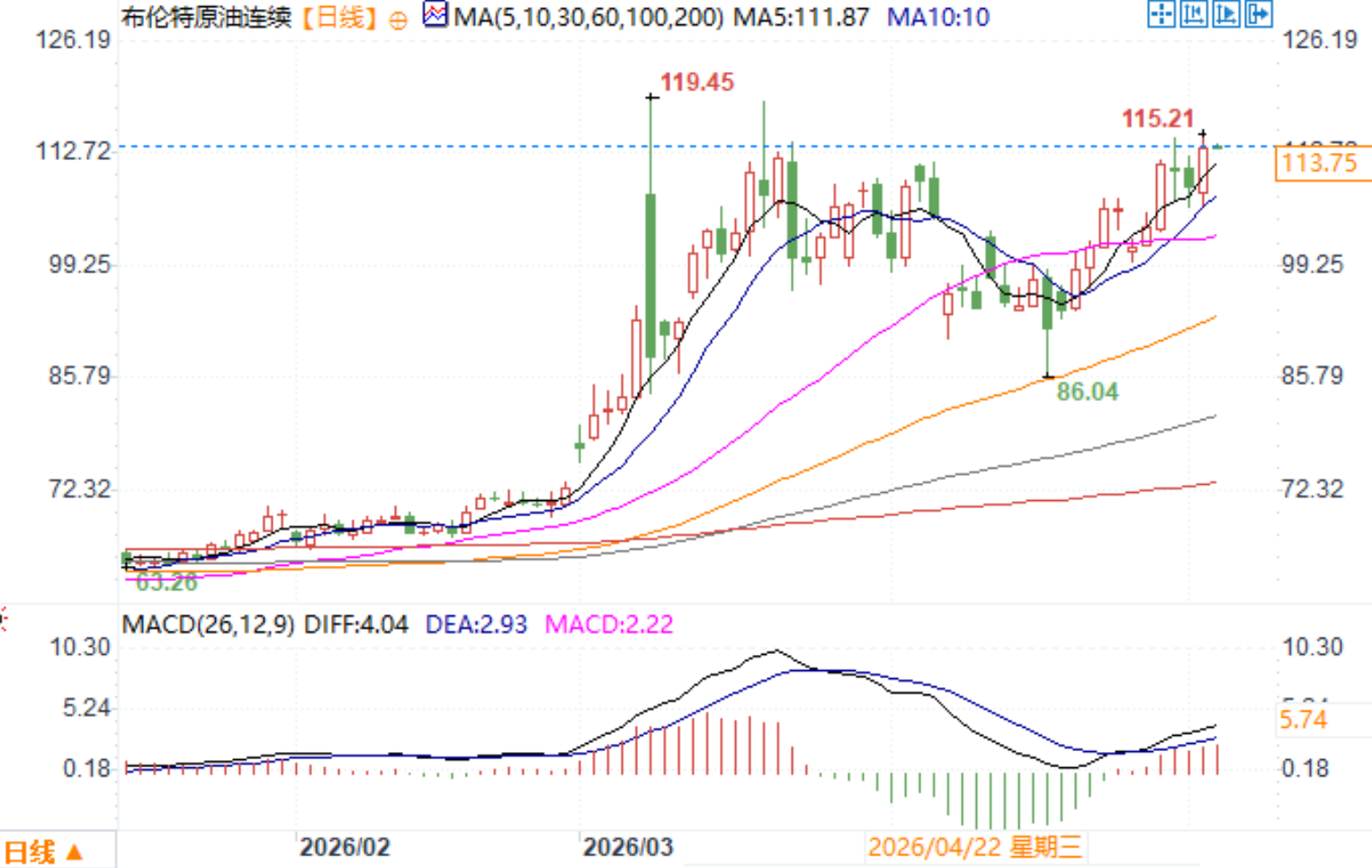
Brent crude oil daily chart source: EasyForex
At 9:20 AM Beijing time on May 5th, Brent crude oil futures were trading at $113.75 per barrel.
Supply risk remains the core driver.
The Strait of Hormuz carries approximately one-fifth of the world's crude oil shipments, and this escalation of the conflict directly threatens this vital waterway. Iran's actions, the US naval intervention in Operation Freedom of Navigation, and conflicting navigation reports from both sides have led to a surge in shipping insurance costs, prompting several major shipping companies to adopt a wait-and-see approach. The fire at the port of Fujairah in the UAE further exacerbates supply concerns, despite the port being one of the few export routes that do not pass through the strait.
Meanwhile, OPEC+ decided to raise production targets for some member countries starting in June, and the UAE, after leaving OPEC, pledged to meet market demand, which provided a long-term supply buffer to some extent. However, in the short term, the impact of geopolitical events on actual output and transportation far outweighs the calming effect of increased production expectations. If the Strait of Hormuz cannot be reopened quickly, oil prices are likely to remain above $100, and US gasoline prices will continue to rise.
Technically, the market is showing a pattern of high-level consolidation.
Recent price movements show that oil prices surged rapidly on news of the conflict, with Brent crude breaking through the $110 mark, indicating strong bullish momentum. However, the pullback in early Tuesday trading suggests profit-taking pressure, with short-term support likely in the $105-$108 range. Holding this area could see oil prices test $120; resistance levels are at $115-$118. If the conflict escalates further, a break above recent highs is more probable; conversely, if there are signs of a significant de-escalation, oil prices may quickly give back their gains.
The simultaneous increase in trading volume and volatility indicates that market sentiment is sensitive, and any new information could trigger sharp fluctuations.
Transaction Alerts
In the current environment, oil price movements are highly dependent on breaking news. Investors are advised to strictly control their positions and avoid heavy-position chasing of rising prices. In the short term, key trigger points to watch include the progress of navigation in the Taiwan Strait, the dynamics of US-Iran negotiations, and the firefighting efforts at a UAE port. Setting clear stop-loss orders is essential to manage the uncertainties of geopolitical events. In the long term, if supply disruptions are alleviated, increased OPEC+ production will exert downward pressure; conversely, the high oil price environment may persist for some time. Investors need to remain flexible and adjust their strategies according to real-time risk conditions.
Brent crude oil daily chart source: EasyForex
At 9:20 AM Beijing time on May 5th, Brent crude oil futures were trading at $113.75 per barrel.
- Risk Warning and Disclaimer
- The market involves risk, and trading may not be suitable for all investors. This article is for reference only and does not constitute personal investment advice, nor does it take into account certain users’ specific investment objectives, financial situation, or other needs. Any investment decisions made based on this information are at your own risk.