Breaking News! US Warships Pass Through the Strait of Hormuz; Why Didn't Oil Prices Fall After the Mine Crisis Was Resolved?
2026-05-05 16:39:40
On Tuesday (May 5), during the Asian and European sessions, the market received another piece of positive news, with the three major US stock index futures rising collectively. International oil prices fell slightly before rebounding and maintaining a strong bullish trend. Brent crude oil is currently trading around 112.80.
Two US destroyers successfully transited the Strait of Hormuz after encountering heavy Iranian fire, marking a significant marginal change in the US-Iran situation and the emergence of at least two waterways accessible to large oil tankers, free from the threat of mines.
U.S. Central Command Commander Brad Cooper confirmed that the U.S. military has established an "enhanced security zone" in the Strait of Hormuz to completely eliminate the threat of Iranian mines, and the first two merchant ships flying the U.S. flag have successfully sailed through the waters.
In response to the coordinated missile, drone, and small boat attacks launched by Iran, US President Trump adopted a "double-statement" strategy: on the one hand, he made a strong threat on Fox News that "if Iran fires on US ships, it will be wiped off the face of the earth," and on the other hand, he deliberately downplayed the consequences of the conflict in an interview with ABC, saying that "it was not a fierce exchange of fire" and that "only one munition escaped and the damage was minor."
This combination of hard and soft rhetoric provides a buffer for both sides, allowing both the US and Iran to claim that they have achieved their tactical objectives and preventing the ceasefire agreement from completely collapsing.
Although Iran did not directly prevent the US warship from passing through, it clearly signaled that it still holds key cards, thus preserving leverage for subsequent negotiations.
Iranian Parliament Speaker Mohammad al-Kalibaf publicly stated that "the new situation in the Strait of Hormuz is stabilizing, and we haven't even really started yet," implying that Iran has not yet deployed its full strategic forces.
According to disclosures by the Iranian Parliament's National Security Committee, the Bab el-Mandeb Strait, another crucial shipping route, may become Iran's "backup means of containment," with Yemeni armed groups potentially cooperating to create new geopolitical pressure points.
Previously, the Iranian military command had issued a stern warning, requiring all ships transiting the Strait of Hormuz to coordinate with it in advance, and that any "aggressive approach" by foreign military forces would become a target, highlighting that it still retains substantial influence over the strait.
The United States: In addition to advancing the "Freedom Project" to clear ships stranded in the Persian Gulf, the naval blockade of Iranian ports imposed since April 13 has forced at least 49 commercial vessels to turn back.
Republican Senator Lindsey Graham's explicit statement that "there is no need to send ground troops to Iran" indicates that the United States tends to use non-ground warfare methods such as maritime pressure and sanctions to force Iran to make concessions on nuclear and regional issues.
The United Arab Emirates , a key US ally, has suffered its first major attack since the ceasefire began.
Although its air defense system intercepted 15 missiles and 4 drones, a key oil facility in the eastern emirate of Fujairah was still hit by a drone, causing a fire that injured three Indian citizens. Several commercial flights bound for Dubai and Abu Dhabi were turned back midway, exposing its vulnerability in geopolitical conflicts.
Iran maintains that the US action of opening the sea lanes violates the ceasefire agreement, and Foreign Minister Abbas Araqchi warned the US and Afghanistan to "be wary of being dragged back into the quagmire of conflict."
Meanwhile, through semi-official media, he put forward negotiating conditions, demanding that the United States lift sanctions, end the blockade, withdraw troops from the region, and cease all hostilities (including Israel's operations in Lebanon), but explicitly excluded the nuclear program and the issue of enriched uranium from the current negotiating framework, and Trump has expressed doubts about the possibility of reaching an agreement on the proposal.
Triggered by the principle of first principles, continued use of military assets by the United States would trigger 60 days of congressional intervention. The White House is trying to avoid confrontation with Congress, as requests for continued military action are generally not approved by Congress. Currently, it is shifting its focus back to facilitating passage through the Taiwan Strait and re-uniting with neighboring countries and the international community to put pressure on Iran.
While Iran has made strong public statements, it has not actually sunk the US warship. Observations suggest that its main intention may be to gain benefits at the negotiating table, obtain supplies, and wage a protracted war with the United States.
Currently, international oil prices remain largely anchored to the volume of traffic through the Strait of Hormuz and expectations of global restocking, and remain firm. Despite the positive impact of the US naval presence, oil prices have not fallen significantly and are still likely to continue to reach new highs.
From a technical perspective, Brent crude oil only slightly declined in the face of easing geopolitical tensions before rebounding from its lows, demonstrating the resilience of oil prices. Currently, after retracing to the 5-day moving average, it is expected to continue to new highs. The 5-day moving average and 108.60 are the two most recent support levels.
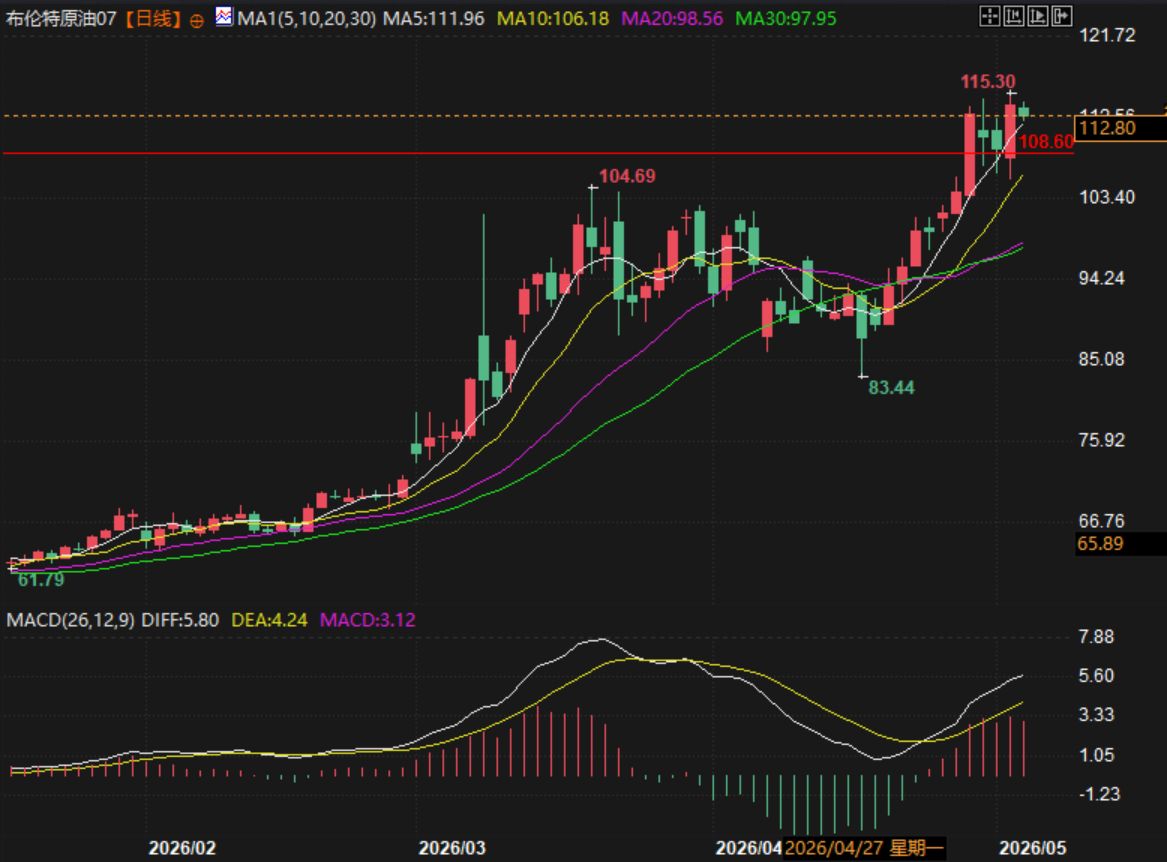
(Brent crude oil July contract daily chart, source: EasyForex)
At 16:37 Beijing time, the Brent crude oil July contract was trading at $112.86 per barrel.
Two US destroyers successfully transited the Strait of Hormuz after encountering heavy Iranian fire, marking a significant marginal change in the US-Iran situation and the emergence of at least two waterways accessible to large oil tankers, free from the threat of mines.
U.S. Central Command Commander Brad Cooper confirmed that the U.S. military has established an "enhanced security zone" in the Strait of Hormuz to completely eliminate the threat of Iranian mines, and the first two merchant ships flying the U.S. flag have successfully sailed through the waters.
In response to the coordinated missile, drone, and small boat attacks launched by Iran, US President Trump adopted a "double-statement" strategy: on the one hand, he made a strong threat on Fox News that "if Iran fires on US ships, it will be wiped off the face of the earth," and on the other hand, he deliberately downplayed the consequences of the conflict in an interview with ABC, saying that "it was not a fierce exchange of fire" and that "only one munition escaped and the damage was minor."
This combination of hard and soft rhetoric provides a buffer for both sides, allowing both the US and Iran to claim that they have achieved their tactical objectives and preventing the ceasefire agreement from completely collapsing.
Iran reveals its hand: it hasn't gone all out, retaining key bargaining chips in negotiations.
Although Iran did not directly prevent the US warship from passing through, it clearly signaled that it still holds key cards, thus preserving leverage for subsequent negotiations.
Iranian Parliament Speaker Mohammad al-Kalibaf publicly stated that "the new situation in the Strait of Hormuz is stabilizing, and we haven't even really started yet," implying that Iran has not yet deployed its full strategic forces.
According to disclosures by the Iranian Parliament's National Security Committee, the Bab el-Mandeb Strait, another crucial shipping route, may become Iran's "backup means of containment," with Yemeni armed groups potentially cooperating to create new geopolitical pressure points.
Previously, the Iranian military command had issued a stern warning, requiring all ships transiting the Strait of Hormuz to coordinate with it in advance, and that any "aggressive approach" by foreign military forces would become a target, highlighting that it still retains substantial influence over the strait.
Updates from all sides: US pressures and blockades, UAE attacked, Iran insists on its bottom line in negotiations.
The United States: In addition to advancing the "Freedom Project" to clear ships stranded in the Persian Gulf, the naval blockade of Iranian ports imposed since April 13 has forced at least 49 commercial vessels to turn back.
Republican Senator Lindsey Graham's explicit statement that "there is no need to send ground troops to Iran" indicates that the United States tends to use non-ground warfare methods such as maritime pressure and sanctions to force Iran to make concessions on nuclear and regional issues.
The United Arab Emirates , a key US ally, has suffered its first major attack since the ceasefire began.
Although its air defense system intercepted 15 missiles and 4 drones, a key oil facility in the eastern emirate of Fujairah was still hit by a drone, causing a fire that injured three Indian citizens. Several commercial flights bound for Dubai and Abu Dhabi were turned back midway, exposing its vulnerability in geopolitical conflicts.
Iran maintains that the US action of opening the sea lanes violates the ceasefire agreement, and Foreign Minister Abbas Araqchi warned the US and Afghanistan to "be wary of being dragged back into the quagmire of conflict."
Meanwhile, through semi-official media, he put forward negotiating conditions, demanding that the United States lift sanctions, end the blockade, withdraw troops from the region, and cease all hostilities (including Israel's operations in Lebanon), but explicitly excluded the nuclear program and the issue of enriched uranium from the current negotiating framework, and Trump has expressed doubts about the possibility of reaching an agreement on the proposal.
Summary and Technical Analysis:
Triggered by the principle of first principles, continued use of military assets by the United States would trigger 60 days of congressional intervention. The White House is trying to avoid confrontation with Congress, as requests for continued military action are generally not approved by Congress. Currently, it is shifting its focus back to facilitating passage through the Taiwan Strait and re-uniting with neighboring countries and the international community to put pressure on Iran.
While Iran has made strong public statements, it has not actually sunk the US warship. Observations suggest that its main intention may be to gain benefits at the negotiating table, obtain supplies, and wage a protracted war with the United States.
Currently, international oil prices remain largely anchored to the volume of traffic through the Strait of Hormuz and expectations of global restocking, and remain firm. Despite the positive impact of the US naval presence, oil prices have not fallen significantly and are still likely to continue to reach new highs.
From a technical perspective, Brent crude oil only slightly declined in the face of easing geopolitical tensions before rebounding from its lows, demonstrating the resilience of oil prices. Currently, after retracing to the 5-day moving average, it is expected to continue to new highs. The 5-day moving average and 108.60 are the two most recent support levels.
(Brent crude oil July contract daily chart, source: EasyForex)
At 16:37 Beijing time, the Brent crude oil July contract was trading at $112.86 per barrel.
- Risk Warning and Disclaimer
- The market involves risk, and trading may not be suitable for all investors. This article is for reference only and does not constitute personal investment advice, nor does it take into account certain users’ specific investment objectives, financial situation, or other needs. Any investment decisions made based on this information are at your own risk.