Dovish voices from key Federal Reserve figures support Hormuz, creating a tense atmosphere.
2026-05-05 20:42:11
On Tuesday morning (May 5), the US fleet passed through the Strait of Hormuz, and tensions were high. However, the dovish comments from Federal Reserve Vice Chairman Williams increased the possibility of a shift in the Fed's interest rate cut, causing the yields on US Treasury bonds of 2-10 years to rise and then fall, but still rise significantly.
Later in the Asian and European sessions, with the US warships successfully passing through without any obvious armed conflict, global risk appetite rebounded and US Treasury yields weakened. Now, Warsh is about to take office. Previously, the Fed's three votes for rate hikes brought significant resistance to Warsh's administration, but Williams' speech gave a glimmer of hope for a Fed rate cut this year.
The latest news indicates that Israel and the United States are coordinating a new round of efforts, including preparations for a new strike against Iran, but it is highly likely that this is more of a show of force than actual action.
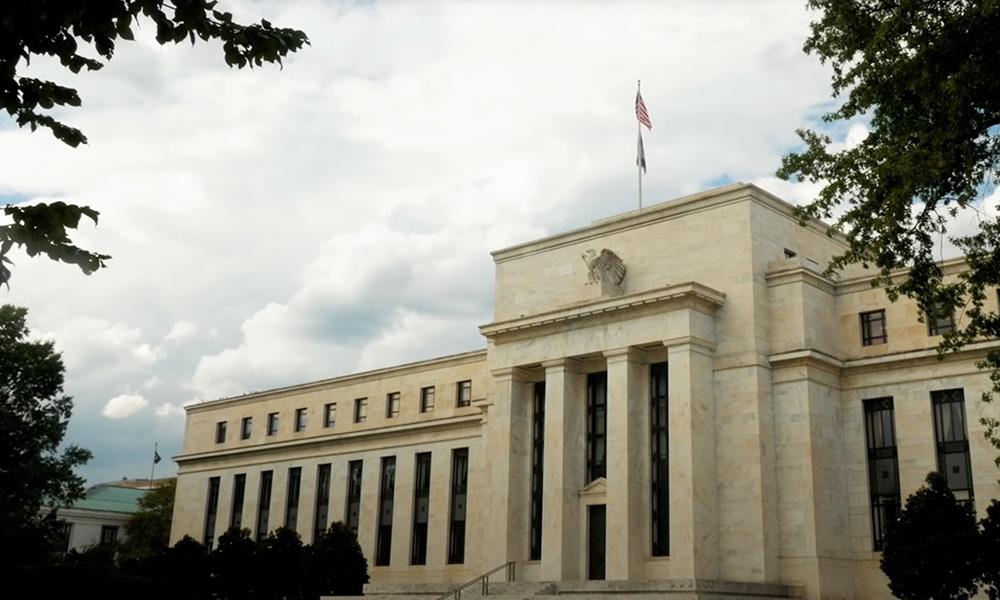
Donald Trump’s nominee, Kevin Warsh, will officially take over as chairman of the Federal Reserve on May 15, but his push for interest rate cuts has faced severe challenges from the outset.
The core obstacle for the new leader comes from Jerome Powell, the Federal Reserve Governor who will remain in office until January 2028. As a key figure who is firmly opposed to aggressive interest rate cuts, Powell's continued tenure is the biggest hindrance to Warsh's easing policies.
Powell revealed that he had originally planned to step down completely, but due to ongoing legal pressure from the Trump administration (including the Justice Department's investigation into alleged cost overruns in the Federal Reserve building renovation project), he decided to remain in office until the matter is "transparent and finally resolved."
This situation, coupled with the Supreme Court's impending ruling to remove Governor Lisa Cook from office, has plunged the Federal Reserve into a political and legal dilemma unprecedented in the history of U.S. central banks.
Although Warsh has secured the top decision-making power at the Federal Reserve, the real battle has only just begun.
The primary challenge comes from the deep division within the Federal Open Market Committee (FOMC): at its latest policy meeting, the decision to keep interest rates unchanged at 3.5%-3.75% was passed with 8 votes in favor and 4 against, marking the highest number of dissenting votes since October 1992, with three of the dissenting votes clearly supporting a rate hike.
More problematic is the rise of hawkish forces—while the presidents of the Federal Reserve Banks in Cleveland, Minneapolis, and Dallas support maintaining current interest rates, they have explicitly refused to signal any future easing.
The potential absence of Stephen Milan, the only Trump-appointed governor who supported a 25-basis-point rate cut (whose departure would require Senate confirmation if Powell were to step down), further weakened the dovish camp.
An analyst at Portfolio Individual Investors (PPI) bluntly stated, "Even if Warsh favors rate cuts, it is almost impossible for him to gather all seven votes in support in the short term."
Even more serious is that if a majority of FOMC members advocate for interest rate hikes, and Warsh votes against it, he will be caught in a double bind of demands for institutional independence and promises of political appointment—such a situation of a chairman publicly dissent has only occurred three times in the history of the Federal Reserve (during the Volcker administration in 1986, the Miller administration in 1978, and the Eccles administration in the 1930s), which could seriously affect its policy implementation and market credibility.
On Monday (May 4), Williams, the third-ranking official at the Federal Reserve and president of the New York Federal Reserve, said publicly that the current monetary policy of the Federal Reserve System is well-positioned to cope with the high degree of economic uncertainty caused by the war in the Middle East.
He also pointed out that the long-term federal funds rate should be around 3%, and once the current short-term surge in inflation is effectively alleviated, the Federal Reserve can refocus its attention on lowering interest rates.
This statement, Williams' first public response since the Federal Reserve decided last week to keep interest rates unchanged, reveals the policymakers' wait-and-see approach in the face of a complex situation, while keeping contingency plans in place.
Neil Dutta, head of economic research at Renaissance Macroeconomics, pointed out: "The threshold for a rate hike has been lowered last week. Although the process may be lengthy, the direction of the FOMC policy statement and the Summary of Economic Projections is clear, and hawks are dominating the discourse."
The market reacted quickly: the CME FedWatch Tool showed that the probability of a rate cut at any of the remaining six FOMC meetings in 2026 was less than 7%, and traders have significantly raised their expectations for a rate hike this year.
Meanwhile, asset markets showed a clear divergence: although the S&P 500 closed at a record high last Friday, it began to pull back 0.4% on Monday;
Meanwhile, U.S. Treasury yields rose across the board, with the 10-year yield climbing 6 basis points to 4.44%, the 5-year yield climbing 7 basis points to 4.10%, and the 2-year yield surging 8 basis points to 3.97%.
Oil price volatility was exacerbated by rising prices – West Texas Intermediate crude oil prices briefly broke through $106 per barrel, triggered by Iranian drone attacks on oil facilities in Fujairah, United Arab Emirates. Tensions in the region, a key shipping route around the Strait of Hormuz, further amplified the risk of energy inflation.
The bond market is sending clear warning signals of "mild stagflation".
Nicholas Kolas, co-founder of DataTrek Research, points out that the implied inflation expectation of the five-year U.S. Treasury bond is about to break through 2.7%, approaching the high point of 2023, while the inflation-adjusted real interest rate is trending downward.
This divergence indicates that the US economy is facing the dual pressures of rising inflation and slowing growth: on the one hand, the oil price increase triggered by the Middle East conflict has begun to spread to the US economy, pushing up price pressures;
On the other hand, below-average real interest rates suggest that economic growth will be slower than in the past three years.
Kolas warned that this environment means "the Fed must raise interest rates this year to maintain the credibility of its 2.0% inflation target, or risk lagging behind the times."
It is worth noting that the stock market and the bond market are showing a clear divergence—stock market investors are focusing on corporate profit margin growth, while the bond market has begun to price in the risk of rising inflation. This divergence highlights the market's digestion of the early stages of stagflation.
The Federal Reserve's policy maneuvering directly affects the dollar index. On April 29, the Fed's three dissenting votes for a rate hike caused the dollar index to reach a recent high. Similarly, Williams' dovish remarks caused the dollar index to fall.
Currently, the US dollar index is influenced not only by expectations of Federal Reserve policy, but also by geopolitical risk aversion and the withdrawal of some funds from the euro for safe haven.
The withdrawal of US troops from Europe and the imposition of tariffs on Europe have led to a short-term influx of safe-haven funds from selling euros and into the US dollar. Meanwhile, the entry of US warships into the Strait of Hormuz to open new shipping routes has weakened risk aversion sentiment in the long term. However, marginal changes that bring the possibility of accidental clashes have led some funds to buy the US dollar as a safe haven in the short term.
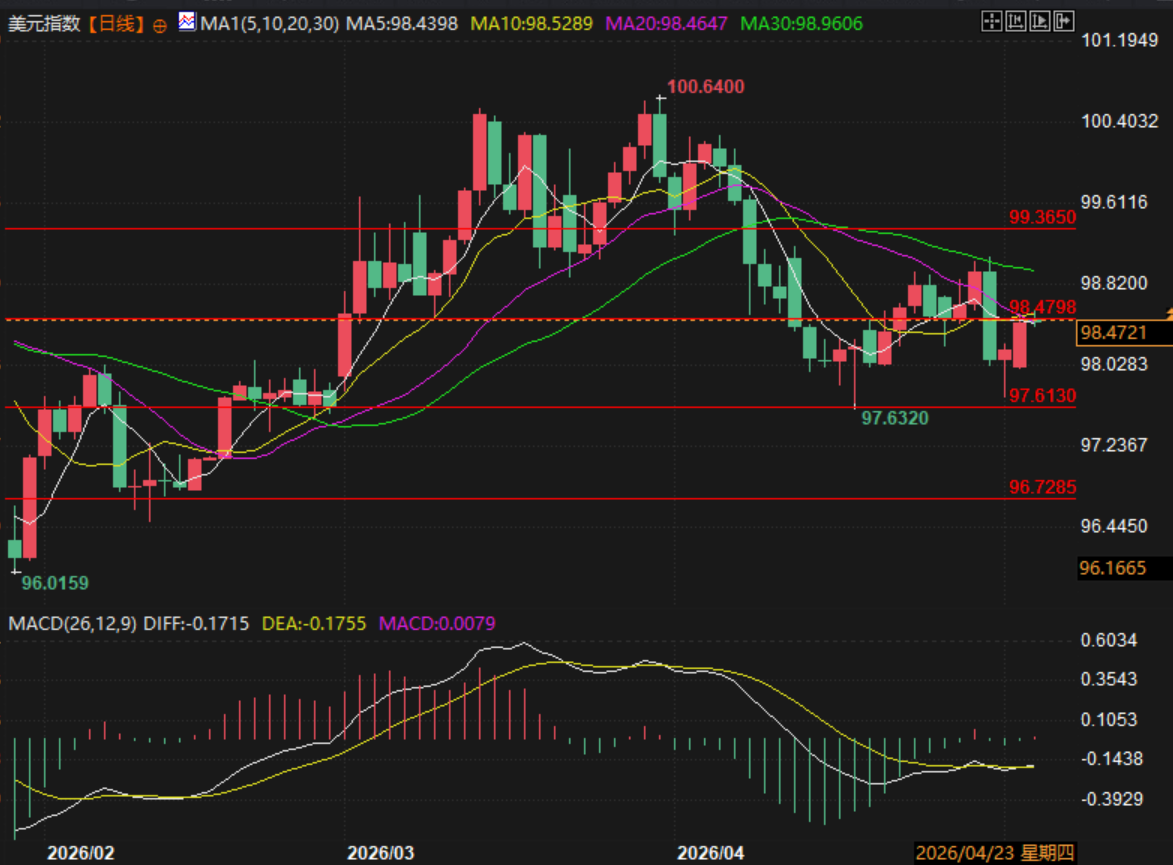
(US Dollar Index Daily Chart, Source: EasyForex)
At 20:38 Beijing time, the US dollar index is currently at 98.48.
Later in the Asian and European sessions, with the US warships successfully passing through without any obvious armed conflict, global risk appetite rebounded and US Treasury yields weakened. Now, Warsh is about to take office. Previously, the Fed's three votes for rate hikes brought significant resistance to Warsh's administration, but Williams' speech gave a glimmer of hope for a Fed rate cut this year.
The latest news indicates that Israel and the United States are coordinating a new round of efforts, including preparations for a new strike against Iran, but it is highly likely that this is more of a show of force than actual action.
Kevin Warsh's Path to the Federal Reserve
Donald Trump’s nominee, Kevin Warsh, will officially take over as chairman of the Federal Reserve on May 15, but his push for interest rate cuts has faced severe challenges from the outset.
The core obstacle for the new leader comes from Jerome Powell, the Federal Reserve Governor who will remain in office until January 2028. As a key figure who is firmly opposed to aggressive interest rate cuts, Powell's continued tenure is the biggest hindrance to Warsh's easing policies.
Powell revealed that he had originally planned to step down completely, but due to ongoing legal pressure from the Trump administration (including the Justice Department's investigation into alleged cost overruns in the Federal Reserve building renovation project), he decided to remain in office until the matter is "transparent and finally resolved."
This situation, coupled with the Supreme Court's impending ruling to remove Governor Lisa Cook from office, has plunged the Federal Reserve into a political and legal dilemma unprecedented in the history of U.S. central banks.
Walsh's Multiple Challenges After Taking Office
Although Warsh has secured the top decision-making power at the Federal Reserve, the real battle has only just begun.
The primary challenge comes from the deep division within the Federal Open Market Committee (FOMC): at its latest policy meeting, the decision to keep interest rates unchanged at 3.5%-3.75% was passed with 8 votes in favor and 4 against, marking the highest number of dissenting votes since October 1992, with three of the dissenting votes clearly supporting a rate hike.
More problematic is the rise of hawkish forces—while the presidents of the Federal Reserve Banks in Cleveland, Minneapolis, and Dallas support maintaining current interest rates, they have explicitly refused to signal any future easing.
The potential absence of Stephen Milan, the only Trump-appointed governor who supported a 25-basis-point rate cut (whose departure would require Senate confirmation if Powell were to step down), further weakened the dovish camp.
An analyst at Portfolio Individual Investors (PPI) bluntly stated, "Even if Warsh favors rate cuts, it is almost impossible for him to gather all seven votes in support in the short term."
Even more serious is that if a majority of FOMC members advocate for interest rate hikes, and Warsh votes against it, he will be caught in a double bind of demands for institutional independence and promises of political appointment—such a situation of a chairman publicly dissent has only occurred three times in the history of the Federal Reserve (during the Volcker administration in 1986, the Miller administration in 1978, and the Eccles administration in the 1930s), which could seriously affect its policy implementation and market credibility.
Latest Fed Developments: Hawkish Tendency and Market Reaction
On Monday (May 4), Williams, the third-ranking official at the Federal Reserve and president of the New York Federal Reserve, said publicly that the current monetary policy of the Federal Reserve System is well-positioned to cope with the high degree of economic uncertainty caused by the war in the Middle East.
He also pointed out that the long-term federal funds rate should be around 3%, and once the current short-term surge in inflation is effectively alleviated, the Federal Reserve can refocus its attention on lowering interest rates.
This statement, Williams' first public response since the Federal Reserve decided last week to keep interest rates unchanged, reveals the policymakers' wait-and-see approach in the face of a complex situation, while keeping contingency plans in place.
Neil Dutta, head of economic research at Renaissance Macroeconomics, pointed out: "The threshold for a rate hike has been lowered last week. Although the process may be lengthy, the direction of the FOMC policy statement and the Summary of Economic Projections is clear, and hawks are dominating the discourse."
The market reacted quickly: the CME FedWatch Tool showed that the probability of a rate cut at any of the remaining six FOMC meetings in 2026 was less than 7%, and traders have significantly raised their expectations for a rate hike this year.
Meanwhile, asset markets showed a clear divergence: although the S&P 500 closed at a record high last Friday, it began to pull back 0.4% on Monday;
Meanwhile, U.S. Treasury yields rose across the board, with the 10-year yield climbing 6 basis points to 4.44%, the 5-year yield climbing 7 basis points to 4.10%, and the 2-year yield surging 8 basis points to 3.97%.
Oil price volatility was exacerbated by rising prices – West Texas Intermediate crude oil prices briefly broke through $106 per barrel, triggered by Iranian drone attacks on oil facilities in Fujairah, United Arab Emirates. Tensions in the region, a key shipping route around the Strait of Hormuz, further amplified the risk of energy inflation.
Institutional Inflation Outlook: Mild Stagflation Risk Emerges
The bond market is sending clear warning signals of "mild stagflation".
Nicholas Kolas, co-founder of DataTrek Research, points out that the implied inflation expectation of the five-year U.S. Treasury bond is about to break through 2.7%, approaching the high point of 2023, while the inflation-adjusted real interest rate is trending downward.
This divergence indicates that the US economy is facing the dual pressures of rising inflation and slowing growth: on the one hand, the oil price increase triggered by the Middle East conflict has begun to spread to the US economy, pushing up price pressures;
On the other hand, below-average real interest rates suggest that economic growth will be slower than in the past three years.
Kolas warned that this environment means "the Fed must raise interest rates this year to maintain the credibility of its 2.0% inflation target, or risk lagging behind the times."
It is worth noting that the stock market and the bond market are showing a clear divergence—stock market investors are focusing on corporate profit margin growth, while the bond market has begun to price in the risk of rising inflation. This divergence highlights the market's digestion of the early stages of stagflation.
The correlation between interest rate trends and the US dollar index
The Federal Reserve's policy maneuvering directly affects the dollar index. On April 29, the Fed's three dissenting votes for a rate hike caused the dollar index to reach a recent high. Similarly, Williams' dovish remarks caused the dollar index to fall.
Currently, the US dollar index is influenced not only by expectations of Federal Reserve policy, but also by geopolitical risk aversion and the withdrawal of some funds from the euro for safe haven.
The withdrawal of US troops from Europe and the imposition of tariffs on Europe have led to a short-term influx of safe-haven funds from selling euros and into the US dollar. Meanwhile, the entry of US warships into the Strait of Hormuz to open new shipping routes has weakened risk aversion sentiment in the long term. However, marginal changes that bring the possibility of accidental clashes have led some funds to buy the US dollar as a safe haven in the short term.
(US Dollar Index Daily Chart, Source: EasyForex)
At 20:38 Beijing time, the US dollar index is currently at 98.48.
- Risk Warning and Disclaimer
- The market involves risk, and trading may not be suitable for all investors. This article is for reference only and does not constitute personal investment advice, nor does it take into account certain users’ specific investment objectives, financial situation, or other needs. Any investment decisions made based on this information are at your own risk.