Geopolitical risk premiums reignite, is gold poised for a second spring?
2026-05-05 21:59:44
On Tuesday, May 5th, spot gold rebounded during North American trading hours. After hitting a more than one-month low in the previous session, gold prices rose approximately 1.2% to $4,575 per ounce. This move occurred as investors assessed the fragile ceasefire agreement in the Middle East, which could have profound implications for global inflation expectations and the path of central bank interest rates. Meanwhile, with several US employment data releases scheduled for this week, market focus may gradually shift from geopolitical headlines to macroeconomic indicators.

Spot gold has seen a technical recovery after its recent correction, primarily driven by bargain hunting at lower levels coupled with indirect support from falling oil prices. Market analysts point out that after previous selling pressure subsided, some funds began to cover their positions, and the marginal easing of energy prices also alleviated some inflation concerns. US gold futures rose 1% in tandem, reaching $4588.60 per ounce, indicating that the futures market also captured this recovery signal.
However, the rebound remains cautious. As a non-yielding asset, gold has limited appeal in the current high-interest-rate environment. Traders need to pay attention to whether the short-term rebound can develop into a trend reversal, which depends on the strength of fundamental catalysts. Institutional views suggest that a significant fundamental catalyst is needed for a gold bull market to regain momentum, while the current situation is merely a sentiment recovery lacking sustained upward momentum.
While the Middle East ceasefire agreement has temporarily eased tensions, its fragility is evident. The clashes between the United States and Iran in the Strait of Hormuz highlight the struggle for control of this crucial waterway. This strait, which carries a significant volume of global oil, fertilizer, and other commodities, has been closed since the conflict escalated on February 28, directly driving up global energy costs.
Although oil prices retreated during this trading day, they remain high overall, limiting further downside. High energy prices directly translate into inflationary pressures, potentially delaying the easing cycles of major central banks. The head of the International Monetary Fund previously warned that if the Middle East conflict drags on until 2027, oil prices could reach $125 per barrel, causing a more severe impact on the global economy.
Gold has traditionally served as an inflation hedge, and its safe-haven properties continue to play a role in this context. However, as gold is increasingly viewed as a risk-sensitive asset, its safe-haven demand has weakened. Nevertheless, continued central bank gold purchases—with global central bank net gold purchases remaining strong in the first quarter of 2026—have effectively buffered against a deeper correction.
This week's US economic calendar is packed with data, including job openings, the ADP employment report, and April non-farm payrolls. Markets have shifted some focus away from geopolitical headlines to these indicators to gauge the likelihood of a Federal Reserve policy shift. The high-interest-rate environment continues to weigh on gold's appeal, as rising bond yields devalue non-interest-bearing assets.
Nevertheless, inflation hedging demand and the structural support from central bank diversified reserves continue to play a role. Analysts believe that gold currently behaves more as a risk-sensitive asset than a pure safe-haven tool, but central bank gold purchases provide an important floor for gold prices. Traders need to assess whether employment data shows a resilient labor market, which could reinforce the Federal Reserve's stance of maintaining high interest rates; conversely, weak employment data could boost expectations of rate cuts and benefit gold.
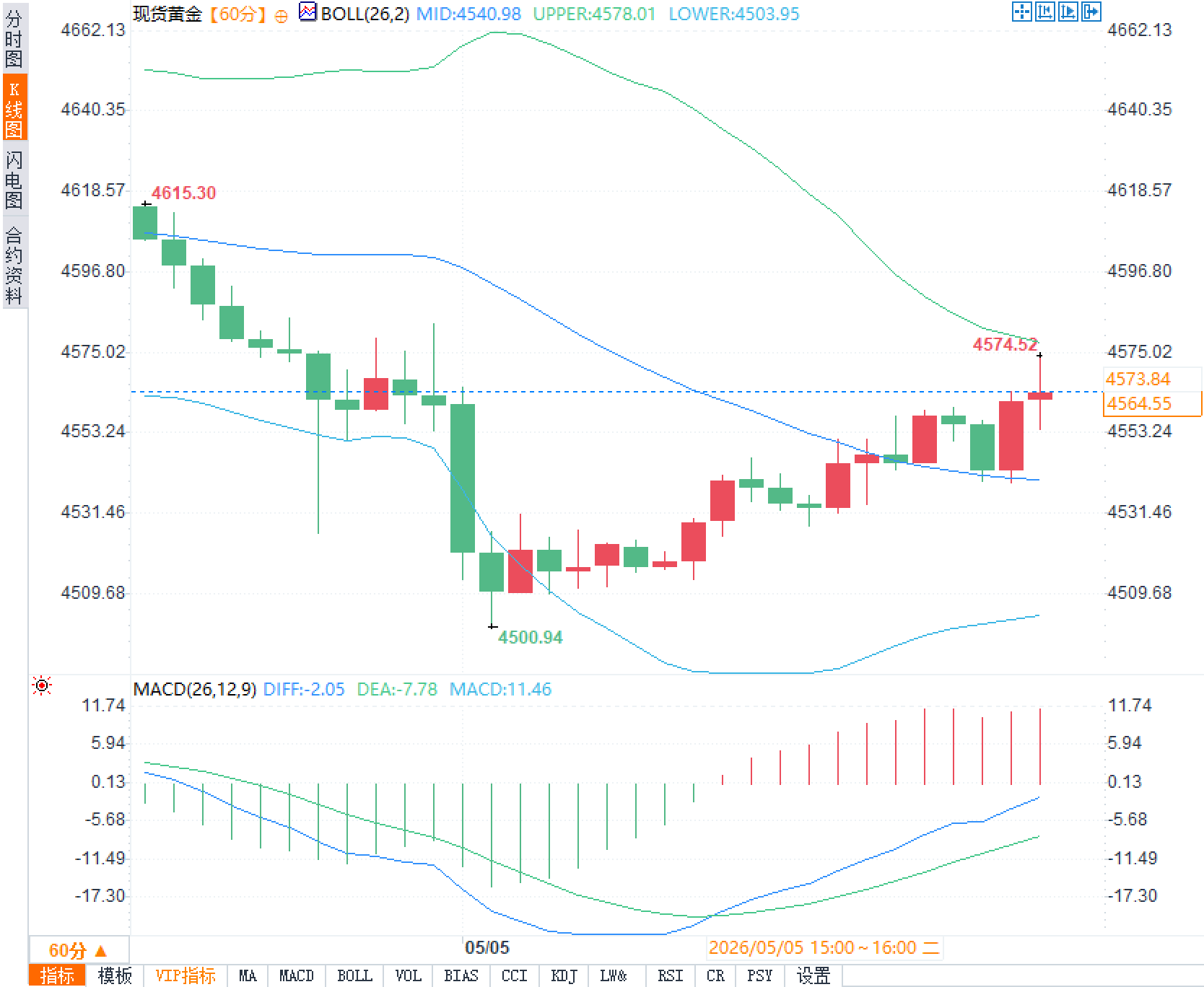
Observing the 60-minute chart, spot gold prices rebounded after finding support near the Bollinger Band middle line at 4540.98, and are currently approaching the upper line area at 4578.01. The Bollinger Bands are generally showing a contraction followed by expansion, indicating that volatility may increase. The MACD indicator shows DIFF at -2.05, DEA at -7.78, and the MACD histogram at 11.46, indicating that short-term momentum has recovered somewhat but is still within the oscillation range.
Market sentiment is mixed: there is buying interest at lower levels, but a lack of strong fundamental catalysts. Traders are generally focused on headline developments while preparing for economic data releases. Overall, gold prices are fluctuating within the $4,500-$4,600 range, and a breakout requires clear signals from geopolitical or policy fronts.
The driving logic behind the short-term rebound in gold prices
Spot gold has seen a technical recovery after its recent correction, primarily driven by bargain hunting at lower levels coupled with indirect support from falling oil prices. Market analysts point out that after previous selling pressure subsided, some funds began to cover their positions, and the marginal easing of energy prices also alleviated some inflation concerns. US gold futures rose 1% in tandem, reaching $4588.60 per ounce, indicating that the futures market also captured this recovery signal.
However, the rebound remains cautious. As a non-yielding asset, gold has limited appeal in the current high-interest-rate environment. Traders need to pay attention to whether the short-term rebound can develop into a trend reversal, which depends on the strength of fundamental catalysts. Institutional views suggest that a significant fundamental catalyst is needed for a gold bull market to regain momentum, while the current situation is merely a sentiment recovery lacking sustained upward momentum.
The ripple effect of the Middle East situation on energy inflation
While the Middle East ceasefire agreement has temporarily eased tensions, its fragility is evident. The clashes between the United States and Iran in the Strait of Hormuz highlight the struggle for control of this crucial waterway. This strait, which carries a significant volume of global oil, fertilizer, and other commodities, has been closed since the conflict escalated on February 28, directly driving up global energy costs.
Although oil prices retreated during this trading day, they remain high overall, limiting further downside. High energy prices directly translate into inflationary pressures, potentially delaying the easing cycles of major central banks. The head of the International Monetary Fund previously warned that if the Middle East conflict drags on until 2027, oil prices could reach $125 per barrel, causing a more severe impact on the global economy.
Gold has traditionally served as an inflation hedge, and its safe-haven properties continue to play a role in this context. However, as gold is increasingly viewed as a risk-sensitive asset, its safe-haven demand has weakened. Nevertheless, continued central bank gold purchases—with global central bank net gold purchases remaining strong in the first quarter of 2026—have effectively buffered against a deeper correction.
Impact of Macroeconomic Data Expectations and Interest Rate Path
This week's US economic calendar is packed with data, including job openings, the ADP employment report, and April non-farm payrolls. Markets have shifted some focus away from geopolitical headlines to these indicators to gauge the likelihood of a Federal Reserve policy shift. The high-interest-rate environment continues to weigh on gold's appeal, as rising bond yields devalue non-interest-bearing assets.
Nevertheless, inflation hedging demand and the structural support from central bank diversified reserves continue to play a role. Analysts believe that gold currently behaves more as a risk-sensitive asset than a pure safe-haven tool, but central bank gold purchases provide an important floor for gold prices. Traders need to assess whether employment data shows a resilient labor market, which could reinforce the Federal Reserve's stance of maintaining high interest rates; conversely, weak employment data could boost expectations of rate cuts and benefit gold.
Technical indicators and market sentiment analysis
Observing the 60-minute chart, spot gold prices rebounded after finding support near the Bollinger Band middle line at 4540.98, and are currently approaching the upper line area at 4578.01. The Bollinger Bands are generally showing a contraction followed by expansion, indicating that volatility may increase. The MACD indicator shows DIFF at -2.05, DEA at -7.78, and the MACD histogram at 11.46, indicating that short-term momentum has recovered somewhat but is still within the oscillation range.
Market sentiment is mixed: there is buying interest at lower levels, but a lack of strong fundamental catalysts. Traders are generally focused on headline developments while preparing for economic data releases. Overall, gold prices are fluctuating within the $4,500-$4,600 range, and a breakout requires clear signals from geopolitical or policy fronts.
Frequently Asked Questions
Question 1: Why did spot gold rebound by 1.2% after hitting a more than one-month low?
A: The main drivers are buying on dips and support from the marginal pullback in oil prices. After previous selling pressure subsided, some funds were used to cover positions. Meanwhile, while the fragile ceasefire agreement hasn't completely eliminated geopolitical risks, it has alleviated extreme risk aversion in the short term. Institutional analysis shows that gold still retains its role as an inflation hedge, but a stronger fundamental catalyst is needed to resume a sustained upward trend.
Question 2: How does the tension in the Strait of Hormuz affect gold prices?
A: The closure of the strait has driven up global energy prices, exacerbating inflationary pressures and potentially delaying central bank interest rate cuts. While high oil prices indirectly benefit gold, the high-interest-rate environment diminishes its attractiveness. The International Monetary Fund has warned that a prolonged conflict could push oil prices to $125 per barrel, worsening the global economic outlook and further highlighting the structural support role of gold.
Question 3: What potential impact will this week's US employment data have on gold prices?
A: Job openings, ADP and non-farm payroll data will influence market expectations regarding the Federal Reserve's interest rate path. Strong employment data may reinforce expectations of high interest rates, putting downward pressure on gold; conversely, weak data may boost expectations of rate cuts and support gold prices.
- Risk Warning and Disclaimer
- The market involves risk, and trading may not be suitable for all investors. This article is for reference only and does not constitute personal investment advice, nor does it take into account certain users’ specific investment objectives, financial situation, or other needs. Any investment decisions made based on this information are at your own risk.