Despite the Reserve Bank of Australia's dovish rate hike, prices surged against the trend! The direction is locked onto the US dollar and inflation.
2026-05-05 21:38:32
On Tuesday (May 5), the Australian dollar traded around 0.7170 against the US dollar, and continued to strengthen after significant fluctuations, even after the Reserve Bank of Australia announced its interest rate hike decision.
This interest rate hike was entirely in line with market expectations. After the positive impact was realized, the Australian dollar was briefly suppressed, but after consolidation, it continued to rise and hit a new intraday high.
Geopolitical tensions fluctuated significantly, and the US dollar index fluctuated back and forth as safe-haven funds flowed into the market, directly causing the Australian dollar to strengthen after a period of sharp volatility.
The Reserve Bank of Australia raised the cash rate by 25 basis points to 4.35% as expected, with a vote of 8 in favor and 1 against.
This is a continuation of the Reserve Bank of Australia's ongoing tightening of monetary policy. However, the overall wording of this rate hike was clearly dovish, with the central bank explicitly signaling a temporary pause in rate hikes and a wait-and-see approach.
Although there is a short-term intention to pause interest rate hikes, the policy level has not completely closed the door to further interest rate increases, leaving room for further tightening in the future.
The Reserve Bank of Australia's decision to raise interest rates was primarily driven by persistently rising domestic inflationary pressures.
The central bank predicts that Australian inflation will rise significantly in the second half of 2025. On the one hand, the supply and demand imbalance caused by limited domestic production capacity will push up prices. On the other hand, the tense geopolitical situation in the Middle East will lead to a sharp rise in international energy prices, creating imported inflationary pressure.
Meanwhile, short-term inflation expectations in Australia continue to rise, with businesses passing on increased operating costs to end consumers, further solidifying inflation stickiness. However, the economic growth outlook remains weak, characterized by weak growth and high inflation, with the risk of stagflation gradually emerging, forcing the Reserve Bank of Australia to maintain a tight monetary policy stance to anchor inflation.
Reserve Bank of Australia Governor Bullock also stated that current monetary policy is already in a moderately restrictive range, and while suppressing inflation, it will also carefully observe subsequent changes in economic data.
TD Securities strategists Prashant Newnaha and Alex Lue pointed out that the Reserve Bank of Australia's dovish rate hike indicates that the risks of inflation and economic growth have reached equilibrium.
Although the central bank intends to postpone interest rate hikes in June, this does not mean that the current interest rate hike cycle has come to a complete end.
The institution emphasized that the Reserve Bank of Australia has set a low-growth economic development path, and the subsequent policy pace will be entirely driven by inflation data. The central bank's own economic forecasts also imply that it may raise interest rates by another 25 basis points in the third quarter.
Back in February, TD Securities predicted that the interest rate in this round of interest rate hikes might reach 4.60%, and the probability of this prediction coming true is continuously increasing.
Commerzbank further explained that the weak economic growth in Australia, coupled with the risk of stagflation due to high energy prices, is the core negative factor suppressing the Australian dollar's performance in the medium to long term.
TD Securities also pointed out that the Reserve Bank of Australia's dovish stance has capped the upside potential of the Australian dollar. If the Australian dollar wants to stand firm and break through the 0.72 level against the US dollar, it can only rely on the overall weakening of the US dollar.
From an external perspective, the situation in the Middle East continues to escalate, with Iran launching drone and missile attacks against the UAE, and the US fleet entering the Persian Gulf to open new oil tanker routes. In the short term, global risk aversion has fluctuated significantly, and funds have been tossed back and forth between the US dollar and the US dollar.
US Treasury yields rose and then fell back. Minneapolis Fed President Kashkari released hawkish signals, indicating that the Fed would not rule out further rate hikes given the continued energy inflation. However, the Fed's third-ranking official, Williams, gave a more dovish tone, suggesting that the federal funds rate should ideally be around 3% and that further rate cuts were possible. This caused the Australian dollar to fluctuate against the US dollar.
On the economic front, global uncertainty continues to spread, and the Reserve Bank of Australia has lowered its economic growth forecast for the country, anticipating that geopolitical conflicts in the Middle East will continue to drag down Australian economic activity and further weaken the attractiveness of Australian dollar assets.
Regarding future policies and the Australian dollar's trajectory, the market generally holds a consensus: the Reserve Bank of Australia (RBA) will most likely keep interest rates unchanged in June, with August being the optimal window for the next rate hike; as long as Australia's second-quarter cut-off average CPI exceeds the central bank's expectations and inflation remains high and sticky, the RBA will complete its final 25 basis point rate hike in August, raising the rate to 4.60% and concluding this rate hike cycle.
Overall, in the short term, the Australian dollar will still rely more on the US dollar's performance against the US dollar, while Australia's own inflation level is also another direct factor determining the Australian dollar's trend.
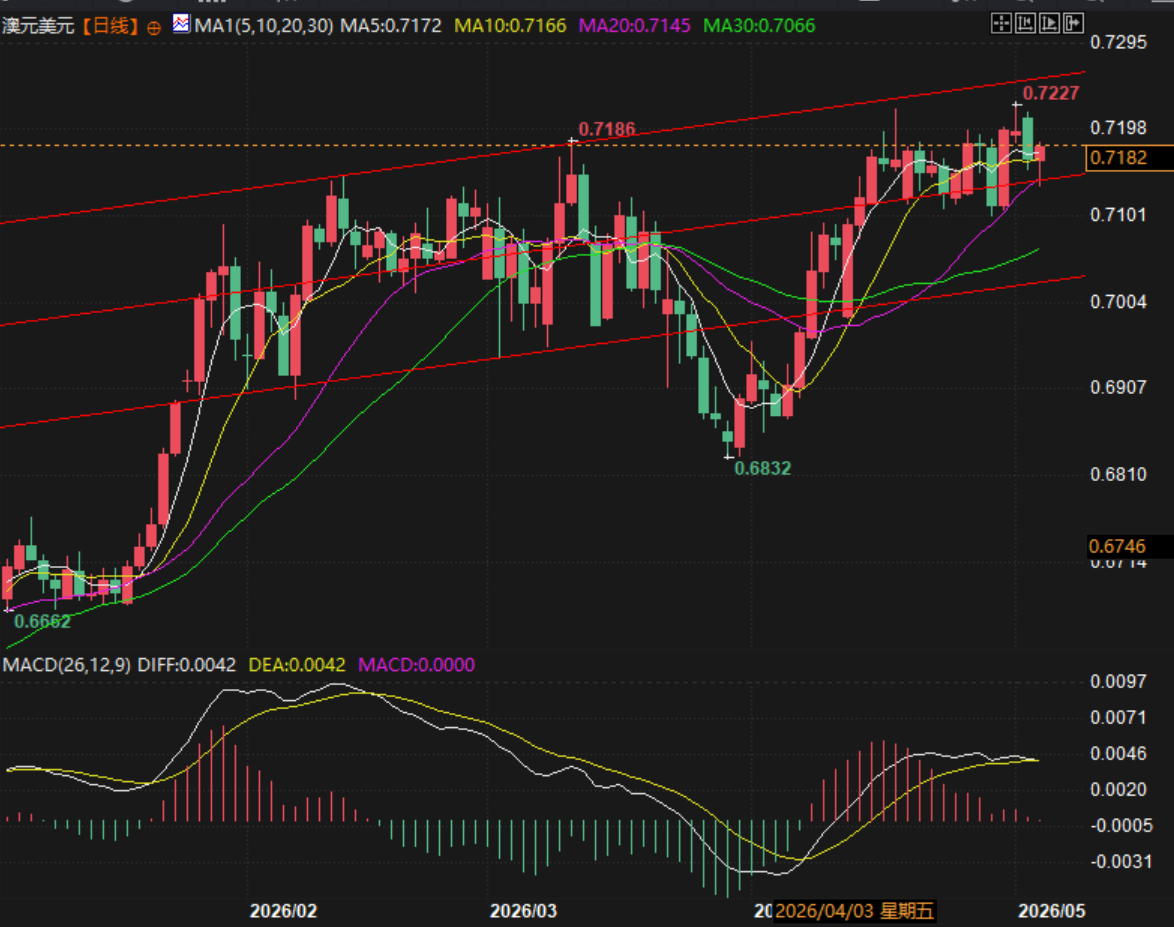
(AUD/USD daily chart, source: EasyForex)
At 21:36 Beijing time, the Australian dollar was trading at 0.7179/80 against the US dollar.
This interest rate hike was entirely in line with market expectations. After the positive impact was realized, the Australian dollar was briefly suppressed, but after consolidation, it continued to rise and hit a new intraday high.
Geopolitical tensions fluctuated significantly, and the US dollar index fluctuated back and forth as safe-haven funds flowed into the market, directly causing the Australian dollar to strengthen after a period of sharp volatility.
Australian interest rate decision: Rate hike in line with expectations, but the rate hike cycle may not be over.
The Reserve Bank of Australia raised the cash rate by 25 basis points to 4.35% as expected, with a vote of 8 in favor and 1 against.
This is a continuation of the Reserve Bank of Australia's ongoing tightening of monetary policy. However, the overall wording of this rate hike was clearly dovish, with the central bank explicitly signaling a temporary pause in rate hikes and a wait-and-see approach.
Although there is a short-term intention to pause interest rate hikes, the policy level has not completely closed the door to further interest rate increases, leaving room for further tightening in the future.
The core reasons behind the interest rate hike: increased inflation stickiness coupled with external energy shocks.
The Reserve Bank of Australia's decision to raise interest rates was primarily driven by persistently rising domestic inflationary pressures.
The central bank predicts that Australian inflation will rise significantly in the second half of 2025. On the one hand, the supply and demand imbalance caused by limited domestic production capacity will push up prices. On the other hand, the tense geopolitical situation in the Middle East will lead to a sharp rise in international energy prices, creating imported inflationary pressure.
Meanwhile, short-term inflation expectations in Australia continue to rise, with businesses passing on increased operating costs to end consumers, further solidifying inflation stickiness. However, the economic growth outlook remains weak, characterized by weak growth and high inflation, with the risk of stagflation gradually emerging, forcing the Reserve Bank of Australia to maintain a tight monetary policy stance to anchor inflation.
Reserve Bank of Australia Governor Bullock also stated that current monetary policy is already in a moderately restrictive range, and while suppressing inflation, it will also carefully observe subsequent changes in economic data.
In-depth analysis from major institutions
TD Securities strategists Prashant Newnaha and Alex Lue pointed out that the Reserve Bank of Australia's dovish rate hike indicates that the risks of inflation and economic growth have reached equilibrium.
Although the central bank intends to postpone interest rate hikes in June, this does not mean that the current interest rate hike cycle has come to a complete end.
The institution emphasized that the Reserve Bank of Australia has set a low-growth economic development path, and the subsequent policy pace will be entirely driven by inflation data. The central bank's own economic forecasts also imply that it may raise interest rates by another 25 basis points in the third quarter.
Back in February, TD Securities predicted that the interest rate in this round of interest rate hikes might reach 4.60%, and the probability of this prediction coming true is continuously increasing.
Commerzbank further explained that the weak economic growth in Australia, coupled with the risk of stagflation due to high energy prices, is the core negative factor suppressing the Australian dollar's performance in the medium to long term.
TD Securities also pointed out that the Reserve Bank of Australia's dovish stance has capped the upside potential of the Australian dollar. If the Australian dollar wants to stand firm and break through the 0.72 level against the US dollar, it can only rely on the overall weakening of the US dollar.
External negative factors combined with future market trends and policy prospects forecast
From an external perspective, the situation in the Middle East continues to escalate, with Iran launching drone and missile attacks against the UAE, and the US fleet entering the Persian Gulf to open new oil tanker routes. In the short term, global risk aversion has fluctuated significantly, and funds have been tossed back and forth between the US dollar and the US dollar.
US Treasury yields rose and then fell back. Minneapolis Fed President Kashkari released hawkish signals, indicating that the Fed would not rule out further rate hikes given the continued energy inflation. However, the Fed's third-ranking official, Williams, gave a more dovish tone, suggesting that the federal funds rate should ideally be around 3% and that further rate cuts were possible. This caused the Australian dollar to fluctuate against the US dollar.
On the economic front, global uncertainty continues to spread, and the Reserve Bank of Australia has lowered its economic growth forecast for the country, anticipating that geopolitical conflicts in the Middle East will continue to drag down Australian economic activity and further weaken the attractiveness of Australian dollar assets.
Regarding future policies and the Australian dollar's trajectory, the market generally holds a consensus: the Reserve Bank of Australia (RBA) will most likely keep interest rates unchanged in June, with August being the optimal window for the next rate hike; as long as Australia's second-quarter cut-off average CPI exceeds the central bank's expectations and inflation remains high and sticky, the RBA will complete its final 25 basis point rate hike in August, raising the rate to 4.60% and concluding this rate hike cycle.
Overall, in the short term, the Australian dollar will still rely more on the US dollar's performance against the US dollar, while Australia's own inflation level is also another direct factor determining the Australian dollar's trend.
(AUD/USD daily chart, source: EasyForex)
At 21:36 Beijing time, the Australian dollar was trading at 0.7179/80 against the US dollar.
- Risk Warning and Disclaimer
- The market involves risk, and trading may not be suitable for all investors. This article is for reference only and does not constitute personal investment advice, nor does it take into account certain users’ specific investment objectives, financial situation, or other needs. Any investment decisions made based on this information are at your own risk.