Is gold presenting a strategic buying opportunity? Top strategists warn: Stop waiting and immediately establish a 3% to 8% position.
2026-05-06 10:35:44
The international gold market has recently experienced volatility. Despite continued price pressure and a cooling of investor enthusiasm, John LaForge, chief alternative strategist at Ned Davis Research (NDR), an independent US research firm, has issued a clear bullish signal. In his view, the current correction and consolidation in gold prices provides investors with a valuable window to establish long-term strategic allocations. He states that gold is not only a traditional safe-haven asset but also plays an irreplaceable role as a "diversifier" and "currency anchor" in modern investment portfolios.

LaForge points out that recent market pessimism regarding gold has clearly accumulated, while the US dollar has shown renewed weakness; these two factors together have triggered a new buy signal.
He emphasized that the NDR's dollar trend model has fully shifted to a bullish signal for gold, and another key indicator—the gold sentiment index—has also fallen into extremely pessimistic territory. Historically, such extreme pessimism often foreshadows an approaching price bottom, so investors should no longer wait and see.
In terms of specific operations, LaForge recommends that investors allocate 3% to 8% of their total assets to gold and include gold as part of their commodity portfolio.
He specifically pointed out that for investors who currently have insufficient gold holdings or no positions at all, now is the right time to start building strategic positions, rather than deliberately waiting for further price corrections before entering the market. This is because the factors supporting the long-term strength of gold are structural changes, rather than short-term tactical fluctuations.
It's worth noting that his bullish view is based on the premise that gold prices have not yet broken through the key initial resistance level of $4,600 per ounce. Once this level is effectively breached, further upside potential may open up. On Monday (May 4), spot gold fell to around $4,500 per ounce, rebounded slightly on Tuesday, and continued its upward trend in early Asian trading on Wednesday, currently standing at $4,630 per ounce.
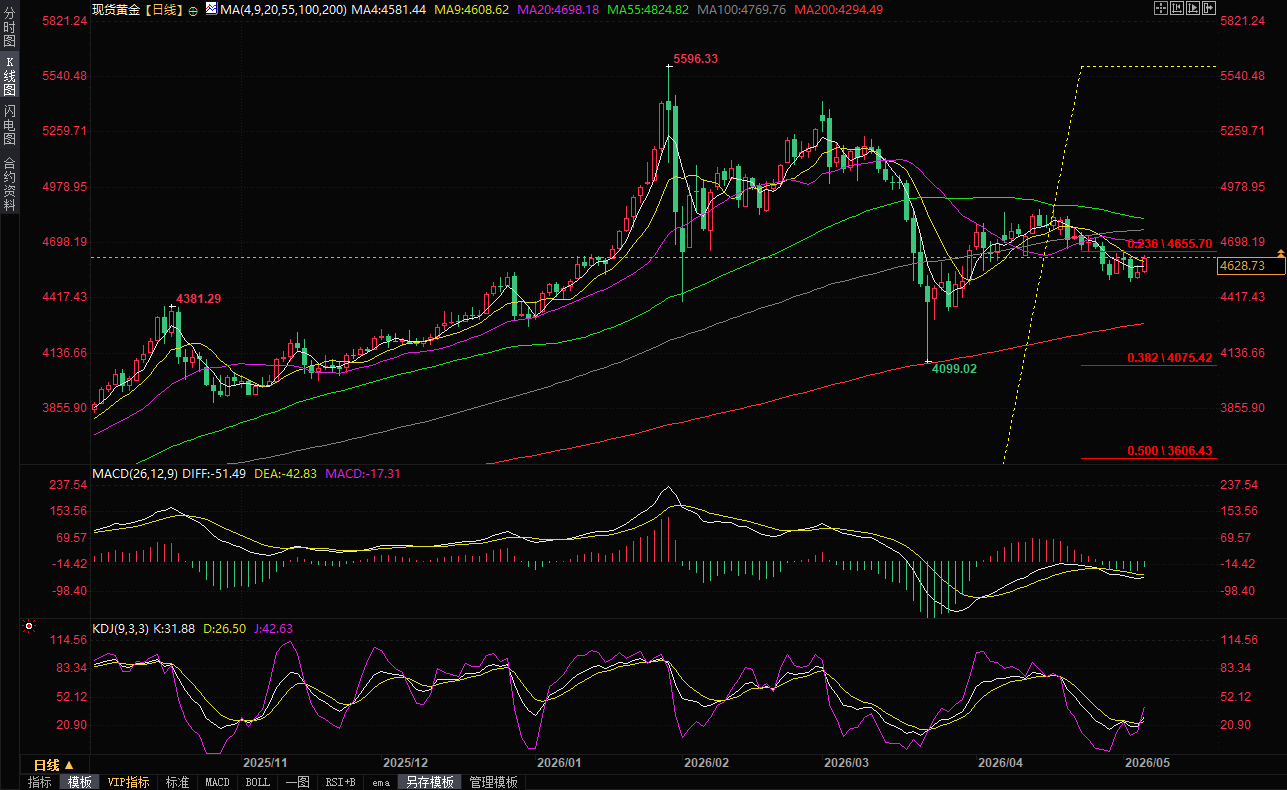
(Spot gold daily chart, source: FX678)
There have long been differing opinions in the market regarding the function of gold—some see it as a tool to hedge against inflation, while others regard it as a safe haven during geopolitical turmoil. However, LaForge offers a more concise summary: gold's two most fundamental functions are, firstly, a diversification tool for investment portfolios, and secondly, a neutral monetary asset. He argues that gold often performs best when the portfolio logic built by investors based on traditional assumptions fails or weakens.
Historical data shows that gold has a low long-term correlation with stocks and bonds, and even exhibits a negative correlation in some periods, particularly during financial crises. LaForge cites the 2022 market as an example: stocks and bonds experienced an unusually synchronized decline that year, causing significant pain for investors, while gold performed exceptionally well. He concludes that when all asset classes collapse simultaneously, a portfolio holding only stocks and bonds does not achieve effective diversification, while the addition of gold can significantly improve the portfolio's resilience.
LaForge published these views at a time when gold prices were generally weak, failing to receive a significant boost despite the ongoing conflict in Iran and persistent geopolitical uncertainty in the Middle East. This unusual phenomenon has multiple causes. First, the turmoil in the Middle East has caused a significant supply shock to the energy market, and rising oil prices have further exacerbated market concerns about inflation. Faced with rising inflation risks, major central banks around the world have been forced to shift their monetary policies to a more neutral stance, and the market has begun to price in potential interest rate cuts this year.
However, tight monetary policy is not necessarily good for gold. Since gold itself does not generate interest or dividends, higher interest rates increase the opportunity cost of holding gold, thus suppressing its price performance. LaForge also frankly points out that gold's historical performance as a pure inflation hedge is not particularly strong; it has typically performed exceptionally well during periods of uncertainty within the entire financial system.
Despite recent downward pressure on gold prices, central banks worldwide have been consistently purchasing large quantities of gold in recent years. LaForge offers a profound analysis of this, arguing that gold is one of the very few major assets without counterparty risk. Gold owes no one anything; its operation requires no CEO management, no judicial system adjudication, and no permission from another government. It is precisely because of these characteristics that central banks are beginning to re-examine their reserve structures.
Looking further, central banks are not merely worried about the distant, low-probability event of US Treasury bonds being requisitioned. The deeper reason is that countries have realized that in a world rife with debt, they already hold too much of it, and the entire international monetary system is built solely on "complete trust and credit." Moderately increasing gold reserves while reducing some debt-like assets is essentially a prudent risk management strategy. LaForge concludes that gold is one of the most direct and time-tested ways to preserve wealth, transcending the monetary policies of individual countries.
In summary, John LaForge's core argument is clear and unwavering: gold's current price level is highly attractive, market sentiment has plummeted, and a weakening dollar is providing support for gold prices. Investors should no longer hesitate to wait for so-called "lower prices," but rather seize this structural investment opportunity to increase gold's share of total assets to a strategic level of 3% to 8%. Whether as a tool for diversifying portfolio risk or as a monetary asset independent of any single country's credit, gold deserves a place in the long-term investment landscape. In a complex environment filled with debt, inflation, and geopolitical games, gold's historical stability is precisely the most scarce asset attribute today.
At 10:33 Beijing time, spot gold was trading at $4,630.52 per ounce.
Pessimistic sentiment dissipates, buy signals emerge
LaForge points out that recent market pessimism regarding gold has clearly accumulated, while the US dollar has shown renewed weakness; these two factors together have triggered a new buy signal.
He emphasized that the NDR's dollar trend model has fully shifted to a bullish signal for gold, and another key indicator—the gold sentiment index—has also fallen into extremely pessimistic territory. Historically, such extreme pessimism often foreshadows an approaching price bottom, so investors should no longer wait and see.
Recommended allocation: 3% to 8% of strategic positions
In terms of specific operations, LaForge recommends that investors allocate 3% to 8% of their total assets to gold and include gold as part of their commodity portfolio.
He specifically pointed out that for investors who currently have insufficient gold holdings or no positions at all, now is the right time to start building strategic positions, rather than deliberately waiting for further price corrections before entering the market. This is because the factors supporting the long-term strength of gold are structural changes, rather than short-term tactical fluctuations.
It's worth noting that his bullish view is based on the premise that gold prices have not yet broken through the key initial resistance level of $4,600 per ounce. Once this level is effectively breached, further upside potential may open up. On Monday (May 4), spot gold fell to around $4,500 per ounce, rebounded slightly on Tuesday, and continued its upward trend in early Asian trading on Wednesday, currently standing at $4,630 per ounce.
(Spot gold daily chart, source: FX678)
The true role of gold: risk diversification and a monetary asset
There have long been differing opinions in the market regarding the function of gold—some see it as a tool to hedge against inflation, while others regard it as a safe haven during geopolitical turmoil. However, LaForge offers a more concise summary: gold's two most fundamental functions are, firstly, a diversification tool for investment portfolios, and secondly, a neutral monetary asset. He argues that gold often performs best when the portfolio logic built by investors based on traditional assumptions fails or weakens.
Historical data shows that gold has a low long-term correlation with stocks and bonds, and even exhibits a negative correlation in some periods, particularly during financial crises. LaForge cites the 2022 market as an example: stocks and bonds experienced an unusually synchronized decline that year, causing significant pain for investors, while gold performed exceptionally well. He concludes that when all asset classes collapse simultaneously, a portfolio holding only stocks and bonds does not achieve effective diversification, while the addition of gold can significantly improve the portfolio's resilience.
Why is gold still weak amid geopolitical conflicts and inflationary pressures?
LaForge published these views at a time when gold prices were generally weak, failing to receive a significant boost despite the ongoing conflict in Iran and persistent geopolitical uncertainty in the Middle East. This unusual phenomenon has multiple causes. First, the turmoil in the Middle East has caused a significant supply shock to the energy market, and rising oil prices have further exacerbated market concerns about inflation. Faced with rising inflation risks, major central banks around the world have been forced to shift their monetary policies to a more neutral stance, and the market has begun to price in potential interest rate cuts this year.
However, tight monetary policy is not necessarily good for gold. Since gold itself does not generate interest or dividends, higher interest rates increase the opportunity cost of holding gold, thus suppressing its price performance. LaForge also frankly points out that gold's historical performance as a pure inflation hedge is not particularly strong; it has typically performed exceptionally well during periods of uncertainty within the entire financial system.
The logic behind the central bank's gold buying spree: avoiding counterparty risk.
Despite recent downward pressure on gold prices, central banks worldwide have been consistently purchasing large quantities of gold in recent years. LaForge offers a profound analysis of this, arguing that gold is one of the very few major assets without counterparty risk. Gold owes no one anything; its operation requires no CEO management, no judicial system adjudication, and no permission from another government. It is precisely because of these characteristics that central banks are beginning to re-examine their reserve structures.
Looking further, central banks are not merely worried about the distant, low-probability event of US Treasury bonds being requisitioned. The deeper reason is that countries have realized that in a world rife with debt, they already hold too much of it, and the entire international monetary system is built solely on "complete trust and credit." Moderately increasing gold reserves while reducing some debt-like assets is essentially a prudent risk management strategy. LaForge concludes that gold is one of the most direct and time-tested ways to preserve wealth, transcending the monetary policies of individual countries.
In summary: Structural opportunities have arrived; there's no need to wait for the perfect entry point.
In summary, John LaForge's core argument is clear and unwavering: gold's current price level is highly attractive, market sentiment has plummeted, and a weakening dollar is providing support for gold prices. Investors should no longer hesitate to wait for so-called "lower prices," but rather seize this structural investment opportunity to increase gold's share of total assets to a strategic level of 3% to 8%. Whether as a tool for diversifying portfolio risk or as a monetary asset independent of any single country's credit, gold deserves a place in the long-term investment landscape. In a complex environment filled with debt, inflation, and geopolitical games, gold's historical stability is precisely the most scarce asset attribute today.
At 10:33 Beijing time, spot gold was trading at $4,630.52 per ounce.
- Risk Warning and Disclaimer
- The market involves risk, and trading may not be suitable for all investors. This article is for reference only and does not constitute personal investment advice, nor does it take into account certain users’ specific investment objectives, financial situation, or other needs. Any investment decisions made based on this information are at your own risk.