A comprehensive analysis of US employment data and an outlook for the US dollar index.
2026-05-06 20:46:57
The ADP national employment report released on Wednesday showed that U.S. private nonfarm payrolls increased significantly more than the market consensus in April.
On the data front, the number of new private sector jobs in March was revised down to 61,000, while the number of new private sector jobs in April reached 109,000.
The ADP employment report is jointly compiled by ADP and the Stanford Digital Economy Lab. The data is released earlier than the official employment report for April from the U.S. Bureau of Labor Statistics on Friday. The latter has a broader statistical coverage and is a core indicator that financial markets pay close attention to.
Historically, ADP private sector employment data has consistently been a weak indicator of the Bureau of Labor Statistics' official employment forecasts. The overall labor market is currently maintaining a stable pattern of "low hiring, low layoffs."

The capital market generally believes that the recent unexpected expansion of capital expenditure by AI-related companies, coupled with the continued recovery of end-user demand in the industrial chain, is indirectly supporting the US job market.
Technology and AI industry chain companies continue to increase investment and expand their business scope, driving a steady recovery in job recruitment demand. This has offset the pressure of weak employment in some traditional industries, becoming an important incremental factor supporting the resilience of US employment and preventing the overall job market from falling into a state of continuous weakening.
According to the latest data on the US labor market, the official JOLTs job openings data for March, released Tuesday evening, exceeded expectations.
Although the number of job openings declined slightly compared to the previous month, the overall data performed better than market expectations, with companies hiring a large number of people, climbing to a new high in more than two years.
A survey conducted last week by The Conference Board also reflected subtle changes in the job market. In April, the percentage of people who felt it was difficult to find a job declined, while the percentage who felt there was an ample supply of jobs remained relatively stable.
Looking ahead to the upcoming non-farm payroll data, an economist survey has given a clear expectation: non-farm payrolls rebounded strongly in March with an increase of 178,000, but the growth rate of non-farm payrolls in April may slow to 62,000;
Following a surge of 186,000 private sector jobs last month, April’s new jobs are expected to fall to 75,000, and the market generally anticipates that the U.S. unemployment rate will remain unchanged at 4.3%.
From a comprehensive market perspective, the US job market remains resilient overall. Although the growth rate of non-farm payrolls and private sector employment is expected to slow down in April, there are no signs of a significant decline, and the balance between low hiring and low layoffs continues.
The better-than-expected job openings and significant rebound in hiring activity in March by JOLTs further confirm that the demand side of the labor market remains supported. Coupled with the long-term employment benefits brought by the expansion of capital expenditure in the AI industry, this has strengthened market expectations for the overall stable operation of the US economy and the avoidance of a recession in the short term. Improved residents' employment perception has also further benefited the fundamentals of the consumer economy.
Technically, the US dollar index rebounded after falling to the previous densely traded area and the lower edge of the trading range, influenced by easing geopolitical risks and data releases. Support is around 97.6, which is also the measured retracement level of the double-top pattern above, while resistance is at the 50% Fibonacci retracement level of the trading range at 98.3 and near the 5-day moving average.
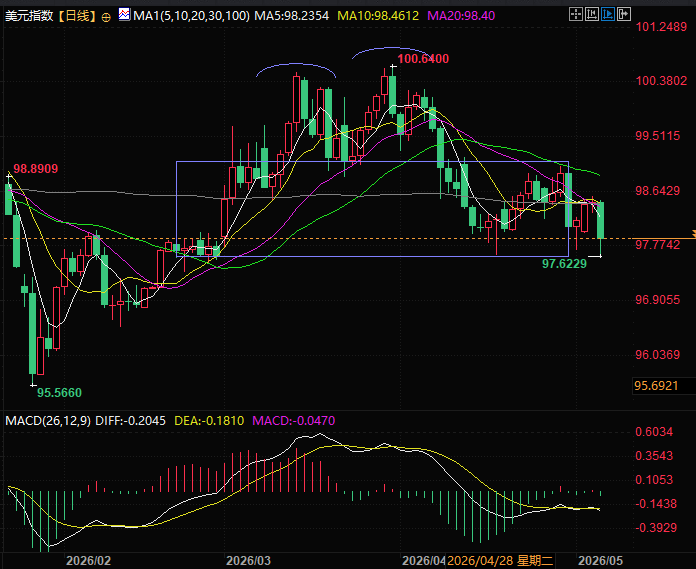
(US Dollar Index Daily Chart, Source: EasyForex)
At 20:43 Beijing time, the US dollar index is currently at 97.90.
On the data front, the number of new private sector jobs in March was revised down to 61,000, while the number of new private sector jobs in April reached 109,000.
The ADP employment report is jointly compiled by ADP and the Stanford Digital Economy Lab. The data is released earlier than the official employment report for April from the U.S. Bureau of Labor Statistics on Friday. The latter has a broader statistical coverage and is a core indicator that financial markets pay close attention to.
Historically, ADP private sector employment data has consistently been a weak indicator of the Bureau of Labor Statistics' official employment forecasts. The overall labor market is currently maintaining a stable pattern of "low hiring, low layoffs."
High growth in capital expenditure by AI companies has become a significant contributor to employment.
The capital market generally believes that the recent unexpected expansion of capital expenditure by AI-related companies, coupled with the continued recovery of end-user demand in the industrial chain, is indirectly supporting the US job market.
Technology and AI industry chain companies continue to increase investment and expand their business scope, driving a steady recovery in job recruitment demand. This has offset the pressure of weak employment in some traditional industries, becoming an important incremental factor supporting the resilience of US employment and preventing the overall job market from falling into a state of continuous weakening.
JOLTs saw a stronger-than-expected increase in job openings and a strong rebound in hiring activity in March.
According to the latest data on the US labor market, the official JOLTs job openings data for March, released Tuesday evening, exceeded expectations.
Although the number of job openings declined slightly compared to the previous month, the overall data performed better than market expectations, with companies hiring a large number of people, climbing to a new high in more than two years.
A survey conducted last week by The Conference Board also reflected subtle changes in the job market. In April, the percentage of people who felt it was difficult to find a job declined, while the percentage who felt there was an ample supply of jobs remained relatively stable.
Market Outlook: April Non-Farm Payrolls Growth Expected to Slow Moderately
Looking ahead to the upcoming non-farm payroll data, an economist survey has given a clear expectation: non-farm payrolls rebounded strongly in March with an increase of 178,000, but the growth rate of non-farm payrolls in April may slow to 62,000;
Following a surge of 186,000 private sector jobs last month, April’s new jobs are expected to fall to 75,000, and the market generally anticipates that the U.S. unemployment rate will remain unchanged at 4.3%.
Summary and Technical Analysis:
From a comprehensive market perspective, the US job market remains resilient overall. Although the growth rate of non-farm payrolls and private sector employment is expected to slow down in April, there are no signs of a significant decline, and the balance between low hiring and low layoffs continues.
The better-than-expected job openings and significant rebound in hiring activity in March by JOLTs further confirm that the demand side of the labor market remains supported. Coupled with the long-term employment benefits brought by the expansion of capital expenditure in the AI industry, this has strengthened market expectations for the overall stable operation of the US economy and the avoidance of a recession in the short term. Improved residents' employment perception has also further benefited the fundamentals of the consumer economy.
Technically, the US dollar index rebounded after falling to the previous densely traded area and the lower edge of the trading range, influenced by easing geopolitical risks and data releases. Support is around 97.6, which is also the measured retracement level of the double-top pattern above, while resistance is at the 50% Fibonacci retracement level of the trading range at 98.3 and near the 5-day moving average.
(US Dollar Index Daily Chart, Source: EasyForex)
At 20:43 Beijing time, the US dollar index is currently at 97.90.
- Risk Warning and Disclaimer
- The market involves risk, and trading may not be suitable for all investors. This article is for reference only and does not constitute personal investment advice, nor does it take into account certain users’ specific investment objectives, financial situation, or other needs. Any investment decisions made based on this information are at your own risk.