Gold Trading Alert: Gold Prices Surge Nearly 3% Amidst Hope for a US-Iran Peace Agreement! Geopolitical Risks Plunge, Protesters Gain Major Breath of Breath.
2026-05-07 07:21:35
The global gold market saw a significant rebound on Wednesday (May 6), with spot gold prices hitting their highest level since April 27, a single-day increase of nearly 3%, fully reflecting the market's positive reaction to the rapid easing of geopolitical risks. This rally not only broke the recent consolidation pattern but also provided investors with an important window to reassess gold's safe-haven attributes and macroeconomic drivers. On Thursday (May 7) in early Asian trading, spot gold traded in a narrow range, currently hovering around $4695 per ounce.
Gold prices surged on Wednesday, boosted by optimistic news that the United States and Iran might reach a peace agreement. Multiple media outlets, citing Pakistani mediators and related sources, reported that Washington and Tehran were close to reaching an agreement on a "one-page memorandum" aimed at formally ending the Gulf conflict that began on February 28, followed by the initiation of more in-depth negotiations.
The Iranian Foreign Ministry stated that it is reviewing the latest US proposal and will respond through Pakistani channels. US President Trump also publicly stated that the two sides had held "very good talks" over the past 24 hours, and that Iran "very much wants to reach an agreement." Although substantial differences remain between the two sides on issues such as Iran's nuclear program, control of the Strait of Hormuz, missile programs, and proxy forces, the market is clearly choosing to capitalize on positive signals first, with a "take a risk now, assess later" trading mentality rapidly spreading.
This expectation directly alleviated market concerns about further deterioration of the situation in the Middle East, increased inflationary pressures, and persistently high interest rates. Peter Grant, Vice President and Senior Metals Strategist at Zaner Metals, pointed out that optimism surrounding the US-Iran agreement, falling oil prices, easing inflation concerns, and a shift in Federal Reserve policy expectations have collectively brought significant short-term relief to the gold market.
Fueled by news of the agreement, spot gold rose nearly 3% on Wednesday, reaching a high of $4,722.59 per ounce before closing near $4,690 per ounce. U.S. gold futures also strengthened, rising 2.8% to $4,694.30 per ounce.
Meanwhile, the dollar index fell 0.48%, hitting its lowest level since late February, making dollar-denominated gold more attractive to holders of other currencies. Major currencies such as the euro and pound sterling strengthened, while the yen surged briefly due to rumors of intervention.
The sharp drop in oil prices and gold prices moved in stark contrast. Brent crude futures plunged nearly 11% at one point, falling below the $100 mark to $96.75 per barrel, before finally closing near $101; U.S. crude also fell by more than 7%. Since the outbreak of the conflict, shipping disruptions in the Gulf region have led to a significant oil supply gap, with oil prices reaching their highest level since March 2022. The glimmer of peace has raised market expectations that the Strait of Hormuz may reopen, significantly reducing energy supply risks and easing inflationary pressures. This has created a double benefit for gold – both reducing the "war premium" in safe-haven demand and weakening inflation expectations through the transmission of oil prices.
Investors have quickly shifted their focus to key U.S. economic data in the latter half of this week. Friday's monthly non-farm payrolls report will be the focal point, testing whether the U.S. economy is resilient enough to support the Federal Reserve maintaining its current monetary policy, or whether a weakening labor market will reignite expectations of interest rate cuts.
The previously released ADP National Employment Report showed that private sector job growth in the US exceeded expectations in April, providing initial support for economic stability. However, the market remains cautious, with officials such as St. Louis Fed President Musaleem emphasizing that inflation risks have shifted upwards, and given the stable job market, interest rates may need to remain unchanged for some time. The market has now largely ruled out the possibility of a Fed rate cut this year.
The bond market also reacted in tandem: the 10-year Treasury yield fell to 4.354%, a new low since April 27; the two-year yield saw a significant single-day decline, reflecting investors' pricing adjustments in response to improved risk appetite. Strong US corporate earnings season, driven by artificial intelligence spending, further supported economic growth expectations, limiting the downside potential for yields to some extent.
Despite high market enthusiasm, analysts caution that uncertainty remains regarding the prospects of an agreement. Iran has described the US proposal as a "wish list" rather than a concrete text, and the two sides have not fully bridged their core differences on nuclear facilities, sanctions relief, shipping through the Strait of Hormuz, and missile issues. Trump himself has also expressed a more pessimistic view on social media and threatened to resume bombing raids.
If a preliminary memorandum is reached, it will initiate 30 days of detailed negotiations with goals including lifting sanctions, unfreezing funds, restricting uranium enrichment activities, and restoring shipping across the Strait. However, any hardening of positions by either side could quickly reverse market optimism.
In summary, the core driver of this round of gold price increases is the "triple positive" effect triggered by expectations of a US-Iran peace agreement: the plunge in oil prices easing inflationary pressures, a weaker dollar increasing the attractiveness of gold, and declining bond yields lowering holding costs. The market is pricing in the most optimistic scenario of the end of a geopolitical conflict.
In the short term, as long as the positive atmosphere of peace negotiations is maintained, gold is expected to continue to receive support. However, investors must also be aware that a genuine comprehensive agreement still faces arduous negotiations over the next 30 days and numerous political and technical obstacles. Friday's US non-farm payroll report will also be a crucial indicator of market expectations for Federal Reserve policy.
Overall, the potential for a US-Iran peace agreement has injected a strong boost of optimism into global markets. Gold has demonstrated strong resilience in this rebound, and its future trajectory will depend on the sustainability of geopolitical easing and the final confirmation from macroeconomic data.
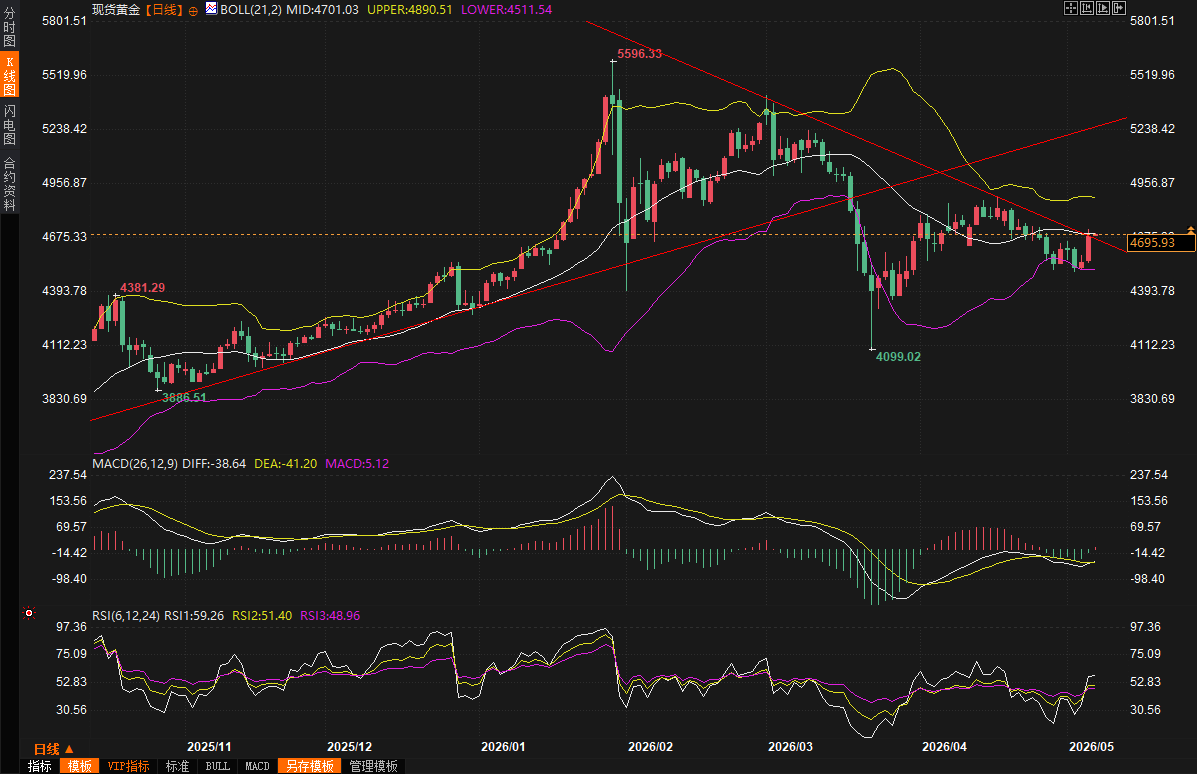
(Spot gold daily chart, source: FX678)
At 07:18 Beijing time, spot gold was trading at $4695.94 per ounce.
Geopolitical easing becomes the core driver of gold prices
Gold prices surged on Wednesday, boosted by optimistic news that the United States and Iran might reach a peace agreement. Multiple media outlets, citing Pakistani mediators and related sources, reported that Washington and Tehran were close to reaching an agreement on a "one-page memorandum" aimed at formally ending the Gulf conflict that began on February 28, followed by the initiation of more in-depth negotiations.
The Iranian Foreign Ministry stated that it is reviewing the latest US proposal and will respond through Pakistani channels. US President Trump also publicly stated that the two sides had held "very good talks" over the past 24 hours, and that Iran "very much wants to reach an agreement." Although substantial differences remain between the two sides on issues such as Iran's nuclear program, control of the Strait of Hormuz, missile programs, and proxy forces, the market is clearly choosing to capitalize on positive signals first, with a "take a risk now, assess later" trading mentality rapidly spreading.
This expectation directly alleviated market concerns about further deterioration of the situation in the Middle East, increased inflationary pressures, and persistently high interest rates. Peter Grant, Vice President and Senior Metals Strategist at Zaner Metals, pointed out that optimism surrounding the US-Iran agreement, falling oil prices, easing inflation concerns, and a shift in Federal Reserve policy expectations have collectively brought significant short-term relief to the gold market.
Gold prices move in tandem with the US dollar and oil prices.
Fueled by news of the agreement, spot gold rose nearly 3% on Wednesday, reaching a high of $4,722.59 per ounce before closing near $4,690 per ounce. U.S. gold futures also strengthened, rising 2.8% to $4,694.30 per ounce.
Meanwhile, the dollar index fell 0.48%, hitting its lowest level since late February, making dollar-denominated gold more attractive to holders of other currencies. Major currencies such as the euro and pound sterling strengthened, while the yen surged briefly due to rumors of intervention.
The sharp drop in oil prices and gold prices moved in stark contrast. Brent crude futures plunged nearly 11% at one point, falling below the $100 mark to $96.75 per barrel, before finally closing near $101; U.S. crude also fell by more than 7%. Since the outbreak of the conflict, shipping disruptions in the Gulf region have led to a significant oil supply gap, with oil prices reaching their highest level since March 2022. The glimmer of peace has raised market expectations that the Strait of Hormuz may reopen, significantly reducing energy supply risks and easing inflationary pressures. This has created a double benefit for gold – both reducing the "war premium" in safe-haven demand and weakening inflation expectations through the transmission of oil prices.
With employment data imminent, expectations for Federal Reserve policy will be put to the test.
Investors have quickly shifted their focus to key U.S. economic data in the latter half of this week. Friday's monthly non-farm payrolls report will be the focal point, testing whether the U.S. economy is resilient enough to support the Federal Reserve maintaining its current monetary policy, or whether a weakening labor market will reignite expectations of interest rate cuts.
The previously released ADP National Employment Report showed that private sector job growth in the US exceeded expectations in April, providing initial support for economic stability. However, the market remains cautious, with officials such as St. Louis Fed President Musaleem emphasizing that inflation risks have shifted upwards, and given the stable job market, interest rates may need to remain unchanged for some time. The market has now largely ruled out the possibility of a Fed rate cut this year.
The bond market also reacted in tandem: the 10-year Treasury yield fell to 4.354%, a new low since April 27; the two-year yield saw a significant single-day decline, reflecting investors' pricing adjustments in response to improved risk appetite. Strong US corporate earnings season, driven by artificial intelligence spending, further supported economic growth expectations, limiting the downside potential for yields to some extent.
Potential Risks and Agreement Prospect Assessment
Despite high market enthusiasm, analysts caution that uncertainty remains regarding the prospects of an agreement. Iran has described the US proposal as a "wish list" rather than a concrete text, and the two sides have not fully bridged their core differences on nuclear facilities, sanctions relief, shipping through the Strait of Hormuz, and missile issues. Trump himself has also expressed a more pessimistic view on social media and threatened to resume bombing raids.
If a preliminary memorandum is reached, it will initiate 30 days of detailed negotiations with goals including lifting sanctions, unfreezing funds, restricting uranium enrichment activities, and restoring shipping across the Strait. However, any hardening of positions by either side could quickly reverse market optimism.
Gold Market Outlook: Short-term positive factors coexist with long-term positive factors.
In summary, the core driver of this round of gold price increases is the "triple positive" effect triggered by expectations of a US-Iran peace agreement: the plunge in oil prices easing inflationary pressures, a weaker dollar increasing the attractiveness of gold, and declining bond yields lowering holding costs. The market is pricing in the most optimistic scenario of the end of a geopolitical conflict.
In the short term, as long as the positive atmosphere of peace negotiations is maintained, gold is expected to continue to receive support. However, investors must also be aware that a genuine comprehensive agreement still faces arduous negotiations over the next 30 days and numerous political and technical obstacles. Friday's US non-farm payroll report will also be a crucial indicator of market expectations for Federal Reserve policy.
Overall, the potential for a US-Iran peace agreement has injected a strong boost of optimism into global markets. Gold has demonstrated strong resilience in this rebound, and its future trajectory will depend on the sustainability of geopolitical easing and the final confirmation from macroeconomic data.
(Spot gold daily chart, source: FX678)
At 07:18 Beijing time, spot gold was trading at $4695.94 per ounce.
- Risk Warning and Disclaimer
- The market involves risk, and trading may not be suitable for all investors. This article is for reference only and does not constitute personal investment advice, nor does it take into account certain users’ specific investment objectives, financial situation, or other needs. Any investment decisions made based on this information are at your own risk.