Crude Oil Trading Alert: US-Iran negotiations signaled a de-escalation, causing oil prices to fall sharply and maintain an adjustment structure.
2026-05-07 09:12:27
U.S. WTI crude oil traded around $96.25 a barrel in early Asian trading on Thursday, with international oil prices retreating after a period of continuous gains, mainly due to rising market expectations of easing tensions in the Middle East. As negotiations between the U.S. and Iran released positive signals, investors' expectations for a stable return to global oil supply significantly strengthened, and risk aversion subsided.

The United States and Iran are advancing a preliminary agreement framework aimed at ending the current conflict and laying the groundwork for broader negotiations on the nuclear issue. US President Trump stated that the US had held "very positive talks" with Iran in the past 24 hours, but no deadline has yet been set for a formal response from Iran.
The market generally believes that if the two sides can reach an agreement, it will help restore normal shipping in the Strait of Hormuz. The Strait of Hormuz handles about 20% of global seaborne crude oil transport . Once shipping risks decrease, the pressure on the global energy supply chain will be significantly alleviated, which directly weakens the oil price risk premium that has recently been driven up by geopolitical tensions.
Meanwhile, the crude oil market remained tight on the supply side. Data released by the U.S. Energy Information Administration (EIA) showed that U.S. crude oil inventories fell by 2.314 million barrels in the week ending May 1, although this was less than the 6.233 million barrel decrease in the previous week, it marked the sixth consecutive week of decline. The market had previously expected a decrease of approximately 2.8 million barrels.
The continued decline in U.S. crude oil inventories reflects the continued resilience of refinery demand and consumption. Although the inventory decline was slightly less than market expectations, overall inventory levels remain relatively low, providing some support for oil prices.
Furthermore, Goldman Sachs analysts pointed out that global oil inventories are currently near their lowest levels in the past eight years. Against the backdrop of limited global supply recovery and uncertainty in some major oil-producing regions, the rapid decline in inventories is becoming a significant supporting factor for international oil prices.
Goldman Sachs analysts said, "Global oil inventories are declining at an accelerating pace, and low inventories have become a key factor influencing oil prices amid supply constraints."
From a market sentiment perspective, the crude oil market is currently caught in a tug-of-war between "easing geopolitical risks" and "low global inventories." On the one hand, continued easing of tensions in the Middle East will weaken safe-haven buying and push oil prices down; on the other hand, low global inventories and the upcoming summer peak demand season may still limit the downside potential for oil prices.
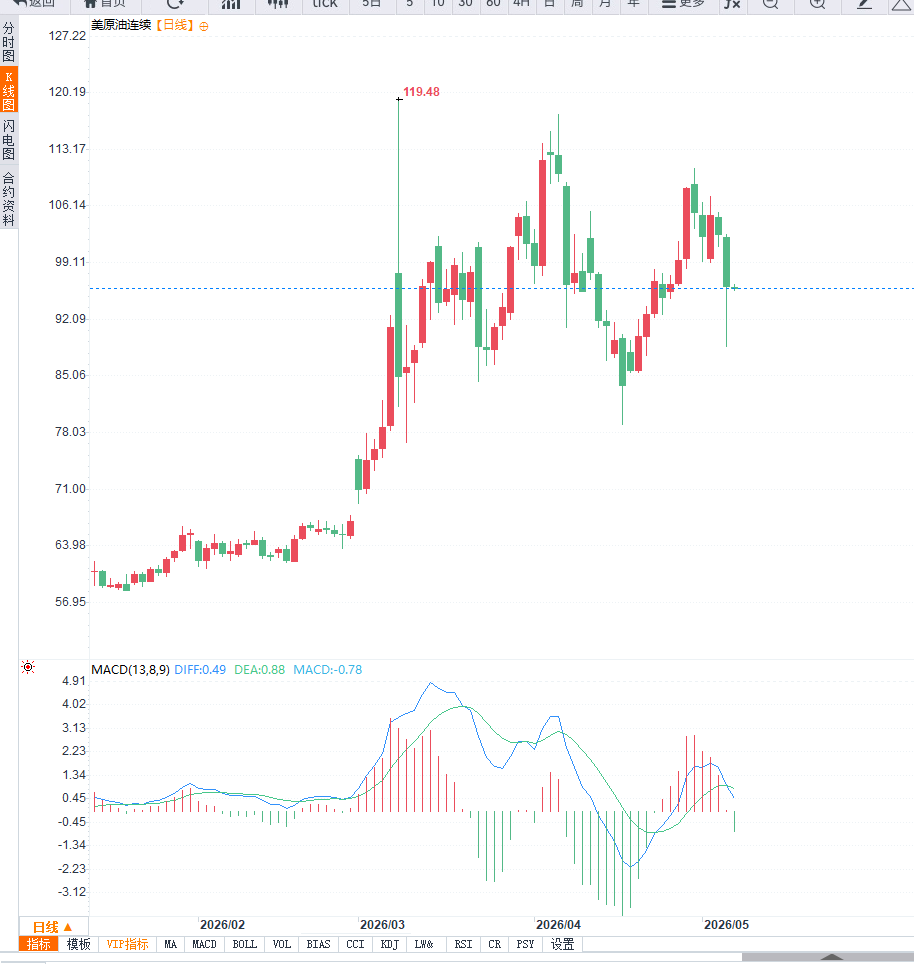
From a technical perspective, WTI crude oil maintains its medium-term upward structure on the daily chart. After breaking through the $100 mark, oil prices surged rapidly and are currently consolidating at higher levels in the short term. The $92 level has become a key short-term support/resistance level . If the $92 support is breached, oil prices may further retrace to the $90 area. On the upside, the resistance areas around $98 and $100 need to be monitored.
The 4-hour chart shows that WTI crude oil's short-term momentum has weakened, with the MACD indicator showing signs of overbought conditions and the RSI indicator retreating from overbought territory, indicating that market enthusiasm for further gains is cooling. However, the price is currently still trading above the major moving average system, and the medium-term trend has not been broken. If the situation in the Middle East re-emerges, oil prices may still retest above $100.
Editor's Summary : The core driving logic of the current international crude oil market has gradually shifted from simple geopolitical speculation to a balance between "supply recovery expectations" and "the reality of low global inventories." In the short term, if the US-Iran negotiations continue to make progress, it will alleviate market concerns about shipping risks in the Strait of Hormuz, and international oil prices may continue to correct from their high levels. However, from a medium- to long-term perspective, global crude oil inventories remain low, and there is still considerable uncertainty regarding the recovery of supply in major oil-producing regions, providing strong support for international oil prices overall. Future market volatility may further intensify, and investors need to pay close attention to changes in the Middle East situation, US inventory data, and global demand performance.
The United States and Iran are advancing a preliminary agreement framework aimed at ending the current conflict and laying the groundwork for broader negotiations on the nuclear issue. US President Trump stated that the US had held "very positive talks" with Iran in the past 24 hours, but no deadline has yet been set for a formal response from Iran.
The market generally believes that if the two sides can reach an agreement, it will help restore normal shipping in the Strait of Hormuz. The Strait of Hormuz handles about 20% of global seaborne crude oil transport . Once shipping risks decrease, the pressure on the global energy supply chain will be significantly alleviated, which directly weakens the oil price risk premium that has recently been driven up by geopolitical tensions.
Meanwhile, the crude oil market remained tight on the supply side. Data released by the U.S. Energy Information Administration (EIA) showed that U.S. crude oil inventories fell by 2.314 million barrels in the week ending May 1, although this was less than the 6.233 million barrel decrease in the previous week, it marked the sixth consecutive week of decline. The market had previously expected a decrease of approximately 2.8 million barrels.
The continued decline in U.S. crude oil inventories reflects the continued resilience of refinery demand and consumption. Although the inventory decline was slightly less than market expectations, overall inventory levels remain relatively low, providing some support for oil prices.
Furthermore, Goldman Sachs analysts pointed out that global oil inventories are currently near their lowest levels in the past eight years. Against the backdrop of limited global supply recovery and uncertainty in some major oil-producing regions, the rapid decline in inventories is becoming a significant supporting factor for international oil prices.
Goldman Sachs analysts said, "Global oil inventories are declining at an accelerating pace, and low inventories have become a key factor influencing oil prices amid supply constraints."
From a market sentiment perspective, the crude oil market is currently caught in a tug-of-war between "easing geopolitical risks" and "low global inventories." On the one hand, continued easing of tensions in the Middle East will weaken safe-haven buying and push oil prices down; on the other hand, low global inventories and the upcoming summer peak demand season may still limit the downside potential for oil prices.
From a technical perspective, WTI crude oil maintains its medium-term upward structure on the daily chart. After breaking through the $100 mark, oil prices surged rapidly and are currently consolidating at higher levels in the short term. The $92 level has become a key short-term support/resistance level . If the $92 support is breached, oil prices may further retrace to the $90 area. On the upside, the resistance areas around $98 and $100 need to be monitored.
The 4-hour chart shows that WTI crude oil's short-term momentum has weakened, with the MACD indicator showing signs of overbought conditions and the RSI indicator retreating from overbought territory, indicating that market enthusiasm for further gains is cooling. However, the price is currently still trading above the major moving average system, and the medium-term trend has not been broken. If the situation in the Middle East re-emerges, oil prices may still retest above $100.
Editor's Summary : The core driving logic of the current international crude oil market has gradually shifted from simple geopolitical speculation to a balance between "supply recovery expectations" and "the reality of low global inventories." In the short term, if the US-Iran negotiations continue to make progress, it will alleviate market concerns about shipping risks in the Strait of Hormuz, and international oil prices may continue to correct from their high levels. However, from a medium- to long-term perspective, global crude oil inventories remain low, and there is still considerable uncertainty regarding the recovery of supply in major oil-producing regions, providing strong support for international oil prices overall. Future market volatility may further intensify, and investors need to pay close attention to changes in the Middle East situation, US inventory data, and global demand performance.
- Risk Warning and Disclaimer
- The market involves risk, and trading may not be suitable for all investors. This article is for reference only and does not constitute personal investment advice, nor does it take into account certain users’ specific investment objectives, financial situation, or other needs. Any investment decisions made based on this information are at your own risk.