May 8th Financial Breakfast: Iran accuses the US of violating the ceasefire agreement; US targets Iranian military facilities; gold prices encounter resistance at the $4700 mark; oil prices rise by over 2%.
2026-05-08 07:24:27
On Friday (May 8, Beijing time) in early Asian trading, spot gold was trading around $4,693.50 per ounce. Gold prices retreated on Wednesday after hitting a two-week high of $4,764.67 per ounce, as Iran accused the United States of violating the ceasefire agreement and that the US military attacked oil tankers and conducted airstrikes on coastal areas. Iran retaliated, which boosted US crude oil prices by more than 2%, and it is currently trading around $97 per barrel.

U.S. stocks closed lower on Thursday, with the S&P 500 down 0.38%, the Nasdaq down 0.13%, and the Dow Jones Industrial Average down 0.63%. Chip stocks retreated after earlier gains, with Intel and AMD both falling about 3%, and the Philadelphia Semiconductor Index dropping 2.7%. Meanwhile, uncertainty surrounding U.S.-Iran negotiations also weighed on market sentiment.
Despite reports that the US and Iran are close to reaching a temporary ceasefire agreement, investors remain cautious. Nvidia and Microsoft bucked the trend, rising nearly 2%, indicating continued confidence in the artificial intelligence giant. Most sectors in the S&P 500 closed lower, with materials and energy leading the decline.
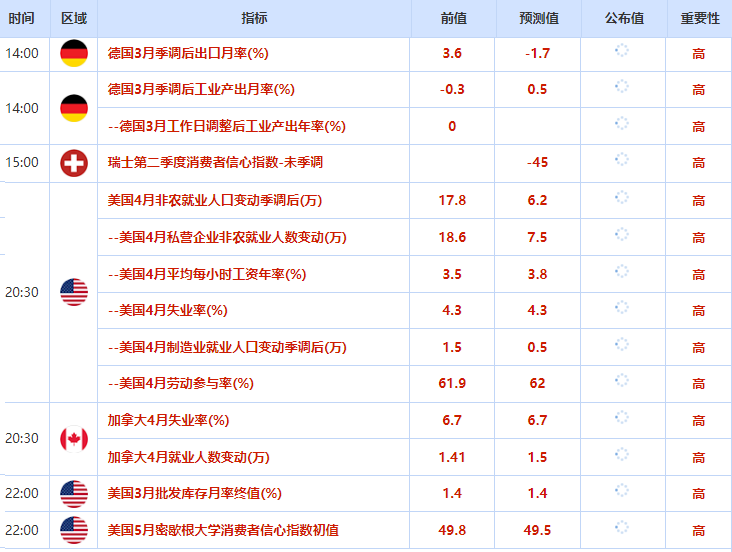
On the economic data front, initial jobless claims rose less than expected last week, and the market is focused on Friday's April non-farm payroll data. Federal Reserve's Hamak stated that interest rates will remain unchanged for a "considerable period of time."
In terms of individual stocks, Datadog surged 31% after raising its earnings forecast, driving up cybersecurity stocks; Whirlpool plummeted 12% due to lower-than-expected sales and the suspension of dividend payments.
Gold prices rose on Thursday, with spot gold settling at $4,700.98 an ounce, up 0.3%, after hitting a two-week high earlier in the session. The rise was mainly driven by optimism that the US and Iran might reach a peace agreement, easing market concerns about persistently high inflation and interest rates. US gold futures also rose 0.4%, settling at $4,710.90.
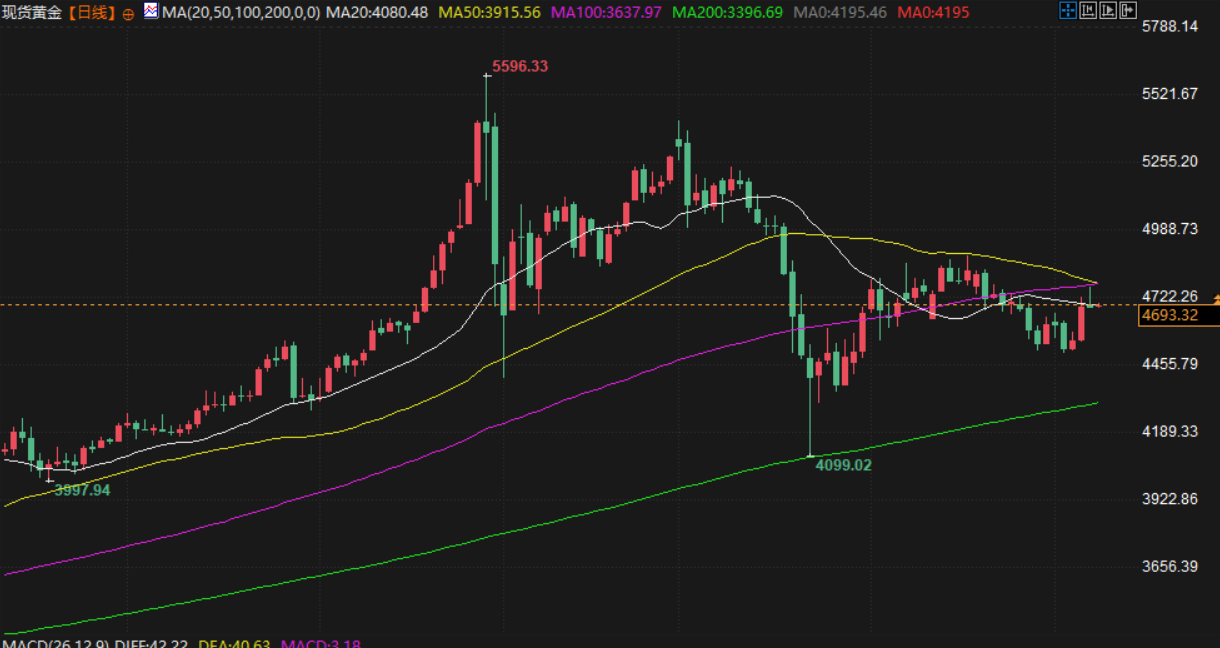
RJO futures strategists said that if the ceasefire were maintained and the Strait of Hormuz were reopened, gold prices could rise to $5,000 per ounce. However, subsequent reports that senior Iranian officials stated they would not allow the United States to reopen the Strait of Hormuz limited further gains in gold prices.
Markets are closely watching the situation in the Middle East and the direction of the Federal Reserve's policy, while awaiting Friday's U.S. monthly jobs report to assess the outlook for monetary policy.
In addition, the People's Bank of China's purchase of gold for the 18th consecutive month in April also supported gold prices. Among other precious metals, spot silver rose 2.6% to $79.32, platinum fell 1.2%, and palladium fell 2.5%.
Oil prices fell about 1% in volatile trading on Thursday, with Brent crude futures down 1.2% to $100.06 a barrel and WTI crude futures down 0.28% to $94.81 a barrel. Prices initially fell by $5 on optimism that the U.S. and Iran were close to reaching a limited ceasefire agreement, but market sentiment was dampened by reports that the U.S. was considering restarting escort operations in the Strait of Hormuz as early as this week to protect merchant ships passing through the key waterway.
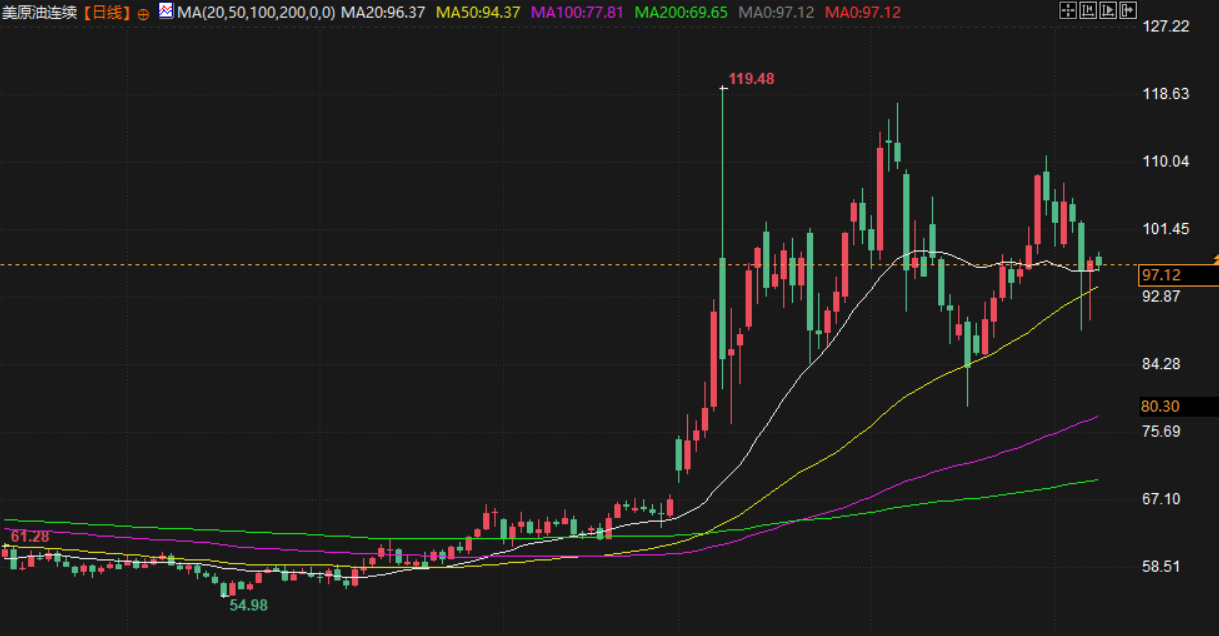
Furthermore, after similar explosions were heard near the Iranian port of Bandar Abbas, futures contracts turned positive in extended trading. SEB Research analysts stated that if a ceasefire agreement is finalized, Brent crude prices could quickly fall back to the $80-90 range, but if negotiations break down or the US resumes military strikes, prices will immediately break through $120. On the supply side, the US Energy Secretary stated that Iranian crude oil production has been reduced by 400,000 barrels per day.
The dollar recovered early losses and strengthened against most major currencies on Thursday as investors weighed hopes for a de-escalation of tensions with Iran. However, market sentiment was dampened after The Wall Street Journal reported that Iran would not accept what the United States called an "unrealistic" plan to reopen the Strait of Hormuz, through which about one-fifth of the world's oil and liquefied natural gas are typically transported.
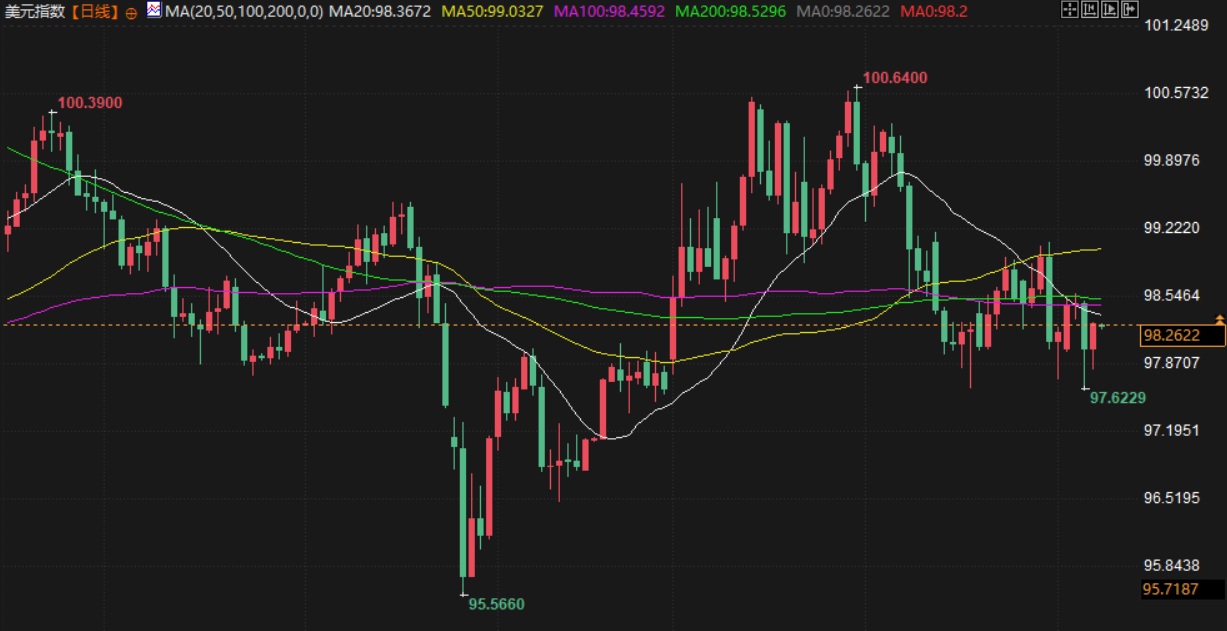
The euro was essentially unchanged at $1.1748, while the pound fell 0.1% to $1.35785. The dollar rebounded by about 0.3% to 156.79 yen against the yen after a sharp rise on Wednesday fueled by intervention speculation. Bank of Japan data showed that it may have spent as much as 5.01 trillion yen to support the currency. Markets remain tense, and analysts are cautious about the yen's outlook, believing it may continue to weaken in the short term unless the Bank of Japan raises interest rates consecutively.
The Norwegian central bank's interest rate hike to 4.25% boosted the Norwegian krone, and the US dollar rebounded against the Norwegian krone after hitting a four-year low. The risk-sensitive Australian dollar fell 0.2%, and the Swedish krona fell approximately 0.2% against the US dollar.
Iranian Armed Forces: Iran has retaliated against US attacks on oil tankers and airstrikes along the coast.
Early on the morning of August 8th local time, a spokesperson for the Hatem Anbia Central Command of the Iranian Armed Forces issued a statement claiming that the US military violated the ceasefire by striking an oil tanker sailing from the waters off Jask, Iran, towards the Strait of Hormuz, and another vessel entering the Strait of Hormuz opposite the port of Fujairah in the United Arab Emirates. The statement also claimed that the US, in cooperation with some regional countries, launched airstrikes against civilian areas along the Iranian coasts of Hamir, Sirik, and Qeshm Island. The statement indicated that the Iranian Armed Forces retaliated against US military vessels east of the Strait of Hormuz and south of Chabahar port, claiming to have caused "significant damage." The spokesperson emphasized that Iran will respond to any act of aggression. (CCTV News)
Sources say three US destroyers were attacked near the Strait of Hormuz.
On August 8th local time, Iranian sources stated that three US destroyers were attacked by the Iranian Navy near the Strait of Hormuz. It is understood that the destroyers are withdrawing towards the Gulf of Oman. Neither Iranian nor US officials have responded to this report. (CCTV News)
Trump: US Destroyers Successfully Transit Strait of Hormuz, Warns Iran of More Violent Actions If It Doesn't Sign Agreement <br />US President Trump stated that three world-class US destroyers successfully transited the Strait of Hormuz during the transit, during which they were attacked. The US destroyers sustained no damage, but the Iranian attackers suffered significant losses. Trump warned, "If Iran doesn't quickly sign the agreement, then in the future, we will deal with them with much stronger and more intense measures." This statement comes at a time when the US-Iran ceasefire agreement is fragile and the military standoff between the two sides continues.
The US reportedly attacked several areas in southern Iran, but the ceasefire continues.
Multiple explosions were heard near Qeshm Island and Bandar Abbas in southern Iran from the evening of May 7 to the early morning of May 8 local time. Iranian officials have not yet issued an official response regarding the exact cause of the explosions. A Fox News reporter, citing a US official, posted on social media that "the US military has just launched strikes against the Iranian ports of Qeshm and Bandar Abbas, but this does not mean a resumption of war, nor does it mean the end of the temporary ceasefire." This report has not yet been confirmed by US officials. Israeli media, citing Israeli sources, reported that "Israel is not involved in the events in Iran." Separately, explosions were also heard in the Minab region of southern Iran early this morning local time. (CCTV International News)
Iranian Foreign Ministry Spokesperson: Supreme Leader Mojtaba has complete control of the situation.
On July 7th local time, a spokesperson for the Iranian Foreign Ministry stated that Iran's Supreme Leader Mojtaba Khamenei has full control over current affairs and developments. The spokesperson said that Supreme Leader Khamenei is managing the situation decisively, forcefully, and prudently, and all actions are being carried out under his authorization, with all national institutions maintaining coordination under his leadership. The spokesperson also stated that adversaries are attempting to create division and confrontation within Iran through manipulating public opinion and launching psychological warfare; all parties should remain vigilant and avoid being exploited by such actions. (CCTV News)
Iran's Supreme Military Command: US attacks on Iranian oil tankers and ships violate ceasefire agreement
Iran's Supreme Joint Military Command issued a statement saying that the United States attacked an Iranian oil tanker and another vessel entering the Strait of Hormuz, violating the existing ceasefire agreement. Iran warned that it would not hesitate to respond forcefully to any attack. The statement also accused the United States, with the cooperation of some regional countries, of launching airstrikes against civilian areas. The United States has not yet responded.
Report: Shipping traffic in the Strait of Hormuz has plummeted to almost zero.
CNN, citing data from the ship tracking website MarineTraffic, reported that commercial vessel traffic in the Strait of Hormuz has plummeted to historic lows in the past 48 hours. Public data shows that no vessels have transited between the Arabian Sea and the Persian Gulf in the past two days. MarineTraffic data presents the navigation situation around the Strait of Hormuz over the past 48 hours. GPS signal interference remains widespread: several vessels appear to be navigating within the strait, but at least four of them are clearly broadcasting false locations, showing their positions either on land or above shallow sandbars—areas considered extremely high-risk navigation zones for cargo ships. GPS spoofing has also occurred off the coasts of Sharjah and Diba Fujairah in the UAE, with multiple vessels simultaneously showing their locations at the same point.
Federal Reserve's Daly: Actions speak louder than words in statements; there should be no overreaction to the energy shock.
San Francisco Fed President Mary Daly downplayed the disagreements surrounding the Fed's statement, hinting that she wouldn't vote against it like some of her colleagues. She stated that the wording of the statement was less important than the actions taken, and that the real signal from the meeting was unanimous agreement. Last month, three officials objected to wording that hinted at future rate cuts, arguing that the uncertainty surrounding the energy shock and the Iran war made a "rates could rise or fall" signal more appropriate. Daly, who has no voting rights this year, said the public understands the Fed's responsibility for price stability. Daly stated that there are no signs that energy prices are pushing up medium- or long-term inflation expectations. "It's too early to judge. If the conflict ends and oil prices fall without escalating to the broader economy, the pre-conflict dynamics are expected to return to normal." She is committed to achieving the 2% inflation target but shouldn't overreact to the expected duration of the energy shock. She described policy as "slightly tightening," adding that a resolution to the war would put downward pressure on inflation; the labor market is stable and hasn't generated inflationary pressure.
US Central Command: Targeted strikes against Iranian military facilities
On May 7 local time, the U.S. Central Command issued a statement saying that a U.S. Navy guided-missile destroyer group intercepted an unprovoked attack launched by Iran while transiting the Strait of Hormuz toward the Gulf of Oman and immediately took defensive action. The statement said that when the USS Truxton, USS Rafael Peralta, and USS Mason transited this international maritime passage, Iranian forces launched multiple missiles and deployed drones and small boats. No U.S. assets were hit. The U.S. Central Command eliminated the threat and conducted targeted strikes against Iranian military facilities responsible for the attack, including missile and drone launch sites, command and control centers, and intelligence, surveillance, and reconnaissance nodes. The statement said that the U.S. Central Command has no intention of escalating the situation but will remain on high alert and ready to protect U.S. forces. (CCTV News)
China's energy storage product exports are booming, defying the off-season.
This year, China's energy storage product exports have seen impressive growth in both scale and rate. According to customs data, in the first quarter of this year, the export value of lithium-ion batteries—one of the most core and critical components of energy storage equipment—increased by over 50% compared to the same period last year. What is the current production and sales situation for energy storage companies? Overseas demand for energy storage products has been steadily increasing this year, a fact that company staff are keenly aware of, with a significant increase in foreign businesspeople visiting to inspect the products. Before exporting energy storage products overseas, a dangerous goods packaging certification must be applied for, demonstrating to relevant departments that the exported goods meet the requirements. This application frequency has also increased significantly this year. (CCTV Finance)
Key Focus Today
stock market
U.S. stocks closed lower on Thursday, with the S&P 500 down 0.38%, the Nasdaq down 0.13%, and the Dow Jones Industrial Average down 0.63%. Chip stocks retreated after earlier gains, with Intel and AMD both falling about 3%, and the Philadelphia Semiconductor Index dropping 2.7%. Meanwhile, uncertainty surrounding U.S.-Iran negotiations also weighed on market sentiment.
Despite reports that the US and Iran are close to reaching a temporary ceasefire agreement, investors remain cautious. Nvidia and Microsoft bucked the trend, rising nearly 2%, indicating continued confidence in the artificial intelligence giant. Most sectors in the S&P 500 closed lower, with materials and energy leading the decline.
On the economic data front, initial jobless claims rose less than expected last week, and the market is focused on Friday's April non-farm payroll data. Federal Reserve's Hamak stated that interest rates will remain unchanged for a "considerable period of time."
In terms of individual stocks, Datadog surged 31% after raising its earnings forecast, driving up cybersecurity stocks; Whirlpool plummeted 12% due to lower-than-expected sales and the suspension of dividend payments.
Gold Market
Gold prices rose on Thursday, with spot gold settling at $4,700.98 an ounce, up 0.3%, after hitting a two-week high earlier in the session. The rise was mainly driven by optimism that the US and Iran might reach a peace agreement, easing market concerns about persistently high inflation and interest rates. US gold futures also rose 0.4%, settling at $4,710.90.
RJO futures strategists said that if the ceasefire were maintained and the Strait of Hormuz were reopened, gold prices could rise to $5,000 per ounce. However, subsequent reports that senior Iranian officials stated they would not allow the United States to reopen the Strait of Hormuz limited further gains in gold prices.
Markets are closely watching the situation in the Middle East and the direction of the Federal Reserve's policy, while awaiting Friday's U.S. monthly jobs report to assess the outlook for monetary policy.
In addition, the People's Bank of China's purchase of gold for the 18th consecutive month in April also supported gold prices. Among other precious metals, spot silver rose 2.6% to $79.32, platinum fell 1.2%, and palladium fell 2.5%.
oil market
Oil prices fell about 1% in volatile trading on Thursday, with Brent crude futures down 1.2% to $100.06 a barrel and WTI crude futures down 0.28% to $94.81 a barrel. Prices initially fell by $5 on optimism that the U.S. and Iran were close to reaching a limited ceasefire agreement, but market sentiment was dampened by reports that the U.S. was considering restarting escort operations in the Strait of Hormuz as early as this week to protect merchant ships passing through the key waterway.
Furthermore, after similar explosions were heard near the Iranian port of Bandar Abbas, futures contracts turned positive in extended trading. SEB Research analysts stated that if a ceasefire agreement is finalized, Brent crude prices could quickly fall back to the $80-90 range, but if negotiations break down or the US resumes military strikes, prices will immediately break through $120. On the supply side, the US Energy Secretary stated that Iranian crude oil production has been reduced by 400,000 barrels per day.
Foreign exchange market
The dollar recovered early losses and strengthened against most major currencies on Thursday as investors weighed hopes for a de-escalation of tensions with Iran. However, market sentiment was dampened after The Wall Street Journal reported that Iran would not accept what the United States called an "unrealistic" plan to reopen the Strait of Hormuz, through which about one-fifth of the world's oil and liquefied natural gas are typically transported.
The euro was essentially unchanged at $1.1748, while the pound fell 0.1% to $1.35785. The dollar rebounded by about 0.3% to 156.79 yen against the yen after a sharp rise on Wednesday fueled by intervention speculation. Bank of Japan data showed that it may have spent as much as 5.01 trillion yen to support the currency. Markets remain tense, and analysts are cautious about the yen's outlook, believing it may continue to weaken in the short term unless the Bank of Japan raises interest rates consecutively.
The Norwegian central bank's interest rate hike to 4.25% boosted the Norwegian krone, and the US dollar rebounded against the Norwegian krone after hitting a four-year low. The risk-sensitive Australian dollar fell 0.2%, and the Swedish krona fell approximately 0.2% against the US dollar.
International News
Iranian Armed Forces: Iran has retaliated against US attacks on oil tankers and airstrikes along the coast.
Early on the morning of August 8th local time, a spokesperson for the Hatem Anbia Central Command of the Iranian Armed Forces issued a statement claiming that the US military violated the ceasefire by striking an oil tanker sailing from the waters off Jask, Iran, towards the Strait of Hormuz, and another vessel entering the Strait of Hormuz opposite the port of Fujairah in the United Arab Emirates. The statement also claimed that the US, in cooperation with some regional countries, launched airstrikes against civilian areas along the Iranian coasts of Hamir, Sirik, and Qeshm Island. The statement indicated that the Iranian Armed Forces retaliated against US military vessels east of the Strait of Hormuz and south of Chabahar port, claiming to have caused "significant damage." The spokesperson emphasized that Iran will respond to any act of aggression. (CCTV News)
Sources say three US destroyers were attacked near the Strait of Hormuz.
On August 8th local time, Iranian sources stated that three US destroyers were attacked by the Iranian Navy near the Strait of Hormuz. It is understood that the destroyers are withdrawing towards the Gulf of Oman. Neither Iranian nor US officials have responded to this report. (CCTV News)
Trump: US Destroyers Successfully Transit Strait of Hormuz, Warns Iran of More Violent Actions If It Doesn't Sign Agreement <br />US President Trump stated that three world-class US destroyers successfully transited the Strait of Hormuz during the transit, during which they were attacked. The US destroyers sustained no damage, but the Iranian attackers suffered significant losses. Trump warned, "If Iran doesn't quickly sign the agreement, then in the future, we will deal with them with much stronger and more intense measures." This statement comes at a time when the US-Iran ceasefire agreement is fragile and the military standoff between the two sides continues.
The US reportedly attacked several areas in southern Iran, but the ceasefire continues.
Multiple explosions were heard near Qeshm Island and Bandar Abbas in southern Iran from the evening of May 7 to the early morning of May 8 local time. Iranian officials have not yet issued an official response regarding the exact cause of the explosions. A Fox News reporter, citing a US official, posted on social media that "the US military has just launched strikes against the Iranian ports of Qeshm and Bandar Abbas, but this does not mean a resumption of war, nor does it mean the end of the temporary ceasefire." This report has not yet been confirmed by US officials. Israeli media, citing Israeli sources, reported that "Israel is not involved in the events in Iran." Separately, explosions were also heard in the Minab region of southern Iran early this morning local time. (CCTV International News)
Iranian Foreign Ministry Spokesperson: Supreme Leader Mojtaba has complete control of the situation.
On July 7th local time, a spokesperson for the Iranian Foreign Ministry stated that Iran's Supreme Leader Mojtaba Khamenei has full control over current affairs and developments. The spokesperson said that Supreme Leader Khamenei is managing the situation decisively, forcefully, and prudently, and all actions are being carried out under his authorization, with all national institutions maintaining coordination under his leadership. The spokesperson also stated that adversaries are attempting to create division and confrontation within Iran through manipulating public opinion and launching psychological warfare; all parties should remain vigilant and avoid being exploited by such actions. (CCTV News)
Iran's Supreme Military Command: US attacks on Iranian oil tankers and ships violate ceasefire agreement
Iran's Supreme Joint Military Command issued a statement saying that the United States attacked an Iranian oil tanker and another vessel entering the Strait of Hormuz, violating the existing ceasefire agreement. Iran warned that it would not hesitate to respond forcefully to any attack. The statement also accused the United States, with the cooperation of some regional countries, of launching airstrikes against civilian areas. The United States has not yet responded.
Report: Shipping traffic in the Strait of Hormuz has plummeted to almost zero.
CNN, citing data from the ship tracking website MarineTraffic, reported that commercial vessel traffic in the Strait of Hormuz has plummeted to historic lows in the past 48 hours. Public data shows that no vessels have transited between the Arabian Sea and the Persian Gulf in the past two days. MarineTraffic data presents the navigation situation around the Strait of Hormuz over the past 48 hours. GPS signal interference remains widespread: several vessels appear to be navigating within the strait, but at least four of them are clearly broadcasting false locations, showing their positions either on land or above shallow sandbars—areas considered extremely high-risk navigation zones for cargo ships. GPS spoofing has also occurred off the coasts of Sharjah and Diba Fujairah in the UAE, with multiple vessels simultaneously showing their locations at the same point.
Federal Reserve's Daly: Actions speak louder than words in statements; there should be no overreaction to the energy shock.
San Francisco Fed President Mary Daly downplayed the disagreements surrounding the Fed's statement, hinting that she wouldn't vote against it like some of her colleagues. She stated that the wording of the statement was less important than the actions taken, and that the real signal from the meeting was unanimous agreement. Last month, three officials objected to wording that hinted at future rate cuts, arguing that the uncertainty surrounding the energy shock and the Iran war made a "rates could rise or fall" signal more appropriate. Daly, who has no voting rights this year, said the public understands the Fed's responsibility for price stability. Daly stated that there are no signs that energy prices are pushing up medium- or long-term inflation expectations. "It's too early to judge. If the conflict ends and oil prices fall without escalating to the broader economy, the pre-conflict dynamics are expected to return to normal." She is committed to achieving the 2% inflation target but shouldn't overreact to the expected duration of the energy shock. She described policy as "slightly tightening," adding that a resolution to the war would put downward pressure on inflation; the labor market is stable and hasn't generated inflationary pressure.
US Central Command: Targeted strikes against Iranian military facilities
On May 7 local time, the U.S. Central Command issued a statement saying that a U.S. Navy guided-missile destroyer group intercepted an unprovoked attack launched by Iran while transiting the Strait of Hormuz toward the Gulf of Oman and immediately took defensive action. The statement said that when the USS Truxton, USS Rafael Peralta, and USS Mason transited this international maritime passage, Iranian forces launched multiple missiles and deployed drones and small boats. No U.S. assets were hit. The U.S. Central Command eliminated the threat and conducted targeted strikes against Iranian military facilities responsible for the attack, including missile and drone launch sites, command and control centers, and intelligence, surveillance, and reconnaissance nodes. The statement said that the U.S. Central Command has no intention of escalating the situation but will remain on high alert and ready to protect U.S. forces. (CCTV News)
Domestic News
China's energy storage product exports are booming, defying the off-season.
This year, China's energy storage product exports have seen impressive growth in both scale and rate. According to customs data, in the first quarter of this year, the export value of lithium-ion batteries—one of the most core and critical components of energy storage equipment—increased by over 50% compared to the same period last year. What is the current production and sales situation for energy storage companies? Overseas demand for energy storage products has been steadily increasing this year, a fact that company staff are keenly aware of, with a significant increase in foreign businesspeople visiting to inspect the products. Before exporting energy storage products overseas, a dangerous goods packaging certification must be applied for, demonstrating to relevant departments that the exported goods meet the requirements. This application frequency has also increased significantly this year. (CCTV Finance)
- Risk Warning and Disclaimer
- The market involves risk, and trading may not be suitable for all investors. This article is for reference only and does not constitute personal investment advice, nor does it take into account certain users’ specific investment objectives, financial situation, or other needs. Any investment decisions made based on this information are at your own risk.