The Australian dollar remained range-bound against the US dollar, awaiting the release of US non-farm payroll data.
2026-05-08 14:31:28
On Friday during Asian trading hours, the Australian dollar (AUD/USD) found support near the 0.7200 level, maintaining a consolidation trend at higher levels. Although the Australian dollar had previously touched its highest level since June 2022, renewed uncertainty in the Middle East and a significant cooling of market risk appetite limited its short-term upward momentum. Recently, the global foreign exchange market has been primarily influenced by two factors: changes in Middle East geopolitical risks and adjustments in expectations regarding monetary policy from major central banks.

Previously, market optimism regarding a potential peace agreement between the US and Iran supported risk assets. However, renewed tensions near the Strait of Hormuz have reignited risk aversion. The US military stated that US warships were attacked by Iran while transiting the Strait of Hormuz, and the US subsequently intercepted them. Iran, in turn, accused the US of violating the ceasefire agreement and striking targets around the strait.
The volatile situation in the Middle East has revived demand for the US dollar as a safe haven, limiting further gains for the Australian dollar. The Australian dollar is a typical risk-sensitive currency; when global risk aversion intensifies, the market typically reduces its allocation to high-risk currencies like the Australian dollar.
However, compared to other non-US dollar currencies, the Australian dollar has remained relatively strong overall, thanks to the Reserve Bank of Australia's (RBA) continued hawkish stance recently. The RBA stated this week that current inflation levels remain high and did not rule out the possibility of further monetary tightening in the future. This means that Australian interest rates are likely to remain high, thereby increasing the attractiveness of Australian dollar assets.
In contrast, with the decline in international oil prices, inflationary pressures in the United States have eased, and market expectations for further interest rate hikes by the Federal Reserve have clearly decreased. Investors have begun to reduce their bets on the Fed continuing to raise rates in 2026. The Reserve Bank of Australia's hawkish stance, coupled with cooling expectations for Fed rate hikes, forms the key interest rate differential supporting the AUD/USD exchange rate. It is precisely this difference in policy expectations that limits the overall upside potential of the US dollar, despite support from safe-haven buying.
Market sentiment is currently cautious, with investors awaiting tonight's release of the US April non-farm payroll data. The market expects approximately 62,000 new non-farm jobs in April, significantly lower than the previous month's 178,000, while the unemployment rate is expected to remain around 4.3%. If the US employment data is significantly stronger than expected, it would indicate that the US economy remains resilient, and the Federal Reserve may maintain high interest rates for an extended period. This would push up the US dollar index and US Treasury yields, thus suppressing the Australian dollar against the US dollar.
Conversely, if employment data is weak, market expectations for a Fed rate cut could intensify, weakening the dollar and pushing AUD/USD to retest recent highs. Furthermore, the market is also closely watching average hourly earnings data. Strong wage growth suggests that US inflationary pressures may remain high, and the Fed's policy stance may remain cautious.
From an Australian economic perspective, the overall Australian economy is currently performing relatively stably. Although the global economic slowdown is putting some pressure on export demand, commodity prices remain relatively high, providing medium- to long-term support for the Australian dollar.
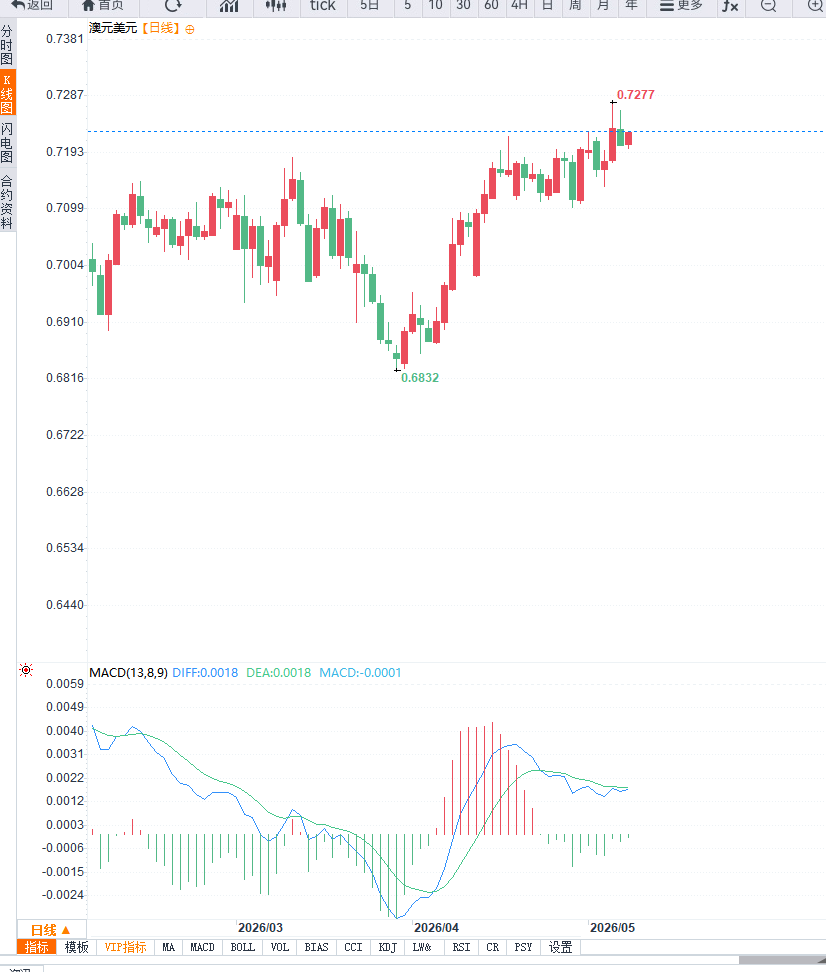
From the daily chart, AUD/USD maintains a clear upward trend. The exchange rate previously broke through the key resistance area of 0.7150 and reached its highest point since June 2022, indicating that the medium-to-long-term bullish structure remains solid. Technically, the daily MACD remains above the zero line, and although the red bars have shortened slightly, the overall bullish momentum remains. The RSI indicator is currently around 63, indicating that the market is still biased towards strength, but short-term chasing sentiment is beginning to cool. Regarding the moving average system, the 5-day, 10-day, and 20-day moving averages maintain a bullish alignment, and the short-term moving averages continue to diverge upwards, indicating that the medium-to-long-term trend remains strong. Currently, 0.7200 has become an important psychological support area. If AUD/USD can break through the 0.7250 area again, it may open up further upside potential. The next target may be the 0.7300 or even 0.7350 area. However, it should be noted that the current exchange rate is approaching its near two-year high, and some short-term funds may begin to take profits. If the US non-farm payroll data exceeds expectations, a rebound in the US dollar could push AUD/USD to retest the 0.7150 support level.
Editor's Summary : The Australian dollar remains relatively strong against the US dollar, but the ongoing tensions in the Middle East have increased risk aversion, limiting further upside potential. Meanwhile, the Reserve Bank of Australia's hawkish stance continues to support interest rates for the Australian dollar. Technically, the daily AUD/USD trend remains bullish, but the 4-hour chart has entered a consolidation phase at higher levels. If US employment data is weak, the US dollar may weaken further, pushing the Australian dollar higher; conversely, strong data could lead to a period of adjustment for AUD/USD.
Previously, market optimism regarding a potential peace agreement between the US and Iran supported risk assets. However, renewed tensions near the Strait of Hormuz have reignited risk aversion. The US military stated that US warships were attacked by Iran while transiting the Strait of Hormuz, and the US subsequently intercepted them. Iran, in turn, accused the US of violating the ceasefire agreement and striking targets around the strait.
The volatile situation in the Middle East has revived demand for the US dollar as a safe haven, limiting further gains for the Australian dollar. The Australian dollar is a typical risk-sensitive currency; when global risk aversion intensifies, the market typically reduces its allocation to high-risk currencies like the Australian dollar.
However, compared to other non-US dollar currencies, the Australian dollar has remained relatively strong overall, thanks to the Reserve Bank of Australia's (RBA) continued hawkish stance recently. The RBA stated this week that current inflation levels remain high and did not rule out the possibility of further monetary tightening in the future. This means that Australian interest rates are likely to remain high, thereby increasing the attractiveness of Australian dollar assets.
In contrast, with the decline in international oil prices, inflationary pressures in the United States have eased, and market expectations for further interest rate hikes by the Federal Reserve have clearly decreased. Investors have begun to reduce their bets on the Fed continuing to raise rates in 2026. The Reserve Bank of Australia's hawkish stance, coupled with cooling expectations for Fed rate hikes, forms the key interest rate differential supporting the AUD/USD exchange rate. It is precisely this difference in policy expectations that limits the overall upside potential of the US dollar, despite support from safe-haven buying.
Market sentiment is currently cautious, with investors awaiting tonight's release of the US April non-farm payroll data. The market expects approximately 62,000 new non-farm jobs in April, significantly lower than the previous month's 178,000, while the unemployment rate is expected to remain around 4.3%. If the US employment data is significantly stronger than expected, it would indicate that the US economy remains resilient, and the Federal Reserve may maintain high interest rates for an extended period. This would push up the US dollar index and US Treasury yields, thus suppressing the Australian dollar against the US dollar.
Conversely, if employment data is weak, market expectations for a Fed rate cut could intensify, weakening the dollar and pushing AUD/USD to retest recent highs. Furthermore, the market is also closely watching average hourly earnings data. Strong wage growth suggests that US inflationary pressures may remain high, and the Fed's policy stance may remain cautious.
From an Australian economic perspective, the overall Australian economy is currently performing relatively stably. Although the global economic slowdown is putting some pressure on export demand, commodity prices remain relatively high, providing medium- to long-term support for the Australian dollar.
From the daily chart, AUD/USD maintains a clear upward trend. The exchange rate previously broke through the key resistance area of 0.7150 and reached its highest point since June 2022, indicating that the medium-to-long-term bullish structure remains solid. Technically, the daily MACD remains above the zero line, and although the red bars have shortened slightly, the overall bullish momentum remains. The RSI indicator is currently around 63, indicating that the market is still biased towards strength, but short-term chasing sentiment is beginning to cool. Regarding the moving average system, the 5-day, 10-day, and 20-day moving averages maintain a bullish alignment, and the short-term moving averages continue to diverge upwards, indicating that the medium-to-long-term trend remains strong. Currently, 0.7200 has become an important psychological support area. If AUD/USD can break through the 0.7250 area again, it may open up further upside potential. The next target may be the 0.7300 or even 0.7350 area. However, it should be noted that the current exchange rate is approaching its near two-year high, and some short-term funds may begin to take profits. If the US non-farm payroll data exceeds expectations, a rebound in the US dollar could push AUD/USD to retest the 0.7150 support level.
Editor's Summary : The Australian dollar remains relatively strong against the US dollar, but the ongoing tensions in the Middle East have increased risk aversion, limiting further upside potential. Meanwhile, the Reserve Bank of Australia's hawkish stance continues to support interest rates for the Australian dollar. Technically, the daily AUD/USD trend remains bullish, but the 4-hour chart has entered a consolidation phase at higher levels. If US employment data is weak, the US dollar may weaken further, pushing the Australian dollar higher; conversely, strong data could lead to a period of adjustment for AUD/USD.
- Risk Warning and Disclaimer
- The market involves risk, and trading may not be suitable for all investors. This article is for reference only and does not constitute personal investment advice, nor does it take into account certain users’ specific investment objectives, financial situation, or other needs. Any investment decisions made based on this information are at your own risk.