A lone force cannot withstand fundamental pressure: Japan's three rounds of intervention cost 70 billion yen, yet the yen remains under pressure.
2026-05-08 14:12:24
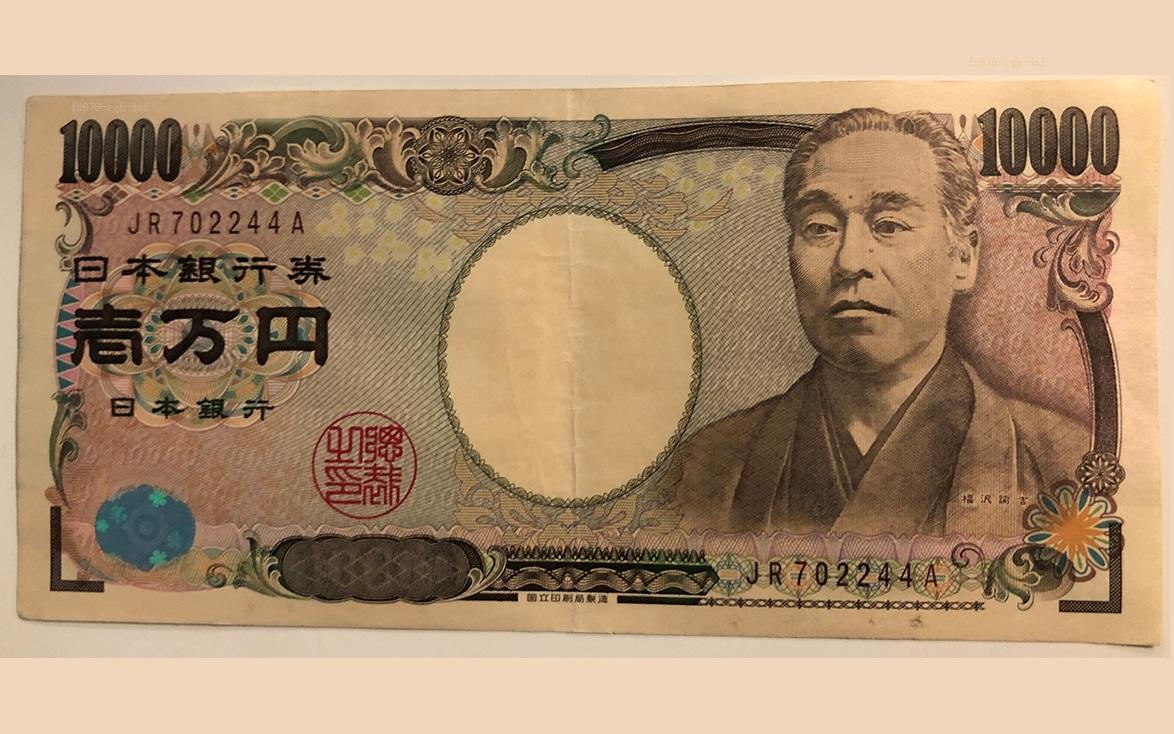
Analysts point out that the Japanese Ministry of Finance's intervention this time has been "less than ideal." After the USD/JPY pair broke through 160 last week, the authorities intervened, and this week they intervened twice more, with a total cost potentially approaching $70 billion. However, the yen only briefly rose before being quickly pushed back down by buying pressure. On Friday (May 8th) in Asian trading, the USD/JPY pair had rebounded to around 157.00, significantly diminishing the deterrent effect of the intervention.
I. Triple headwinds in fundamentals make intervention difficult to overcome the overall trend.
Japan's Ministry of Finance is well aware that they face an overwhelming fundamental backdrop: the ongoing Iraq War, high energy prices, and all factors pointing to a weaker yen. Even if the war ends today, the normalization of the oil market will take months, and high oil prices will continue to drag down the Japanese economy. Coupled with the ongoing "Takashi-Sanae trade" and the Bank of Japan's dilemma between raising interest rates and a weak economy, the yen lacks any fundamental basis for a reversal.
II. Intervention at the wrong time: Low liquidity is a "signal killer".
Analysts believe that intervening this week during a period of low liquidity (Japanese holidays, the Asian and European trading sessions) was a mistake. The core logic is that the significance of intervention lies not in the scale of funds, but in the transmission of signals. Sufficient market participants need to receive and amplify the signal, forming a consensus that "we cannot go against the Ministry of Finance/Central Bank." However, when liquidity is insufficient, the signal is diluted and ultimately perceived by the market as "noise" rather than an effective guiding signal.
Third, the more hasty the approach, the less effective it will be, and it will only embolden those who short sell.
Analysts bluntly stated that continuing intervention this week could be "a wrong step." As Japanese authorities become increasingly anxious due to ineffective interventions and continue their futile efforts, traders are emboldened to "punish" the yen. Currently, the authorities continue to loudly proclaim that they have the situation under control, but have already spent nearly $70 billion, and the pressure on foreign exchange reserves is increasing.
If the US dollar is boosted by non-farm payroll data or geopolitical risks and breaks through 157.49 (38.2% retracement level), it is expected to test the Bollinger Middle Band area of 158.45-158.67.
If expectations of a Fed rate cut intensify or the Bank of Japan releases hawkish signals, and the price falls below 155.49 (61.8% retracement level), it will test the medium-term support levels of the EMA200 (154.45) and the 78.6% Fibonacci retracement level (154.07).
Before tonight's non-farm payroll report is released, the market will likely remain in a narrow range of 156.00-157.50, waiting for the data to break the deadlock.
The USD/JPY pair is currently in a dual technical state of "bearish pressure from moving averages" and "extremely narrow Bollinger Bands"—the medium-term bearish structure remains unchanged, but short-term volatility has contracted to its limit, and a breakout could occur at any time. Tonight's non-farm payroll data will be the key catalyst for a breakout: weak data may push the pair down to the 155.41-154.22 area, while strong data may lead to a rebound to test the 158.45-158.67 area. Traders should wait for a clear directional signal before making any moves.
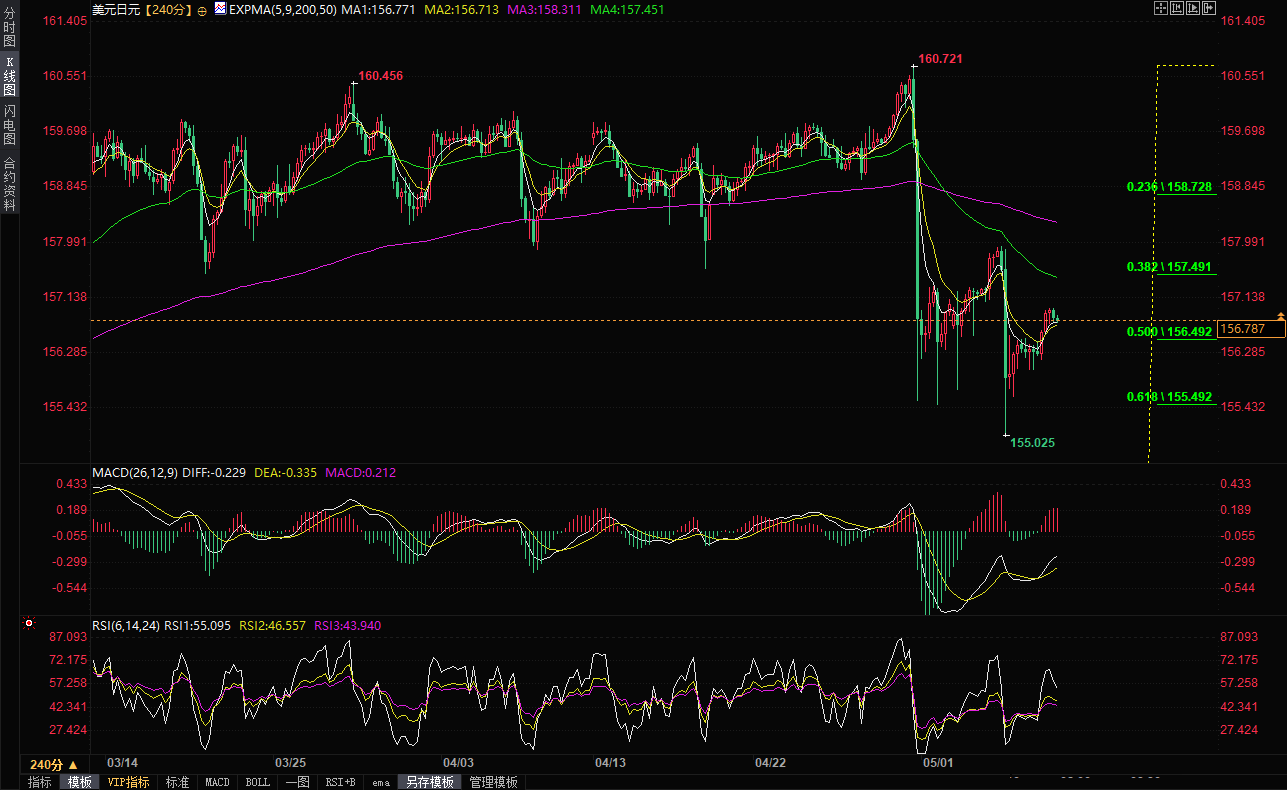
(USD/JPY daily chart, source: FX678)
In conclusion, without a fundamental change in the yen's fundamentals, intervention alone cannot reverse its weakness. The "signal failure" during periods of low liquidity significantly diminishes the effectiveness of intervention, and continued ineffective intervention may even encourage more aggressive short-selling. The question now is: has Japan reached the point where it needs to sell US Treasury bonds to raise ammunition? This may be the next focus of market attention.
At 14:09 Beijing time on May 8, the USD/JPY exchange rate was 156.80/81.
Why were the results unsatisfactory? Three main reasons analyzed.
I. Triple headwinds in fundamentals make intervention difficult to overcome the overall trend.
Japan's Ministry of Finance is well aware that they face an overwhelming fundamental backdrop: the ongoing Iraq War, high energy prices, and all factors pointing to a weaker yen. Even if the war ends today, the normalization of the oil market will take months, and high oil prices will continue to drag down the Japanese economy. Coupled with the ongoing "Takashi-Sanae trade" and the Bank of Japan's dilemma between raising interest rates and a weak economy, the yen lacks any fundamental basis for a reversal.
II. Intervention at the wrong time: Low liquidity is a "signal killer".
Analysts believe that intervening this week during a period of low liquidity (Japanese holidays, the Asian and European trading sessions) was a mistake. The core logic is that the significance of intervention lies not in the scale of funds, but in the transmission of signals. Sufficient market participants need to receive and amplify the signal, forming a consensus that "we cannot go against the Ministry of Finance/Central Bank." However, when liquidity is insufficient, the signal is diluted and ultimately perceived by the market as "noise" rather than an effective guiding signal.
Third, the more hasty the approach, the less effective it will be, and it will only embolden those who short sell.
Analysts bluntly stated that continuing intervention this week could be "a wrong step." As Japanese authorities become increasingly anxious due to ineffective interventions and continue their futile efforts, traders are emboldened to "punish" the yen. Currently, the authorities continue to loudly proclaim that they have the situation under control, but have already spent nearly $70 billion, and the pressure on foreign exchange reserves is increasing.
Market Outlook
If the US dollar is boosted by non-farm payroll data or geopolitical risks and breaks through 157.49 (38.2% retracement level), it is expected to test the Bollinger Middle Band area of 158.45-158.67.
If expectations of a Fed rate cut intensify or the Bank of Japan releases hawkish signals, and the price falls below 155.49 (61.8% retracement level), it will test the medium-term support levels of the EMA200 (154.45) and the 78.6% Fibonacci retracement level (154.07).
Before tonight's non-farm payroll report is released, the market will likely remain in a narrow range of 156.00-157.50, waiting for the data to break the deadlock.
The USD/JPY pair is currently in a dual technical state of "bearish pressure from moving averages" and "extremely narrow Bollinger Bands"—the medium-term bearish structure remains unchanged, but short-term volatility has contracted to its limit, and a breakout could occur at any time. Tonight's non-farm payroll data will be the key catalyst for a breakout: weak data may push the pair down to the 155.41-154.22 area, while strong data may lead to a rebound to test the 158.45-158.67 area. Traders should wait for a clear directional signal before making any moves.
(USD/JPY daily chart, source: FX678)
Intervention failed to reverse the trend; the market awaits the next signal.
In conclusion, without a fundamental change in the yen's fundamentals, intervention alone cannot reverse its weakness. The "signal failure" during periods of low liquidity significantly diminishes the effectiveness of intervention, and continued ineffective intervention may even encourage more aggressive short-selling. The question now is: has Japan reached the point where it needs to sell US Treasury bonds to raise ammunition? This may be the next focus of market attention.
At 14:09 Beijing time on May 8, the USD/JPY exchange rate was 156.80/81.
- Risk Warning and Disclaimer
- The market involves risk, and trading may not be suitable for all investors. This article is for reference only and does not constitute personal investment advice, nor does it take into account certain users’ specific investment objectives, financial situation, or other needs. Any investment decisions made based on this information are at your own risk.