The situation in the Middle East is destabilizing the oil market, and a crisis of rapidly depleted global crude oil inventories is looming.
2026-05-11 11:13:44
As oil tankers from the Persian Gulf arrive at their destinations, many countries have begun releasing strategic crude oil reserves to fill supply gaps in the Middle East and stabilize oil prices. However, this emergency response is unsustainable in the long term. The ongoing geopolitical conflict in the Middle East is causing global crude oil inventories to be depleted at an unprecedented rate. Coupled with the approaching peak demand season in the Northern Hemisphere, tight supply in the spot market, and multiple pressures from low inventories, weakening demand, and geopolitical stalemate, the global crude oil supply and demand situation is entering a long-term fragile state.
The last batch of oil tankers from the Persian Gulf have arrived at their destinations. Countries are relying on the release of strategic crude oil reserves to temporarily fill the supply gap in Middle Eastern crude oil and suppress the rise in oil prices.
Industry analysts and energy company executives generally believe that the longer the situation in the Middle East continues, the more severe the global crude oil supply situation will become. Recent industry monitoring data shows that global crude oil inventories are declining at the fastest pace in history. Market analysts point out that the inventory buffer is ultimately limited and cannot offset the impact of continuous supply disruptions in the long term.
This crisis coincides with the regular restocking window for refineries in the Northern Hemisphere, a period traditionally peak for demand during the summer, driven by driving, agricultural production, and air travel. Driven by the Middle East situation and rising oil prices, crude oil demand this peak season is likely to weaken significantly, and the impact of supply shortages will gradually spread from Asia to the rest of the world. Although the futures market has seen relatively calm fluctuations, shortages are already evident in the physical crude oil market, and the tense situation is expected to last for at least several months.
Total Energy CEO Patrick Pouyanne stated that even if the Middle East conflict ends in May, global crude oil inventories are already at extremely low levels. He estimates that global daily crude oil inventory depletion reaches 10 to 13 million barrels, with global reserves cumulatively depleted by 500 million barrels since the conflict began. Rystad Energy is even more pessimistic, stating that global supply losses since early March are approximately 600 million barrels, and even if Persian Gulf shipping returns to normal by the end of this month, the overall supply gap will remain substantial.
The current risks associated with crude oil inventories are more prominent, as the overall inventory level is already far lower than it was five years ago.
Global crude oil inventories in 2021 were sufficient to meet over 90 days of consumption demand, falling below 80 days in 2022, and continuing to decline under monitoring by multiple authoritative institutions. These institutions have projected three possible scenarios for the Middle East situation, and regardless of the outcome, global crude oil inventories are expected to continue declining until 2027; if shipping disruptions continue beyond the end of June, inventories may fall to a critical level, sufficient to meet only 70 days of demand.
The market's self-regulating effect has already emerged, with high oil prices beginning to suppress consumer demand. Related data shows that Asian crude oil imports in April plummeted by 30% year-on-year, hitting a ten-year low for the same period, with scarcity of supply and high prices jointly suppressing purchasing intentions. Europe is experiencing a shortage of jet fuel, forcing airlines to reduce flights; insufficient naphtha supply in Asia is dragging down production in the chemical industry chain; and US crude oil and refined product inventories are declining simultaneously, further weakening energy security. US gasoline inventories have fallen to multi-year lows for the same period, significantly lower than the five-year average.
The situation in the Middle East is unlikely to see substantial easing in the short term. Although the US and Iran have made statements regarding a ceasefire, both sides continue to confront and retaliate against each other. Despite repeated expressions of willingness to make peace, no effective consensus has been reached. With the situation at a stalemate, the probability of an optimistic resolution is decreasing, while the likelihood of a negative scenario is increasing. The global oil supply situation will further tighten, and oil prices and the supply-demand balance will continue to face pressure.
Overall, relying on strategic reserves can only provide short-term support to the oil market and cannot resolve the fundamental supply and demand imbalance. The Middle East conflict has prolonged the inventory depletion cycle, coupled with already low global inventory levels, pressure on peak season demand, the spread of regional oil product shortages, and the geopolitical stalemate, the global crude oil market has entered a highly vulnerable period, and low inventory levels and tight supply may become the norm in the future.
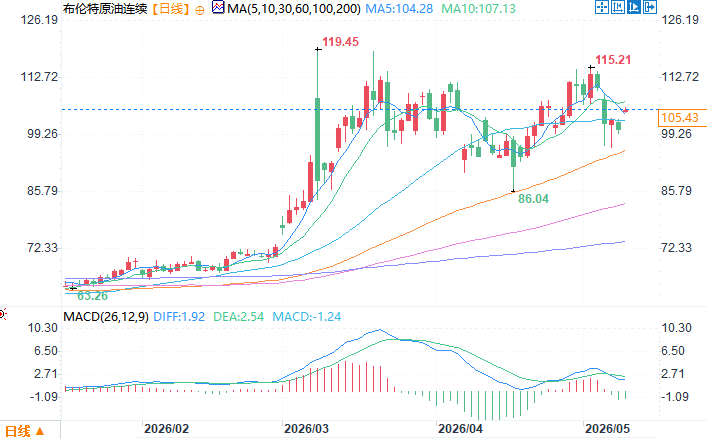
Brent crude oil daily chart source: EasyForex
At 11:13 AM Beijing time on May 11, Brent crude oil futures were trading at $105.51 per barrel.
Emergency oil reserves are unsustainable, and inventory depletion has reached a record high.
The last batch of oil tankers from the Persian Gulf have arrived at their destinations. Countries are relying on the release of strategic crude oil reserves to temporarily fill the supply gap in Middle Eastern crude oil and suppress the rise in oil prices.
Industry analysts and energy company executives generally believe that the longer the situation in the Middle East continues, the more severe the global crude oil supply situation will become. Recent industry monitoring data shows that global crude oil inventories are declining at the fastest pace in history. Market analysts point out that the inventory buffer is ultimately limited and cannot offset the impact of continuous supply disruptions in the long term.
This crisis coincides with the regular restocking window for refineries in the Northern Hemisphere, a period traditionally peak for demand during the summer, driven by driving, agricultural production, and air travel. Driven by the Middle East situation and rising oil prices, crude oil demand this peak season is likely to weaken significantly, and the impact of supply shortages will gradually spread from Asia to the rest of the world. Although the futures market has seen relatively calm fluctuations, shortages are already evident in the physical crude oil market, and the tense situation is expected to last for at least several months.
Total Energy CEO Patrick Pouyanne stated that even if the Middle East conflict ends in May, global crude oil inventories are already at extremely low levels. He estimates that global daily crude oil inventory depletion reaches 10 to 13 million barrels, with global reserves cumulatively depleted by 500 million barrels since the conflict began. Rystad Energy is even more pessimistic, stating that global supply losses since early March are approximately 600 million barrels, and even if Persian Gulf shipping returns to normal by the end of this month, the overall supply gap will remain substantial.
Global inventories were already low, and the downward trend continued under multiple scenarios.
The current risks associated with crude oil inventories are more prominent, as the overall inventory level is already far lower than it was five years ago.
Global crude oil inventories in 2021 were sufficient to meet over 90 days of consumption demand, falling below 80 days in 2022, and continuing to decline under monitoring by multiple authoritative institutions. These institutions have projected three possible scenarios for the Middle East situation, and regardless of the outcome, global crude oil inventories are expected to continue declining until 2027; if shipping disruptions continue beyond the end of June, inventories may fall to a critical level, sufficient to meet only 70 days of demand.
The market's self-regulating effect has already emerged, with high oil prices beginning to suppress consumer demand. Related data shows that Asian crude oil imports in April plummeted by 30% year-on-year, hitting a ten-year low for the same period, with scarcity of supply and high prices jointly suppressing purchasing intentions. Europe is experiencing a shortage of jet fuel, forcing airlines to reduce flights; insufficient naphtha supply in Asia is dragging down production in the chemical industry chain; and US crude oil and refined product inventories are declining simultaneously, further weakening energy security. US gasoline inventories have fallen to multi-year lows for the same period, significantly lower than the five-year average.
Geopolitical stalemate remains unresolved, fueling pessimistic expectations in the oil market.
The situation in the Middle East is unlikely to see substantial easing in the short term. Although the US and Iran have made statements regarding a ceasefire, both sides continue to confront and retaliate against each other. Despite repeated expressions of willingness to make peace, no effective consensus has been reached. With the situation at a stalemate, the probability of an optimistic resolution is decreasing, while the likelihood of a negative scenario is increasing. The global oil supply situation will further tighten, and oil prices and the supply-demand balance will continue to face pressure.
Summarize
Overall, relying on strategic reserves can only provide short-term support to the oil market and cannot resolve the fundamental supply and demand imbalance. The Middle East conflict has prolonged the inventory depletion cycle, coupled with already low global inventory levels, pressure on peak season demand, the spread of regional oil product shortages, and the geopolitical stalemate, the global crude oil market has entered a highly vulnerable period, and low inventory levels and tight supply may become the norm in the future.
Brent crude oil daily chart source: EasyForex
At 11:13 AM Beijing time on May 11, Brent crude oil futures were trading at $105.51 per barrel.
- Risk Warning and Disclaimer
- The market involves risk, and trading may not be suitable for all investors. This article is for reference only and does not constitute personal investment advice, nor does it take into account certain users’ specific investment objectives, financial situation, or other needs. Any investment decisions made based on this information are at your own risk.