Middle East risk aversion coupled with strong non-farm payroll data drove a rebound in the US dollar index, with the DXY index holding steady above the 98 level.
2026-05-11 14:49:39
On Monday during Asian trading hours, the US dollar index (DXY) continued its rebound, hovering around 98.10 . Amid renewed tensions in the Middle East, risk aversion in global markets has clearly intensified, with funds flowing back into dollar assets. Stronger-than-expected US employment data further strengthened the short-term support for the dollar.

US President Trump formally rejected Iran's latest peace proposal, describing it as "completely unacceptable." Meanwhile, Iran stated its response focused on a comprehensive ceasefire, the situation in Lebanon, and shipping safety in the Strait of Hormuz. However, the two sides have yet to reach an agreement on ceasefire conditions and the opening of key shipping lanes. Some market institutions point out that the continued tension in the Middle East is driving global markets back into a risk-averse trading mode. As the world's core reserve currency, the US dollar typically attracts inflows during periods of international instability, which is one of the key reasons for the recent rebound in the dollar index. With the renewed escalation of tensions in the Strait of Hormuz, market concerns about the security of global energy transportation have significantly intensified.
Meanwhile, the renewed rise in international crude oil prices has further intensified market concerns about renewed global inflationary pressures. Some institutions believe that rising oil prices may force major central banks around the world to maintain high interest rates for a longer period, which provides temporary support for the US dollar. Besides safe-haven demand, US economic data has also been a significant driver of the dollar's rise. Data from the US Bureau of Labor Statistics showed that US non-farm payrolls increased by 115,000 in April, lower than the previous month's 185,000, but significantly higher than the market expectation of 62,000; the unemployment rate remained at 4.3% in April, in line with market expectations. After the data release, US Treasury yields rose again, and market bets on a rapid interest rate cut by the Federal Reserve cooled significantly.
Market analysts believe that while the US job market has slowed marginally, the overall economic resilience remains stronger than previously feared. As a result, rising US Treasury yields have further enhanced the attractiveness of dollar assets, thus driving the dollar index to maintain its rebound. However, the dollar index is not currently in a completely one-sided strong position. Some institutions believe that signs of slowing US economic growth persist, and market concerns about the risk of future economic cooling have not completely disappeared. Although US employment data was stronger than expected, the number of new jobs created has slowed compared to previous periods, indicating that US economic momentum is cooling marginally. Furthermore, there is still some disagreement in the market regarding the future policy path of the Federal Reserve. Some investors believe that if US inflation data shows a significant decline in the future, the Federal Reserve may reconsider interest rate cuts this year, which could limit the further significant rise in the dollar index.
From a technical perspective, the daily chart of the US dollar index shows that it has regained its footing above the 98.00 level , indicating a short-term trend recovery. After finding significant support around 97.20, the dollar index rebounded and is now approaching the 98.30-98.50 resistance zone. On the daily chart, the 20-day moving average is gradually flattening, suggesting a weakening of the previous downtrend. The MACD indicator's bullish crossover at a low level and the continued expansion of the red bars reflect strengthening short-term bullish momentum. The RSI indicator has risen to around 55, indicating that market sentiment has gradually shifted from bearish to neutral to bullish. The 97.60 area currently constitutes the first key support level on the daily chart; a break below this level could lead to a retest of the 97.00 low. On the upside, the 98.50-99.00 area remains a significant resistance zone. If the situation in the Middle East continues to escalate and US Treasury yields rise further, the dollar index could still have a chance to test the 99 level.
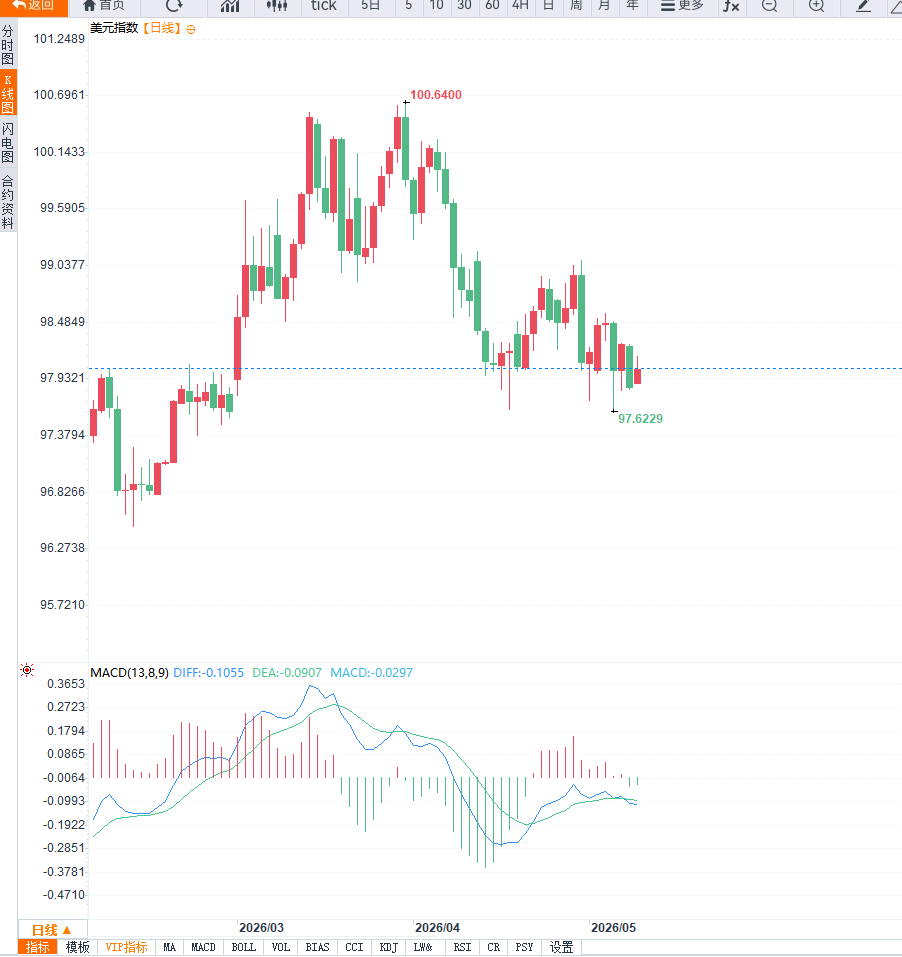
Furthermore, given the current lack of significant economic data to drive the market, the short-term trend of the US dollar index may continue to be influenced by the situation in the Middle East and changes in US Treasury yields. As long as risk aversion remains high, the US dollar index will generally remain relatively strong in the short term.
Editor's Summary : The current US dollar index market is in a tug-of-war between "safe-haven demand" and "expectations of economic slowdown." Continued tensions in the Middle East are driving global capital flows into dollar assets, while stronger-than-expected US employment data has further strengthened market expectations that the Federal Reserve will maintain high interest rates. However, signs of a marginal slowdown in the US economy persist, and market expectations for future rate cuts have not completely disappeared, limiting further significant gains in the dollar index. From a technical perspective, the dollar index has formed a short-term rebound, but still faces significant technical resistance above. The market needs to focus on three key areas going forward: first, changes in the Middle East situation; second, US inflation and employment data; and third, subsequent policy signals from the Federal Reserve. Overall, the dollar index is likely to maintain a high-level, slightly bullish trend in the short term, with safe-haven sentiment remaining the core driving factor.
US President Trump formally rejected Iran's latest peace proposal, describing it as "completely unacceptable." Meanwhile, Iran stated its response focused on a comprehensive ceasefire, the situation in Lebanon, and shipping safety in the Strait of Hormuz. However, the two sides have yet to reach an agreement on ceasefire conditions and the opening of key shipping lanes. Some market institutions point out that the continued tension in the Middle East is driving global markets back into a risk-averse trading mode. As the world's core reserve currency, the US dollar typically attracts inflows during periods of international instability, which is one of the key reasons for the recent rebound in the dollar index. With the renewed escalation of tensions in the Strait of Hormuz, market concerns about the security of global energy transportation have significantly intensified.
Meanwhile, the renewed rise in international crude oil prices has further intensified market concerns about renewed global inflationary pressures. Some institutions believe that rising oil prices may force major central banks around the world to maintain high interest rates for a longer period, which provides temporary support for the US dollar. Besides safe-haven demand, US economic data has also been a significant driver of the dollar's rise. Data from the US Bureau of Labor Statistics showed that US non-farm payrolls increased by 115,000 in April, lower than the previous month's 185,000, but significantly higher than the market expectation of 62,000; the unemployment rate remained at 4.3% in April, in line with market expectations. After the data release, US Treasury yields rose again, and market bets on a rapid interest rate cut by the Federal Reserve cooled significantly.
Market analysts believe that while the US job market has slowed marginally, the overall economic resilience remains stronger than previously feared. As a result, rising US Treasury yields have further enhanced the attractiveness of dollar assets, thus driving the dollar index to maintain its rebound. However, the dollar index is not currently in a completely one-sided strong position. Some institutions believe that signs of slowing US economic growth persist, and market concerns about the risk of future economic cooling have not completely disappeared. Although US employment data was stronger than expected, the number of new jobs created has slowed compared to previous periods, indicating that US economic momentum is cooling marginally. Furthermore, there is still some disagreement in the market regarding the future policy path of the Federal Reserve. Some investors believe that if US inflation data shows a significant decline in the future, the Federal Reserve may reconsider interest rate cuts this year, which could limit the further significant rise in the dollar index.
From a technical perspective, the daily chart of the US dollar index shows that it has regained its footing above the 98.00 level , indicating a short-term trend recovery. After finding significant support around 97.20, the dollar index rebounded and is now approaching the 98.30-98.50 resistance zone. On the daily chart, the 20-day moving average is gradually flattening, suggesting a weakening of the previous downtrend. The MACD indicator's bullish crossover at a low level and the continued expansion of the red bars reflect strengthening short-term bullish momentum. The RSI indicator has risen to around 55, indicating that market sentiment has gradually shifted from bearish to neutral to bullish. The 97.60 area currently constitutes the first key support level on the daily chart; a break below this level could lead to a retest of the 97.00 low. On the upside, the 98.50-99.00 area remains a significant resistance zone. If the situation in the Middle East continues to escalate and US Treasury yields rise further, the dollar index could still have a chance to test the 99 level.
Furthermore, given the current lack of significant economic data to drive the market, the short-term trend of the US dollar index may continue to be influenced by the situation in the Middle East and changes in US Treasury yields. As long as risk aversion remains high, the US dollar index will generally remain relatively strong in the short term.
Editor's Summary : The current US dollar index market is in a tug-of-war between "safe-haven demand" and "expectations of economic slowdown." Continued tensions in the Middle East are driving global capital flows into dollar assets, while stronger-than-expected US employment data has further strengthened market expectations that the Federal Reserve will maintain high interest rates. However, signs of a marginal slowdown in the US economy persist, and market expectations for future rate cuts have not completely disappeared, limiting further significant gains in the dollar index. From a technical perspective, the dollar index has formed a short-term rebound, but still faces significant technical resistance above. The market needs to focus on three key areas going forward: first, changes in the Middle East situation; second, US inflation and employment data; and third, subsequent policy signals from the Federal Reserve. Overall, the dollar index is likely to maintain a high-level, slightly bullish trend in the short term, with safe-haven sentiment remaining the core driving factor.
- Risk Warning and Disclaimer
- The market involves risk, and trading may not be suitable for all investors. This article is for reference only and does not constitute personal investment advice, nor does it take into account certain users’ specific investment objectives, financial situation, or other needs. Any investment decisions made based on this information are at your own risk.