The euro rebounded against the yen due to a weaker yen, but the 200-period moving average provided resistance.
2026-05-11 18:02:29
On Monday (May 11), the euro opened lower against the yen in the Asian session at around 183.80, but quickly attracted bargain hunters, reversing the decline. This marked the third consecutive trading day of gains for the pair. In the first half of the European session, the exchange rate continued its steady upward momentum, gradually recovering to near last week's highs. Against the backdrop of a generally weaker yen, bulls are attempting to push the exchange rate further above the psychological level of 185.00.

The core reason for the yen's downward pressure lies in the renewed escalation of tensions between the US and Iran, coupled with continued disruptions to energy supplies through the Strait of Hormuz, which has driven up global oil prices. As a major energy importer, Japan's economic outlook faces downside risks, dragging down the yen's performance. However, factors also exist to limit further yen weakness: market speculation that the Japanese monetary authorities may intervene again to support the currency, while the hawkish outlook of the Bank of Japan (with the market pricing in a 60% probability of a June rate hike) also deters yen short sellers. This tug-of-war between the two forces suggests that the upside potential for the euro/yen exchange rate may be relatively limited, and short sellers are unwilling to aggressively bet at current levels.
From a technical perspective, the current signals for EUR/JPY are mixed. On the positive side, the RSI is hovering around 62, in bullish territory but not yet overbought, and the MACD is holding steady above the zero line, indicating that upward momentum remains, and the exchange rate has rebounded steadily from recent lows (around 182.00). However, negative signals cannot be ignored: the exchange rate previously broke below the 200-period moving average, a break that was considered a key bearish trigger signal, and so far the exchange rate has failed to recover this moving average, meaning that the current rebound is still considered a "weak rebound," and the sustainability of the upward momentum is questionable.
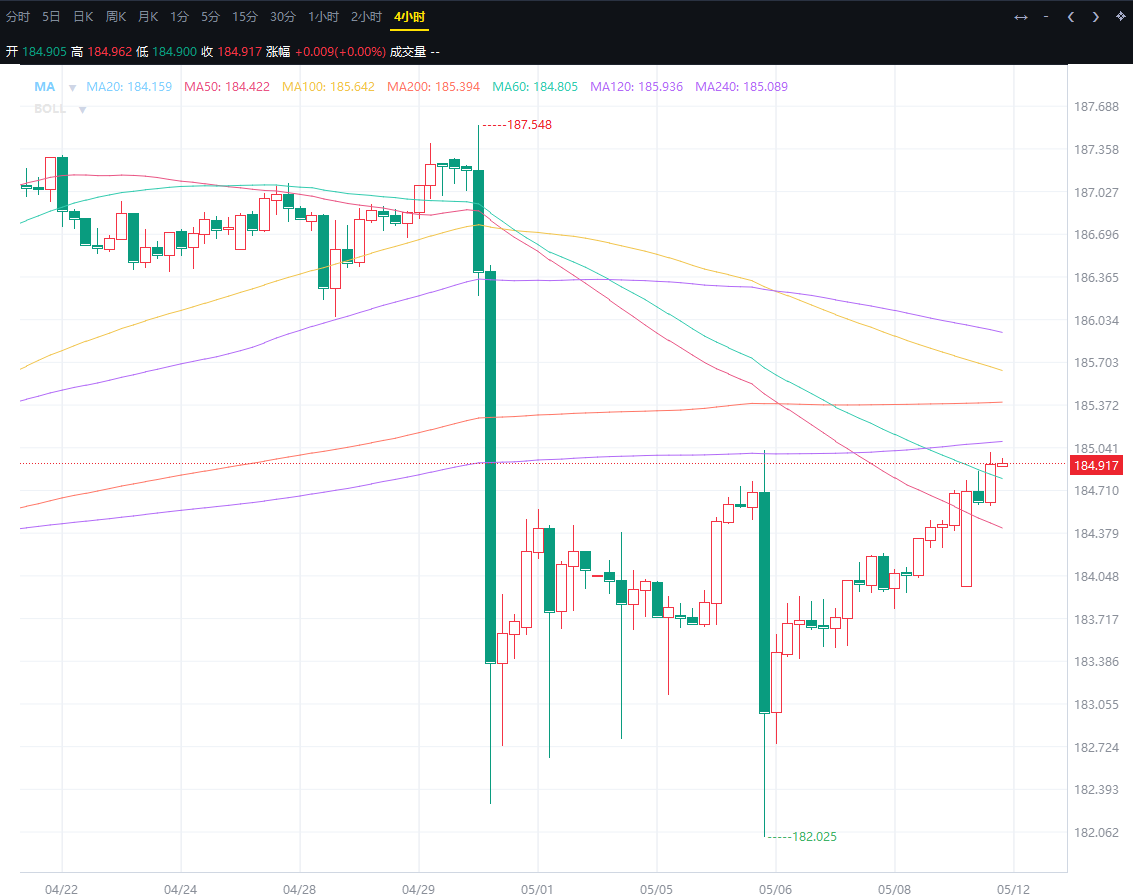
(EUR/JPY 4-hour chart, source: FX678)
Regarding key levels, the first resistance is at 185.40 (200-period moving average), which is also the dividing line between the current bearish and bullish trends. If the exchange rate can continue to hold above this level, it will effectively reverse the bearish bias, with a further target above 186.00. On the downside, due to the lack of clear support levels nearby, Monday's low of 183.80 and the recent low of 182.00 will serve as short-term references. In terms of trading strategy, if the exchange rate encounters resistance at 185.40 and falls back, it may trigger a new round of selling pressure, with a target of 182.00.
The EUR/JPY pair is currently at a critical technical crossroads. Short-term momentum indicators support further upside, but the 200-period moving average (185.40) is a key bastion that bulls must overcome – any rebound should be considered a fragile upward attempt rather than a trend reversal signal until a decisive break above this level is achieved. Traders should wait for one of two scenarios before making directional moves: a close above 185.40 on the daily or 4-hour chart would confirm a bullish outlook, with targets at 186.00 and higher; conversely, a pullback near 185.40 followed by a break below the intraday low would confirm a bearish outlook, with a retest of the 182.00 support area. In the short term, investors should also pay attention to developments in the Middle East, speeches by Bank of Japan officials, and potential market intervention, all of which could have a sudden impact on the EUR/JPY pair's movement.
At 17:46 Beijing time on May 11, the euro was trading at 184.87/88 against the yen.
I. Fundamental Drivers: The Yen Weakens Amidst Intervention Risks
The core reason for the yen's downward pressure lies in the renewed escalation of tensions between the US and Iran, coupled with continued disruptions to energy supplies through the Strait of Hormuz, which has driven up global oil prices. As a major energy importer, Japan's economic outlook faces downside risks, dragging down the yen's performance. However, factors also exist to limit further yen weakness: market speculation that the Japanese monetary authorities may intervene again to support the currency, while the hawkish outlook of the Bank of Japan (with the market pricing in a 60% probability of a June rate hike) also deters yen short sellers. This tug-of-war between the two forces suggests that the upside potential for the euro/yen exchange rate may be relatively limited, and short sellers are unwilling to aggressively bet at current levels.
II. Technical Analysis: Mixed Signals Suggest Caution
From a technical perspective, the current signals for EUR/JPY are mixed. On the positive side, the RSI is hovering around 62, in bullish territory but not yet overbought, and the MACD is holding steady above the zero line, indicating that upward momentum remains, and the exchange rate has rebounded steadily from recent lows (around 182.00). However, negative signals cannot be ignored: the exchange rate previously broke below the 200-period moving average, a break that was considered a key bearish trigger signal, and so far the exchange rate has failed to recover this moving average, meaning that the current rebound is still considered a "weak rebound," and the sustainability of the upward momentum is questionable.
(EUR/JPY 4-hour chart, source: FX678)
III. Key Locations and Operational Strategies
Regarding key levels, the first resistance is at 185.40 (200-period moving average), which is also the dividing line between the current bearish and bullish trends. If the exchange rate can continue to hold above this level, it will effectively reverse the bearish bias, with a further target above 186.00. On the downside, due to the lack of clear support levels nearby, Monday's low of 183.80 and the recent low of 182.00 will serve as short-term references. In terms of trading strategy, if the exchange rate encounters resistance at 185.40 and falls back, it may trigger a new round of selling pressure, with a target of 182.00.
IV. Conclusion and Outlook
The EUR/JPY pair is currently at a critical technical crossroads. Short-term momentum indicators support further upside, but the 200-period moving average (185.40) is a key bastion that bulls must overcome – any rebound should be considered a fragile upward attempt rather than a trend reversal signal until a decisive break above this level is achieved. Traders should wait for one of two scenarios before making directional moves: a close above 185.40 on the daily or 4-hour chart would confirm a bullish outlook, with targets at 186.00 and higher; conversely, a pullback near 185.40 followed by a break below the intraday low would confirm a bearish outlook, with a retest of the 182.00 support area. In the short term, investors should also pay attention to developments in the Middle East, speeches by Bank of Japan officials, and potential market intervention, all of which could have a sudden impact on the EUR/JPY pair's movement.
At 17:46 Beijing time on May 11, the euro was trading at 184.87/88 against the yen.
- Risk Warning and Disclaimer
- The market involves risk, and trading may not be suitable for all investors. This article is for reference only and does not constitute personal investment advice, nor does it take into account certain users’ specific investment objectives, financial situation, or other needs. Any investment decisions made based on this information are at your own risk.