Oil prices fell after Trump called Iran's response "completely unacceptable," yet the market is betting on peace talks?
2026-05-11 15:28:31
On Monday (May 11), during the Asian and European sessions, international oil prices opened sharply higher but then retreated. Trump expressed strong dissatisfaction with Iran, causing international oil prices to open significantly higher. However, the market continued to maintain an optimistic sentiment, with Asian stock markets rising overall, and oil prices retreating from their highs.
On May 10 local time, US President Trump posted on his social media platform Real Social that he had just read the reply from the so-called "representatives" of Iran and was very dissatisfied with it, saying that "this response is completely unacceptable."
Trump also accused the Islamic Republic of Iran of "delaying" and "playing tricks" on the United States and other countries for 47 years since its founding, and reiterated his criticism of former Presidents Obama and Biden's policies toward Iran, calling Obama a "sucker" and Biden even worse.
The market is still collectively betting on the prospects of peace talks, so asset pullbacks caused by major negative news have become buying opportunities in the capital market.
The escalation of geopolitical tensions is already evident in the recent escalating military conflicts.
Since the joint US-Israeli military strikes began on February 28, Iran and its armed allies have carried out hundreds of cross-border strikes using drones.
Recently, a merchant ship in the waters near Qatar was attacked by a drone, causing a fire. The UAE and Kuwait subsequently reported that drones had illegally entered their airspace. The UAE shot down two drones and identified Iran as the source of the attack.
The battle between maritime blockade and counter-blockade is equally intense. Since April 13, the US military has imposed a blockade on Iranian ports, intercepting a total of 61 civilian merchant ships. Earlier this month, it also precisely targeted two Iranian oil tankers that attempted to break through the blockade.
Iran has long blocked the Strait of Hormuz and warned that any attack on its ships would provoke a saturation response against US bases and enemy ships.
In addition, the South Korean-operated cargo ship "HMM Namu" was struck by two unidentified flying objects while anchored in the strait on May 4, causing an explosion and fire. Although none of the 24 crew members were injured, the ship was severely damaged, and no party has yet come forward to explain the situation.
In response to the 15-condition ceasefire proposal put forward by the United States, Iran submitted a formal response through Pakistani mediators.
Tehran authorities deemed the US proposal tantamount to coercion and resolutely rejected it, making clear demands: the US must compensate for war losses, Iran must gain full control of the Strait of Hormuz, the US must lift all sanctions and remove sanctions related to Iranian oil sales within 30 days, and the US must unfreeze billions of dollars in frozen assets.
Iranian President Pezechzian emphasized that Iran will never yield to its enemies, and that the goal of dialogue and negotiation is to fight for national rights and defend national interests.
On the nuclear issue, the Iranian military has entered a state of maximum combat readiness to protect its uranium storage facilities. Data from the United Nations nuclear regulatory agency shows that it currently possesses more than 440 kilograms of uranium enriched to 60%, which can be converted into weapons-grade nuclear material with only simple technical processing.
Iran's new Supreme Leader Mojtaba Khamenei also issued a new strategic directive to "continue military operations and strongly counter hostile forces."
Israel, a key US ally in the Middle East, has reacted strongly to this situation.
In an interview, Prime Minister Netanyahu stated that the conflict with Iran is not over, and the core issue is the need to completely eliminate the enriched uranium stockpile within Iran. He revealed that Trump had told him of a "plan to send troops into Iran," and that such a military operation was feasible.
Netanyahu refuted the New York Times report that he encouraged Trump to launch a war to bring about regime change in Iran, saying that both he and Trump were aware of the risks of military action, but the danger of letting the situation deteriorate was far more deadly.
In addition, Netanyahu also revealed plans to gradually reduce the US's annual $3.8 billion military aid to Israel to zero over the next ten years in response to domestic scrutiny of the aid.
The international community is paying close attention to the situation between the United States and Iran, and different countries have reacted differently.
Russian President Vladimir Putin reiterated that Russia is well aware that Iran has no plans to develop nuclear weapons, and that its proposed solutions to assist in the transfer of Iran's enriched uranium and promote geopolitical reconciliation still have room for implementation. He stated that the proposal aims to contribute to easing tensions, rather than "gaining political capital."
Britain and France plan to lead a multinational escort operation in the Strait of Hormuz. Britain has already deployed the HMS Dragon destroyer to the Middle East, while France's aircraft carrier Charles de Gaulle is transiting the Suez Canal toward the southern Red Sea in preparation for war.
However, Iranian Deputy Foreign Minister Qazim Gharibabadi issued a strong warning that if British, French and other countries’ ships cooperate with the US’s unilateral actions that violate international law, the Iranian armed forces will immediately take strong countermeasures.
French President Macron responded that the plan was not a military deployment, but rather an international cooperation mission for shipping security to be carried out after the situation stabilized.
The market is characterized by constant disturbances in the Strait of Hormuz, but there has been no actual exchange of fire. Even when there is actual exchange of fire, it is officially interpreted as disturbance rather than actual fighting.
Meanwhile, the international community is providing support. Russia has provided a destination for enriched uranium, while Britain and France are using military assets to help the United States pressure Iran.
Meanwhile, with Trump's visit approaching, the market is still heavily betting on optimistic short-term peace talks between the US and Iran. As a result, a special phenomenon has emerged in global asset prices: negative news becomes a buying opportunity. Recently, global equity markets have risen sharply, and opening lower has become a buying opportunity.
From a technical perspective, Brent crude oil found support near the upward channel and then opened higher, rising above the 5-day moving average. Currently, the resistance level is around 106.4, which is the 0.768 Fibonacci retracement level of this round of upward movement.
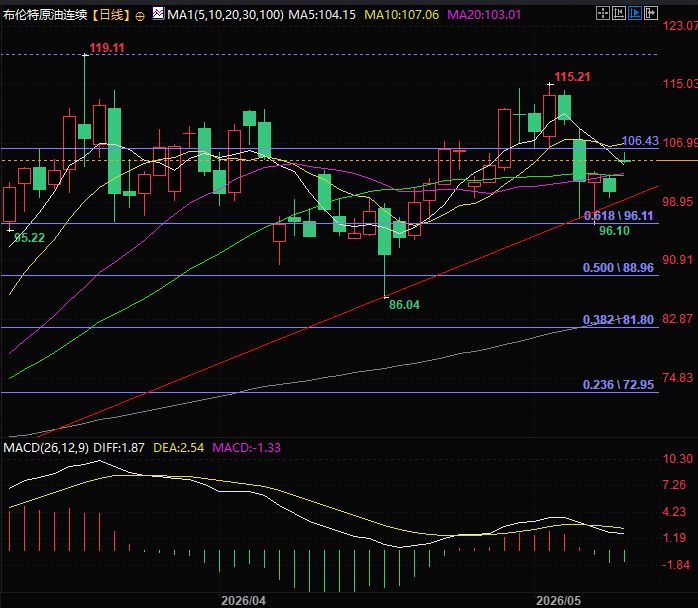
(Brent crude oil futures daily chart, source: EasyForex)
At 15:27 Beijing time, Brent crude oil futures were trading at $104.8 per barrel.
On May 10 local time, US President Trump posted on his social media platform Real Social that he had just read the reply from the so-called "representatives" of Iran and was very dissatisfied with it, saying that "this response is completely unacceptable."
Trump also accused the Islamic Republic of Iran of "delaying" and "playing tricks" on the United States and other countries for 47 years since its founding, and reiterated his criticism of former Presidents Obama and Biden's policies toward Iran, calling Obama a "sucker" and Biden even worse.
The market is still collectively betting on the prospects of peace talks, so asset pullbacks caused by major negative news have become buying opportunities in the capital market.
Recent firefights and naval maneuvers have been all bark and no bite.
The escalation of geopolitical tensions is already evident in the recent escalating military conflicts.
Since the joint US-Israeli military strikes began on February 28, Iran and its armed allies have carried out hundreds of cross-border strikes using drones.
Recently, a merchant ship in the waters near Qatar was attacked by a drone, causing a fire. The UAE and Kuwait subsequently reported that drones had illegally entered their airspace. The UAE shot down two drones and identified Iran as the source of the attack.
The battle between maritime blockade and counter-blockade is equally intense. Since April 13, the US military has imposed a blockade on Iranian ports, intercepting a total of 61 civilian merchant ships. Earlier this month, it also precisely targeted two Iranian oil tankers that attempted to break through the blockade.
Iran has long blocked the Strait of Hormuz and warned that any attack on its ships would provoke a saturation response against US bases and enemy ships.
In addition, the South Korean-operated cargo ship "HMM Namu" was struck by two unidentified flying objects while anchored in the strait on May 4, causing an explosion and fire. Although none of the 24 crew members were injured, the ship was severely damaged, and no party has yet come forward to explain the situation.
Iran responds firmly to US proposal: No bargaining chips to be shrugged before negotiations begin.
In response to the 15-condition ceasefire proposal put forward by the United States, Iran submitted a formal response through Pakistani mediators.
Tehran authorities deemed the US proposal tantamount to coercion and resolutely rejected it, making clear demands: the US must compensate for war losses, Iran must gain full control of the Strait of Hormuz, the US must lift all sanctions and remove sanctions related to Iranian oil sales within 30 days, and the US must unfreeze billions of dollars in frozen assets.
Iranian President Pezechzian emphasized that Iran will never yield to its enemies, and that the goal of dialogue and negotiation is to fight for national rights and defend national interests.
On the nuclear issue, the Iranian military has entered a state of maximum combat readiness to protect its uranium storage facilities. Data from the United Nations nuclear regulatory agency shows that it currently possesses more than 440 kilograms of uranium enriched to 60%, which can be converted into weapons-grade nuclear material with only simple technical processing.
Iran's new Supreme Leader Mojtaba Khamenei also issued a new strategic directive to "continue military operations and strongly counter hostile forces."
Israel cuts aid requirements
Israel, a key US ally in the Middle East, has reacted strongly to this situation.
In an interview, Prime Minister Netanyahu stated that the conflict with Iran is not over, and the core issue is the need to completely eliminate the enriched uranium stockpile within Iran. He revealed that Trump had told him of a "plan to send troops into Iran," and that such a military operation was feasible.
Netanyahu refuted the New York Times report that he encouraged Trump to launch a war to bring about regime change in Iran, saying that both he and Trump were aware of the risks of military action, but the danger of letting the situation deteriorate was far more deadly.
In addition, Netanyahu also revealed plans to gradually reduce the US's annual $3.8 billion military aid to Israel to zero over the next ten years in response to domestic scrutiny of the aid.
International Community Assists in Advancing the Situation: Russia Proposes Mediation, Britain and France Mobilize Military Assets
The international community is paying close attention to the situation between the United States and Iran, and different countries have reacted differently.
Russian President Vladimir Putin reiterated that Russia is well aware that Iran has no plans to develop nuclear weapons, and that its proposed solutions to assist in the transfer of Iran's enriched uranium and promote geopolitical reconciliation still have room for implementation. He stated that the proposal aims to contribute to easing tensions, rather than "gaining political capital."
Britain and France plan to lead a multinational escort operation in the Strait of Hormuz. Britain has already deployed the HMS Dragon destroyer to the Middle East, while France's aircraft carrier Charles de Gaulle is transiting the Suez Canal toward the southern Red Sea in preparation for war.
However, Iranian Deputy Foreign Minister Qazim Gharibabadi issued a strong warning that if British, French and other countries’ ships cooperate with the US’s unilateral actions that violate international law, the Iranian armed forces will immediately take strong countermeasures.
French President Macron responded that the plan was not a military deployment, but rather an international cooperation mission for shipping security to be carried out after the situation stabilized.
Summary and Technical Analysis:
The market is characterized by constant disturbances in the Strait of Hormuz, but there has been no actual exchange of fire. Even when there is actual exchange of fire, it is officially interpreted as disturbance rather than actual fighting.
Meanwhile, the international community is providing support. Russia has provided a destination for enriched uranium, while Britain and France are using military assets to help the United States pressure Iran.
Meanwhile, with Trump's visit approaching, the market is still heavily betting on optimistic short-term peace talks between the US and Iran. As a result, a special phenomenon has emerged in global asset prices: negative news becomes a buying opportunity. Recently, global equity markets have risen sharply, and opening lower has become a buying opportunity.
From a technical perspective, Brent crude oil found support near the upward channel and then opened higher, rising above the 5-day moving average. Currently, the resistance level is around 106.4, which is the 0.768 Fibonacci retracement level of this round of upward movement.
(Brent crude oil futures daily chart, source: EasyForex)
At 15:27 Beijing time, Brent crude oil futures were trading at $104.8 per barrel.
- Risk Warning and Disclaimer
- The market involves risk, and trading may not be suitable for all investors. This article is for reference only and does not constitute personal investment advice, nor does it take into account certain users’ specific investment objectives, financial situation, or other needs. Any investment decisions made based on this information are at your own risk.