The US dollar rallied as safe-haven demand surged, putting downward pressure on the New Zealand dollar, which now awaits US inflation data to determine its direction.
2026-05-12 15:12:48
On Tuesday (May 12) during Asian trading hours, the New Zealand dollar failed to maintain its gains against the US dollar from the previous day, encountering renewed selling pressure and falling below 0.5950. Global risk sentiment remained fragile, and the possibility of a peace agreement between the US and Iran was increasingly slim, which boosted the safe-haven asset, the US dollar, putting pressure on the New Zealand dollar against the US dollar.

US President Trump and Iran rejected each other's peace proposals to end the war, with major differences remaining between the two sides on the Iranian nuclear issue and the standoff in the Strait of Hormuz.
Reports indicate that Trump has lost patience with the continued closure of the Strait of Hormuz, believing that internal divisions within Iran's leadership are hindering substantial concessions in nuclear negotiations. The report, citing Trump aides, states that Trump is considering resuming large-scale military operations more seriously than in recent weeks. This perpetuates geopolitical risks and, amid weakening market expectations for further policy easing by the Federal Reserve in 2026, has solidified the dollar's reserve currency status.
However, dollar bulls appear hesitant ahead of the key US Consumer Price Index (CPI) release. This data will have a crucial impact on the Federal Reserve's interest rate path, thereby driving the dollar's performance and providing new momentum for the New Zealand dollar against the US dollar. The market generally expects that if inflation exceeds expectations, it could strengthen the expectation that the Fed will maintain high interest rates, further supporting the dollar; conversely, moderate inflation could put pressure on the dollar.
In addition to the situation in the Middle East, the market will closely monitor further developments, as these factors could continue to trigger volatility in global financial markets. Meanwhile, the market expects the Reserve Bank of New Zealand to maintain a cautious stance, or consider tightening policy to bring inflation back to the 2% midpoint target, which is expected to provide some support for the New Zealand dollar against the US dollar and limit its further downside.
Dollar bulls remain cautious ahead of the US CPI data release, potentially limiting the downside for the New Zealand dollar. The Reserve Bank of New Zealand's expected hawkish stance and further developments in the Middle East will be key variables influencing the NZD/USD exchange rate. Traders are awaiting US inflation data to gauge the Federal Reserve's future interest rate path.
As of press time, the New Zealand dollar was trading around 0.5942 against the US dollar, down slightly by 0.34% on the day. After rebounding yesterday, the exchange rate retreated slightly today, exhibiting a narrow consolidation pattern overall. On the daily chart, the current price of 0.5942 is firmly above most major moving averages, exhibiting typical bullish market characteristics. The short-term moving average MA20 is at 0.5901, forming the most direct dynamic support level; the moving average system is diverging upwards with reasonable spacing, indicating a healthy uptrend without signs of overextension. Furthermore, MA100 (0.5881) is higher than MA50 (0.5854) and MA120 (0.5859), forming a multiple support zone in the medium term, further solidifying the medium-term bullish tone.
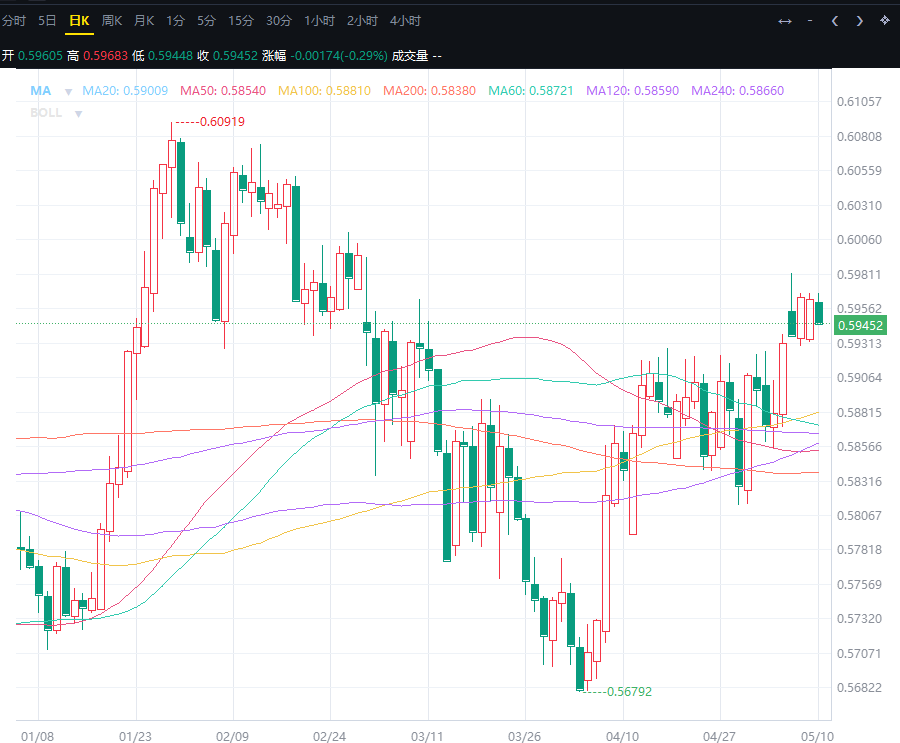
(NZD/USD daily chart, source: FX678)
At 15:11 Beijing time on May 12, the New Zealand dollar was trading at 0.5942/43 against the US dollar.
US President Trump and Iran rejected each other's peace proposals to end the war, with major differences remaining between the two sides on the Iranian nuclear issue and the standoff in the Strait of Hormuz.
The risk of escalation is rising.
Reports indicate that Trump has lost patience with the continued closure of the Strait of Hormuz, believing that internal divisions within Iran's leadership are hindering substantial concessions in nuclear negotiations. The report, citing Trump aides, states that Trump is considering resuming large-scale military operations more seriously than in recent weeks. This perpetuates geopolitical risks and, amid weakening market expectations for further policy easing by the Federal Reserve in 2026, has solidified the dollar's reserve currency status.
The market awaits guidance from US CPI data.
However, dollar bulls appear hesitant ahead of the key US Consumer Price Index (CPI) release. This data will have a crucial impact on the Federal Reserve's interest rate path, thereby driving the dollar's performance and providing new momentum for the New Zealand dollar against the US dollar. The market generally expects that if inflation exceeds expectations, it could strengthen the expectation that the Fed will maintain high interest rates, further supporting the dollar; conversely, moderate inflation could put pressure on the dollar.
Supporting factors for the New Zealand dollar in the future
In addition to the situation in the Middle East, the market will closely monitor further developments, as these factors could continue to trigger volatility in global financial markets. Meanwhile, the market expects the Reserve Bank of New Zealand to maintain a cautious stance, or consider tightening policy to bring inflation back to the 2% midpoint target, which is expected to provide some support for the New Zealand dollar against the US dollar and limit its further downside.
Dollar bulls remain cautious ahead of the US CPI data release, potentially limiting the downside for the New Zealand dollar. The Reserve Bank of New Zealand's expected hawkish stance and further developments in the Middle East will be key variables influencing the NZD/USD exchange rate. Traders are awaiting US inflation data to gauge the Federal Reserve's future interest rate path.
As of press time, the New Zealand dollar was trading around 0.5942 against the US dollar, down slightly by 0.34% on the day. After rebounding yesterday, the exchange rate retreated slightly today, exhibiting a narrow consolidation pattern overall. On the daily chart, the current price of 0.5942 is firmly above most major moving averages, exhibiting typical bullish market characteristics. The short-term moving average MA20 is at 0.5901, forming the most direct dynamic support level; the moving average system is diverging upwards with reasonable spacing, indicating a healthy uptrend without signs of overextension. Furthermore, MA100 (0.5881) is higher than MA50 (0.5854) and MA120 (0.5859), forming a multiple support zone in the medium term, further solidifying the medium-term bullish tone.
(NZD/USD daily chart, source: FX678)
At 15:11 Beijing time on May 12, the New Zealand dollar was trading at 0.5942/43 against the US dollar.
- Risk Warning and Disclaimer
- The market involves risk, and trading may not be suitable for all investors. This article is for reference only and does not constitute personal investment advice, nor does it take into account certain users’ specific investment objectives, financial situation, or other needs. Any investment decisions made based on this information are at your own risk.