Bank of Japan board members prepare for interest rate hike, but Bessant's meeting in Tokyo tacitly approved intervention and avoided discussing rate hikes.
2026-05-12 15:53:46
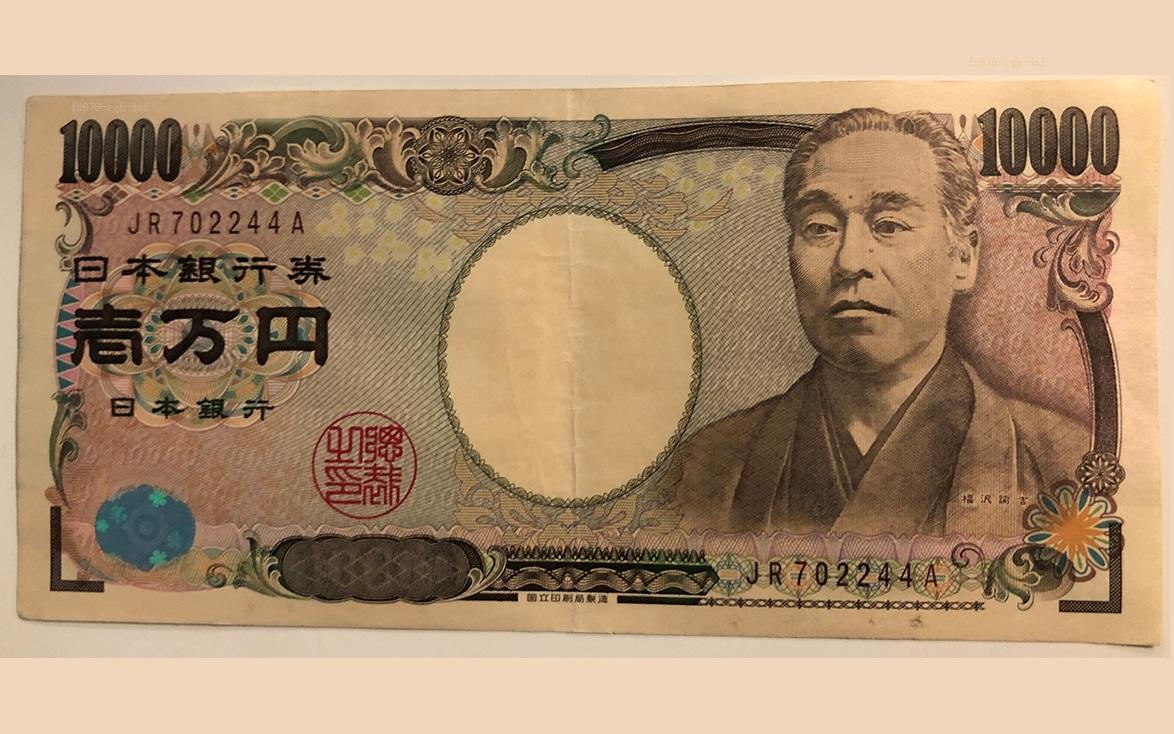
U.S. Treasury Secretary Scott Bessant said on Tuesday (May 12) after meeting with Japanese Finance Minister Satsuki Katayama in Tokyo that the U.S. and Japan maintain "continuous and strong" coordination in dealing with undesirable and excessive exchange rate volatility. This statement suggests that Washington largely acquiesces to Japan's recent intervention to support the weak yen. The yen's depreciation is putting pressure on the Japanese economy by pushing up import costs.
Bessant posted on social media, "I am pleased to reaffirm the strong economic partnership between the U.S. and Japan." He added, "Our team's level of communication and coordination in addressing adverse and excessive volatility in currency markets remains 'consistent and robust.'"
Following Bessant's remarks, the dollar rose to approximately 157.72 yen against the yen, but then suddenly fell to 156.74 yen. The rise in the dollar/yen exchange rate was due to Bessant's comments failing to meet market expectations of a stronger warning of a sharp yen decline, after which the yen rebounded. It remains unclear whether this rise was due to intervention.
"The market wants to know if Bessant's stance on Japan's monetary policy has not changed," said an executive advisor at SBI FX Trade. "Bessant's comments on social media didn't offer much new information for the market."
Katayama Satsuki stated that she and Bessant confirmed that Japan's actions to address currency fluctuations were in line with the joint statement signed with the United States last September, which allows for intervention in foreign exchange markets to address excessive market volatility.
When asked if Bessant had commented on Japan's recent apparent intervention to support the yen, Katayama said, "Given the current situation, we reaffirmed the need for continued close coordination on market volatility." When asked if "close coordination" meant the U.S. could proactively address a sharp depreciation of the yen, Katayama added, "We discussed deepening coordination across various areas."
Japanese policymakers are hoping that Bessant's endorsement of their currency market interventions will provide additional effectiveness and help slow the yen's decline. Some analysts also speculate that Bessant may again call on the Bank of Japan to accelerate the pace of interest rate hikes as a way to support the yen.
However, when asked whether his meeting with Bessant involved the Bank of Japan's monetary policy, Satsuki Katayama declined to comment. Bessant has also not yet commented on the Bank of Japan.
Bank of Japan Governor Kazuo Ueda will return to Tokyo on Wednesday after attending a meeting of the Bank for International Settlements in Switzerland. It remains uncertain whether Ueda will be able to return in time to meet with Bessenter, whose three-day visit concludes that day.
The summary of the April meeting revealed that, influenced by the increased price pressure from soaring oil prices triggered by the war, some Bank of Japan policymakers advocated for a possible interest rate hike as soon as possible, with one member mentioning the possibility of action in June. Economists at BNP Paribas stated that the summary indicated the Bank of Japan's April meeting showed that committee members were preparing for a near-term rate hike, but also left room for policy choices when the committee meets again in June. A key consideration in deciding the next rate hike may be whether the Middle East conflict will lead to serious supply chain problems. "The summary shows that even among members who generally hold a tight stance on rate hikes, there remains a strong sense of caution regarding the risk of potential supply chain disruptions."
Japan had previously indicated it might consider intervening in the oil futures market, citing the perceived speculative surge in energy prices as a major driver of the yen's weakness against the dollar. However, Satsuki Katayama clarified on Tuesday that Japan has not yet taken this step.
Bessen also met with Japanese Minister of Economy, Trade and Industry Ryomasa Akazawa, and the two sides agreed to strengthen cooperation in the energy and key mineral sectors.
As of Tuesday's press time, the USD/JPY pair was trading around 157.463, up slightly by 0.20% on the day. Notably, the pair briefly plunged to around 156.80 during the session due to comments from Bessenter, before rebounding to recover most of its losses, indicating intense competition between bulls and bears. The USD/JPY pair is currently trading within a range of 156.70-158.68. Short-term daily moving averages (MA20/MA50) are providing resistance, while medium-term moving averages (MA100/MA120) are offering support, indicating a temporary balance between bullish and bearish forces. The market is closely watching progress in USD/JPY exchange rate coordination and policy signals from the Bank of Japan.
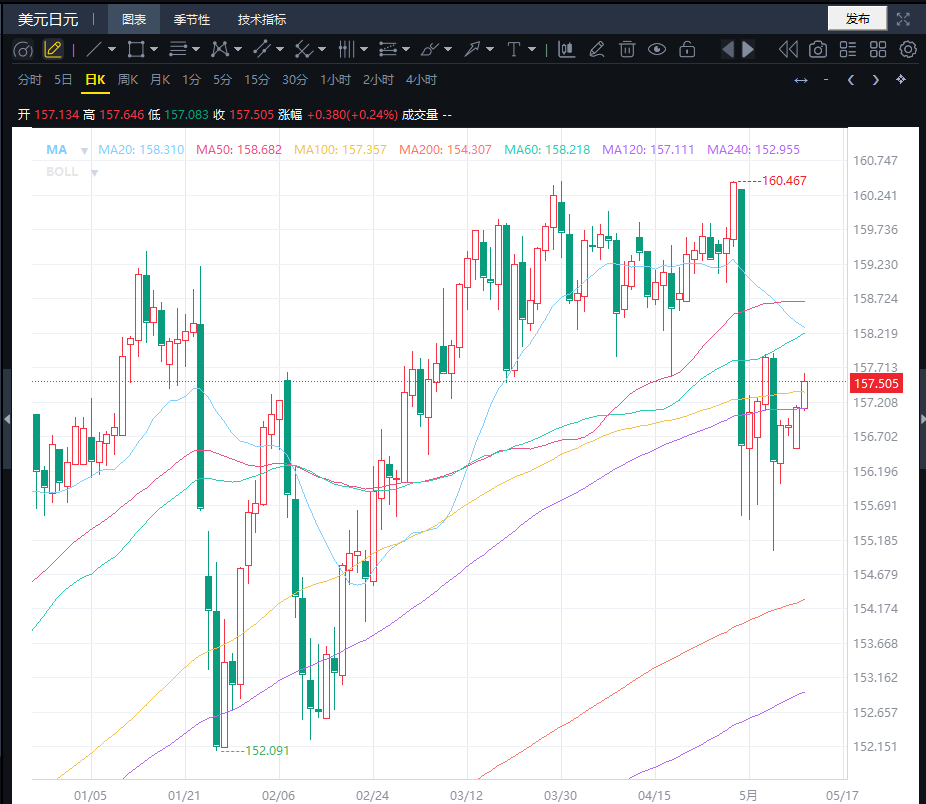
(USD/JPY daily chart, source: FX678)
At 15:31 Beijing time on May 12, the USD/JPY exchange rate was 157.47/48.
Bessant posted on social media, "I am pleased to reaffirm the strong economic partnership between the U.S. and Japan." He added, "Our team's level of communication and coordination in addressing adverse and excessive volatility in currency markets remains 'consistent and robust.'"
Market reaction: The yen briefly jumped before falling back.
Following Bessant's remarks, the dollar rose to approximately 157.72 yen against the yen, but then suddenly fell to 156.74 yen. The rise in the dollar/yen exchange rate was due to Bessant's comments failing to meet market expectations of a stronger warning of a sharp yen decline, after which the yen rebounded. It remains unclear whether this rise was due to intervention.
"The market wants to know if Bessant's stance on Japan's monetary policy has not changed," said an executive advisor at SBI FX Trade. "Bessant's comments on social media didn't offer much new information for the market."
Japan's position: Actions to address currency exchange rates are in line with the US-Japan agreement.
Katayama Satsuki stated that she and Bessant confirmed that Japan's actions to address currency fluctuations were in line with the joint statement signed with the United States last September, which allows for intervention in foreign exchange markets to address excessive market volatility.
When asked if Bessant had commented on Japan's recent apparent intervention to support the yen, Katayama said, "Given the current situation, we reaffirmed the need for continued close coordination on market volatility." When asked if "close coordination" meant the U.S. could proactively address a sharp depreciation of the yen, Katayama added, "We discussed deepening coordination across various areas."
Silence on the Bank of Japan's monetary policy
Japanese policymakers are hoping that Bessant's endorsement of their currency market interventions will provide additional effectiveness and help slow the yen's decline. Some analysts also speculate that Bessant may again call on the Bank of Japan to accelerate the pace of interest rate hikes as a way to support the yen.
However, when asked whether his meeting with Bessant involved the Bank of Japan's monetary policy, Satsuki Katayama declined to comment. Bessant has also not yet commented on the Bank of Japan.
Bank of Japan Governor Kazuo Ueda will return to Tokyo on Wednesday after attending a meeting of the Bank for International Settlements in Switzerland. It remains uncertain whether Ueda will be able to return in time to meet with Bessenter, whose three-day visit concludes that day.
Other developments: Japan has not yet intervened in the oil market; cooperation in energy and mineral resources is strengthening.
The summary of the April meeting revealed that, influenced by the increased price pressure from soaring oil prices triggered by the war, some Bank of Japan policymakers advocated for a possible interest rate hike as soon as possible, with one member mentioning the possibility of action in June. Economists at BNP Paribas stated that the summary indicated the Bank of Japan's April meeting showed that committee members were preparing for a near-term rate hike, but also left room for policy choices when the committee meets again in June. A key consideration in deciding the next rate hike may be whether the Middle East conflict will lead to serious supply chain problems. "The summary shows that even among members who generally hold a tight stance on rate hikes, there remains a strong sense of caution regarding the risk of potential supply chain disruptions."
Japan had previously indicated it might consider intervening in the oil futures market, citing the perceived speculative surge in energy prices as a major driver of the yen's weakness against the dollar. However, Satsuki Katayama clarified on Tuesday that Japan has not yet taken this step.
Bessen also met with Japanese Minister of Economy, Trade and Industry Ryomasa Akazawa, and the two sides agreed to strengthen cooperation in the energy and key mineral sectors.
As of Tuesday's press time, the USD/JPY pair was trading around 157.463, up slightly by 0.20% on the day. Notably, the pair briefly plunged to around 156.80 during the session due to comments from Bessenter, before rebounding to recover most of its losses, indicating intense competition between bulls and bears. The USD/JPY pair is currently trading within a range of 156.70-158.68. Short-term daily moving averages (MA20/MA50) are providing resistance, while medium-term moving averages (MA100/MA120) are offering support, indicating a temporary balance between bullish and bearish forces. The market is closely watching progress in USD/JPY exchange rate coordination and policy signals from the Bank of Japan.
(USD/JPY daily chart, source: FX678)
At 15:31 Beijing time on May 12, the USD/JPY exchange rate was 157.47/48.
- Risk Warning and Disclaimer
- The market involves risk, and trading may not be suitable for all investors. This article is for reference only and does not constitute personal investment advice, nor does it take into account certain users’ specific investment objectives, financial situation, or other needs. Any investment decisions made based on this information are at your own risk.